The Aussies Do Efficient Scoring Signage

This is a post for all of the standard bearers of the world.

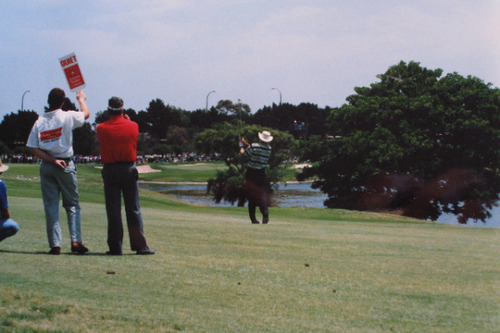
Doug Ferguson pointed out the cleverly designed scoreboards here at the Australian Open. The volunteers do not have to access different numbers and keep red and black ones straight, but instead just need to flick little slits from white to black to update scores. While the signs are a lot heavier than the American versions we see, they are far superior on an efficiency basis.

They also have clever on-course leaderboards that use the same system featuring a handy design that easily lets the volunteer lower and raise the board to update scores.

Video demonstration:
 

A Few Early Round Tiger Observations

With Tiger vaulting to the top of the Australian Open leaderboard, it's hardly a revelation to say his game is rounding into shape. But even before he ran off birdies at the 13th, 14th, 16th and 18th holes to post an opening 32, he's exuding much more confidence and focus than even a month ago when he played at CordeValle.

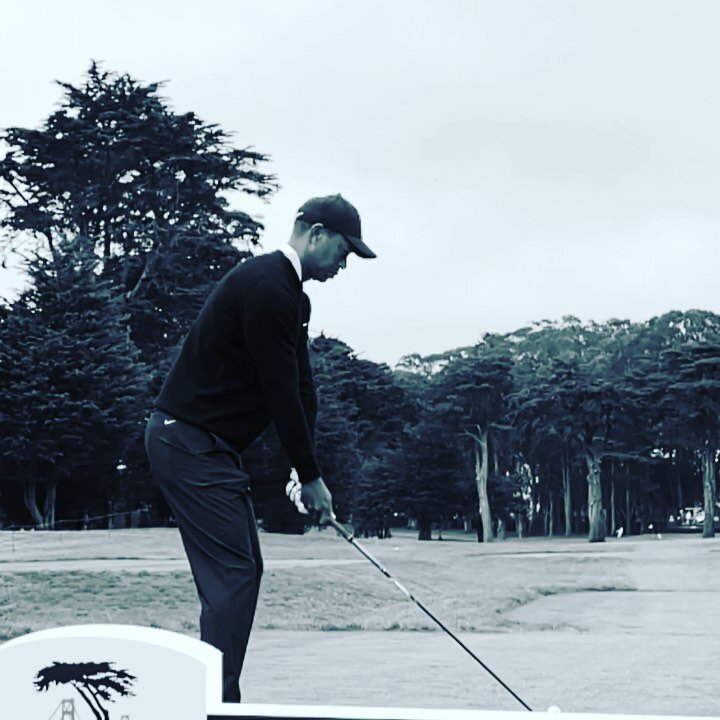
Despite the glacial pace and anti-ready golf of playing partners Jason Day and Robert Allenby, Woods' swing and body language looked as comfortable as I've seen in some time. 

His short game is looking better, highlighted by a brilliant lob wedge on the par-5 11th hole (his second hole of the day). He missed the birdie putt, but the shot was a far cry from some of the lousy short game antics he's displayed in the last year or so. 

One thing to look for and I haven't a clue what it means: a Gary Player-like follow through where his right foot and hip gently spin through after impact. Twice it happened on downhill lies, but he also sported one flat lie and I wonder if it's a move to take a little pressure off his right knee leg?

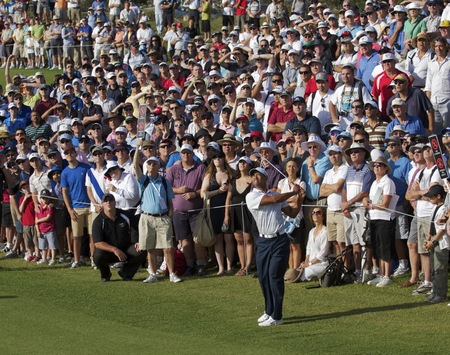
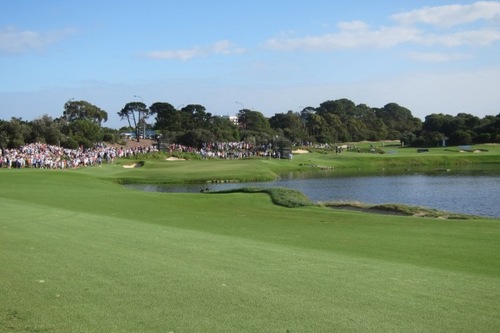
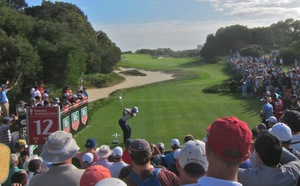
A few images from early in the round (click on them to enlarge) hopefully captures the energy and passion of Aussie golf, where the spectators are very supportive of Woods:


Start Of The Lakes Back Nine Photo Gallery

After the more intimate front where holes move back and forth on a smaller scale, The Lakes back nine opens with a tight short par four before exploding on a grand scale with several dramatic holes highlighted by striking water hazards.

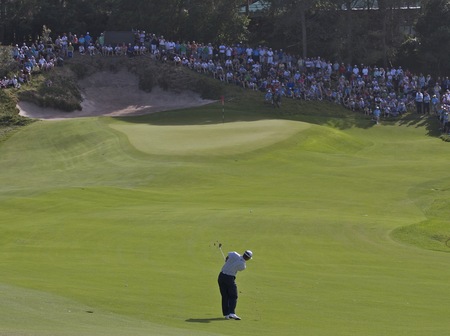
Because of an approaching storm, I was only able to get solid shots of the first four holes of the back but I think you'll enjoy seeing the architecture and quality detailing work by Mike Clayton and his team.

The images show the narrow, short par-4 tenth, followed by the neverending three-shot 11th, the long 12th playing to a skyline green, and the fantastic driveable downhill 13th. From there the water takes over to set up what should be a dramatic finishing stretch before intimacy returns with the short par-3 18th.

Front Nine At The Lakes, A Photo Gallery

The front nine at The Lakes doesn't get the respect it deserves because of the grand scale of the back nine and generally sad perception that great golf must be on a large, sharply undulating scale.

The first plays with water on the left--certainly not ideal--before crossing under a road and traversing back and forth on beautiful terrain. The holes are separated by sandy areas which look old and full of character despite having been unveiled less than two years ago.

The greens are large and bold, with a plethora of great hole locations and only a couple that struck me as not being of great interest. The tee complexes sit in the ground beautifully and offer plenty of options, as well as a model for "proper" tees. Little splashes of sand and scrub make the blend in beautifully, but never get in the way of setting up the hole.

But mostly, the front has the appearance of being a fun, challenging nine with a solid variety of holes if you can look past some of the routing constraints. Hopefully these images help supplement the television coverage starting Wednesday night at 11 p.m. ET. (Click on the photos page to see captions.)