
Ratings Up Solidly For ESPN's Open Championship Coverage
/Nice showing for ESPN, especially for Monday's final round, a summer work day in the States.
Read More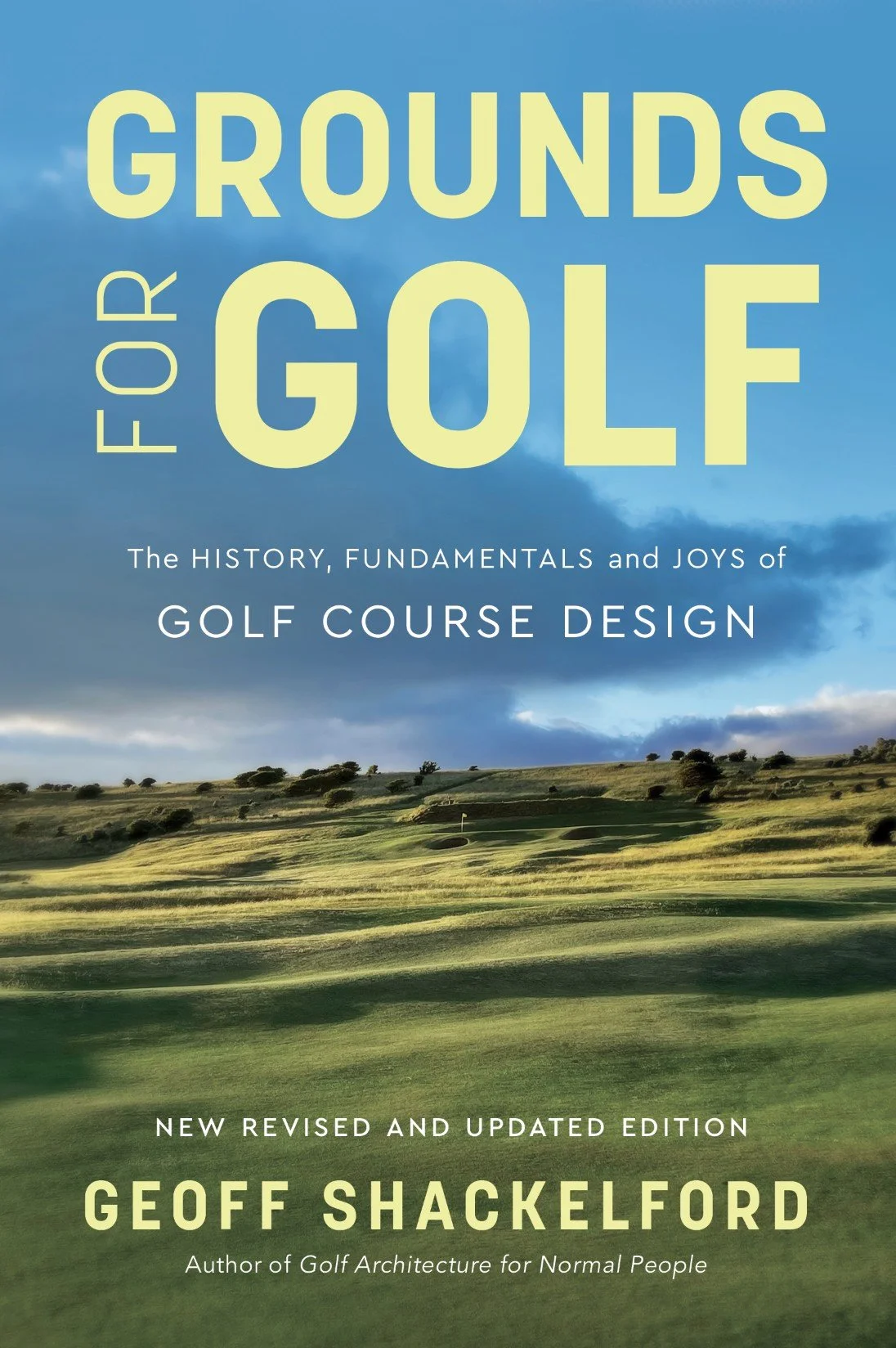
It’s back!
Twenty years later Tatra Press has kindly allowed me to bring back Grounds For Golf now that golf architecture is of more interest to the masses. A new Introduction looks at what’s driven the interest growth and two new chapters I had a blast adding (plus a few edits to keep things up-to-date).
The Amazon purchase page for the book arriving June 15, 2026.

Reveals that ESPN showed many more shots during Monday's final round from St Andrews than last year at Hoylake.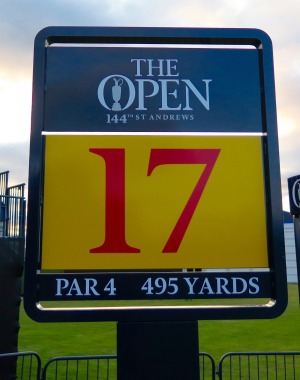 From their write-up, which includes links to the breakdowns at the year's other majors.
ESPN showed 358 shots during this period which worked out to 1.23 strokes per minute - a sizable increase over the ESPN shot rate of 1.01 from the 2014 Open Championship.
This was also a higher shot rate than I tracked for CBS from the 2015 Masters and Fox from the 2015 US Open, but trailed the rate that NBC showed during the 2015 Players. The Masters post contains links to the shot charts I did for the 2014 majors.
As WatchESPN was blocked here in the UK, I wasn't able to see much of the Road hole coverage or other digital feeds. Anyone watch and any thoughts?
While ESPN had a great week under difficult circumstances according to Golf World's John Strege, BBC's coverage was pretty weak visually. While I couldn't hear the announcing, apparently Peter Alliss made a few remarks that haven't gone over well.  An unbylined Telegraph report says two comments in particular didn't go over too well.
Alliss, 84, had already sent social media alight on Sunday night with his comment about young Irish amateur Paul Dunne being hugged by his mother as he came off the course with a share of the third-round lead.
"Ah, that must be mum," said Alliss. "Perhaps he likes older women. I don't know but I hope I got the right one."
And this when Zach Johnson's wife Kim was shown congratulating her husband.
As the camera focused on her, Alliss mused about how the couple would spend the prize money: "She is probably thinking - 'if this goes in I get a new kitchen'," commented Alliss.
The BBC has one more Open to televise in 2016 before handing the rights to Sky Sports.
The AP's Tim Dahlberg considers the Grand Slam quest and suggests the putt which will ultimately haunt Jordan Spieth came at the 17th green.


 He writes:
The Road Hole was playing so long into the rain and wind that Spieth couldn’t reach the green in two. No matter, because he plopped his pitch just eight feet from the hole.
“If I stood on 17th tee box and you told me I had that putt for par on the hole,” Spieth said later, “I would have certainly taken it.”
Almost shockingly, he missed it right. The best putter in the game didn’t make the one that mattered the most.
Ryan Lavner at GolfChannel.com points out the statistical and ironic notion of Spieth, the world's best putter, costing himself a shot not with loose ball striking, but with his blade.
Because after blowing away the field at Augusta and then watching Dustin Johnson crumble on the 72nd green at Chambers Bay, this time it was Spieth who cracked on the biggest stage.
The greatest irony? His magical short game – his greatest strength – was the part that let him down the most in his quest for a third major in a row.
Ranked first on Tour in three-putt avoidance, Spieth’s speed control was off all week, leading to a career-worst 37 putts in Round 2, including five three-putts, and a four-putt on the eighth green Monday.
Spieth's post round comments about his trouble with speed all week led to the miss that was so uncharacteristically poor: his first putt on the par-3 8th.
Q. Take us through 8. You said you made a mental mistake there.
JORDAN SPIETH: Yeah, I believe we played 8 and 17 as hard as anybody -- as hard as any group today, were those two holes. It was the hardest rain and the hardest wind at the same time of the day. We stepped on that tee box, and you'd like to maybe have a downwind hole where it doesn't really make that much of a difference, but when you look up from the ball and you're getting pelted in the face, it's a hard shot, and I just tried to sling one in there and I left it 40 yards from the pin on the green there, and it's just a no-brainer. If you make bogey, you're still in it. If you make double bogey, it's a very difficult climb, and there's absolutely no reason to hit that putt off the green. I can leave it short, I can leave if eight feet short and have a dead straight eight-footer up the hill where I'll make that the majority of the time. My speed control was really what cost me this week, the five three-putts the second round, and then just my speed control in general wasn't great. On that hole I had left so many of them short throughout the week, I said, I'm not leaving this one short, I'm going to get this one up there, and instead hit it off the other side of the green where it was really dead there, so that was a mental mistake on my part. Instead of being patient and just accepting eight feet from 40 yards like I do on a 40-yard wedge shot, I instead was a little too aggressive with it when it wasn't necessary.
And this regarding taking putting from the practice green to the course and his first putt proximity talents.
JORDAN SPIETH: Yeah, it wasn't 100 per cent. It wasn't the way it felt at Augusta. I just didn't feel like I was getting aligned perfectly. My stroke was good. I had really good practice. On these practice greens you're not able to get a good feel for the touch. It's tough to get pace practice because they're so small, so I didn't have much of it this week, and I kind of had to go off my feels, when typically you've got enough room -- I did plenty of work on the golf course, it's no excuse, but as far as right before the round getting a pace for that day and the conditions and how the greens are cut, it's tough. You have to kind of go with it after you have one long putt. That was the struggle for me in this tournament was what my -- I think my biggest advantage over anybody in the world is, and that's my first putt proximity, and that was -- I think on the lower half of the field this week, and it certainly cost me at least a couple shots.
**Ian O'Connor at ESPN.com with some good behind the scenes observations on Spieth's run ending at The Old Course.
The standard bearer for the Spieth-Day group was a 19-year-old from Long Island named Luke Smith, who said he was struck by how much time Spieth had spent analyzing putts over the first 16 holes. But Smith and another official with the group thought Spieth spent less time on this one. "It seemed a little rushed," Smith said. Near the 18th green, as the fans quietly waited for the two-time major winner to play his way into Old Course lore, an official with a walkie-talkie whispered, "Spieth just missed a 6-footer for par on 17." The grandstand crowd groaned when his name was removed from the top of the board and restored a few notches below, next to the red number 14.
Brandel Chamblee thinks the Open was lost not on the greens, but in the pot bunkers which have, historically, been key to victory here. John Strege reports.
Going first out in Sunday's third round at The Open, David Duval posted a 67 and signaled that he's not ready to stop playing just yet.  While the chances of another 67 are unlikely given the weather forecast, Karen Crouse with some stellar insights from Duval and his veteran caddie Ron Levin into one of golf's most fascinatingly complex personalities. (Thanks reader Tim.)
Levin added: “He wants to win golf tournaments. That’s all he’s ever wanted to do. He didn’t grow up and say, ‘I want to be a golf announcer.’ ”
The broadcast booth is where noncompetitive players go to reinvent themselves. But for Duval, analyzing the performance of other players has reinvigorated his game.
“When you’re playing well, you forget immediately about the bad shots,” Duval said. “But when you’re not playing well and you’re struggling, you feel like everybody else is hitting it beautiful and perfect all time.”
Duval said, “Sitting up there when you’re announcing and recapping the tournaments, you realize, ‘Man, these guys hit some really ugly shots.’ ” He added, “Seeing that, it’s like, ‘Oh, yeah, everybody screws up and does bad things,’ and so it removes a little bit of the pressure of ‘I have to go out and play perfectly.’ ”
There have been many awkward, empathy-inducing comments from Tiger Woods as he continues to struggle, but this might have been the saddest:
Q. Did you learn anything about your game this week?
TIGER WOODS: You know, it's kind of funny because I didn't -- we were talking about that the other day; I hit the ball solid. It's just that it wasn't getting through the wind. I don't know what was causing that, and it's something that we're going to have to take a look at, look at my numbers, see if the spin rates are on or not, but it was so frustrating because all my shots that I hit solid and flush into the wind, they just weren't carrying at all.
 John Strege has this roundup of some takes on Tiger, including this from ESPN.com's Kevin Van Falkenburg who says we're seeing something unprecedented.
But after watching him trudge around the Old Course for three days, and seeing the melancholy look on the man's face when it was finally over, I no longer feel even a hint of schadenfreude. I feel only empathy.
When he took off his hat on the 18th green to shake hands with Jason Day and Louis Oosthuizen, he looked as close to broken as I've ever seen a truly great athlete look. He entered this event thinking he had a real chance to contend. He wasn't even close to making the cut.
John Huggan builds a case for Tiger being done.
Right this minute, Tiger is not capable of winning major championships. Nor is he capable of winning a regular tour event. He is, in reality, a well-below average PGA Tour player.
The numbers are instructive. So far in 2015, Tiger has hit 52.86 per cent of the fairways he has aimed at. That would make him the 194th most accurate driver (out of 199) on the PGA Tour. In ‘greens in regulation’, his percentage is 61.11, “good” enough for 190th spot. But the most egregious figure is his stroke average of 72.796. Only former Masters champion Mike Weir is worse. Little wonder then, that Woods is ranked the 241st best golfer on the planet.
Ryan Lavner at GolfChannel.com adds this and more about the spin rates comment:
“We're going to have to take a look at my numbers, see if the spin rates are on or not,” he said.
What happened to just hitting golf shots?
Now fully healthy, Woods has been working through this most recent swing change with Chris Como for about nine months. It's unclear if he's made any progress at all. His good swings are very good. He pures it at home, and on the tournament range, and in practice rounds – or, in other words, when it doesn’t matter.
Doug Ferguson noted that Woods' preparation was strange, too
He looked lost on the Old Course.
"I felt like I was playing well enough to win this event," Woods said.
He arrived on Saturday to do a junior clinic for Nike - Woods typically is all about preparations at the majors - and then after practice rounds on Sunday and Monday, he didn't play another practice round on the Old Course until the championship started. Woods said he knew the course, practiced in both wind directions and wanted to conserve energy for what usually is a long week.
Geoff Shackelford is a Senior Writer for Golfweek magazine, a weekly contributor to Golf Channel's Morning








Copyright © 2022, Geoff Shackelford. All rights reserved.

