U.S. Open Roundup: The State Of The Favorites
/I wish I could tell you that Oakmont is favoring a certain type of player,
Read MoreWhen you come to think of it that is the secret of most of the great holes all over the world. They all have some kind of a twist. C.B. MACDONALD

I'm not sure what this means about the golf course, but it's interesting to see the different approaches to Oakmont for the 2016 U.S. Open.
 Rickie...first saying you have to play carefully, then saying he will be aggressive with the big stick.
Q. So you see taking a risk off the tee as being worthwhile, ultimately?
RICKIE FOWLER: To a certain extent. You can't try and be very aggressive on this golf course. You kind of have to take what it gives you. You can't try and push it too much. There's some holes where it's just as wide with driver as it is with a driving iron or a 3 wood, and I feel like I hit my driver just about as straight as any of those.
So I'd rather take my chances of having the shorter iron in and having a chance to possibly play aggressive and get a shot close, versus just trying to get one on the green.
Rory McIlroy, on the other hand, plans to hit very few drivers this week.
I don't think there's going to be many drivers out there this week. Maybe the two par 5s you'll hit driver. 7th hole. I think, if the 2nd hole is downwind, you can hit driver there and try to hit it up on the green. But, yeah, I don't think there's going to be many drivers this week, to be fair. I'll hit 2 iron off the tee much more than I'll hit driver.
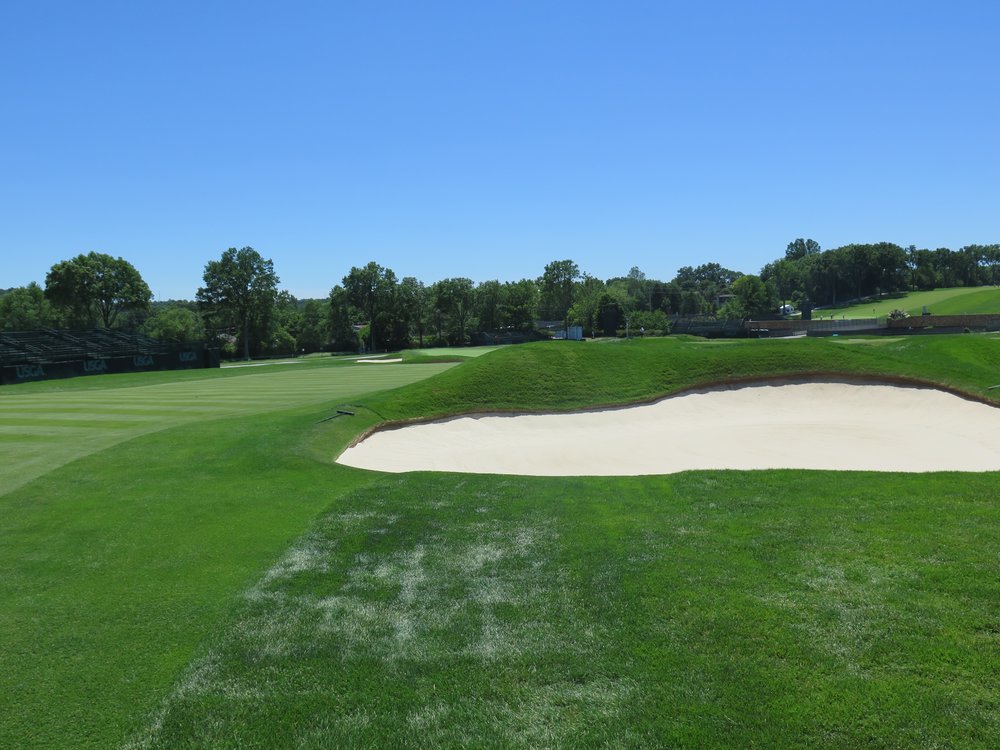 Ernie Els, 1994 U.S. Open Champion at Oakmont, on what's changed in 22 years:
It's crazy. I don't know how many of you guys were here in '94. Oh, there you go. A couple. But it's amazing how we played the game in those days and how we play today with the golf ball, and a lot of us were still using wooden drivers back in '94 and so forth. And it's amazing how the golf course has also changed. You could definitely move the ball out of the rough on to a lot of these greens. Nowadays, you can't really do that.
I don't know what kind of chemicals they put in that grass, but it's growing. So that changed a lot. It's been how many? 22 years since '94. Obviously, a lot of tournaments have passed. I think I played in my second U.S. Open then, and I think I'm playing my 24th. It's been quite a journey, to say the least. It's all good.
I would say they've really upped the ante the last five to ten years with the rough. Whatever they call it, the graduation of the rough, whatever, it's just thick, and it's a lot more dense than it was back in the day. We could move the ball around. It was almost more fun to play that way because you could advance the ball, you could get the ball to run towards the green. You're not always going to hit the perfect shot, but you had a chance of actually hitting a shot.
Now it's at least a half a shot penalty. You try to get a wedge out to where you can play your next shot from. That's just the way it is. They've really got the premium on accuracy and ball striking. It is what it is. I'm just saying, back in the day, it was a little different. We could maneuver the ball out of the rough.
That's interesting given the desire of the USGA to encourage recovery play, and may be why there was a 1/4 inch rough height lowering Tuesday.
Prior to the tournament, the USGA's Jeff Hall described to the Tribune's Jeff Paulk the playability factor they hoped for with the rough.
“The whole idea is if you have 10 golf balls in the rough, we'll like to see six or seven be able to play to the green,” Hall said. “Maybe three or four you have to chop it out. But the 5-inch rough will be just the opposite.
“Where we think the benefit of that is at Oakmont, when firm and greens are bold, we want that players can chase a 6- or 7-iron onto the green and let the architecture take the ball where it's going to go as opposed to hitting a sand wedge out then wedging it onto the green. We don't want to lose some of the excitement. It's about the characteristics of the ground, which are used masterfully with the design."
Based on Els' comments on the stuff we've seen players post, I'm not sure the recoverability factor is there off the tee or around the greens with this look:
Rough short of 17 green... Yeah, I'd say Oakmont is ready 😳 @usopengolf
A video posted by Justin Thomas (@justinthomas34) on
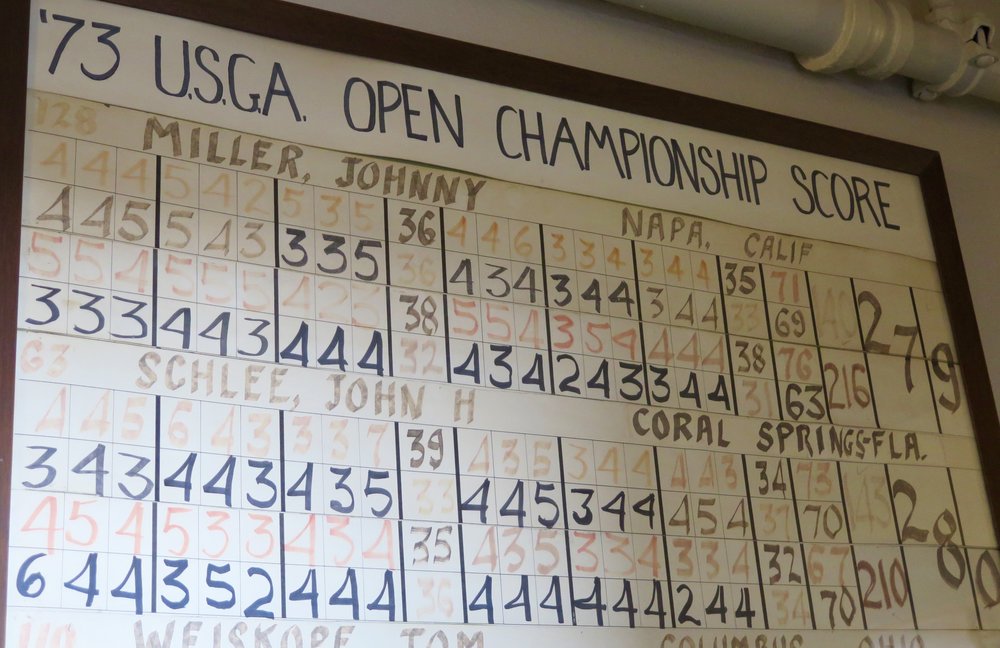
It is funny how the combination of Johnny Miller bringing up his 63 a few too many times and the lack of great memories/video has actually led to Johnny's 1973 U.S. Open winning 63 becoming downplayed for its historical significance.
 Thankfully some smart folks have used stats and historical perspective to refute some of the misperceptions about his great play at Oakmont.
Adam Lazarus and Steve Schlossman have posted a definitive look at the round and attempt to clarify myths, legends and fact. Nice work fellows.
Jaime Diaz files a Golf Digest June issue look at the 63 barrier in golf and sets aside quite a bit of space for Johnny's round.
Miller will tell you about it. His frequent references to the round—especially as a commentator—have caused a backlash. When he says things like, "I mean, it was sort of an easy 63—pretty pure," Miller, now 69, seems a victim of "the older I get, the better I used to be" syndrome. But his playing partner that day at Oakmont, Miller Barber, said, "It very easily could have been 60." A closer look reveals Miller's round has mostly been underappreciated.
Diaz also filed this follow up for GolfDigest.com highlighting some numbers, including these:
He missed two fairways and had 29 putts, including a three-putt on the par-3 eighth hole. Nine of his full-iron approaches (three of them 4-irons) finished within 15 feet of the hole, four of them getting within six feet. In 2014, Golf World’s David Barrett, retroactively applying the PGA Tour’s “strokes gained” calculation, convincingly established that Miller’s is the greatest 18 holes ever shot.
One of the great touches in Oakmont's locker room is the handwritten scoreboard from the 1973 U.S. Open and on. Johnny's 63:
Joel Beall with a GolfDigest.com report on Jordan Spieth's Monday press conference at Oakmont, where the defending champion was asked a bit about last year, and a lot about his Masters finish. Spieth sounds over it even if we are not. Beall lays out how the back and forth went down.
"It was just a mis-hit. I wasn't trying to hit it at the hole," the two-time major winner said about his dunks in Rae's Creek. "Two badly timed swings."
From there, how do you move on?
"I just made two poor timed swings. It happens."
I mean now?
"I did move on. I moved on."
Doug Ferguson reports that Spieth saw huge changes in Oakmont and didn't sound overly thrilled with a stark change in the bunker sand denity.
"When I played it six weeks ago, there was very compact sand, and that meant that if the ball trickled into the sand, it wasn't a bad shot," Spieth said. "Just barely went into the sand, you could hit the green no problem (if) you hit a good, solid shot. They have dumped so much sand into these bunkers, and now it is so tough to get a clean strike on the ball."
At Monday's architecture forum held for select USGA members, Superintendent John Zimmers chalked it up to a fluffing procedure on the sand last week, combined with Sunday's dry wind. The USGA's Mike Davis said some moisture would be added but also said expected rain was part of the thinking.
Steve DiMeglio highlighted the Masters loss discussion with some historical perspective and also rightly noted Spieth's observation about the finishing holes.
“If you don’t hit fairways on the last five holes, you could lose a 4- or 5-shot lead like that. Just not even doing anything wrong. You can hit decent shots that just barely miss the fairway. And all of a sudden, you have to do well to have 10 feet for par. ...
“So as much as I speak to major championships being like two events in one, you have to have the patience for two rounds each round.”
Josh Berhow at Golf.com noted how Spieth left open a slight crack in the door to skipping the Rio games. Granted, it's an opening only a mouse could slip through, but it was a change in attitude toward the Zika issue.
“I’m not sure where I’ll play next, even after this week,” Spieth said. “You never know. Right now I’m pretty confident with what we have heard from not only the PGA Tour but our personal outreach. I think being an Olympian is just an absolute tremendous honor, but does being an Olympian outweigh any kind of health threat? No. If I thought that the threat was significant I certainly wouldn’t go, but based on what’s come to my knowledge at this point it seems like it’s going to be an extremely memorable experience and I look forward to trying to win a gold for the United States.
While Arnold Palmer is not expected to visit Oakmont this week, his home and office in Latrobe are not too far away. Leave it to Callaway's Hashtag Chad and A.J. Voelpel to get a tour of The King's office from the great Doc Giffen.
It's 45 minutes but the most extensive look I've seen and a dream tour for a golf memorabilia fan.
House and I discuss my first impressions from the course, Oakmont's rough being so dense that skill around the greens will be negated, the odds and some sleeper picks.
 Later in the show we discuss year two of Fox Sports before a conversation with TheRinger.com editor at large Bryan Curtis, who profiled Joe Buck. We also talk to Curtis about his Grantland look at Jordan Spieth media coverage from a year ago.
ShackHouse now has a convenient page at TheRinger.com where you can find key links to all podcast providers!
As always, you can subscribe on iTunes and or just refresh your device subscription page.
Same deal with Soundcloud for the show, and Episode 10 is here.
And the ShackHouse Stitcher page.
Special thank you to our sponsor Callaway, who have a stellar Father's Day gift guide to make your life easier.
Thanks to OdysseyGolf.com for the love and the White Hot face putters that make them the #1 putter in golf.
Thanks to Helix, where you can get $50 off a specially engineered mattress based on answering just a few questions, just use promo code HOUSE.
And to MeUndies.com, House's favorite statement making underwear where you can get 20% off your first order just using this link location.
Thanks to all for subscribing, listening, offering your feedback and supporting our advertisers, including Bill Simmons and TheRinger.com, launching Any Given Wednesday on June 22! ShackHouse remains the #1 golf podcast on iTunes!
Ron Sirak reports from Washington where there of the best in women's golf made spirited--bogey free!--runs at the KPMG LPGA before Brooke Henderson prevailed in a playoff over Lydia Ko.
 Sirak says:
Holy Pine Trees, Bat Man, a spectacular Sahalee CC threw everything it had at the best gals in golf and they handled it with grace and grit. And no one was more brilliant than Brooke Henderson, Lydia Ko and Ariya Jutanugarn, who engaged in a game of “can you top this” in Sunday’s final round.
This just astounds...
That trio combined to make a grand total of ZERO bogeys under the stress and strain of final-round play in a major.
Alex Myers notes that the great sportsmanship continued after the playoff when Henderson took to social media.
The final round highlights:
Joel Beall offers nine reasons to be optimistic that Fox won't stumble during the U.S. Open broadcast this year, and I agree with most of them, including Paul Azinger's presence. Here is this week's Forward Press, where I chat with Azinger about the announcer plan and why he's golf's version of John McEnroe.
And the column includes the necessary Fox, USOpen.com and Golf Channel coverage times.
Geoff Shackelford is a Senior Writer for Golfweek magazine, a weekly contributor to Golf Channel's Morning



Copyright © 2022, Geoff Shackelford. All rights reserved.