Unauthorized And Harmless Genesis Videos Emerge! Pieters Tee Shot Clips His GF And Spieth's Unusual Club Flick

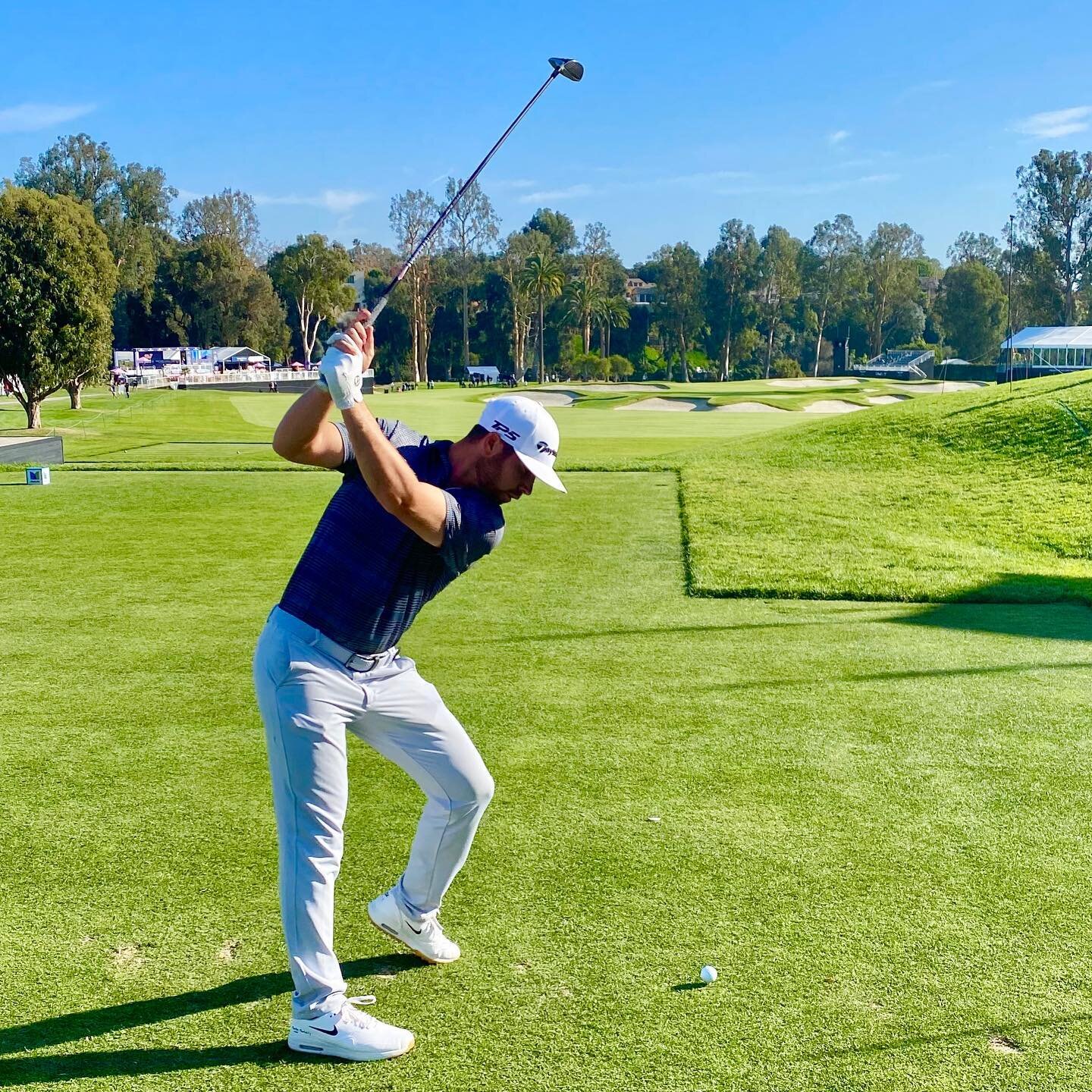
I've been enjoying Golfballed's video posts from the Genesis Open. All of this was against the tournament rules (for spectators too), though enforcement was non-existent due to the marshal force being severely depleted (weather and the amazing idea that a new sponsor means volunteers must buy a new uniform).

Anyway, Golfballed has 85.4k followers who got to see some nice shots from Riviera not shown on television to the best of my knowledge.


Note to Ponte Vedra Police: I just copy and paste...twelve years running. I do not condone this egregious violation of the fine print.

SI Roundtable On The Distance Report: "Nothing about this study rings true."

I'm continuing to savor the skepticism aimed at the USGA and R&A's latest distance report suggesting all is stable. A growing group of "truthers"--probably a majority of golf observers--are struggling to believe insignificant changes have occurred since 2003.  Especially when the non-flatbellies are seeing big gains.

This week's SI roundtable includes rebuttals from Ritter, Shipnuck, Bamberger, Sens and Passov, but it's the lengthy answer from longtime tour caddie John Wood that is worth diving into.

Here's a snippet related the role Trackman has played in recent years:

Then, there’s Trackman. The launch monitor leaves nothing to chance. Every driver built for these guys won’t make the lineup unless it shows optimal launch conditions. Launch angle and spin rate and landing angle and ball speed aren’t left to chance or feel anymore, but achieved and optimized scientifically. I could go on and on but, mercifully I won’t. The bottom line is that "study" isn’t worth the paper it’s written on. Maximum drives are significantly longer than they were 10-15 years ago. That’s obvious. And in my opinion, while the R&A, the USGA and the PGA Tour may say they’re keeping a close watch and controlling the distance professionals drive it (and providing statistics and studies to back up their claim), I think they’re probably doing so with a wink and a nod.

Not to always slip back into a baseball analogy, but in the midst of the home run binges of Mark McGwire, Sammy Sosa, Jose Canseco, Barry Bonds, etc. it’s well known that other players, managers, GM’s and owners had an inkling of what was going on, but it was in their best interest to let things proceed as they were. Why? Because fans loved it. Attendance and ratings soared. So, why would the golf establishment want to restrict or roll back the golf ball? As Greg Maddux once told us, "Chicks" (and fans) "dig the long ball." Simply put, more people will pay to watch DJ power his way around a golf course hitting 360 yard drives than would pay to watch another player plot and strategize their way around shooting the same score.

It's fascinating that with something like Trackman, which has become mainstream well after the Statement, offers an opening to admit a discussion must be had. And yet, they pass...

Increasing Athleticism! Then How Are Geezers Picking Up Yards?

With the tour in town I haven't had a chance to read the USGA/R&A distance report, so I'm relying on Mike Stachura's take at GolfDigest.com. It's fascinating to see that those suggesting distances are changing were labeled distance "truthers", implying a conspiratorial element.

That description is even more peculiar given this:

To clarify, the PGA Tour driving distance average has grown by 2.8 yards from 2013-’16, or 0.7 yards per year. In that same time frame, the PGA Tour Champions has seen a 5.7-yard increase, or nearly 1.5 yards per year, while the Web.com Tour is up 2.1 yards since 2013, or better than half-a-yard per year.

So the not-flatbellies of the PGA Tour Champions have picked up five yards in four seasons--once an eye-opening number--yet we are to believe athleticism is driving many increases as opposed to the manufacturers and Trackman out-maneuvering the governing bodies?

The Distance Report specifically breaks down distance into several groups, including the percentage of 300-yard drives as tracked by the European Tour and PGA Tour. Most notable is how the PGA Tour with 31.2 percent of its drives longer than 300 yards in 2016 shows nearly a 17-percent increase since 2003.

When the 2003 Joint Statement of Principles was issued by the organizations it discussed the skill word, the significant word and the statement did not care what caused increases. A 17 percent increase is, apparently, not significant.

As well, the number of players averaging more than 300 yards for the season has increased. In 2003, that number was nine. That figure was 13 in 2008, 21 in 2011 and 25 in 2014. By 2016, it had tripled to 27. This year’s number (38) is actually about 20 percent fewer than a year ago (47).

But back to increasing athleticism. From the USGA's John Spitzer:

“We do not have a trigger and there’s no contemplation of one, but clearly even if you look at this slow creep of one foot a year and attributed that to athleticism, in 20 years you’re going to have a seven-yard increase,” he said. “Athleticism is still going to increase and at some point it may need to be addressed, just not as an equipment issue but as a pure distance issue long term.”

How did the Joint Statement of Principles fail to address the long term?

Genesis Open Second/Third Round This And That

It'll be a 36 or so hole grind on Sunday at Riviera, with Dustin Johnson leading Pat Perez and Cameron Tringale by one.

Riviera drained beautifully after three inches of rain, but given the pristine conditioning and benign weather forecast for Sunday, the 72-hole record could be in jeopardy. Players will be playing the ball down for the final 36 holes, speaking to just how well Riviera has drained.

Still, it seems like the early/late side of the draw got a huge advantage weather-wise, Rex Hoggard writes.

The early wave scoring average for Round 2, those who played through the worst of Friday’s tempest, was 72.86 (including just 29 of 72 rounds in the 60s), while the afternoon draw was more than two strokes better with a 70.47 average.

There were several WD's, including Bubba Watson (two holes to go after morning restart), and Bryson DeChambeau (injury). Hoggard reports.

Sahith Theegala has made the cut and the Pepperdine sophmore is getting to play with Phil Mickelson for the final 36 holes. My Golfweek.com story on Theegala.

For leader Johnson, it's another chance to win at Riviera.

From the ShotLink team:

Cameron Tringale with the shot of the day:


Phil Mickelson with the recovery of the week, by far:


Monty's Back! Wouldn't Trade His Career For Tiger's And How Technology Deprived Tiger Of Majors

It wasn't all about Monty. In fact, he said some pretty interesting stuff about the de-skilling of elite level golf due to technology, which was once a concern of the governing bodies (they even put it in writing!).

Speaking to golf.com's Michael Bamberger, who wisely just turned on his tape recorder and let Colin Montgomerie talk. After reminding us repeatedly that he predicted Tiger's success at the 1997 Masters--he was villified!--Monty offered this assessment of technology and Woods.

“What might Woods have done had the game never moved off the balata ball and the wooden wood? Many golf fans would say he would have won less. I believe he would have won far more. He has the 14 majors. Without the equipment changes, I believe he’d have well into his 20s now. Because now everybody has clubs where they can do what he could do.

“Two others lost out hugely to technology. Greg Norman was one. He was the best driver of the ball with the wooden club ever. He lost out when drivers went to metal and suddenly we could do what he did. He lost his asset. And the other was Seve. When Ping developed its L-wedge, with box grooves, we could suddenly do what Seve could do with a 52° club. He lost his asset too. Tiger had all that, in spades. And then we were given equipment that allowed us to do what he could do."

But driving distances are steady, so all is well.

The line that is getting all the attention.

“I never won a major. Tiger won 14. But would I trade my career for Tiger’s? No. I started out this game a pretty good golfer and finished in the Hall of Fame. I feel I have overachieved. So how could I say I wish it were better? People will say, `Well, he didn’t win a major.’ And, yes, I would have liked to shut them up by winning one. But that’s my only regret, really. Great that I have won senior majors, which has quieted the odd person.

Odd, indeed.

"Are pro golfers losing their longevity?"

That's the topic tackled by the WSJ's Brian Costa in light of injuries to top players, huge purses, wraparound calendars and signs that we may see shorter runs by tour players.

After setting up the premise, Costa includes this:

Of course, no one wants to end up exactly like Woods, no matter how many tournaments they win along the way. His present is painful and his future appears increasingly bleak. And there are plenty of ways today’s stars can avoid the same fate.

Day said he is making a slight swing change this year that will make it easier on his back even if it is likely to cost him a few yards off the tee. Players are becoming ever smarter about the way they approach fitness. And if more of them break down at earlier ages, their peers can draw lessons from that.

“If these guys only have 10-year careers, that will be more learning for golf,” said 2006 U.S. Open champion Geoff Ogilvy. But if they have 20-year careers, that might well be enough for some of them.

Thomas Pieters, a 25-year-old Belgian who is one of golf’s rising stars, said for as much as he wants to win major championships now, he wants to do something else by the time he is in his mid-40s. He has thought about joining some of his friends in the real estate business one day.

“There is more to life than golf,” he said.

Euro Tour Chief Wants Thursday-Friday "Payoff"

Alan Shipnuck talks to European Tour Chief Keith Pelley and commissioner Elton is questioned about his eyeglasses and other fun stuff, but it's his comment on Thursday-Friday play that intrigued me.

The "payoff" quote:

"Because in the way that people live their lives, they want immediate gratification," he continued. "They want to be able to get immediate results. And they want to follow things that are meaningful, because there is such a saturation of content. Our Thursday-Fridays are not as meaningful as they need to be. Yes, they position you for the weekend, but there is no result. There is no payoff at the end of Thursday or Friday. So what I'm turning our attention to internally is what are we going to do in 2018 to address Thursday-Friday? Because we need more engagement. We need higher ratings. I think that is a worldwide challenge for every tour. You're the only person I've ever said that to."

Lucky Alan! His poor staff.

This is the nature of a golf tournament, unless the formats create more volatility. Can't wait to see what they come up with!

USGA & R&A Declare Distance Gains Not Happening, And Positively No One Is Taking Them Seriously At This Point

These kids today? So cynical!
I remember the good old days when the USGA and R&A would dump one of their heaping piles of horse manure on our laps and it would be me, a few architects and the late, great Frank Hannigan calling them out. Well, thankfully while I was busy chasing some fun stories around Riviera today, others gave away time they'll never get back in their lives to point out just how absurd our governing bodies' latest report appears.

Before we get there, For Immediate Release:

USGA and The R&A Publish Research on Driving Distance in Golf

FAR HILLS, N.J. and ST. ANDREWS, SCOTLAND (February 15, 2017) -  The USGA and The R&A have published their annual review of driving distance, a research document that reports important findings on driving distance in golf.

Introduced last year, the review examines driving distance data from seven of the major professional golf tours, based on approximately 285,000 drives per year. Data from studies of male and female amateur golfers has also been included for the first time.

Key facts noted in the paper include:

Between 2003 and the end of the 2016 season, average driving distance on five of the seven tours has increased by approximately 1.2%, around 0.2 yards per year.

For the same time period, average driving distance on the other two tours studied decreased by approximately 1.5%.

Looking at all of the players who are ranked for distance on the PGA TOUR and PGA European Tour, the amount by which players are “long” or “short” has not changed – for instance, since 2003 the 10 shortest players in that group are about 6% shorter than average, while the 10 longest players in the group are about 7% longer than average. The statistics are not skewed toward either longer or shorter players.

The average launch conditions on the PGA TOUR – clubhead speed, launch angle, ball speed and ball backspin – have been relatively stable since 2007. The 90th-percentile clubhead speed coupled with the average launch angle and spin rate are very close to the conditions that The R&A and the USGA, golf’s governing bodies, use to test golf balls under the Overall Distance Standard.

Mike Davis, executive director/CEO of the USGA, said, “We appreciate the collaboration we have received, industry-wide, to access and review this data to benefit the entire golf community, which can be used to both educate golfers and advance the game.”

Martin Slumbers, chief executive of The R&A, said, “In the interests of good governance and transparency it is important that we continue to provide reliable data and facts about driving distance in golf.

“Driving distance remains a topic of discussion within the game and the review provides accurate data to help inform the debate.”

Furthermore, Governor William J. Lepotomane chimed in: "Gentleman, this study is the finest of its kind ever published!"

Now, I write to you from Riviera where, when I started hitting balls on the driving range tee in the late 80s, a 10-12 foot fence was in place. Then it went to 40 or so feet in the 90s, 80 feet in the 2000's and since 2012, for the PGA Tour's annual February visit, a special extension is added to raise the driving range fence to 120 feet.

The same fence extension will be needed this August when the U.S. Amateur comes to Riviera. Here's guessing the USGA would not appreciate an invoice to cover the cost of installing a temporary addition since, after all, today's report says recent distance gains are a figment of our imagination.

Reading today's report, GolfChannel.com's Will Gray writes more presciently than he probably realizes given that the USGA leans so hard on its outside PR firms to spin certain news:

As any PR firm can attest, statistics are a versatile tool. Choose the right data points, frame the right time period, and you can quantify support for nearly any argument. Such is the case with this study, the second in as many years released by the game’s governing bodies and one that simply continues to miss the point.

And I enjoyed this key point by Gray:

The study’s data focuses not on distance outliers, but instead on the large swath in the middle where, for the PGA Tour, the average drive reportedly lingers around 290 yards. But those top-end outliers have become increasingly noticeable in recent years as more and more marquee players launch towering drives.

A whopping 27 players cracked the 300-yard average last season on Tour, 15 more than the 2010 season and 18 more than in 2003. Individual drives over 300 yards, which made up just 26.56 percent of tee shots in 2003, accounted for 31.14 percent last season.

Then there’s Rory McIlroy tweeting out other-worldly Trackman data, Dustin Johnson bending Oakmont to his will and Henrik Stenson lifting the claret jug by relying not on his driver, but instead his trusty 3-wood.

And don’t forget about Ariya Jutanugarn, who powered her way to LPGA Player of the Year honors while barely touching her driver in 2016, mostly hitting 2-irons off the tee.

Those are data points that the study fails to address, although the findings insist that PGA Tour players hit driver on “measured” driving holes more than 95 percent of the time last year.

James Hahn even took to Twitter to agree:

Rex Hoggard talked to players and equipment reps at Riviera and noted the skepticism about the USGA/R&A launch conditions take.

According to multiple equipment representatives from various companies, the average golf ball spin for a driver on Tour is down about 500 rpm from ’03, while the average launch on drives is up between 2 and 4 degrees. Without getting lost in the science of the golf swing and new technology, lower spin and higher launch means more distance and it’s the players with the highest clubhead speed that enjoy the greatest benefit from this evolution.

Put another way, more clubhead speed is the byproduct of better athletes, not better equipment, and modern technology can be maximized for these players, which at least partially explains why the number of players averaging 300-plus yard drivers has tripled since 2003.

“You have kids like Justin Thomas who are using their bodies in ways that we weren’t taught and they swing for pure distance with their drivers,” said Johnson Wagner, who only half-jokingly refers to himself as a “dinosaur.”

“I think it’s working out, it’s launch monitors, it’s coaching. I don’t think it’s equipment; the clubs are what they are and have been for the last 10 years. It’s just everything and there’s nothing you can do.”

Oh don't be so sure!