Grayson Murray Is Back: Fires Veteran Caddie Mid-Round

Thanks to reader JD for Aaron Schoonmaker's Wells Fargo Championship report on the latest dust-up for PGA Tour rookie Grayson Murray. A Grade 1, All-Conference Twitter point-misser, Murray apparently got into an "altercation" with veteran caddie Mike Hicks, formerly of Payne Stewart fame.

Worse, Hicks has been on the bag for Murray at Q-School and Web.com Tour play. Not anymore.

Murray, and his caddie Mike Hicks, got into an altercation on the ninth hole Sunday in the final round at Eagle Point Golf Club in Wilmington. Hicks then dropped the bag and handed his smock to a replacement caddie selected by Murray from outside the ropes.

According to sources, the replacement caddie was a friend of Murray named Alex.

The altercation came following a bogey on No. 8 that sent Murray to 1-over for the tournament. Murray then bogeyed Nos. 11, 15 and 18 to finish the event at plus-4.

Murray is scheduled to be part of Wednesday's first-time participants press gathering at The Players.
PGA Tour Doing "Comprehensive" Slow Play Review

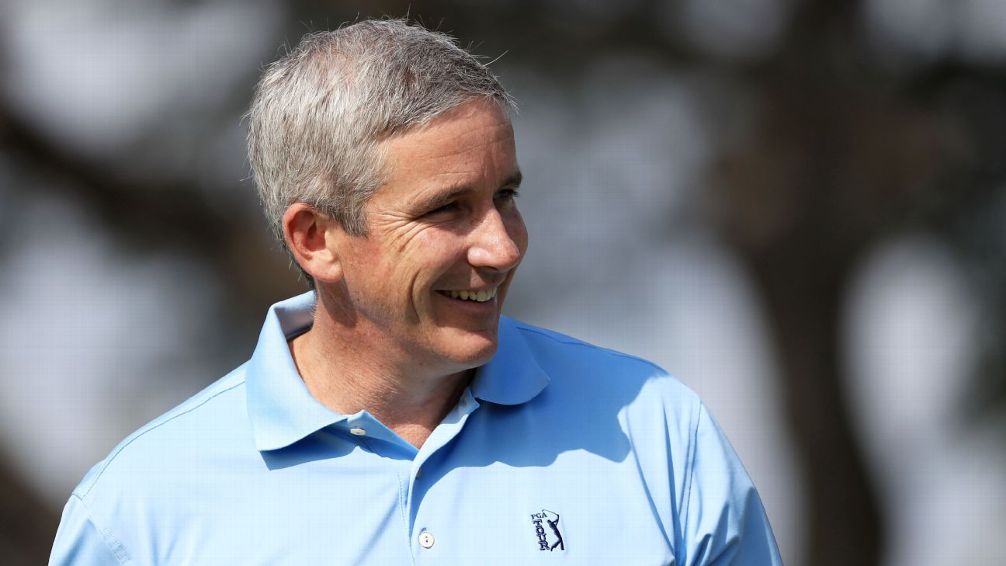
Bob Harig kicks off Players week with an extensive ESPN.com profile of new Commissioner Jay Monahan.

Much of what Monahan says mirrors comments he made on ShackHouse (message discipline students take notice!), but one area we did not cover on the show stood out in Harig's piece. Monahan, to date, has brushed aside most pace of play talk. But this sounds like he's taking a harder look at the matter.

"As it relates to slow play, a lot has happened behind the scenes in the last 12 to 18 months. We've developed a Shotlink dashboard for our rules officials where you can at any point in time see where a player is relative to time-par, see where a player is relative to their own historical averages. And we disclose all that information to the players, and so the players are well aware. (Players are only given information about themselves, not other players.) They have access now.

"And we're in the midst of a comprehensive review on pace of play. It's not something that we just say it's our policy and that's how it's always going to be. We recognize that with technology, we can be far more intelligent about what's happening. Now what do you do with it? I would venture to say at this point we are taking a good hard look at it.''

Eric Trump: "We own our courses free and clear"

Mark Moore and Chris Perez report for the New York Post on Eric Trump's response to golf journalist James Dodson's story about the way Trump Golf finances projects.

From the Post report:

“We own our courses free and clear,” Eric said, insisting that the report was “categorically untrue” and “complete garbage.”

“We have zero ties to Russian investors,” he added.

Must Read: "Threat of stalkers, trolls makes social media complicated for LPGA players"

Beth Ann Nichols files a Golfweek.com eye-opener on the social media ramifications for LPGA Tour players.

From the security issues to sponsorship opportunities won and lost, it's a fascinating look into the risks players take in sharing more about their lives.

Just one of the many revealing bits from LPGA Tour Security Director Joe Funk, who says he spends about 60 percent of his time tackling social media related issues for players.

Funk also warns against players posting too much private information about their schedules. Geotags, for example, make public the real-time GPS location of a player’s whereabouts.

Though in the case of four-time winner Wie, something as innocuous as a Tweet about a sunrise practice session at the LPGA stop in Portland, Ore., a few years back turned alarmingly bizarre.

It didn’t take long for security to notice the man in the powder blue suit and floppy hat at 6 a.m. Turns out he took a bus from Iowa to Portland to propose to Wie.

“We took him to the hotel and put him on a bus back to Iowa,” Funk said. The man showed up once more in Rochester, N.Y., but hasn’t been heard from since.

Rory Teases New Driver On Verge Of Announcing Mega TaylorMade Deal

Golfweek's Forecaddie reported it and I can confirm: Rory McIlroy is becoming a member of Team TaylorMade this week. He'll be signing a huge money deal to play a full bag of their equipment. While adding another huge contract to the Taylor Made payroll will get plenty of attention, the signing is also a reminder that parent company Adidas is still attempting to sell the brand. Will signing Rory excite excite a buyer?

Rory's post...

Back on the range and ready for next week's @theplayerschamp 🏌️⛳️

A post shared by Rory McIlroy (@rorymcilroy) on May 7, 2017 at 12:00pm PDT


NY Times: "Chicago’s South Side Golf Courses in Line for a Tiger Woods Upgrade"

Julie Bosman of the New York Times went to Chicago to check out the proposed public-private partnership with the Chicago Park District that would see Jackson Park Golf Course and South Shore merged into a Tiger Woods redesign capable of hosting the BMW Championship. The alliance headed by Mark Rolfing needs to raise around $30 million to fund the Woods redo and operation once completed.

As usual and as should be expected (and understandable), the debaters seem pro-redevelopment, but not at the cost to affordability for those currently enjoying the facilities now.

On a recent morning at the 18-hole Jackson Park Golf Course, two employees lingered in the building near the first tee, where golfers could buy a $1 cup of coffee and a $6 Polish sausage at the snack bar.

Keith McGrue, 60, a South Side resident, said he had heard chatter from regulars who wonder what a Tiger Woods-designed course could bring.

“A lot of people have been playing here for 25, 30 years,” Mr. McGrue said. “The question becomes, Who benefits from the change? Who loses out and who wins? Most people that play here, especially the black folks, live in the neighborhood. This is our golf course.”

Alan Brothers, 71, who was playing at the South Shore course, said that he was hoping for the sort of growth that a new facility could bring to the South Side.

“This neighborhood has been in need of economic development for a very long time,” he said, pointing to the south, where several blocks away, four people were shot dead in a restaurant in March in an apparent act of gang retribution.

"Caddies aren't just for private clubs anymore."

Jason Scott Deegan at GolfAdvisor.com posts a pair of stories on signs of caddie programs popping up at more than just country clubs. While it's too early to say there is a renaissance taking place, the likely inclusion of caddies at Bandon Dunes as well as new caddie businesses like CaddieMaster, Looper and Premier Caddie, may keep the "upswing" going.

A couple of Deegan's numbers stood out:

•    Nearly 100 public/resort facilities and/or private clubs with some public access offer caddies in America. Since many of the 97 facilities I found feature multiple courses, that adds up to slightly more than 150 courses around the country where public golfers can hire caddies.
   
    •    21 states don't offer caddies at any public-accessible facility: Alaska, Alabama, Arkansas, Connecticut, Delaware, Iowa, Kansas, Kentucky, Louisiana, Missouri, Montana, New Hampshire, New Mexico, North Dakota, Ohio, Oklahoma, Rhode Island, South Dakota, Tennessee, Vermont, Virginia.
  
    •    17 states offer caddies at more than one public-accessible facility: Arizona, California, Colorado, Florida, Georgia, Hawaii, Illinois, Michigan, Mississippi, New Jersey, New York, Nevada, North Carolina, Oregon, South Carolina, Washington, Wisconsin       

He also files a companion piece on the ten best destinations for caddies worth checking out.

Author James Dodson Claims Trump Family Acknowledged That Russians Financed Recent Golf Projects

The Guardian's Martin Pengally reports on the comments of Arnold Palmer biographer and longtime golf writer James Dodson, who told WBUR-FM during an interview that both President Donald Trump and son Eric explained their golf course financing source.

The conversation, which Dodson recounted as he considers himself someone who enjoyed his time playing golf with Donald Trump, took place three years ago.

“Trump was strutting up and down, talking to his new members about how they were part of the greatest club in North Carolina,” Dodson said. “And when I first met him, I asked him … you know, this is the journalist in me … I said, ‘What are you using to pay for these courses?’ And he just sort of tossed off that he had access to $100m.”

Eric Trump, the president’s younger son who is now executive vice-president of the Trump Organization, was also present.

Dodson continued: "So when I got in the cart with Eric, as we were setting off [to play], I said, ‘Eric, who’s funding? I know no banks – because of the recession, the great recession – have touched a golf course. You know, no one’s funding any kind of golf construction. It’s dead in the water the last four or five years.’

"And this is what he said. He said, ‘Well, we don’t rely on American banks. We have all the funding we need out of Russia.’ I said, ‘Really?’ And he said, ‘Oh, yeah. We’ve got some guys that really, really love golf, and they’re really invested in our programs. We just go there all the time.'

Dodson also told a story about the late Arnold Palmer and his view of Donald Trump.

Make sure to check out the backstory of how Dodson got to hang out with the Trumps from the original interview with Bill Littlefield.

"I knew Trump was very interested in golf," Dodson says. "I knew he was buying up golf courses. His M.O. was to find a financially distressed property, buy it, keep it in bankruptcy, do a half-a-million-dollar renovation, fire the entire staff and hire a third back."

So James Dodson, who grew up a Republican but currently describes his political stance as "radical centrist," knew that. And maybe he thought that’s all there was to know about Donald Trump. But that was before they’d met. Which, as I’ve suggested, wasn’t Dodson’s idea.

"Can Sand Valley Make Wisconsin the Next Golfing Destination?"

The New York Times' Tom Redburn visited Sand Valley last fall and just when it sounded like he had visited too early, he makes clear he was taken with Mike Keiser's latest vision. To avid followers of the Keiser project, there won't be much new here. However, it's refreshing to read old style travel writing that takes you to a special place, gives you an idea what to expect, but doesn't give all of the surprises away.

He also gives this preview of what to expect from the resort going forward:

After the resort’s opening, the Coore/Crenshaw layout will be the only course fully available for play. But a second design, by David McLay Kidd, who created the first links at Bandon Dunes, is already well underway. A six-hole loop named Mammoth Dunes is expected to open for preview play this summer, and the full 18 holes might be ready as early as September.

Lisa and I walked the first hole and a couple others as the sun was setting, and the course looks like it will be as beautiful, and even more wide open, than Sand Valley. Mr. Coore and Mr. Crenshaw are also designing a short par-3 course, which should be ready in 2018.

“There’s already great golf in Wisconsin,” said Josh Lesnik, an executive at KemperSports, which will manage Sand Valley for the Keisers. “But soon golfers will look to Wisconsin as a place like Scotland or western Ireland, where they can go for a week and, within a short drive, play someplace special every day.”

Reed Goes Minimalist On The Greens, Leads Wells Fargo By One

Like Luke Skywalker turning off his targeting computer to destroy the Death Star--okay maybe that's a bit strong--Patrick Reed has set aside his green reading guide and is using the Force to putt his way into the Wells Fargo Championship lead.

Leading by one as Teryn Schaefer notes here in the PGATour.com Takeaway, Reed credits the switch to shelving overanalysis, reports GolfChannel.com's Rex Hoggard.

“I've done that pretty well all week,” he said. “I have my green-reading book with me just to kind of confirm, not really to go off of it, just to make sure I'm seeing what the book is saying and just kind of going from there.”

Reed's comments come at an interesting time given this week's discussion of possible governing body action against the green reading books and in particular the Strackaline approach that Josh Berhow explains here for Golf.com.

Jim Stracka sees the issue as a slow play issue more than anything else.

"Some of the older guys think, 'We already understand these greens. We don't need greens guides,' and all they see is people using books and it's a perception that they are actually playing slower," Stracka said. He believes golf should have a shot clock and allow players to do whatever they want before they play their ball, as long as it's done inside the time allotted. "My opinion on slow play is slow players are slow and fast players are fast. It doesn't really matter what type of technology they have."

PGA CEO Hopes President Trump Gets More Public Courses Funded

Kevin Casey sums up Ahiza Garcia's CNN Money interview with PGA of America CEO Pete Bevacqua who makes the case that President Donald Trump, who has said he sees golf as aspirational, will go all FDR on us and include WPA-style golf construction projects as part of future infrastructure rebuilding efforts.

“That’s a powerful story because those golf courses are open to everybody, they’re very affordable, and now we’re bringing golf’s best and one of golf’s major championships to those public venues year after year,” Bevacqua said. “We think that’s a powerful signal for the game.”

WSJ: "How Pro Golf Became a Bromance"

Thanks to reader John for Brian Costa's WSJ look at the bromancing of professional golf after year two of the Casamigos Bakers Bay Challenge Presented by Wheel's Up.

He pulls together quotes from Arnold Palmer and Rory McIlroy the fine line between competition and a tour getting too comfortable, and includes this from Smiley Kaufman on the marketing side of their bromancing.

Kaufman said social media offers them “a huge opportunity” to appear relatable and likable to a wider audience. He described the Bahamas group almost as if he were talking about characters on a show.

“Rickie is the go-getter, the racer, the fearless kid,” he said. “Jordan’s the genuine, honest, Arnold Palmer-type of kid. Justin is the kid who’s always been successful at every level. And I’m just the one that likes to have a good time.”

Getting In The Mood For Changes At The Players

You'll hear about the new 12th, revamped 6th and 7th, a new entrance drive and revitalized driving range at next week's Players Championship.

But to get a good for feel for those changes and to see things presented in new, fun ways, check out this PGATour.com feature from Sean Martin and the photo/video team in Ponte Vedra.

After seeing all of this, the new grass lawn effect to the first tee struck me as the most interesting for players. The overall effort seems to be a simplication and toning down of some bombast, but obviously most of the attention will be given to the new risk-reward 12th replacing the old risk-risk 12th.

Jason Day and others also contribute thoughts to the package.

Not Many Stepping Forward To Support Green Reading Books

The rules community may have the backing of top players should they target the new green-reading books.

Rex Hoggard reports from the Wells Fargo Championship on comments from Adam Scott and Lucas Glover.

“I think probably we should ban the book,” Adam Scott said. “If they feel that reading the green needs to be more of an art and it's an advantage to a player who's a creative, great green reader, then I wouldn't have a problem with that.”

Glover also took the position that putting artistry is being undermined.

“It’s more the powers that be see it as a possibility of losing the art of the game. It’s just like judging the wind or reading a lie, there’s got to be art to it. Science has already taken over enough.”

I'm still not understanding the passion for protecting artistry as the proposed new rules usher in rangefinders suggest the rules community is targeting these books selectively.

As I wrote for Golfweek, this screams of a pace issue more than a skill issue.

If you haven't seen the materials in question, Tripp Isenhour did a nice job showing what they look like and the benefits some players seen in them. Note the portion where he explains the specialized data that incorporates that days' hole location.


In advance of the Players, Justin Leonard shared this story on the Golf Channel conference call in support of banning the books.

JUSTIN LEONARD: I played last week at the Texas Open, and Steve Hulka was caddying for me, and he had one of those books with, you know, the arrows and everything. I looked at it twice and I couldn't -- it was too much information for me.

I think the reason they are looking at it -- and I'll tell you that I had a putt on Friday on No. 9 to make the cut, about a 25-footer. And Steve told me what the book said, and it did exactly what it said.

Q. Did you make it?

JUSTIN LEONARD: I made the putt. Absolutely I made it. Of course I did. I made the cut and played on the weekend.

But that being said, I think to me, it's a slow-play issue. It takes too much time. It takes the feel away from the game. I know we're in a time where technology plays such a role in all sports, and it's certainly playing a role in golf with TrackMan and everything.

But I think that there's also a – there needs to be a feel and guys using instincts and using past experience, charting putts and things like that from years past. Practice rounds are important.

I'm not a fan of these greens books. I think they slow down play and they take away a player's natural ability and need to feel and see what's going on on the golf course.

PGA Tour's Slow Play Policy Needs Work (First)

As the European Tour unveils a shot clock this weekend at GolfSixes, AP's Doug Ferguson considers the PGA Tour's first slow play penalty in nearly 22 years and says the policy is the problem.

Talking to players who did cite the right causes (fast greens, Brian Harman) or reasons no action has occurred sooner (tournaments somehow finishing on time, Pat Perez), it still comes down to policy.

Here's what is not in the book - when players are put on the clock, that's not their first interaction with a rules official. They first are asked to pick up the pace, a courtesy to allow for outside circumstances (such as a lost ball). Secondly, while timing is not an exact science, players are not given a bad time if they go a few seconds over the limit. A bad time generally is a really bad time.

Either way, it's a bad policy.

''If a slow player gets behind and they're asked to pick it up, the first question they ask is, 'Am I on the clock?' Because if they're not on the clock, they're not going to change,'' Haas said. ''If they are on the clock, they change. I don't like that. Because then all they do is run down the fairway.''