
Links Magazine On The Costs Of Hosting A USGA Event

Adam Schupak does a very nice job in this Links Magazine piece looking at the pluses and minuses of hosting a USGA-governed national championship. Surprisingly, even post-$1.2 billion Fox Sports television deal, Schupak says "a club’s burden would be more palatable if USGA coffers weren’t overflowing." This is because the USGA kicks in smaller-than-expected amounts to host courses of lesser championships (but does pay substantial rent and royalties to U.S. Open venues).
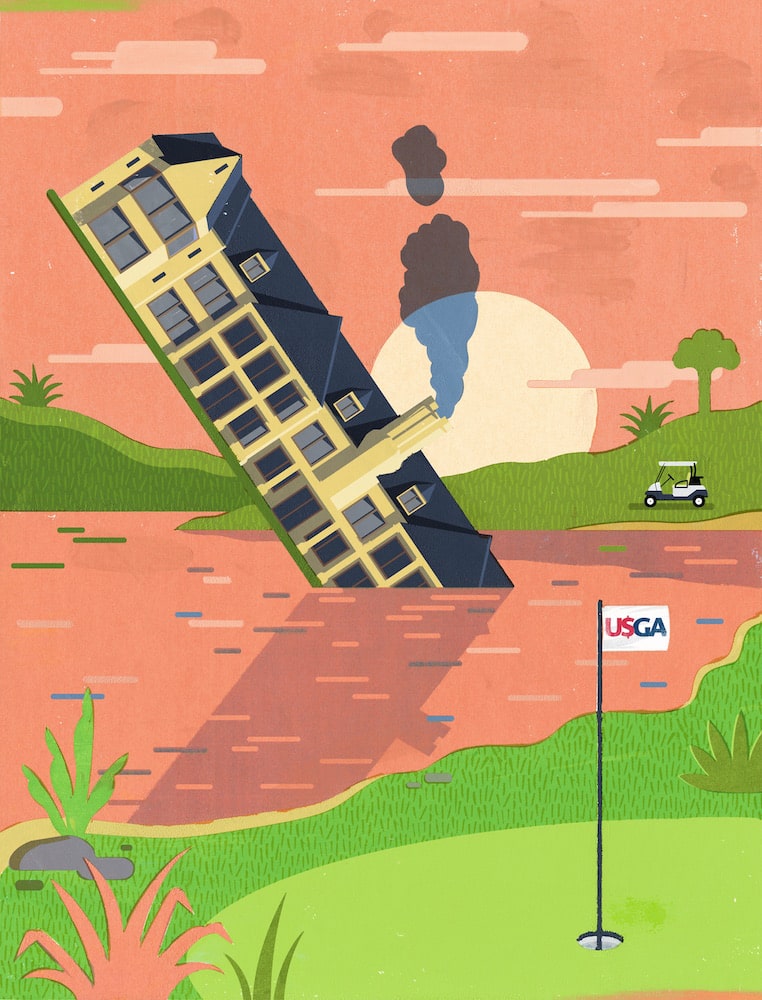
While the hosting costs may be minor to the clubs and resorts hoping to host a more lucrative event down the road or simply to offset the down time involved in hosting a cumberson championship, the expenses are still substantial and even unexpected to some courses. Schupak writes:

The starting price can be as modest as roughly $150,000 for the U.S. Women’s Mid-Amateur, balloons to $750,000 for the Walker Cup, and gets close to $1 million for the U.S. Amateur when a larger footprint for worldwide media and television compounds is factored in. To raise the money, host facilities often are forced to get creative, ranging from throwing golf outings to finding local sponsors. It took approximately 50 well-heeled members at Country Club of Birmingham in Alabama—a century-old, 36-hole private facility that had slipped out of golf’s Top 100 lists—to bankroll the $300,000 budget for the 2013 U.S. Mid-Amateur Championship.

Schupak provides this example from Vero Beach's John's Island Club, host of the 2015 U.S. Mid-Amateur.

According to Mulvoy, the budget for the 2015 Mid-Am topped $650,000, which included $100,000 for a reunion of Mid-Amateur champions held prior to the competition, and hiring a full-time championship coordinator. The USGA’s financial contribution to the operating budget? A net total of $59,000, or less than 10 percent of the championship’s operating costs.

The USGA counters that they've upped the dollars going to host courses, according to John Bodenhamer.

Bodenhamer estimates the 2017 budget for the USGA’s 10 amateur championships is $12 million this year, an increase of $2.5 million from three years ago.

Video: Erin Hills Thirteenth Hole Flyover

I realize in posting these we take some of this information for granted, but after speaking to a few qualifiers Monday in Newport Beach, these flyovers provide an important scouting tool. Part of their usefulness is thanks to the unknown venue, and some relates to just getting a sense of what lies ahead.

Anyway, players educting themselves is another fascinating element of this year's U.S. Open, which features a 193-yard, par-3 13th playing over a wetland. The hole features a large bunker left and crowned green edge on the right. A prominent swale should make things fun and for those pitching up to the large green or just trying to land and hold shots.

You can get a good look at the green complex in the USGA's flyover.

The Erin Hills flyover:


Forbes: Rory 7th Among Athletes, Ahead Of Phil, Tiger, Jordan

As always take these numbers with a grain or two, but at least we see where golfers are lining up with the highest paid athletes.

Rory McIlroy landed T6th on the Forbes list at $50 million, tied with Andrew Luck and ahead of Steph Curry. The year comes on the heels of winning the FedExCup and finishing fifth in the Race To Dubai. His $16 million in on course earnings accounts for his 2016 PGA Tour play, FedExCup and European Tour play in the June 2016 to June 2017 window used by Forbes.

Phil Mickelson ranked 12th, with $43.5 million overall, of which $40 million was from off course endorsements. Tiger Woods at No. 17 is credited with $37.1 million of which $37 million was made off the course. And Jordan Spieth ranked 21st, making $34.5 million, with $29 million of that credited to endorsement income.

Video: PGA CEO Explains Possible May Move To Members

PGA of America CEO Pete Bevacqua lays out the timing, thinking and state of discussions to move the PGA Championship to May in coordination with the PGA Tour. The comments were directed at PGA of America members.

It was most intriguing to hear his comments on the changing sports landscape, which I take as he, Jay Monahan and others genuinely seeing that the long term health of their events will be strengthened by a tighter golf window before fall sports take over.

PGA CEO Pete Bevacqua from PGA of America on Vimeo.


TV Golf Viewers Still Skew Old, But At Least We're Not Wrestling!

In "Going gray: Sports TV viewers skew older" Sports Business Daily's John Lombardo & David Broughton return to their 2006 survey of sports viewers and find that the audience is getting older across the board.

Golf, naturally, tops most of their lists with a median age of 64. Only one sports saw their median age drop, and golf was not greying the fastest (that wrestling!).

The study, conducted exclusively for SportsBusiness Journal by Magna Global, looked at live, regular-season game coverage of major sports across both broadcast and cable television in 2000, 2006 and 2016. It showed that while the median age of viewers of most sports, except the WTA, NBA and MLS, is aging faster than the overall U.S. population, it is doing so at a slower pace than prime-time TV.

Of course, as fascinating as the story is, I can only imagine the meetings this week where this comes up and nervous execs obsess about how we get the kids in our sports. The answers aren't pretty unless you see an opportunity here to tighten broadcast windows up a tad.

The trends show the challenges facing leagues as they try to attract a younger audience and ensure long-term viability, and they reflect the changes in consumption patterns as young people shift their attention to digital platforms.

“There is an increased interest in short-term things, like stats and quick highlights,” said Brian Hughes, senior vice president of audience intelligence and strategy at Magna Global USA. “That availability of information has naturally funneled some younger viewers away from TV.”

We also got some PGA Tour Live numbers out of this effort, so there is that. From the PGA Tour's Ty Votaw:

Votaw also noted that audience trends today can’t be solely focused on the linear TV viewer and pointed to a younger audience on tour-run digital properties.

“When you go to PGATour.com, the median age is 55 and for our PGATour Live (over-the-top network), the median age is 20 years younger than on broadcast,” he said.

That still puts the median at 44, which PGA Tour Live is still largely watched by Non-People-Who-Matter viewers (aka millennials).

There were several charts with the piece, but the one showing golf not graying quite so badly proved eye-opening given the supposed hipster status of pro wrestling and UFC.

Video: Erin Hills Twelfth Hole Flyover

If you've listened to the latest ShackHouse you know that Mike Davis cited this hole as one that could be adversely effected by a wind different than the one forecast.

The flyover makes it pretty evident why: the tee shot carry, narrowness and crowned landing area that is great fun to play to when the 464-yard hole is playing close to its scorecard yardage. This is one of the most memorable holes on the course but as I recall from my visit there, feels like one of those holes that is almost great but lacks a little charm. Or, maybe it's the giant catch basin in the approach.

Anyway, here is the USGA flyover.

The Erin Hills flyover is here.

ShackHouse 37: The USGA's Mike Davis And Erin Hills

In our pre-preview of the 2017 U.S. Open, USGA Executive Director Mike Davis joins us to discuss Erin Hills, venue selection, course setup and his investment in a public golf course.

A few of our questions were informed by this excellent Jaime Diaz Golf Digest interview with Davis, as mentioned in the show.

As always, you can subscribe on iTunes and or just refresh your device subscription page.

Here is The Ringer's show page.

Same deal with Soundcloud for the show, and Episode 37 is here to listen to right now.

ShackHouse is brought to you by Callaway, makers of the Epic Driver that is now part of Callaway's very groovy Customs program along with Chrome Softs and other fun stuff. Check it out just in time with Father's Day, or, if you just want to enjoy some fun customization practice play with the new Customs features. It's wonderfully therapeutic!

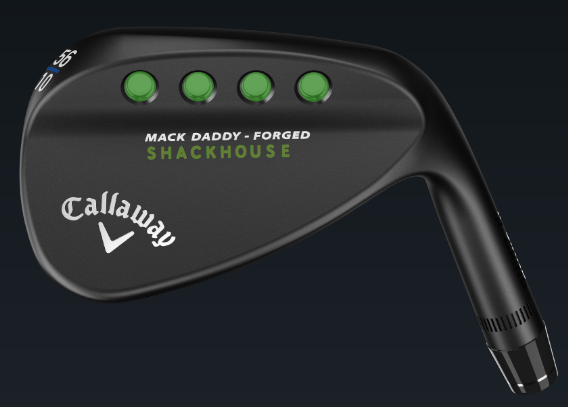
The ShackHouse wedge above was created in the program and, as noted in the show, promo code HOUSE25 will get you $25 off a custom wedge purchase for the next three weeks.

Here is the Callaway Father's Day Gift Guide.

Here is the embed, though as always we recommend you subscribe wherever fine podcasts are streamed!


U.S. Open: This Year It's Good To Be (An) Alternate

In the aftermath of another successful U.S. Open Sectional Qualifying that produced the usual array of stories, many have been asking where the first alternate comes from. Surely Phil Mickelson's likely WD is fueling some of this intrigue, but as Doug Ferguson writes in his AP notes column, this year is a particularly good one for alternates given a few factors.

But where that first alternate comes from, remains a mystery.

Ferguson explains here why it's good to be an alternate with the USGA holding back six spots from the qualifier for possible last minute OWGR top 60 status players to move into the field.

Chris Wood is at No. 60 in the world, and he would stay there provided Scott Piercy doesn't finish among the top 20 at the FedEx St. Jude Classic. So that's one spot, maybe. But with Soren Kjeldsen withdrawing from the St. Jude Classic, only one other person has a mathematical chance to get into the top 60 in the world, and he would have to win the St. Jude Classic. That applies to only about five players, such as Ian Poulter and Hudson Swafford.

So at least four spots will be going to alternates, and that doesn't even include Phil Mickelson, who plans to withdraw because of his daughter's high school graduation.

But as for which venues produced alternates first, Ferguson writes that is a secret. Though he does say this:

The priority is based on a formula that includes how many spots each section was allocated, and the strength of field determined by the world ranking (pro and amateur).

Roundup: 2017 U.S. Open Sectional Qualifying

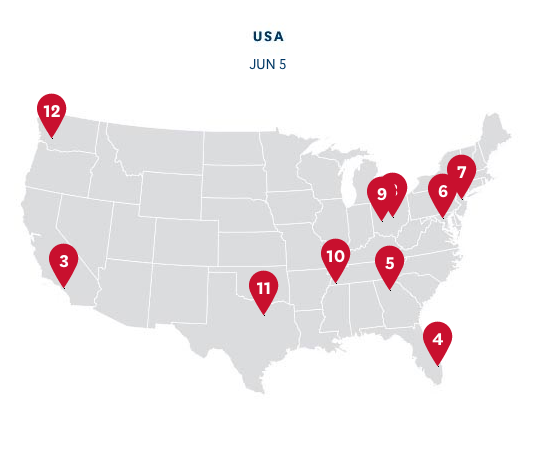
Golf's Longest Day produced its traditional array of expected and unexpected qualifying stories. Elite players were grinding across the land and merely based on the scene in Newport Beach, the day remains the ultimate dreamland for aspiring players.

Seeing five of six amateurs make it from the SoCal qualifier, and finding out just how little thought they'd given the host venue, spoke to the wild ride they're about to take.

Finally, congrats to all players, caddies, volunteers, state and regional golf associations, and others for surviving (and making it) a great day.

Here is Golfweek's roundup page.

Here is the USGA's roundup page.

My roundup from the Newport Beach qualifier hosted by the SCGA, where five of the six were amateurs and all are going to be first-time U.S. Open contestants. J.D. Cuban’s images from the qualifier.

Brentley Romine’s
notes from the Tequesta, Florida qualifier where Jack Maguire medaled. Lisa Mickey filed this story from on site as well. Scott Miller’s photos from there.

Kevin Casey’s
Memphis wrap, where Steve Stricker qualified for his 20th U.S. Open and the first in his home state. John Gress's images from Memphis.

Jeff Babineau on the Columbus qualifier where Stewart Cink was the qualifying headliner. Also making it were J.T. Poston, Jason Kokrak; Bud Cauley; Martin Laird; Keegan Bradley; Jamie Lovemark; Bryson DeChambeau; C.T. Pan; David Lingmerth; and Ted Potter Jr.  The delay added some fun to Fred Vuich’s image gallery from Columbus.

Tuesday morning at Lakes Golf & Country Club, four players will face off for three available spots: The group consists of Peter Uihlein, Talor Gooch, Michael Putnam, and amateur Scottie Scheffler.

Mark Button’s roundup from Dallas, where Roman Robledo, Nick Flanagan and Walker Lee qualified.  Here’s a link to Darren Carroll’s image gallery from Dallas.

Kevin Casey with the Springfield roundup where Corey Connors was medalist, with Brian Stuard, Brice Garnett and Ryan Brehm made it to Erin Hills. And here is a gallery of Matt Sullivan’s images.

Tom Cade reports from Lakewood, Washington where Derek Barron medaled and was joined by Jordan Niebrugge, Max Greyserman and Daniel Miernicki.  Here are Steve Diapola’s images from Tacoma Country Club.

David Dusek says Canoe Brook qualifier Daniel Chopra is no longer playing as a blonde but he is headed to Erin Hills.  Michael Cohen’s images from Canoe Brook.

Garrett Johnston reports from Woodmont in Maryland where Sam Ryder was medalist.  Joel Kowsky's images from there.

Stephan Jaeger and Alex Smalley were the qualifiers in Georgia, but no stories have been posted as of post time.

A Few U.S. Open Sectional Links And Notes

Things are off to a tough start in Columbus with a weather delay where Steve Stricker is one of the hopefuls, writes Jeff Babineau, but not as rough as the plight of PGA Tour LatinoAmerica member Michael Buttacavoli, who had to WD from the Tequesta, Florida qualifier because his clubs were lost by the airline. Will Gray reports.

Otherwise action is underway across the country and the USGA has a scoring central link here to follow.

These are the storylines most worth following, but everyone in action is chasing a grand dream and surely has a story or two to share!

Full coverage at Golfweek.com, as well.

Fox Sports 1 will feature a one-hour roundup show at midnight, ET.

Video: Golf Course Bear Steals Lunch!

It's hard to pinpoint the best part of this bear strolling out onto the course...

Is it the fascination with the flagstick that another bear famously enjoyed?

Is it the golfer panicking that he has an orange in his bag and prompting him to put his foot down?

Is it the bear's casual stroll after committing the theft?

Either way, such simple pleasure viewing for a Monday...(H/t Alex Myers): 


Video: Erin Hills Eleventh Hole Flyover

It's blind and you need to pick a line in conjunction with the wind. In other words, it's tougher than it looks.

The 460-yard par 4 eleventh at 2017 U.S. Open host site Erin Hills features a landing area not visible from the tee. Throw in the wind exposure and the bunkers played short of the putting surface, and this one isn't likely to be a player-favorite.

A good look at the smallish green can be seen in this USOpen.com flyover.

Here is the Erin Hills version in later light:

Only Nine Players Hit Muirfield's 16th On Sunday

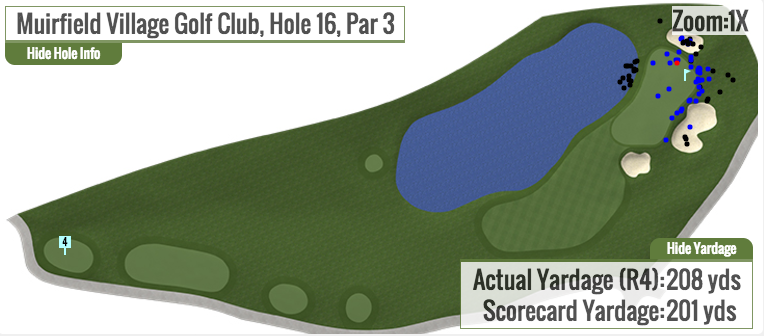
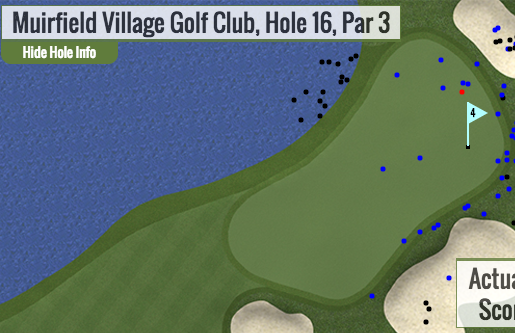
The weather was feisty but the quality of the leaderboard made it a bit eye-opening that only nine players hit Muirfield Village's 16 green Sunday. Gary McCord hit the point as deftly as he could with the architect of the revamped hole hosting the event.

TTo have only nine players in the final round of the Memorial keep their tee shots on the putting surface was one thing, but to have so many miss so consistently will be of even greater concern when the tour staff reviews the ShotLink numbers. The 2017 leaderboard was stacked with some pretty big names, and while we'd love to chalk this freaskishly low number to just the wind, the architecture deserves more scrutiny. A combination of the hole's odd angle, yardage and green complex remains problematic, at best. And new green firmness can no longer be blamed.

Here are the greens in regulation numbers from Thursday to Sunday: 44, 40, 47 and 9. One birdie Sunday.

The scatter charts are pretty wacky:

Dufner Joins U.S. Open Discussion With Bizarre Memorial Win

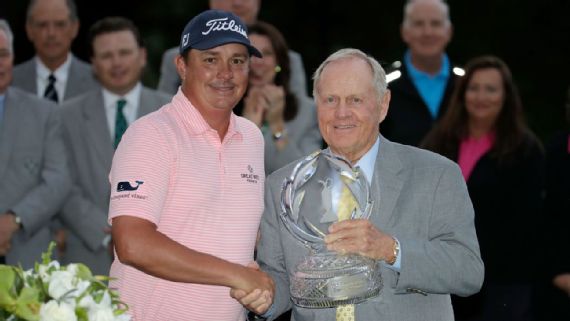
Not only did Jason Dufner win the Memorial for a long-awaited return to the winner's circle, he did it in entertainingly bizarre fashion. The weather, the wind, the rain, the delays, the quality leaderboard, the 16th hole and the 18th all tried to trip up the third-round 77-shooter. But Dufner somehow overcame it all to win at Jack's place for his fifth PGA Tour victory.

He heads to Erin Hills and the U.S. Open a legitimate threat given his play, ball striking and newfound confidence.

Kevin Casey at Golfweek on the amazing back nine turnaround.

Birdies at 10 and 12 got him in position, another at 15 pushed him into the lead and a stuffed wedge from 119 yards inside 3 feet at the par-4 17th meant another. Suddenly, he was 13 under and had a two-shot on the 72nd hole. Would Dufner cave to the pressure, especially with Rickie Fowler directly behind him? No chance.

Dufner drove it into the right rough on 18 before lightning hit and play was suspended. Again.

Inclement weather had forced suspension of play at 4:18 p.m. Eastern. The delay would last for 1 hour and 17 minutes. Another delay started with that lightning at 6:48 p.m. and lasted until an 8:05 p.m. restart.

Once play started again, Dufner knocked his second shot into more rough beside the fairway and then put one 40 feet from the hole. With that left for par and hanging onto a two-shot lead, Dufner drained the long putt to essentially seal the deal. Clutch.

Bob Harig at ESPN.com on Dufner becoming the first player since Nick Faldo in the 1989 Masters to overcome a score of 77 or higher to win a PGA Tour event.

"I've always been a fighter," said Dufner, who shot a final-round 68. "Especially since I turned professional. Doing this hasn't come easy for me. There's been a lot of struggles and a lot of setbacks. I didn't come straight out of college and play the PGA Tour. It took me almost 10 years to get out here. Took me another two after that to win and actually get to where I felt comfortable.

"So I always take pride in kind of being a fighter, trying to come back. I played really good a couple of weeks ago in Dallas and have a great history at Colonial, and I missed the cut. I was pissed. I was upset. I was disappointed. You have all these thoughts in the moment."

The winning putt:

The extended highlights:


Scott First Of Many To Put USGA On Notice Over Setup, Rules

Take your pick of issues--TV rulings, greens too fast for contours, tough setups, green reading books, purse value--pro golfers have the USGA on their radar. The next few weeks will provide an opportunity for both sides to jockey for their positions, starting with course setup.

With Chambers Bay driving much conjecture given Erin Hills' similar newness as a venue, Adam Scott's comments to Golfweek's Jeff Babineau probably mirror the views of many players fearing a repeat.

“Maybe it’s time to do away with the even-par target, just thinking about the bigger picture of the game of golf,” Scott said after finishing up at Memorial on Sunday, where he shot 74 to finish at 1-under 287.

“If their major pinnacle event for them requires courses to be the way they are, it doesn’t set a good example for every other bit of golf that they try to promote. Maybe we should get the numbers out of our heads and try a new strategy.”

Good news with Erin Hills: it's far more lush than Chambers Bay and the greens are a pure strain of bent, so almost all issues with balls moving on greens, balls bouncing on greens and balls bouncing over greens, seem unlikely to arise.

Scott's comments on the USGA, however, probably won't get him an invited to the Bobby Jones Award ceremony.

“Whether it’s rules changes or any other decisions they make, I think their process is out,” Scott said. “I just don’t see how they get to some of these decisions. . . . They’re hanging onto the Rules of Golf by a thread, really. That’s why they’re panicky and they’re trying to see what’s going on out here on Tour.”

Interestingly, this is the gripe of many everyday amateur golfers who also just want to play some relaxed, less complicated rules. Every time I get an email asking for the Relaxed Rules bag tag put out by Golf Channel's Morning Drive, it's hard not to wonder why we aren't bifurcating.

Whether all of this speaks to a failed or successful roll out of revised views depends on your point of view. I happen to think that the proposed rules revisions were successful because a mostly positive response suggested golfers wanted what was delivered, only more. So will these last few months and next few weeks help shape and even stronger push to make the rules simpler, cleaner and easier?