Travelers Field Quality Boost, Explained

Rex Hoggard at GolfChannel.com looks at the field strength boost enjoyed this week by the Travelers Championship.

While we'd love to think Rory, Jason and Jordan are there for the fun of it, this is the highest profile example yet of a very shrewd PGA Tour rule change.

The circuit initiated a strength-of-field regulation this season, which requires players who didn’t have at least 25 starts in the previous season to add an event to their schedules that they hadn’t played in the last four seasons.

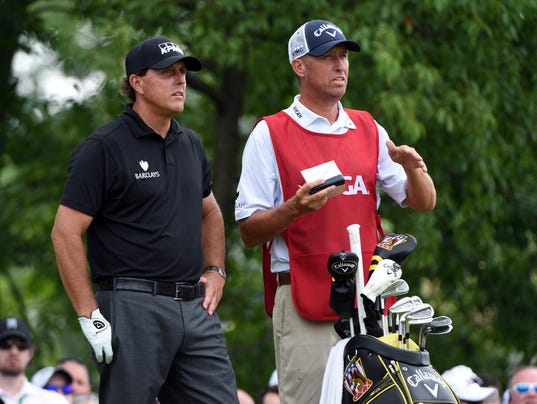
"As Phil and Bones part ways, an appreciation of what made them so good together"

Alan Shipnuck's Golf.com mailbag covers many topics, but this on Phil and Bones was strong:

There may never be another player-caddie combo like it again, with such a pair of outsized personalities, both of whom were willing to take us inside the ropes with their insights about the game. Phil and Bones will both be all right going forward, but I'm definitely going to miss watching them do their thing.

And this from Michael Bamberger, also at Golf.com:

Bones's job was to get Mickelson in a place where he could play his best golf. That's why he is unlike any other caddie that came before him. It was a deeper role than any of us had seen before. But Mickelson was a prodigy even before the two had met, good enough to win the Tour's Tucson stop as an amateur, in 1991. In their quarter-century together, Mickelson has often needed to dance to songs he recorded himself and Bones never wavered in his support. So whether it was carrying two drivers or practicing away from the site of a major or playing catch as a warm-up exercise, Bones was all in. Phil needs somebody to look at him, and Bones did.

Should Erin Hills Get Another U.S. Open?

If I had to vote, the answer would be a reluctant no. While the B grade given on Morning Drive to Erin Hills would be more than enough to get it another U.S. Open most years and certainly proved to be a much better venue than Whistling Straits, the next eight years of courses elevates the U.S. Open in ways that Erin Hills is unable to inspire.
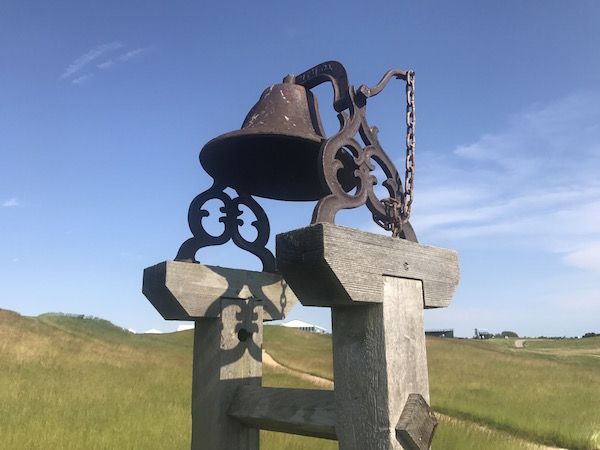
That said, a remote place with no business pulling off such an undertaking did so in fine fashion.

A course that had undergone so much surgery was able to shine, with several strong holes and no silliness.

The fans of Wisconsin are wonderful and I heard very little complaining about the lack of up-close viewing opportunities. They would have been within their right to complain.

The conditioning and presentation of the course, outside of the over-stimulated natives immediately off the fairways, was excellent.

Had the weather cooperated and the course remained dry all week--always an if this time of year--the width so many despised would have been necessary.

A few other views on the topic, starting with Golf World's Jaime Diaz.

It’s well positioned if the USGA is truly committed to moving the championship around the country. At the moment, there is a vacuum in the Midwest. Medinah and Olympia Fields in Chicago don’t inspire and former USGA mainstays Hazeltine and Oakland Hills have become more aligned with the PGA. The same with Whistling Straits, which has had two PGA and is slated for another Ryder cup.

And in an unofficial competition comparison with another minimalist style public course that is vying to be deemed a modern classic, Erin Hills has come off better than Chambers Bay near Seattle.

Erin Hills, with sheer bigness that requires less retrofitting for distance than older courses, and a brawn accented by humpy land and jagged bunkers that can make for exciting golf, offers a welcome but only occasional – maybe once every 20 years - change of pace from the traditional Golden Age classics.

Gerry Dulac of the Pittsburgh Post-Gazette isn't a fan of the public course experiment.

If it were up to me and not Mike Davis and the USGA, I’d play every U.S. Open on the great, traditional, classic and iconic courses in our country, not these pop-up daily-fee facilities designed to bring the national championship to the public golfer, which, to me, is like playing the Super Bowl at Cupples Stadium on the South Side.

Michael Bamberger wanted to play...to the greens on the driving range, which is one of the best I've seen. From this SI/Golf.com roundtable:

Bamberger: Good for them. Not for us. The USGA wants to preach a message of playability. This course was too easy for the elites. And unplayable for 90-shooters, from any tee. Some of the greens are nutty. The place is beautiful, though. Spectacular. I'd love to play holes on the driving range all through a long dusk.

Teddy Greenstein thinks the course deserves another shot but wonders if there is competition from a nearby state.

The USGA is committed through 2026 with a greatest hits collection that includes Shinnecock Hills, Pebble Beach, Winged Foot and Oakmont. USGA executive director Mike Davis said that “in a few months, we’re going to name another tried-and-true.”

Insiders predict Oakland Hills’ South Course, a Donald Ross design near Detroit that has hosted six U.S. Opens, will get the call in 2027. Erin Hills should return soon after as another anchor of the Midwest.

USGA executives love that owner Andy Ziegler was willing to close Erin Hills to public play in October, taking a financial hit with the payoff of perfect conditioning.

Todd Milles of the Tacoma News Tribune wonders if Erin Hills will join (maybe) Chambers Bay in the every 20-year category.

Unless something unforeseen happens, Erin Hills has made such a favorable impression this week that it would be hard not to see it emerge as the USGA’s go-to venue in the Midwest for the foreseeable future.

“Erin Hills won’t be in the 10-year rotation,” Putnam said, “but it will be in the 20-year rotation.”

Your votes please...

Should Erin Hills Get Another U.S. Open?
pollcode.com free polls

Large U.S. Open Corporate Hospitality Tents "Going by way of the dinosaur"

John Lombardo's SBD report (subscription required) on all things USGA business reveals that the organization is looking to add two more "partner" sponsors, with hopes of having six primary partners next year at Shinnecock Hills.

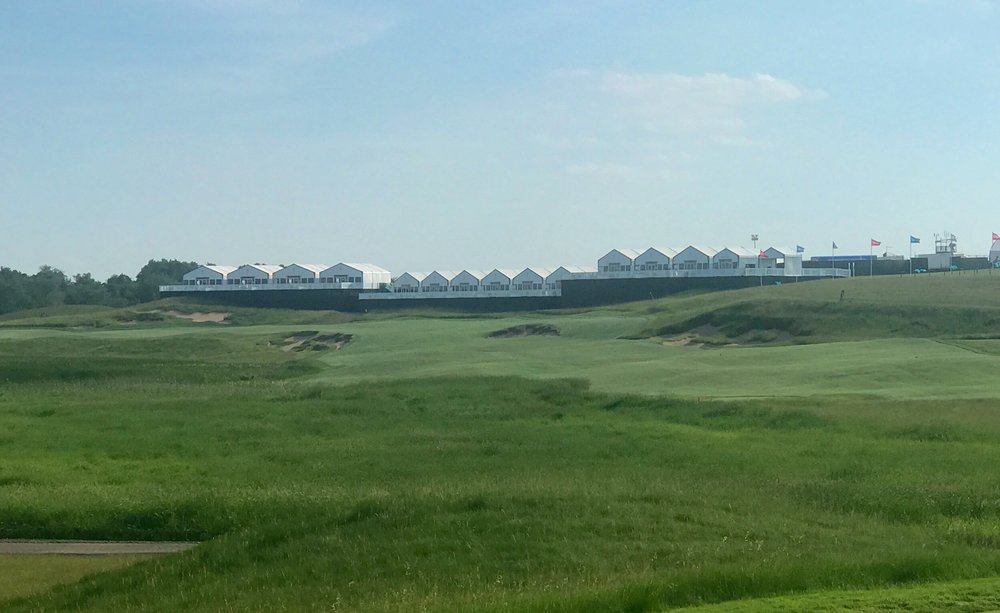
But more interesting, at least to those who would like to see venues not need another 80 acres for corporate hospitality tents, is a trend away from companies wanted large, expensive dedicated tents.

Mimi Griffin, CEO of the hospitality sales company handling the event for the USGA, says there is a big shift occurring in demand toward more modest tables and nimble offerings.

Fading away are the 100-125 ticket "chalets" that have crept closer to play and cost $325,000 at Erin Hills. In? More table packages with a prediction from Griffin that after the next two years, we'll see fewer classic corporate tents.

“The 100-ticket tent is going by way of the dinosaur,” Griffin said from a suite overlooking the scenic sixth green at Erin Hills. “Smaller, nimble and daily, that is what the market demands.”

Hospitality offerings at Erin Hills ranged from the platinum premier package along the 18th hole, which cost $325,000 for 125 tickets for the week, to a one-day table package for $9,225 along the 13th hole that included 15 tickets.

Griffin said hospitality sales at Erin Hills were down about 10 percent from last year’s event held at Oakmont outside of Pittsburgh. “It is not drastic, but noticeable.”

"Mickelson was from Mars, Mackay from Venus, and they ruled in their own universe."

As brother Tim Mickelson takes over looping for brother Phil (DiMeglio/USAToday), the San Diego Union-Tribune's Tod Leonard salutes the Jim "Bones" Mackay run of 25 years despite his shock at the news.

He writes:

This is Lucy divorcing Desi. In a pressure-cooker sport in which some caddies change partners as often as Taylor Swift rotates beaus, Phil and “Bones” working more than 550 tournaments together with not so much as a single public spat borders on being a miracle.

Let’s be real: The fact “Bones” didn’t strangle Phil on numerous occasions makes him something of a saint.

Rex Hoggard says it was fitting that one of the great player-caddie runs ended two weeks ago in Memphis where it all began.

“I do think every time I come back here, 25 years ago to the day basically on Monday, Tuesday, it was at Farmington Golf Course was the first day that Bones and I ever worked together. It was exactly 25 years ago this week,” Mickelson said on June 7. “Every time I come back here to Memphis I always think about that and that particular moment.”

U.S. Open: Return To Walking Officials With All Groups

After seeing the USGA's revision to its U.S. Open rules setup at Erin Hills, I write for Golfweek that bringing back walking officials would be the prudent thing to do.

While there were no major rules situations, I know of one player whose playing partners were not paying attention to his ball as it entered the tall stuff at hole No. 1. But since there was a bit of a grey area there and no walking referee was there as you might find at The Open, NCAA's and many other events, the player had to play as if he lost his ball.

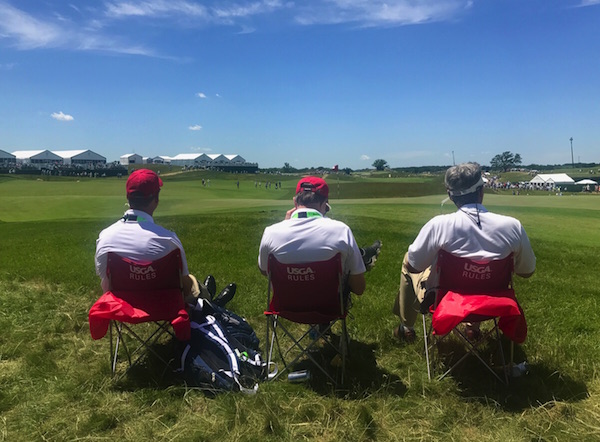
As I note in the piece, this is also a perk for those who put in long hours working less-glamorous events. It was embarrasing seeing them sitting in the rough or in those parade-viewing chairs and in awful red hats.

But mostly the change this year seemed like an odd reaction to 2016's events and without a referee in each group, will some day prove costly for a player.

PGA Tour To Test Blood, Announce Drug Related Suspensions

The news of blood testing to more comprehensively test for doping and the decision to announce suspensions for all violation is a fascinating one on many levels. **I elaborate here at Golfweek.com.

(A) It's about time. Golf took too many hits for appearing to protect players. Given the repeated assurances that there would be few violations, those protections seemed particularly unnecessary.

(B) Odd timing. This was probably planned for announcement in anticipation of the IOC's upcoming consideration of golf going forward in the Olympics. That was, until they jumped the gun last week and committed to golf through 2024. Take that WADA!

(C) Odd timing, part 2. The folks at the Travelers, who have assembled a stellar field this year, should not be pleased to have this announcement on their press conference Tuesday.

The full press release:

Anti-Doping Program, which will take effect with the start of the 2017-18 PGA TOUR Season. The revisions, approved by the PGA TOUR Policy Board, include the implementation of blood testing, supplementation of TOUR’s Prohibited List to include all of the substances and methods currently on the World Anti-Doping Agency (WADA) Prohibited List of Substances and Methods, and the reporting of suspensions related to drugs of abuse (recreational drugs).
 
The TOUR will begin a comprehensive education program to ensure that all players understand the changes to the testing procedures, the Prohibited List and the adjudication process in advance of the 2017-18 season.
 
“While we are extremely pleased with the implementation and results of the PGA TOUR Anti-Doping Program to date, we believe that these changes to our program are prudent in that they further our objectives of protecting the well-being of our members and better substantiate the integrity of golf as a clean sport,” said PGA TOUR Commissioner Jay Monahan.
 
Blood Testing

Blood testing will be added to the Anti-Doping Program as one of the TOUR’s regular testing protocols, beginning next season. Urine testing will continue to be the predominant method.
 
While the vast majority of the substances on the Prohibited List are best detected through urine testing, there are some, like Human Growth Hormone, that are only detectable through blood. To date, the PGA TOUR has not implemented blood testing, although those substances have been prohibited. The scientific community has made substantial advancements with the creation of new detection methods, which have been successfully implemented throughout the world of sport. In addition, golfers who competed in the Olympic Games underwent blood testing with no issues.
 
Prohibited List
The PGA TOUR Prohibited List will include all of the banned substances and methods from the current WADA Prohibited List of Substances and Methods and be reviewed annually, by calendar year, to determine what (if any) changes TOUR deems advisable to make to the PGA TOUR Prohibited List based upon any changes to the WADA List.

Since the inception of the Program, the PGA TOUR Prohibited List has differed slightly from the WADA Prohibited List, primarily in three categories: asthma medications; allergy and anti-inflammatory medications, such as corticosteroids; and pseudoephedrine over a designated threshold level. Although not a signatory to the WADA Code and not required to consult with WADA on the TOUR Prohibited List, given the global nature of professional golf, consistency with the WADA list ensures professional golfers need to comply with just one list in competition around the world as well as in Olympic competition.

The TOUR has maintained a comprehensive Therapeutic Use Exemption (TUE) program, which enables players with legitimate medical conditions to use prohibited substances as prescribed by their physicians and under the advisement of the TUE Committee. The application, review and monitoring of TUEs has been successfully functioning since 2008, and the addition of three new categories of medication will be implemented for the TUE program beginning with the 2017-18 season.
 
Reporting

Reporting of suspensions related to violations of the Program for performance enhancing substances have been part of the TOUR’s protocol since the inception of the Anti-Doping Program in 2008. Beginning with the 2017-18 PGA TOUR Season, suspensions related to violations of the Program, whether for performance enhancing substances or drugs of abuse, will be reported publicly. Once the adjudication process has been completed, the TOUR will issue a statement containing the name of the player, the fact that a violation for either a performance enhancing substance or a drug of abuse has occurred and the length of the suspension.
 
Currently, violations for drugs of abuse are handled under the PGA TOUR Tournament Regulations as Conduct Unbecoming a Professional. Disciplinary matters related to Conduct Unbecoming a Professional are not reported to the public; thus, violations related to drugs of abuse have been treated confidentially.

Jack On Erin Hills: "Great tournament" But "I'm not sure that I thought that was what a U.S. Open should look like"

Fox News' Bret Baier talked to Jack Nicklaus about a range of topics, including the 2017 U.S. Open at Erin Hills.

I'm not sure that I thought that was what a U.S. Open should look like, but I'm not used to seeing no rough around the green or wide fairways with extreme rough if you hit a real bad tee shot.  And I'm not sure that I thought that was what a U.S. Open should look like, I don't want to be an old fogey about it and say that everything that we did was the right way.  There's other ways to do it and they did it a different way and I think they had a great tournament.

The full interview:

ShackHouse 39: 2017 U.S. Open Review

Apologies in advance for some sound issues, clearly the tech Gods were not with us today as we had our first recorded show get torpedoed for a random tech issue that also tried to kill my second recording, too.

Nonetheless, House and I reconvened for a mulligan post-U.S. Open show to consider the week of Brooks Koepka, Erin Hills as a venue, the USGA and Fox's mostly strong coverage.

Apologies in advance for the thunderstorm passing, naturally, as I recorded from a rental car en route to O'Hare (I pulled over)! And thanks to producer Jim Cunningham for making something out of our phone call.

As always, you can subscribe on iTunes and or just refresh your device subscription page.

Here is The Ringer's show page.

Same deal with Soundcloud for the show, and Episode 39 is here to listen to right now.

ShackHouse is brought to you by Callaway, makers of the Epic Driver that is now part of Callaway's very groovy Customs program along with Chrome Softs and other fun stuff. Check it out just in time to compensate for the Father's Day gifts you didn't get, or, if you just want to enjoy some fun customization play with the new Customs features.

The ShackHouse wedge above was created in the program and, as noted in the show, promo code HOUSE25 will get you $25 off a custom wedge purchase for the next week.

One more week, HOUSE25! And free customization of Chrome Softs in June. Get on it at CallawayGolf.com.

"He died on the golf course, just days after her"

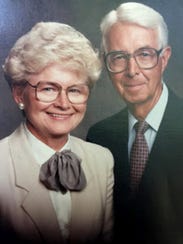
What a beautiful piece of writing by Bill Glauber of the Journal-Sentinel on what was a difficult subject: the death of 94-year-old Marshall Jacobs, who passed away watching the U.S. Open.

Jacobs was a lifelong golfer and golf fan who loved watching Golf Channel with his wife Lucille, who passed away last week. Marshall wasn't going to miss the U.S. Open's first playing in Wisconsin, circling it on his calendar back in 2010.

But he wasn't going to miss this tournament. He had made plans to see it back in 2010 when Erin Hills was awarded the championship, telling his son, "I hope I'm still alive when this thing is here."

Perched at the sixth green, father and son saw the game's great players go by during the second round.

"We spent three hours of bliss out there," Bill Jacobs said.

Even better, he got to see his favorite golfer, Steve Stricker, make a putt shortly before he passed. Sweet story.

Video(s): Fox Sports 2017 U.S. Open Features & #BrowniePoints

Fox Sports produced visually stimulating telecasts from Erin Hills, aided by several features and the real standout: Ken Brown's Brownie Points. As D.J. Piehowski noted on Twitter, Brown is doing so much with so little: one camera, a few toys, and a nice splash of creativity.

Before those links, a few random observations on Fox's year-three coverage, which really hit its visual stride this year. Last year's coverage of the DJ fiasco earned the network credibility and while the sound and tech touches were fun, there was a sense that they didn't quite help tell the story.

Yet even with a very difficult venue to cover due to its size, the combination of camera locations, gizmos and amazing player sound delivered on the network's original promise to tell a golf tournament story in a fresh and innovative way. The ending was a little rough with Joe Buck's reference to Brooks' former girlfriend and another awkward trophy ceremony, but that shouldn't taint what was such a strong week visually.

And on that topic, here's the list of links to features and Brownie Points. I'm embedding a few below, but with Twitter embeds not playing sometimes these days, the links should be more reliable:

U.S. Open Features

Ken Brown’s #BrowniePoints

The Arnold Palmer feature with Clint Eastwood narrating. 

Brownie on the par-3 16th where there really isn't that much profound to say about this hole, and yet he managed to milk all of the key details out in this entertaining piece:

And this instant classic on the fescue rough.


2017 U.S. Open: Round Four This And That

The on-site forecast calls for winds 15-25 mph out the west until noon, shifting to WNW at midday and letting up a bit around 4 pm CT.

Already we've seen that Erin Hills will play as a much different course, with greens noticeably faster and one hole location (13th) moved.

The flag on the 18th hole will pay tribute to Arnold Palmer, as shown in this Facebook live of the pin placement. There is also a change to the grandstand canvas featuring a Palmer tribute. All players and spectators are receiving a replica pin of his 1960 contestant badge. So cool!

I'll add the course setup notes of note when we receive them.

Golfweek's staff made picks. I went with Rickie, because I know you were dying to find out.

Day four links...

Your television full viewing guide is here.

USOpen.com has live featured group and hole coverage early in the day.

Tee times.

The leaderboard.

Golfweek's Live Blog

Diaz: "Everybody loses when players don't come to the interview room."

After an opening 65, Rickie Fowler was asked by USGA officials to visit the interview room for a sitdown with writers and various television outlets. Instead, he kept his comments confined to various TV interviews and the "flash" area.

But as Jaime Diaz of Golf World explains, this was a precedent-setting move in line with the recent tradition of players increasingly staying out of the press center and distancing themselves from the press. Because of the player in question--and one who is traditionally media friendly--Diaz views this new precedent as dangerous.

But Fowler was the leader, and his decision to break precedent matters. Whether they like it or not, the game’s best players are also its most influential thought leaders. What they say at tournaments, and especially majors, can both inspire and deepen understanding of a nuanced game. Forfeiting such a platform ultimately hurts golf.

What’s worrisome is that players will take note of Fowler’s decision and start to emulate it. Indeed, through he first two rounds of the championship at Erin Hills, more than 50 players were interviewed in the flash area, but only one—Brian Harman (one of four players who tied for the 36-hole lead)—came to the press center to be interviewed.

It’s understandable in the current climate—which now includes journalists regularly considered to be putting out “fake news”—that agents and managers who handle the players see an opportunity for lessening media obligations. Perhaps Fowler’s decision was in part a test to see if anyone would notice.