Video: Eye On Design, LACC's Little 17th

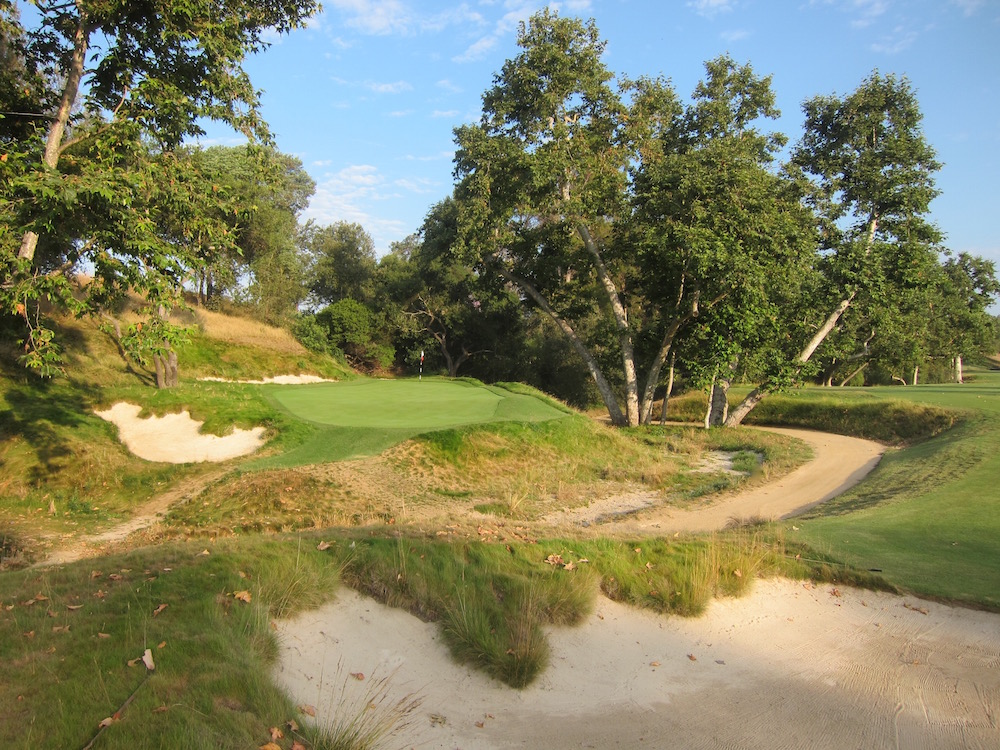
It won't be used in the Walker Cup matches but you'll see if sitting next to the big 17th hole.

We restored this little beauty of a greensite that caused George Thomas headaches after a course setup gone awry in the 1925 California State Open.

In this Eye On Design, I explain what the history of this hole is all about...

Roundup: Early Walker Cup Preview Stories

For Golfweek I considered the idea of LACC opening its doors after all these years and what to expect from the North Course. And

And yes, I dared to claim for this week's Golfweek digital edition that the North may be the second best match play venue on the planet after the Old Course.

John Strege of Golf World on LACC letting its guard down to host a major golf event.

John Mummert of the USGA's image gallery of the course is really nice viewing.

Justin Thomas on his fond memories of playing the Walker Cup.

USA Captain Spider Miller with thoughts on each of his players.

The Team USA official page and bios.

Team GB&I bios are here.

Rory McIlroy makes a pretty powerful statement about the importance of making Walker Cup.

Robert MacIntyre of Scotland is profiled by Martin Dempster for The Scotsman.

Dempster also profiles the first "Fifer" to make the GB&I squad since 1985, Connor Syme.

AmateurGolf.com's Walker Cup page of TV Times and other pertinent information.

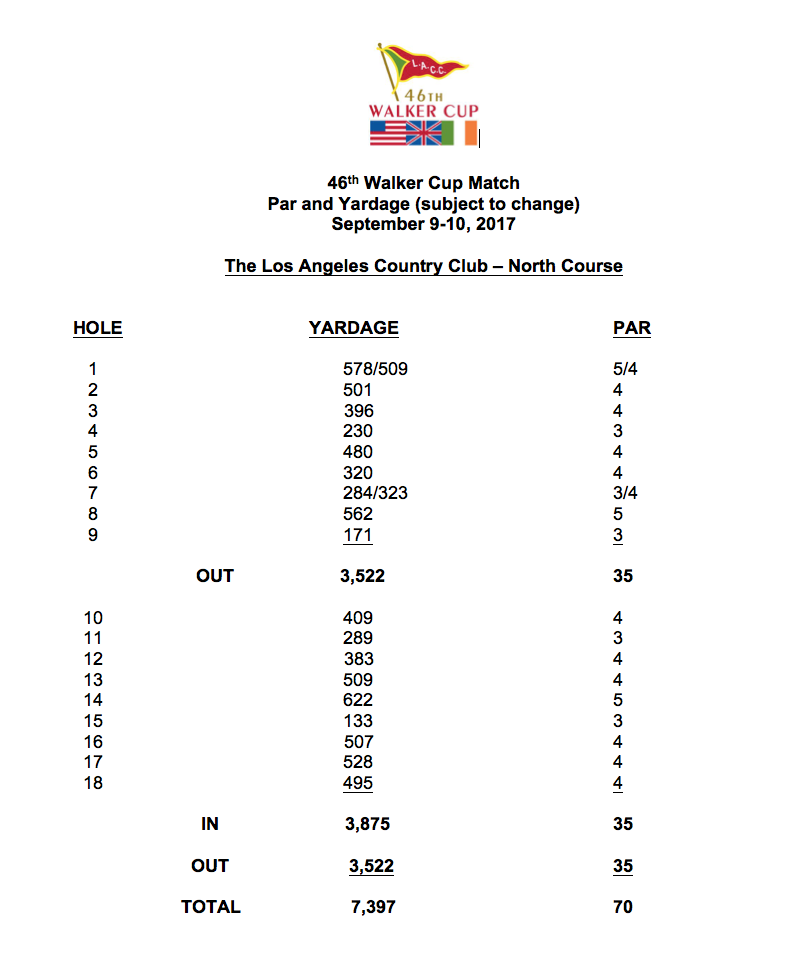
Here is the course yardage breakdown, though it'll almost be guaranteed not to play this long. The USGA's Jeff Hall has some exciting plans for taking advantage of what I believe to be the best match play golf course outside of St. Andrews. 

The first social post from of the teams, this one by Maverick McNealy of Will Zalatoris:


"But, what else can I say? I love LA." -Dr. Dre (📷: @13maverickm)

A post shared by Will Zalatoris (@willzalatoris) on Sep 4, 2017 at 12:10pm PDT


A SHOTLINKcast For Pro Golf?

While golf stats are certainly different than baseball numbers in predicting performance, they are getting more interesting and visually attractive.

With the PGA Tour and Microsoft chipping away at some of the hurdles, we are not far from having more presentable stats that have meaning and add to our enjoyment of a telecast. (Golf course scatter charts and numbers are already there and have begun to be incorporated at times.)

With this and a recent MLB "SABRcast" in mind, Martin Kaufmann of Golfweek makes some strong points on the need for golf to give such a broadcast a go.

The announcers didn’t dwell on balls and strikes, or even talk much about balls in play. The running discussion was more topical. They delved into the reasons behind Giants catcher Buster Posey’s declining pitch-framing skills and his offensive performance when catching vs. playing first base; factors in the Cubs’ lackluster play compared to last season; the difference of pinch-hitting against starters vs. relievers; and the Giants lack of power and the types of free-agent sluggers who might excel in their spacious park

World Long Drive Is (Already) Back: And Meet Troy Mullins

There are four big changes this year for the Volvik World Long Drive Championship: the women's final will be played Wednesday on the same night as the men, Tuesday features a mixed team event, drivers can only be 48 inches and the event is now in early September (better weather!). 

The men's round of 16 is now set after qualifying, with one big surprise in top-ranked Maurice Allen's failure to advance, writes Will Gray for GolfChannel.com.

OPEN DIVISION (MEN’S) ROUND OF 16 MATCHES:

(1) Ryan Reisbeck (Layton, Utah) vs. (16) Wes Patterson (St. Louis, Mo.)
(8) Kevin Shook (Bradenton, Fla.) vs. (9) Mitch Grassing (Ottawa, Ont., Canada)
(4) Tim Burke (Orlando, Fla.) vs. (13) Stephen Kois (Wheaton, Ill.)
(5) Trent Scruggs (Hickory, N.C.) vs. (12) Kyle Berkshire (Orlando, Fla.)
(2) Justin James (Ponte Vedra Beach, Fla.) vs. (15) Bobby Bradley (Wellington, Fla.)
(7) Paul Howell (Wilson, N.C.) vs. (10) Steve Monroe (Clearwater, Fla.)
(3) Will Hogue (Memphis, Tenn.) vs. (14) Josh Cassaday (Denver, Colo.)
(6) Joe Miller (London, England) vs. (11) Nick Kiefer (Chicago, Ill.)

Mark Wahlberg is excited...

Last week I had the privilege of chat at Wilshire Country Club with budding star Troy Mullins, winner recently in Denver, a favorite for the women's title and Los Angeles native who attended high school near Wilshire before attending Cornell. Troy is already one of the more fascinating young studies in golf, using off-the-(Roger Dunn)-shelf drivers, athleticism developed as a heptathlete and aspiring to play LPGA Tour golf.

Here is the chat and a short feature produced by Ben Elisha:

Here was Mullins recently in her final preparation as posted by instructor George Gankas, which involves getting uber-flexible for the shot at the belt.

@trojangoddess going deep💦💦💦💦

A post shared by George Gankas (@ggswingtips) on Aug 29, 2017 at 4:05pm PDT

Long Drive airs on Golf Channel Tuesday from 9-11 p.m. ET and 9-11:30 p.m. ET on Wednesday.

Video: Eye On Design, The Walker Cup Explained

The 2017 Walker Cup is here and Los Angeles is sensing the buzz! The motorcades have stifled traffic and the paparazzi have staked out the team hotel and...ok that's a stretch. But as we discussed on Morning Drive today, this is one we Angelenos have been anticipating for some time.

But while the teams enjoy some sightseeing golf, as Ryan Lavner noted for GolfChannel.com, this site is going to be all in on this event. So my apologies in advance for those still hurting from the lack of Solheim Cup coverage during U.S. Amateur week, but this is just the third Walker Cup to visit the west coast, the first in Southern California and Los Angeles Country Club's first national television appearance. (Clubhouse and pub sign on right depicted by Lee Wybranski.)

Full and only disclosure here for the week: I worked on the restoration of LACC's North Course since 2007 with Gil Hanse, Jim Wagner and many fine shapers, contractors, club officials and fine committees. The Walker Cup will be a celebration of all that went into restoring George Thomas and Billy Bell's 1927-28 redesign. More details on that later in the week, but if you must jump ahead, Ran Morrissett's 2014 review should tell you plenty about the architecture.

This latest Eye On Design is for those who aren't aware of what the Walker Cup is all about or if they should fork over the $75 to come out and watch. (Tickets here, and parking on the adjoining South Course is free! There is also an Uber dropoff at Comstock Avenue near the club driving range.)

In the video I explain the format and general superiority of this event over just about all others in golf based on the experiences had by all at the 2013 Walker Cup. You'll see many of my images from that event in the Eye On Design embedded below.

Video: The Golf Side Of Jake Olson's Amazing Life Story

If you didn't hear about Jake Olson snapping the ball for his USC Trojans Saturday, you'll want to check out Bill Plaschke's LA Times take on the blind athlete who lost his sight due to cancer.

ESPN's Kyle Bonagura also included this piece and some great post game interview embeds.

And if that's not enough inspiration, this piece from not long ago by Shelley Smith catching up with the young cancer patient she covered before learning she had cancer, is a definite must.

But Olson is also a golfer and this Travis Matthew ambassador piece tells you about that side of his courageous life...

Stacy Lewis Wins For Houston, KPMG Matches

What a story seeing Stacy Lewis pledge her winnings to the relief effort in her hometown following hurricane Harvey.

From Beth Ann Baldry's Golfweek story on the win and match by her sponsor:

The now 12-time winner played for a cause bigger than herself, pledging early in the week to donate all her winnings to Hurricane Harvey relief efforts. Lewis’ first-place check at the Cambia Portland Classic meant $195,000 would go toward helping people in her hometown rebuild their lives. Her sponsor, KPMG, surprised Lewis on Sunday by announcing that the company would match that number, bringing the total to $390,000. Lewis also collected shoes from fellow players to ship back to Houston.

Technophobic Media Is Getting Younger: Millennials Not Buying!

It's a wonderful thing, how these "technophobic" times have changed. The kids are increasingly on board!

As distances have spiked again and rumors of a bifurcation movement looming that might introduce a variable distance ball, our friends in Fairhaven have updated a talking points "stack" they've peddled for years with a summer 2017 update to their case against any kind of golf ball regulation.

(Note: in 50+ pages they never mention the millions spent to change golf courses or to pay for the issues arising from golf balls flying to places never before reached.)

But I can sit back, nurse a cold beverage and watch others do the heavy lifting on an issue that will keep coming up as long as folks keep telling us nothing's happening. Couple this with and increasingly sustainability-focused generation not buying the arguments for sitting still, and there is an air of inevitability to some sort of regulatory action.

Alex Myers at GolfDigest.com considered the driving distances of Champions Tour players this year compared to their PGA Tour averages at age 30 and of course, everyone has gotten longer as their waistlines have expanded, their backs tightened and their clubs have grown more powerful.

Kenny Perry ranks fourth on the PGA Tour Champions in 2017 at 295 yards per poke. In 1990, he had a driving-distance average of just 270.8 yards. That's not bad considering Tom Purtzer led the PGA Tour that season at 279.6 yards (for comparison, Rory McIlroy's 316.4 yards leads this season) but that equates to nearly a 9-percent increase in driving distance from the time Perry was 30 to his current average as a 57-year-old.

The increase is even bigger for Fred Couples, if we use his driving-distance average (a whopping 300.4 yards) from 2015, the last time he played enough rounds on the PGA Tour Champions to have official stats. In 1990, two years before Freddie won the Masters and ascended to No. 1 in the Official World Golf Ranking, he averaged a measly 272.6 yards on his tee shots. Of the players we looked at, Couples' 10.2-percent increase led the way. (It should be noted that the Callaway Big Bertha was launched in 1991, ushering in a new era where driver heads grew to the size of small microwaves, giving a boost to driving distance stats.)

But Alex, don't discount the two-a-day yoga sessions and bicep curls Fred has been doing following his 9 minute planks!

In the wake of last week's 341-yard clutch drive by Dustin Johnson, many revisited the question of distance and whether the sport is better when a top player can drive that far.  I support the long hitter right to his advantage but as we all know, the sport can't keep expanding venues to accommodate distance gains that are going to keep coming as we replace pre-Trackman, pre-watermelon-sized driver heads with those who have never known anything else but swinging hard.

Tron Carter, another young influencer from the only generation that matters, had some fun exchanges with Twitterers about distance. You can read those by clicking on the tweets at his profile or these two (here and here), which no doubt have earned ihs Twitter account top status on some sort of watch screen in Fairhaven.

Anything To Play Faster Files: Even Higher-Profile Backstopping

Here's the fun thing about this bizarro trend of men's professional golfers leaving their chip shots around the hole, all in the name of slow play: they are getting more brazen. Even better, this is going to help us bring back the stymie!

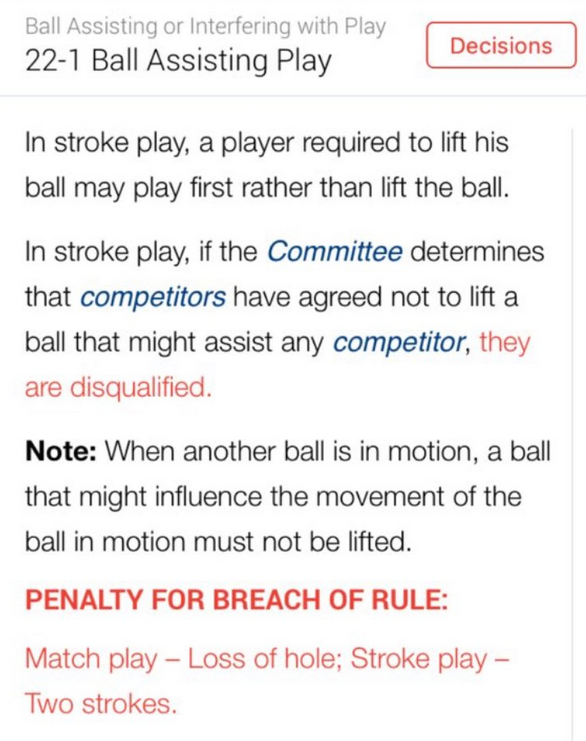
The backstopping/sideboarding practice of leaving your ball down--in the name of speeding up play of course--used to be something that only happened in lower profile situations. Increasingly though big name players in big name pairings have been so eager to speed up play, they are willing to not protect the field by leaving their ball in a place that might help their fellow PGA Tour brother competitor. Of course to do so knowingly results in disqualification under the Rules.

And for those who say it doesn't happen, may I refresh your memories here.

This was Saturday with the Spieth-DJ pairing at the 2017 Dell Technologies (link here if the embed doesn't work):

The practice, which only seems to be happening in men's pro golf, is also continuing in Europe. This was Saturday and an all timer given the proximity of the playing partners who just couldn't take that extra 7 seconds to mark their ball.

Here's the bad news: as this strange, buddy-buddy, backscratching practice picks up steam, someone will stand fifteen feet from his ball, watch his ball get hit by another player who then makes par instead of bogey. That player will ends up winning a tournament by a shot or costing someone his card and will be publicly shamed. His reputation might even be ruined. And all for just doing what everyone does every day on the tour because that's how they play the game out there.

And play will still be slow. This practice might be cutting 20-30 seconds a round.

Yet guys will still mark 18 inchers to not step in a through line, but they'll leave their ball down 18 inches from the hole to help out a buddy who might help them later in the round.

I know shining a light on suspect behavior is upsetting for many in a sport where the players are generally the most honest and upstanding in all of sports. But as a clubby sport by nature that values protecting those who have joined the gang, suggests image of those who stick together over good, old-fashioned competition. As a sport, if fans sense the players are just playing week to week hoping for their shot and helping their buddies out at other times, pro golf will ultimately lose a certain edge and purity if a practice like this continues.

Oh, and there is also the "what other rules are they bending" question that is so dangerous to a sport's reputation.

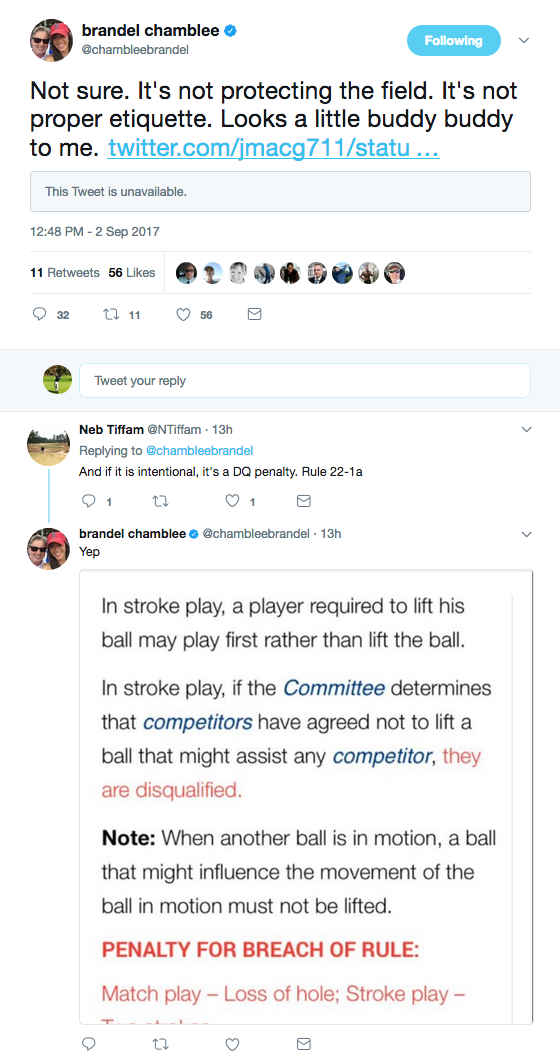
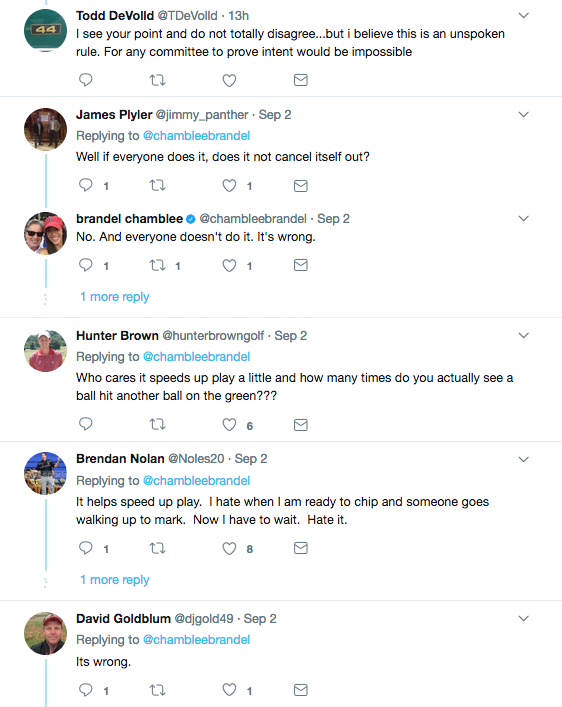
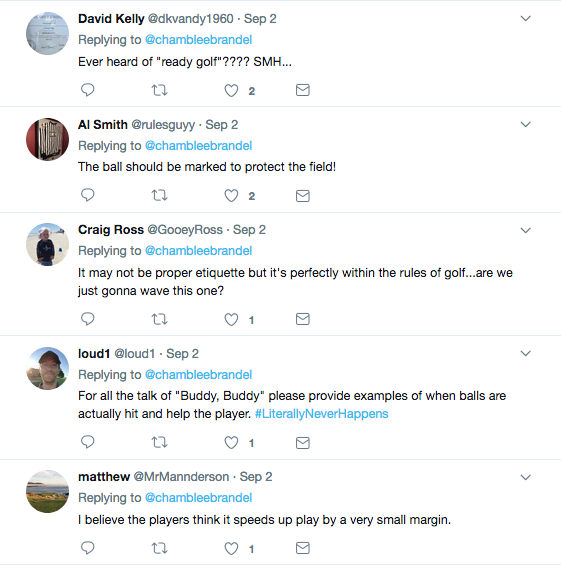
Brandel Chamblee engaged with readers on the topic Saturday after the above incident. The original questioner deleted his question, but it's a nice mix of those who see this for what it is (some bizarre tacit agreement that has festered) and those who believe the guys just are trying to speed things up.

PGA Tour Makes The Right Call To Stick With The Current Network TV Deal Through 2021

We all want to see golf on television adapt to the times and improve. While Friday’s network opt-out deadline came and went as an opportunity for the PGA Tour to shake things up, they chose not to do so.

Very shrewd move, Commissioner Jay Monahan.

For fans, the only intrigue in a possible opt-out would have centered around Monahan’s desire to move the look and feel of golf into the future. But the cost of risking partnerships and jumping in with new partners was too great, with no clear sign of a positive outcome for such a move at a time ratings are down.

Besides, significant progress has come with various tracer technologies, HD, employing Trackman, super slow motion replays, Playing Through, live look-ins on breaking events and alternate viewing options like Amen Corner Live.

Despite the views of some at PGA Tour headquarters reportedly pushing for change, Monahan made the right call to put off any shake-up for a few years while the PGA Tour revamps its schedule. (Golf Channel’s current deal to televise also expires in 2021, with no opt-out). This also allows them to get a better sense of how the cable vs. streaming wars play out and strike a better deal going forward.

Consider just some of the reasons Monahan made the right call (The PGA Tour confirmed the contract is going forward and may be addressed at the Tour Championship):

—Schedule madness. The upcoming schedule revamp has way too many open-ended questions and uncertainties to have renegotiated deal terms or welcomed-in other networks. It’s going to be tricky enough to work out the changes with current network partners, sponsors and players, why add more headache?

—Our Future Is Not Quite Here Yet. Many believe streaming is the future and cord cutting will collapse the cable model, but has any major sports property said goodbye to guaranteed network or cable money to take their chances with disruptive mediums? Golf should be about the last sport to do so because…

—The Audience Is Not Ready. While many younger fans are prepared to watch golf via streaming, a majority of golf’s demographic still watches via cable. That demographic hurdle is not changing fast enough to justify taking a tour event away from a network and putting it on Amazon or YouTube or Twitter.  Unless the tour is in the business of setting precedent over making money for its players.

—Sponsors Are Not Ready. You might get a more engaged audience of 180,000 watching the final round of the Dell Technologies on Apple and Amazon TV’s. You might even get one that directly taps that sponsor’s audience, but nearly all tournaments would still rather take their chances reaching a larger number of eyeballs. The blue-chip brands the PGA Tour loves (and who like golf) want to see their logos on big screens in bars and golf courses. They still want to invest in something reaching more than a very targeted audience. The current deal accomplishes this for the people who fund the product.

—Opportunity To Change The Tone. I’ve heard no shortage of players and PGA Tour brass suggest angrily they could be doing way better. Now, this ignores that things are pretty incredible right now, and definitely ignores the post-Tiger ratings decline. But this attitude also mystifies countless network types and marketing world figures who cannot fathom how the PGA Tour believes they hold the stronger hand in the post-sports rights fee bubble. With a good deal for all sides in place through 2021, Monahan can use his personality to repair relationships and create a dialogue amongst his media partners that satisfies their needs and the desires of the Tour’s fanbase.

—Alignment Possibilities. There is a lingering bitterness over the sense that the PGA Tour left money on the table by locking into Golf Channel through 2021—a deal many saw as just as big of a risk for Golf Channel at the time. This rage clouds the thinking of many who disregard how simple it is for fans, bartenders and anyone with a cable package to find PGA Tour golf on a Thursday, Friday or weekend morning. But as the media world changes, not opting out allows the PGA Tour to gain a few more years of perspective and data. In two years they can better align possible weekday partners with weekend partners in a new deal or spend hundreds of millions starting their own channel. Or, pursue different terms with Golf Channel that can serve as an anger-management soother for Ponte Vedra’s disillusioned Vice Presidential core. Win-win!


Status Of TPC Boston Stop Still In Limbo As Opt-Out Day Arrives

It's opt-out day!

That's right, the September 1 deadline has arrived and we'll find out if the PGA Tour is going to continue with its current CBS/NBC network deal until 2021 or exercise an option to get out of the contract to renegotiate different terms.

In the meantime, Bill Doyle explains the issues facing the PGA Tour's Boston stop, currently sponsored by Dell Technologies through 2018, and it sounds like it may be transitioning to a spot in someone's tournament rota. Who what someone is, we're not sure.

Jordan Spieth said he’s been involved in discussions about revamping the PGA Tour schedule.

“There’s still a chance,” he said Thursday after playing in the pro-am at TPC Boston, “that we would still move up here every other year or something. So there’s still a lot of options available. There’s not much set in stone right now.”

Spieth went on to say that the PGA Tour might even come to TPC Boston only every third year.

There were also these two interesting quotes...

“I don’t blame them for watching football,” Dustin Johnson said, “because I probably would be too.”

“If we can make it,” Rickie Fowler said, “to where we’re ‘the’ thing to watch on TV at the end of our season, I think that’s the main goal.”

Week After Anti-Bombing Gripes, TPC's Anti-Bombing Change Causes Gripes

Last week some players were mad that Glen Oaks' 18th favored Dustin Johnson's ability to hit a super-human length drive under pressure and be rewarded. This week at TPC Boston, the newly updated 12th is causing consternation because it's forcing players to consider possible routes interrupted by bunkering, some a play down the 13th hole possible according to AP's Doug Ferguson who predicts many players will go all Lon Hinkle on us.

Brian Wacker at GolfDigest.com has some of the player reaction, including Paul Casey calling the hole awful. That's an eye-opener given his general astuteness, appreciation of centerline hazards and understanding that you can't judge a hole by one practice round.

However, architect Gil Hanse, who oversaw the changes along with Jim Wagner, is preaching patience and is not shy in suggesting that hazards were placed to prevent the bombs away approach found to be so upsetting last week.

Rex Hoggard at GolfChannel.com allows Hanse to explain the thinking behind the hole and need to consider it after more than just one impression.

“The expectation was it would take several rounds for these guys to learn how to play it and how they wanted to tackle it,” he said. “Unfortunately, some of the early reaction came after one practice round.

“The conversation we’ve had with three or four players is, 'Listen, just give it three or four rounds. Try to figure it out.' If we build a golf hole that the players can figure out after one round, then we probably haven’t done our job challenging them.”

And on preventing the new 12th from giving long hitters a distinct advantage:

“This golf course, rightfully or wrongly, has always been characterized as a bomber’s golf course,” said Hanse, who lengthened the 12th by 50 yards. “So when you’re making alterations, you have that in the back of your mind, and you don’t want to be seen increasing that advantage. We felt like the positioning of these hazards gives the average guy room to hit the ball. But as you want to push around 330, it gets more narrow.”

Hunter Mahan Starts Effort To Kickstart Career With 68

On the list of questions I get from readers, Hunter Mahan has recently pushed aside Nick Watney and Anthony Kim atop the list of "where has he gone?"

Thankfully Tim Rosaforte at Golf World answers what has happened to Mahan's game, what he's doing to repair his confidence and what the prospects are for the one-time 4th ranked player in the world and 2014 Ryder Cupper.

Most prominently, Mahan's switched to instructor Chris O'Connell.

Mahan and O’Connell were connected through Tom Dundon, a mutual friend and developer whose golf interests include Trinity Forest in Dallas and Topgolf. O’Connell had been following Mahan’s career since he finished second in the 2002 U.S. Amateur and won the Haskins and Hogan Awards before wrapping up his college career at Oklahoma State in 2003. Seeing Mahan struggle, Dundon was persistent that O’Connell was the correct fit.

“I don’t expect Hunter and Kuch to look alike, but they both do specific things critical in the area of delivering the club into the ball,” O’Connell said. “I told [Mahan] at first, 'I don’t want to teach you anything you didn’t know or do. I simply want to put back what you were doing when you were highly regarded as one of best hitters out there.' I would not want to do anything else but just restore him.”

The restoration process involves rebuilding confidence. Mahan missed seven straight cuts in the early stages of the transition, but he's coming off a T-16 at the Wyndham Championship that included back-to-back 65s. He jumped from 791st to 731st in the world at the Wyndham, and goes into the Nationwide Children’s Hospital Championship ranked 748th.

Mahan opened with a 68 in round one of the Nationwide Children's Hospital Classic.

Knapp Wins Senior Am On First Try...In His 43rd USGA Event

Dave Shedloski files a superb Golf World game story from the U.S. Senior Amateur at Minikahda Club where Sean Knapp won the U.S. Senior Amateur in his first year of eligibility.

For a player who has had his share of moments in amateur golf, it's a great story. But winning after 43 USGA events, for someone who started the game at age 19, is something to behold in the era of short amateur careers.

When you add the emotions of winning one with Knapp's late father very much on his mind, it's an incredible story you'll want to take in.

An accomplished player in Western Pennsylvania, Knapp has been a fixture in USGA championships, twice advancing as far as the semifinals of the U.S. Mid-Amateur. In the 1995 U.S. Amateur at Newport Country Club, he defeated Notah Begay in a second-round match only to be stopped in the Round of 16 by eventual winner Tiger Woods. In 1998, he got to the quarterfinals at Oak Hill C.C.

But it had been more than three years since he had qualified for a USGA championship, and that one, the U.S. Amateur at Atlanta Athletic Club, ended before it began when Knapp received a call from his sister. Their father, Roger, stricken with cancer, had taken a turn for the worse. Knapp marched to his car and drove 11 hours straight home to Oakmont. On the way he phoned his dad. Said Knapp, “He could barely speak, but I told him this selfishly, ‘Dad, stay alive. We’re coming home for you.’ ”

When he arrived, Sean put his hand on his father’s chest and told his father, “I’m so proud of you.” His dad replied, “Sean, just in time.”