Mike Tirico's Chat With Mike Davis: Pebble Has Never Looked This Good

Mike Tirico’s Vantage Point chat which covered a range of topics, with a slight undertone of awkwardness given recent years and player griping, nonetheless it’s worth a few minutes if you’re interested in hearing about this week or Davis’ view on the USGA’s role going forward as a steward of the game. He notes that the organization puts more money into the game than any other.

Bodenhamer On Setup Philosophy, Calling In Other Voices To Help USGA Get It's Groove Back

Screen Shot 2019-06-12 at 9.57.46 AM.png

As we await the USGA’s annual news conference here at Pebble Beach, Brendan Porath’s lengthy Q&A with new course setup supervisor John Bodenhamer is a pretty revealing look at the lengths he is taking to ensure they hear all points of view.

Check it out, but this was interesting as it relates to Mike Davis, who is still involved but no longer in charge. No shortage of opinions have been sought!

We try to follow what the architect intended. I think it’s really fun to be around that with Mike. I’ve learned a lot.

As far as different, I don’t know — I think Pebble Beach will always be what Pebble Beach has been for the U.S. Open. I mean, why would we do anything different when we’ve had Nicklaus, Watson, Kite, Woods, and McDowell win, and in dramatic fashion every time. Why would we change the recipe? We’re not going to. Now look, there are a few new putting greens here, some new teeing areas, you know it’s little bit different golf course than it was in 2010 and the weather is going to be different probably and all of that. There are some differences.

The one thing that I would say that I have tried to infuse, and Mike and our team are fully supportive, is to be a little more informed with how we’re going into this U.S. Open. What I mean by that is we have Jason Gore on our staff [Gore was announced as the USGA’s first Player Relations Director in March]. A player that has won 11 times at the professional level, seven times on Tour. And he’s informing our process from a setup standpoint.

Nick Price, we’re involving Nick in what we’re doing here at Pebble Beach. Nick will be here this week. We also brought in a guy that I’ve known for a long time — a guy by the name of Casey Boyns. He’s a 37-year caddie here at Pebble Beach and a two-time California amateur champion and probably won 20 other major amateur events around California and the country. I’ve known him a long time, played golf with him years ago. He’s won two California amateurs at Pebble Beach, when he won in the 80s and 90s. But he caddies 250 to 300 times a year here and he’s done it for 37 years. There is nobody who knows this golf course better than him. We brought him out and went around the golf course with him. We showed him our plan. He knows how these greens behave in certain types of weather. He knows what the four new putting greens are behaving like. He knows what the wind will do certain times of the year. It’s fascinating and we’ve brought him in and that’s a little bit new for us.

Tiger Says Putting From Below The Hole A Priority (On Poa)

I will side with Tiger Woods since he knows what he’s doing and certainly would never want to putt from above the hole at Pebble Beach, but it’s still interesting to consider the best strategy for playing a U.S. Open course. Yesterday in his 2019 US Open press conference, Woods explained his priority in approaching the Pebble Beach poa annua greens:

The trick to putting on poa is to make sure they're always below the hole. If you're putting downhill, it's like a Plinko effect, you're going to go every which way. The key is to be below the hole where you can take low lines and try and take the bumpiness out of play.

Strokes Gained Guru Mark Broadie has been studying the effort to get a ball under the hole now that ShotLink numbers are tracking putts from different parts of greens and is making the case that it all evens out on the greens. Granted, he wasn’t talking about specific grass types, but it’s still fascinating food for thought given modern green speeds and players wanting to be below the hole, even if it does not necessarily apply to Pebble Beach this week.

Simple: It’s very hard, over the course of a full season, for a player to leave himself a lot more easier putts than difficult ones, and vice-versa. Over the course of dozens and dozens of rounds, everything tends to even out. So planning to give yourself more uphill putts than downhill ones isn’t a strategy worth pursuing. No evidence exists to show that players can systematically leave themselves with easier types of eight-footers.

Now Brooks Koepka Feels Slighted By A FOX Promo Omission...

Screen Shot 2019-06-11 at 4.59.13 PM.png

The Brooks Koepka-needs-motivation parade has moved to Pebble Beach where the two-time defending champion was understandably annoyed by a Fox omission of his likeness in a U.S. Open promo. Still, calling for a firing seems a bit much.

From Steve DiMeglio’s Golfweek report after Koepka’s pre-tournament press conference:

“There’s been a couple of times where it’s just mind boggling. It’s like, really? Like, how do you forget that?” Koepka said Tuesday at Pebble Beach. “Just kind of shocked. They’ve had over a year to kind of put it out. So I don’t know. Somebody probably got fired over it or should.”

The promo-make joins a graphics coordinator and Brandel Chamblee on the list of snubbers who also deserve credit for helping fuel Koepka’s four-major run.

Crews Will Be Standing By To Put Out Pebble Beach Hotspots

Screen Shot 2019-06-11 at 8.45.59 AM.png

Nice note here from Rex Hoggard at GolfChannel.com on the USGA advising players of the right to hit greens with water midday to prevent, well, we all know…

One of the concerns following the last U.S. Open at Pebble Beach, in 2010, was how the poa annua greens became particularly difficult in dry conditions, much like those forecast for this week. Perhaps in reaction to that officials have told players that they will syringe greens between the morning and afternoon waves on Thursday and Friday if needed.

First Impressions Of Pebble Beach's 2019 U.S. Open Setup

Latest on-site weather forecast from Thorguard…

Latest on-site weather forecast from Thorguard…

I got out for a bit to throw golf balls around, check out the rough and assess it for Golfweek.

The course is in a great spot heading to the event and more than able to handle the surprising heat we’ve experienced Sunday and Monday.

Last year’s U.S. Amateur winner, Viktor Hovland, visited the media center and compared the setup to last summer’s event he won over Devon Bling.

VIKTOR HOVLAND: Yeah, definitely generally the rough is a lot thicker than it was last year, and a lot of the fairways are narrower. So, for example, on 4, the fairway is right of that bunker; that used to be in the middle of the fairway. And, for example, on 11, that one is basically cut in half. And there's one other one. For example, 8 is moved all the way over on the right side, where you used to have the world to the left.

But as of right now, the greens are pretty soft and on the slower side. At the Am they were fairly firm and fast. But I'm assuming they're going to become that way later in the week. So not too worried about that.

Q. More along those lines, how about things like the rough, and also can you take anything from that experience and bring it into this, or does this feel like a completely different world?

VIKTOR HOVLAND: I mean, a lot of things are different. Obviously the atmosphere and the tournament is different. But it's still the same course and you still have somewhat of the same lines off of the tees. The greens still do the same way, they still break the same ways. And I think just a couple of things here and there. Oh, yeah, I missed it in the left bunker, but that wasn't too bad in, for example, that spot that you kind of learn.

Golf.com’s Pat Ralph talked to the USGA’s John Bodenhamer about the setup he’s overseeing this year. This sums up the changes since 2010:

Both 14 and 17 were really restored to more of what the architect originally intended for it to do. So those four greens 9, 13, 14 and 17, are different and we think that the restoration of those is a great improvement. A new teeing area that was added a few years ago on number nine adds about 21 yards for that par 4 when played from the very back. The only other thing, really, that’s different is that a little bit of the fairway on number 11 has been rerouted from the right-back to the left, where it originally was. And at 14, we had a runoff left of the green that’s no longer there which is all rough again. So it’s really going back to what the U.S. Open has always been at Pebble Beach.


Pebble Beach Flyovers: Seventeenth And Eighteenth Holes

By 2010 the 17th green had devolved to the point players were intentionally placing their tee shot in the bunker, then taking the chances with an up-and-down. As I recall—please tell me if you think otherwise—the hole was cut left on this hourglass green all four days.

Here was a then and now view of 17 (1929 vs. 2010) that I posted from the U.S. Open.

Since then the green was remodeled and is significantly more playable and interesting than last time we saw U.S. Open conditions here. It’s always one of the most difficult holes to gauge the wind’s effect in U.S. Open conditions due to the grandstand by the green and more protected tee area.

I am not sure what to expect of the famous closing hole this time around since players were regularly reaching the hole in August’s U.S. Amateur. The fairway has been narrowed significantly and forces tee shots to hug the cliffs, with the fairway bunkers now protected by rough.

The layup isn’t much to worry about without the overhanging tree of yesteryear, but the 70-foot tall replacement can be a killer if a player goes for the green and leaves a shot out to the right. Still, expect players to try and get as close to the green as possible if they hit a good tee shot.

90 Years Later: The 1929 U.S. Amateur As One Of Golf's Seminal Events

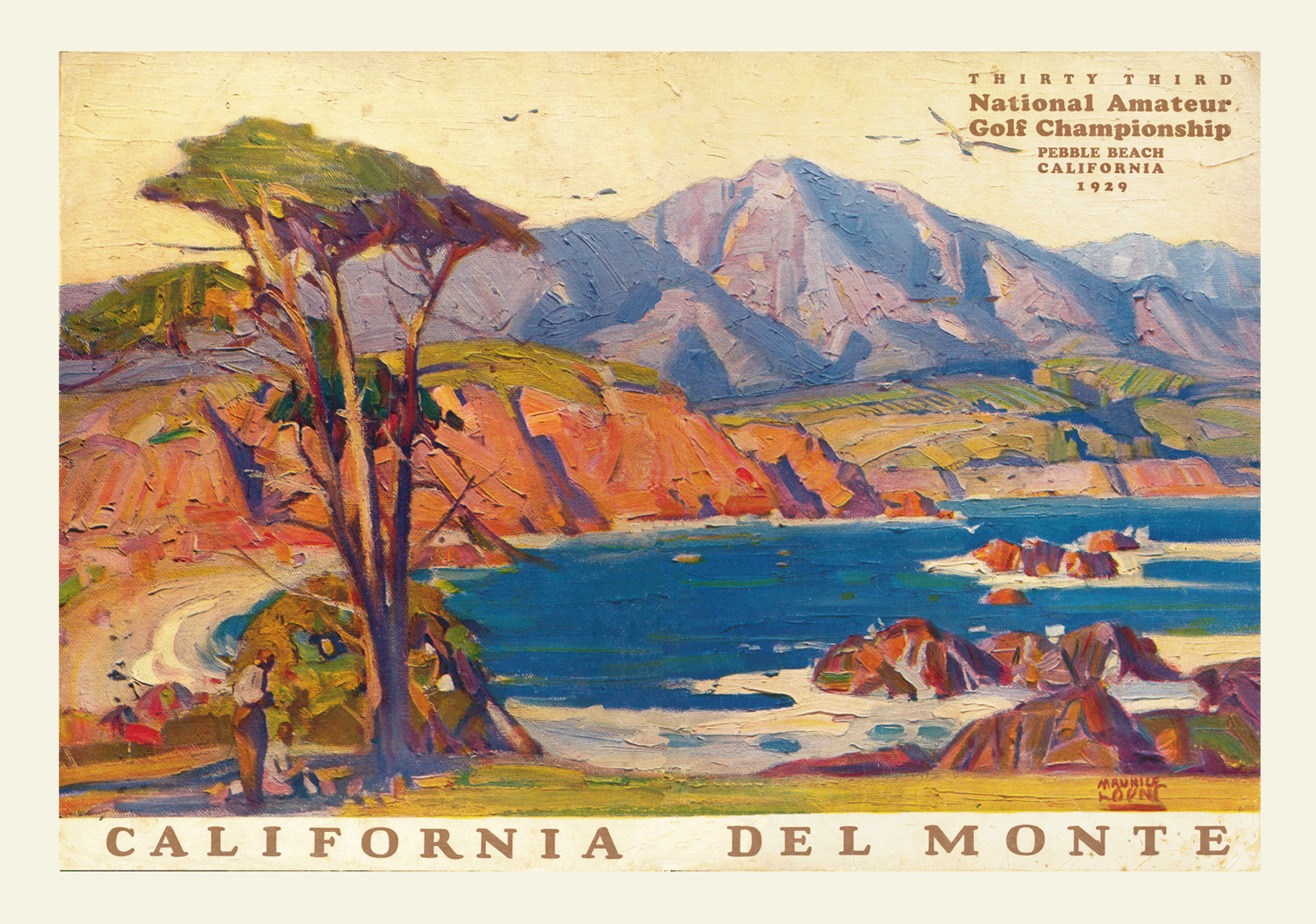
1929 US Amateur Program, painting by Maurice Logan, digital restoration by Tommy Naccarato

1929 US Amateur Program, painting by Maurice Logan, digital restoration by Tommy Naccarato

If there was one event I could go back and experience, I now believe it’s the 1929 U.S. Amateur. Sure, ‘13 at The Country Club and the 1930 British Amateur at St. Andrews come to mind, as does 1960 at Cherry Hills. But after going back and revisiting everything that went on in advance of the 1929 U.S. Amateur at Pebble Beach and what that event meant for west coast golf, U.S. Opens at Pebble Beach and even the Masters, I try to make the case for ‘29 in this Golfweek story.

I mention this because this year marks the 90th anniversary and as the U.S. Open arrives at Pebble Beach, celebrating its centennial, this amateur was the event putting the course and region on the map. I also bring it up since the first amateur at Pebble Beach was always a footnote, lazily written off as the amateur Jones lost during an incredible 1-1-2-1-1-Rnd32-1 stretch.

Some of my favorite golf photos are in this USGA gallery of the 1929 event.

Pebble Beach Flyovers: Fifteenth and Sixteenth Holes

With the awkwardness of an elevated tee aiming you right, prevailing wind in your face or quartering, and out-of-bounds down the right, even today’s launchers are discouraged from attempting to drive over the fairway pot bunker 290 away.

Besides, just hitting the fairway still leaves a wedge or sand wedge approach and a great birdie opportunity, so why bother?

The line off the tee here is crucial. A tee shot played too far left can lengthen the approach yardage significantly, especially since this is likely another iron or hybrid off the tee. And with the sandy area in front (once a more menacing barranca) tee shots in the left rough will be faced with a decision on how to approach the green.

Definitely one of the most difficult putting surfaces at Pebble Beach to gauge how an approach reacts and in reading putts.

Getting In The Mood: 1982 U.S. Open Film, My US Open With Watson

Screen Shot 2019-06-08 at 11.03.34 AM.png

The cheese factor is high, with a strong late 70s influence in hair, music and kitsch factor, which makes this 1982 U.S. Open film so much fun. It has a happy ending too. And how about PSA for the member’s program!

And here’s a great fast-forward to the present day with Watson talking about ‘82 with highlights.

Pebble Beach Flyovers: Thirteenth And Fourteenth Holes

I’ve always had something for 13 given it’s simple, but timeless strategy: hug the huge left bunker, get a great view and stance for approach the steeply-pitched Alister MacKenzie green from 1926.

Bail out right and the view stinks, the angle isn’t great and the stances vary. The bunkers down the right were suggested by the USGA’s Tom Meeks and should be filled in at the first opportunity. Like the third hole, the player should be lured to bail out, not deterred by sand.

The green has been remodeled since the last U.S. Open and certain functions much better. It still gives players fits with its steep pitch.

At 380 yards into the wind back in 1929, it was also seen as a long iron approach hole.

The 13th will feature a new tee this time around. For what it’s worth, players in last summer’s U.S. Amateur were not shy about bailing out way left.

At 580 yards the 14th can play seemingly a hundred yards longer to into the wind and uphill. It’s 330 to carry the bunkers and hard to do visually from the tee. The lurking OB right, with the wind in from the left, doesn’t help, either.

This green has been remodeled since the last U.S. Open and should function better, though without an attempt to restore the old lost front right pin, will be a bit one-dimensional again. The removal of a short grass chipping area left of the green this time around should encourage a few players to attack the green in two after a long drive.