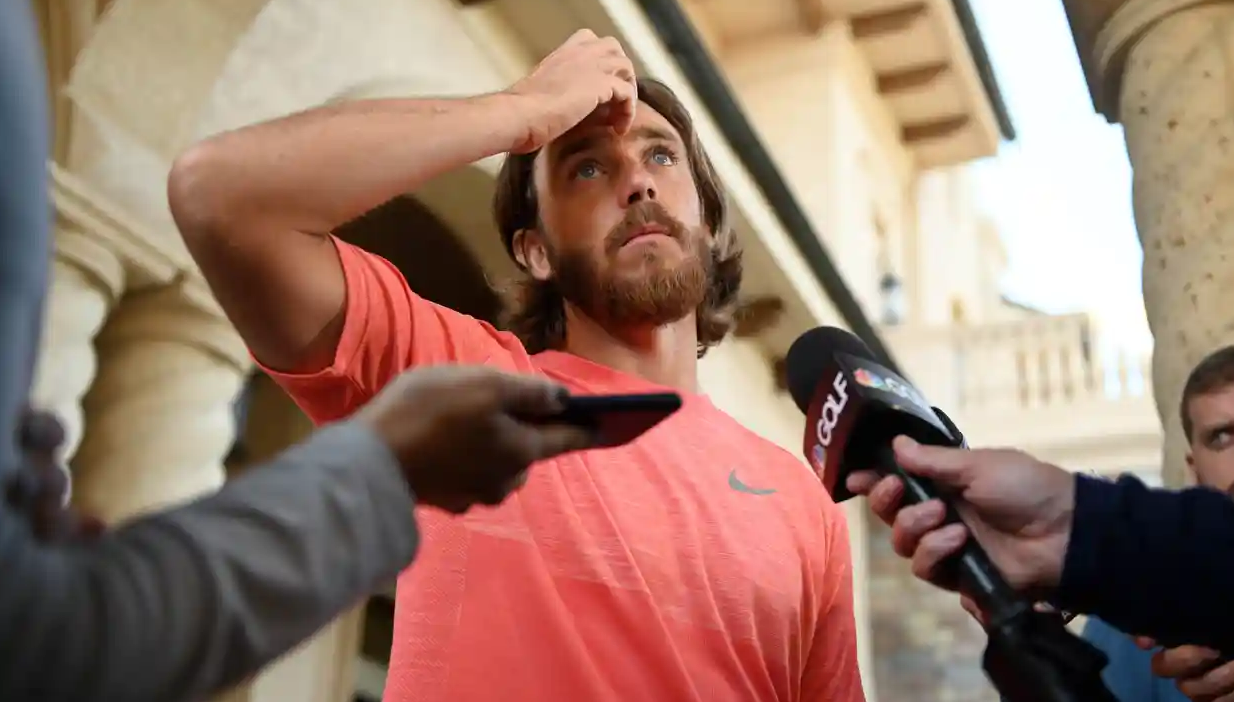
Fleetwood On Several Topics, Including The Pain Of Last Year's Open Championship

Screen Shot 2020-05-03 at 8.15.17 PM.png

The Guardian’s Ewan Murray covers a wide array of topics with Tommy Fleetwood, including how the unexpected layoff has been a positive, the 2018 Ryder Cup and of particular note his heartbreak over finishing second at the 2019 Open Championship.

Even though Shane Lowry won convincingly at Royal Portrush, Fleetwood’s still kicking himself but with refreshing perspective, as well.

Fleetwood articulates his level of despair – finishing second in the Open is hardly disastrous – perfectly. “When I was seven, I wanted to win the Open. I left the course that Saturday night, driving back with my family … the dream you’ve had for 20-odd years is very close. It went when I double-bogeyed 15 on Sunday, it was still there until then.

“That might be the closest I ever get, but I can say: ‘You know what, I had a dream when I was a kid and I played in the Sunday of an Open in the last group with a chance of achieving it.’ But I’m not living my life to finish second. I don’t live in a bubble where I weep about being second in the Open but second isn’t what I’m striving for. I don’t think I’ve reached my potential yet.”

Morning Read: Beginning To Ponder The Golf Experience Beyond A Time Of Pandemic

Screen Shot 2020-05-03 at 7.47.32 PM.png

The COVID-19 pandemic and ensuing tragedy—nearing 70,000 Americans dead—with accelerate emerging trends or radically alter ways of life we’ve come to know. MorningRead.com deserves plaudits for being one of the only golf publications to look past Brooks Koepka’s birthday or Rory v. Billy on Peloton to ponder the fate of of golf’s substantial industry.

Besides contributions from Dan O’Neill and Tom Coyne, an excellent three part-series has been filed by Brad Klein on various elements of the “business: and “experience” that will change.

Read Part 1 here and Part 2 here, and note this from Part 3 about the likely changes in turf management influenced by forces like staff or budget reductions, among other reasons.

From the modern makeover piece posted as part 3:

For course management and setup:
* Delayed starting times as reduced crews attend to necessary daily setup.

Warning, on the golf values reset I plan to make a case for this at a later date. But go on Klein:

* Varied conditions of presentation, with less emphasis upon flawless, TV-style lush-green setups and more tolerance for less maintenance of roughs, native areas and areas around tees. This ecologically sustainable approach will entail less water, fewer chemicals, less-frequent applications and reliance more upon scientific principles of agronomic management such as ”degree growing days” and moisture-level monitoring.

* In an effort to reduce turf stress and heavy reliance upon chemical inputs, courses will adopt marginally raised mowing heights of fairways (say, from 0.40-inch to 0.55-inch) to reduce mowing demands and make the playing experience more fun and enjoyable for mid-to-high-handicappers and newcomers. This trend will vary from facility to facility, depending upon client and member expectations. These setup conditions also can vary depending upon the occasion.

* Superintendents will be relying on smaller, more efficient crews, which means more interaction among golfers and workers. These reduced crews will devote more of their workday, especially at the start, to sanitizing equipment, keeping safe distance in the workplace and attending to safety conditions among golfers.

While so many questions still remain, Klein still dares to consider the food and beverage side of golf operations where the change figures to be more extreme and surprising.

For club operations:
* Reconfigured food-and-beverage facilities, with greater spacing among serving tables, if necessary, and any unused banquet halls converted to regular dining.

* More emphasis upon takeout of casual meals, which has proved to be popular during the recent social-distancing measures. As we rebound to a semblance of normalcy, the practice might well become habit-forming for consumers; it certainly is more efficient for clubs to provide – less labor, less waste of food and easier to prepare and serve. This will require additional supplies of disposable serving supplies, such as bags, plastic plates and Styrofoam containers, and less emphasis upon conventional flatware and glassware.

Anyway, lots to ponder and worth reading if you are in the industry. The facilities that get out in front of innovation and adopt changes either inspired by trends pre-virus or the new world order, should be able to take advantage of the newfound appreciation for golf.

Golf Digest Surveys PGA Tour Players On What Is Needed For A Return

Golf Digest’s reporters surveyed 35 PGA Tour players and just over half said they are only will compete “if there is a comprehensive testing plan in place at every event”. The next largest subset does not need testing but supports safety measures at events.

The options:

A) I don’t need anything to be different than before the virus. I’m ready to play.
B) I am willing to compete under whatever safety measures the PGA Tour chooses to implement, but don’t think we need comprehensive testing at tournaments.
C) I am only willing to compete if there is a comprehensive testing plan in place at every event.
D) I am not willing to compete until a vaccine or major medical development is in place.

And this was noteworthy:

Players, who were told they could answer anonymously, were also asked to elaborate further regarding their thinking. Some chose to go on the record while others asked for anonymity, but their responses help frame the issues many within golf are weighing as they contemplate a return to competition.

“I do trust [the Tour’s] decision-making process, but I’m not sure that the decision to start playing or not start playing has much to do with trusting their decisions,” said Stewart Cink. “To me this feels like a very personal decision about when the comfort level is enough to get back out there traveling. And also there’s still the very significant factor of social accountability and whether it's right to get back into a routine where everyone is traveling, etc.”

Increasingly, it seems travel worries and optics of returning are going to be as important as whatever testing protocols the PGA Tour develops.

Incidentally, Cink’s caddy, Kip Henley, called out Policy Board member Charley Hoffman this week on Twitter as another “rich guy sitting at home” in not considering the economic need to return to tournament play.

The Shack Show Episode 8 With Guest Rick Reilly

Screen Shot 2020-05-01 at 8.23.05 PM.png

Rick Reilly doesn’t produce a weekly column any longer but his latest guest contribution to the Washington Post reminded me that the greats never lose their ability to read a green. “The first things I’ll do when this is over” produced some comforting laughs during what is an otherwise not the easiest times to crack wise.

So I hope you enjoy this chat with Reilly from his southern California home where he’s doing some reading, some longing to get back out playing, and Tweeting away about Donald Trump. Reilly’s lastest book, Commander in Cheat, is now in paperback and we discuss why he tackled a book about the on-course antics of the 45th president. A dollar of every paperback copy is going to a good cause, discussed in the show.

Though as discussed during the show, the staggering funds raised for Nothing But Nets, all after he decided to turn on a hotel TV and get a column out of it, alone should make Reilly Noble Prize worthy. ($70 million!)

Before recording, I brushed up on some more recent Reilly columns from Tiger Meet My Sister…And Probably Other Things I Shouldn’t Have Said. I found a lot to love.

It’s been a while, but I was always a huge Missing Links fan, and as the podcast discussion revealed, so have been some of the bigger names in Hollywood.

While I embedded Amazon links above, I’m encouraging use of Bookshop.org where all of Rick’s in-print books are available, too. And to the benefit of independent booksellers (now up to $1.1. million raised).

As for other writers mentioned—Murray, Wodehouse, Runyon, Twain, Wilde—I’ll let you find those.

Rick’s favorite pasta-tossed-in-a-cheese-wheel spot in Florence.

All but one food spot in this Instagram post I did is courtesy of his outstanding suggestions.

Here’s the show on iHeart’s page, or the Apple option, or wherever you get your podcasts. Your subscriptions are most appreciated.

DeVries: A Golf Architect's Perspective On Post-Pandemic Effects

Screen Shot 2020-04-30 at 7.38.32 PM.png

Golf architect Mike DeVries considers the long-term effects of COVID-19 on golf in the United States and while I found it calming because I agree with what he writes, I think even those eager to see a return to everything we knew in golf will enjoy DeVries’ calming, sensible tone.

Writing for Golf Course Architecture, DeVries highlights how it might be time for golf in the U.S. to focus even more on how a course plays and less how it looks. And after making several strong points, concludes:

We can emerge from the Covid-19 era with a better idea of what is really important about our favourite pastime. We’ll walk, play, and exercise while engaging with others, and still pursue that little white ball. By simplifying its ‘touches’ and carefully limiting the potential for exposure to the virus, golf maintenance might just deliver us a more sustainable model. Golf may become more affordable and, therefore, more popular to a wider demographic. The ‘grow the game’ initiatives of the last few years have been searching for new ways to interest more people. Perhaps the restrictions and related impacts of this challenging period will point the game back towards its humbler roots and make it more popular than ever.

COVID-19 Relief Fundraiser With Rory, Johnson, Fowler And Wolff In The Works

Screen Shot 2020-04-30 at 8.12.00 PM.png

Two different sources—Barstool’s Riggs and Hank Haney say another foursome is trying to set the pace for COVID-19 fundraisers. Format is unclear with a team component as well as a Skins format mentioned. If you were worried. Riggs says a place called Admiral’s Cove is the likely venue if the event happens May 17th.

Oh, and of course, releases being granted for the players.

That reminds me, no word yet if the PGA Tour has signed off on independent contractor’s Woods and Mickelson who requested releases for The Match 2 with Peyton Manning and Tom Brady, which was announced without Tour sanctioning.

Here’s Haney discussing on his podcast:

Key to this: Rory telling his Starbucks barista to juice him with a Reserve Blend jolt. Because he’ll need to do a lot of talking over 18 holes to make this TV friendly.

RandA's Post-Golf Lockdown Guidelines: Pass On The Card And Pencil If You Can

Screen Shot 2020-04-29 at 9.19.01 PM.png

The “card and pencil” mindset lamented by early 20th century golf leaders remains high on the list of values needing a reset, and after reading the R&A guidelines for golf course presentation post-COVID-19 lockdown, they beat us to it.

From National Club Golfer’s Steve Carroll reporting on the extensive suggestions and recommendations:

e. Rules of Golf Related Matters

Until further notice, the following provisions are considered acceptable on a temporary basis:

Forms of Play and Scoring

  • It is recommended that non-competition play is used during the initial period of golf being played, and that stroke play competitions involving players in different groups are avoided.

  • If competitive stroke play is played, a method of scoring needs to be used that does not require any handling or exchanging of scorecards.

This was less appealing:

  • Committees may choose to allow methods of scoring in stroke play that do not strictly comply with Rule 3.3b, or do not comply with the normal methods used under Rule 3.3b. For example:

    • Players may enter their own hole scores on the scorecard (it is not necessary for a marker to do it).

    • It is not necessary to have a marker physically certify the player’s hole scores, but some form of verbal certification should take place.

    • It is not necessary to physically return a scorecard to the Committee provided the Committee can accept the scores in another way.

  • As provided in the Rules of Golf, scorecards can be electronic, which could include emailing or texting scores to the Committee.

And this is just pathetic:

  • Bunkers

    • If golfers take due care when smoothing bunkers, there should be no need to provide a Local Rule for bunkers. But if the Committee feels that the enjoyment of the game is being significantly affected by there being no rakes, it may introduce preferred lies in bunkers and provide that a player may place a ball in the bunker within one club-length of the original spot and not nearer to the hole than that spot.

Stay strong Committees! The first world has faith you can stand up to the whining.

LPGA Commish: "It’s possible in 2020 we could eat up most of the savings we saved in the last 10 years in 10 months."

Screen Shot 2020-04-29 at 8.21.48 PM.png

Golfweek’s Beth Ann Nichols spells out and gives context to Mike Whan’s LPGA teleconference where the Commissioner presented a new schedule. It features a mid-July start, reports GolfChannel.com’s Randall Mell. There are even tournaments cancelled sharing some purse money with others, and Whan explaining where this leaves the LPGA Tour.

This about summed it all up:

“It doesn’t put us on a death watch,” he said, “but I’ve been very proud and I’ve said in many interviews, we’ve saved more money in the last 10 years than in the 60 years before, but it’s possible in 2020 we could eat up most of the savings we saved in the last 10 years in 10 months. When we’re not playing and not producing TV, and as a result not delivering for international partners, it hurts players, it hurts caddies, and I can promise you it hurts the LPGA.”

To that end, the LPGA is also expanding fields even as health guidelines suggest trying to reduce the size of gatherings. It also means more tests, if that becomes an issue. But Whan is bullish on robust COVID-19 testing availability.

“What we’re really hearing is that testing could be available in large supply by the end of May,” said Whan, “so if you kind of ­– if you do what we do in COVID world, which is to say, well, that sounds good but let’s just build a few weeks out on to that, and I mean by large supply, I mean tens of millions, so not a couple hundred thousand where you really get to the point where testing is pretty regularly available to anybody.”

To that end, Whan said he’s not sure if they’ll be virus testing players and caddies every day, but he does expect there to be some kind of daily test.

“At a minimum you’ll probably be getting a fever scan,” he said, “a thermal scan for fever with facial recognition.”

He estimates that the cost of testing for the rest of the season will come close to seven figures.

Expensive but ultimately a small cost if the LPGA Tour can eventually return.

Hadwin: If Flagstick Stays In Hole, "That might make me honestly rethink playing"

Screen Shot 2020-04-29 at 7.35.29 PM.png

Scott Stallings suggested PGA Tour players were “not going to play for their livelihood with no rakes in the bunker.”

And now Adam Hadwin is wondering if he can play with flagsticks left in the cup to prevent excessive player/caddie contact with the pin.

Now, all of these great golfers are eager to get back and undoubtedly a few are practically inconsolable without golf to prepare for. But it’s also clear that when they return, things will change, less money might be there and some “sacrifices” will need to be made.

Hadwin is a very grounded person and comes off that way during the rest of the interview where he expresses empathy for those dealing with the virus. So it’s a bit startling to hear an elite golfer suggest in this time of pandemic that putting with the flagstick in has proven so untenable.

“Are we not going to be allowed to touch pins, or flags?” Hadwin said. “I putt with the flag out, so if we all of a sudden are going to be forced to putt with it in to not touch a flag, I’m going to have issues with that, and that might make me honestly rethink playing, because it changes everything.”

This picture painted by Hadwin illustrates an issue golf faces, assuming the sport and world listens to pros instead of just telling them this is (temporarily) how it’s going to be for a while.

“Maybe there’s one person wearing gloves walking with every group that pulls flags for us when we need to so caddies or players aren’t touching it,” Hadwin said. “If you force us to play with the flag in it changes everything. It messes me up on the greens and I can promise you I’m thinking about it. Doesn’t matter how well I’m hitting it; when I get on the greens I’ll be thinking about it, how I’m putting with the flag in and I haven’t been able to adjust to it and I shouldn’t have to adjust to it. Maybe I’ll protest, maybe I wouldn’t. If that’s the only possible way for us to play again, I don’t know, maybe. Maybe I’ll play and moan about it every day that I play and just go do it. Hopefully it doesn’t come to that.”

I’d do a poll, but pretty sure 99% of you would vote for Hadwin going the route of “I’ll play and moan about it every day that I play and just go do it.”

The full interview:

Padraig Budges: Might Have "To Take One For The Team" And Play Fan-Free Ryder Cup

Screen Shot 2020-04-28 at 7.49.17 PM.png

The first drip came in the form of a column by Paul McGinley, and given that piece, combined with a thought, I gave a Shack Show quick take about how the world mood should dictate a low key Ryder Cup.

Yet key players (McIlroy, Fleetwood) and 2020 European Captain Padraig Harrington who have emphatically declared: no fans, no Ryder Cup. Harrington made his views known in early April but now the captain has budged, Rick Broadbent reports in the Times.

Padraig Harrington has admitted that the Ryder Cup could end up having to “take one for the team” and be played without fans.

The Europe captain is adamant that he and the players want spectators to be present at the biennial event in September, but accepts the decision is “above my pay grade” and different scenarios are being investigated. He also said he thought that if the PGA Tour made a successful comeback in June then it “massively” increased the likelihood of fans being allowed into the Ryder Cup.

But as Brian Keogh at the Irish Golf Desk noted on Twitter, this may be more about the very survival of the European Tour, which banks significant Ryder Cup revenue necessary for operations.

Pat Perez On PGA Tour's June Return: "I think it's a little early"

Screen Shot 2020-04-28 at 8.21.56 PM.png

Bob Harig at ESPN.com caught up with Pat Perez about what he’s been doing during the COVID-19 lockdown. Like many players, Perez hasn’t touched his clubs much, instead working on a new home renovation.

Perez offered this on the PGA Tour’s planned June 8th return.

"I think it's a little early,'' said Perez, 44, a three-time PGA Tour winner who is ranked 141st in the world. "But I understand what they want to do. Everybody wants sports back. Of course they do. Everybody wants to get back. But it's such a bigger deal than sports, it's such a small percentage of what is going on in the world right now. People are sick, we don't know who all has [the virus]. It's serious.”

“Hey golfers, let’s not screw this up”

Incidents of golfers defiantly resisting distancing rules and other behaviors are on the upswing (Tim Gavrich with the GolfAdvisor roundup of incidents in Connecticut, Massachusetts and England) and the sight of Presidio Golf Course being turned into a park won’t do much for pulse rates (Tessa McLean with that report, and Jason Deegan with an excellent analysis of this growing par/golf debate at GolfAdvisor).

Still, the signs are positive for golfers itching to play. Course openings are up and in the United States, are projected to be in the 77% neighborhood by early May according to this week’s NGF report. It remains clear that golf is one of the safest and best things you can do.

Yet, as expected when the pandemic broke out and golf courses were closed despite the benefits, there is a sense the sport will subject itself to backlash by pushing too fast to open courses or convene large scale tournaments.

Sam Weinman addressed this in an excellent GolfDigest.com piece after a recent round with his son, suggesting golf is a litmus test of sorts.

We all want to play, and a cursory glance at courses in my area suggests most are trying to make it work—tee times spaced out, practice facilities and clubhouses closed, carts banned or limited to those who really need them. When my course sends out weekly emails outlining or emphasizing these restrictions, the subtext is always, “We’ve got a decent thing going here. Don’t screw this up.”

Yet there are reports out of different parts of the country and abroad where golfers are holding firm to the game they’ve always played. Big groups, two players to a cart. Beers flowing post-round. At a time when deep sacrifices are being made all around, there is great danger, both symbolic and otherwise, in assuming the asks being made of society don’t apply to golf. The game fights a bad rap as it is.

And this was well stated by Joe Beditz, CEO of the NGF:

“Golf now has an incredible opportunity to lead, not to mention an obligation to set a safe, responsible example for other sports and activities,” Joe Beditz, CEO of the National Golf Foundation, said recently. “Done right, this is a chance to show how golf as an industry, and community, can not only weather this crisis but come out of it in a positive light.”

"No cameras, no trophies, but Adam Scott just won the lockdown's act of kindness award"

Screen Shot 2020-04-27 at 9.09.58 PM.png

Thanks to reader Kim for this dandy from Roy Masters in the Sydney Morning Herald on a kind gesture by Adam Scott.

Here’s the setup:

In this story, it’s an Adam extending the kindness to a guy who considers Adam his best mate. Confused? Well, so is 76-year-old Ross Campbell, who is suffering from seven brain tumours and believes 39-year-old professional golfer Adam Scott is his best mate.

In fact, although wheelchair bound, Ross thinks he plays regular golf games with Adam, exchanges tips and joins him in beers at the Riverside Oaks club house.

Check out the rest here.

Rick Reilly: "The first things I’ll do when this is all over"

Screen Shot 2020-04-27 at 9.32.12 PM.png

Good to see Rick Reilly pulling out his typewriter and in fine form for this Washington Post guest column on the first things he’ll do when this COVID-19 is all over. Plenty of golf references, including…

● Tip waiters like I’m Phil Mickelson

● Walk on the sidewalk and not in the gutter

● Smile at strangers instead of suspecting them of wanting to murder me with a cough

● Have a conversation with friends that doesn’t involve a laptop, Zoom and a two-second delay

Golf Reset: Goodbye To The Almighty, Overprimped, Must-Be-Raked Daily Bunker?

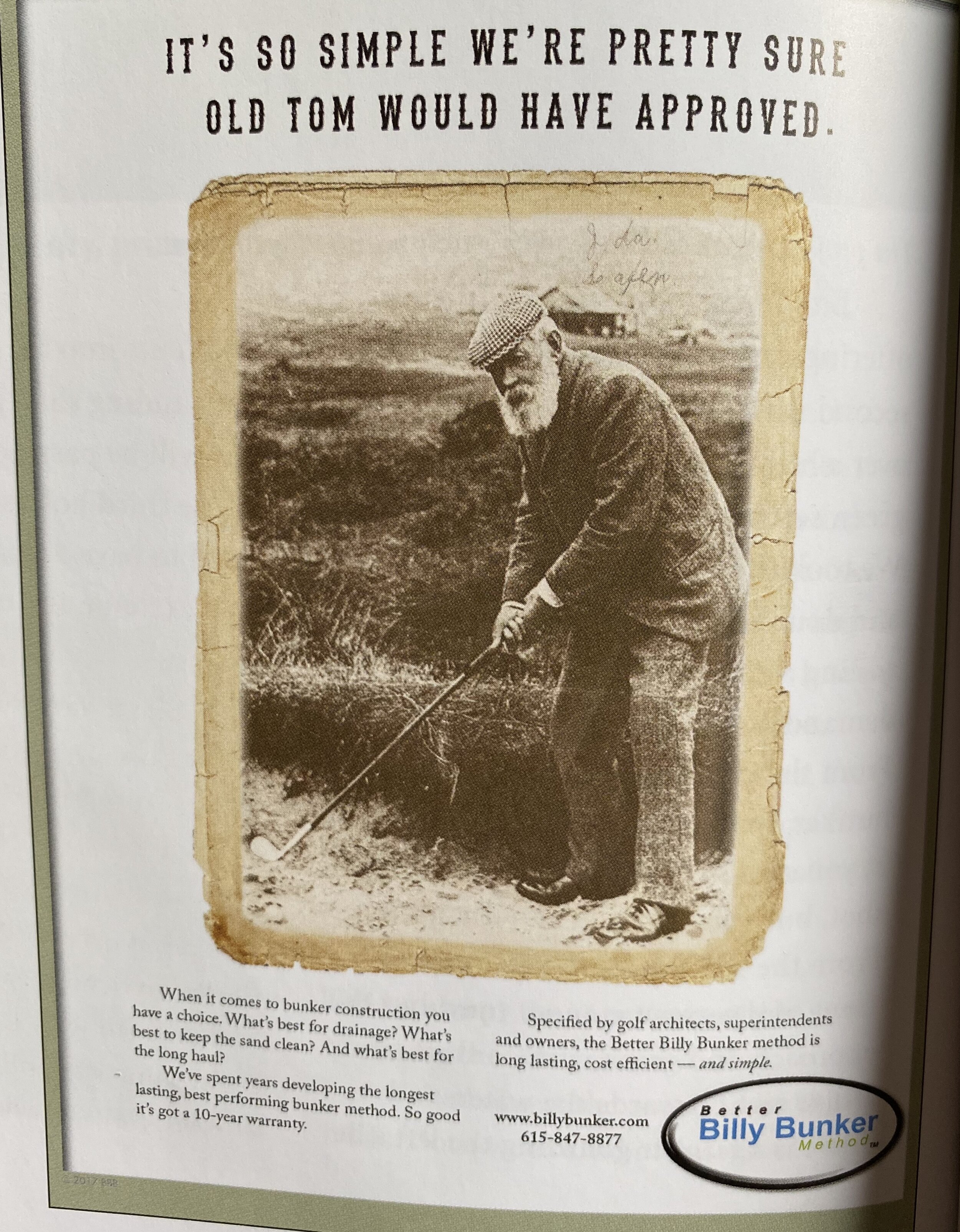
Ad from Golf Architecture magazine suggesting Old Tom Morris would have approved of Better Billy Bunker.

Ad from Golf Architecture magazine suggesting Old Tom Morris would have approved of Better Billy Bunker.

I realize that jumping from the large scale topic of what really matters in golf—recreational vs. pro game—is a bit like jumping from talk of vaccines to multi-vitamins. Worse, doing so as we have as so much suffering is taking place in hospitals feels inconsiderate.

But the COVID-19 pandemic will accelerate trends in so many sectors, and as I noted in the introductory post to this occasional series, golf is not immune. So we march on with those caveats in mind and consider how this will change the bunker maintenance industry. And an industry, it has become.

Just a quick reminder here in case you skipped early Gaelic 101, “bunker” is derived from Old Scottish “bonker” and meant a chest or box, and became secondarily defined as a “small, deep sandpit in linksland”.

Since these bunkers appeared naturally on linksland, no one thought to arm them with a rake or liners to keep the shells out. That nonsense came later.

The first known reference in golf’s literature came in 1812, used in Regulations for the Game of Golf according to Peter Davies in the Dictionary of Golfing Terms.

Over the ensuing centuries golfers changed from accepting bunkers as accidental pits scraped out by divots or sheep, to demanding more maintenance. The shift was caused by two factors: the move from a match play mentality to a card-and-pencil, handicap-based game where tallying up a score could be disrupted by an unraked sand pit.

As golf courses moved inland, bunkers become very clearly man-made. The shift from natural to artificial changed expectations. Throw in the whining of golf professionals who were making their living on the links, and you have today’s irrational and expensive focus on perfect hazards. Even the Old Course rebuilds theirs every five years or so, which is why you get this kind of visual and psychological contrast from the old days to the present.

Hell Bunker on the Old Course a long time ago.

Hell Bunker on the Old Course a long time ago.

Hell at the 2015 Open Championship.

Hell at the 2015 Open Championship.

Besides the obvious changes in symmetry, artistry and beauty, the more “functional” Hell has been rigged with a flat floor to send balls closer to the face. Such artificiality goes against everything that makes the Old Course incredible. It could also be easily countered by raking the bunker once a week and letting whatever happens over those days leave the golfer wondering what they will find if unsuccessfully taking on Hell.

Not to pick on the Old Course, but the bunkers there used to look like this:

cartgatecondemned.jpg.png
StAndrewsOldCourse_13thbunker_Item_6380_3.jpg

Despite the horrible looking lies to be found, golf somehow spread beyond the Old Course and became popular! All in spite of unfair bunkers that today would be seen as antithetical to growing the game.

Still, there were hopeful signs before the pandemic that the minimalist, scruffy, less-defined bunker was becoming more acceptable than the maintained bunker. The look of age, erosion and imperfection has become attractive again in part because of the thrill golfers find in overcoming such a bunker compared to carrying an overprimped hazard.

Here is a modern bunker, maintained for a tournament round, but otherwise looking ancient and imposing in an appetizing way:

Screen Shot 2020-04-27 at 8.59.41 PM.png

Increasingly American superintendents have mimicked the Sandbelt concept of Claude Crockford’s day (and today) only raking bunker floors.

Here’s what a Kingston Heath bunker looked like in 2011:

Screen Shot 2020-04-27 at 8.47.48 PM.png

With good intentions, this is an Americanized take on less raking. Though it’s mostly born out of a desire to prevent buried lies while ensuring clean, colorful, sanitary sand conditions:

Screen Shot 2020-04-27 at 7.54.31 PM.png

In times of societal or economic trouble, bunkers have been filled in by courses. Even a master bunker creator like A.W. TIllinghast set out on his mid-1930s “PGA tour” of American courses looking for ways to save money. Bunkers topped his list.

However, filling these sandy things falls into the baby-with-the-bathwater class of overreactions. Especially these days where so much time and discussion is put into bunkers.

Which brings us to the rake.

Even though the chances of the coronavirus lingering on the surface of a rake seems extraordinarily slim, the removal of them from most golf courses allows us to think about a version of golf where hazard perfection is both antithetical to the role of a bunker and unnecessarily expensive.

The height of insanity might be seen as the time when courses spent bundles on various liners to keep sand in place and loose impediments out to prevent damaging nicks to clubs. Maybe having a chip or dent on the wedge will be scene as a bad of honor while bringing back genuine fear factor of landing in a bunker.

An entire cottage industry centered around selling bunker products reached a zenith when a golf architect, consultubg with a governmental agency to craft proposal specs, emphasized a costly bunker renovation using one particular liner product.

Turns out, the architect was president (at the time) of the bunker liner company that was recommended.

Concerns about making a course better and highlight its special heritage? Non-existent. Thankfully the scam was outed and he lost the design job. Now even the American Society of Golf Course Architects, of which he is a member, says the lifespan of an American bunker is twenty to twenty-five years, a big improvement from not long ago when ten years was the number.

Some of this bunker maintenance mania stems from the issues presented in the first golf reset post: making the professional golf bigger than the sport. But as easy as it seems to blame televised pro golf for many expensive trends, the bunker neuroses is mostly on average golfers fussing about their scorecard. Then again, there are you Scott Stallings’ of the world declaring unraked bunkers as a line-crossing that would make precious pros reconsider sending in their entry form to the first post-COVID-19 tournaments.

Think of bunkers and the all-mighty raking that was so cherished: imagine if footprints on beaches were deemed unsafe, and only the beaches raked and filtered daily were allowed to be open? The cost of such maintenance would be astronomical. Plus, the wait for beaches to be open after the maintenance teams had been through would drive everyone mad. A less extreme version of such nonsense occurs with golf course bunkers.

No one expects us to return to the days of yesteryear (above). Maintenance crews will still maintain bunkers and courses will leave rakes out, but golf without rakes (for the time being) should be seen as an opportunity to highlight the waste of resources and energy spilled to prevent the indignity of a bad lie in a place you’re not supposed be.