6th Hole Winged Foot Then And Now: 2020 U.S. Open (So Far) vs. 1929 Playoff

The short par-4 sixth features such a simple design and yet remains one of the world’s best short par-4’s, even with the fairway shrunken down to counter advancements by today’s physics majors.

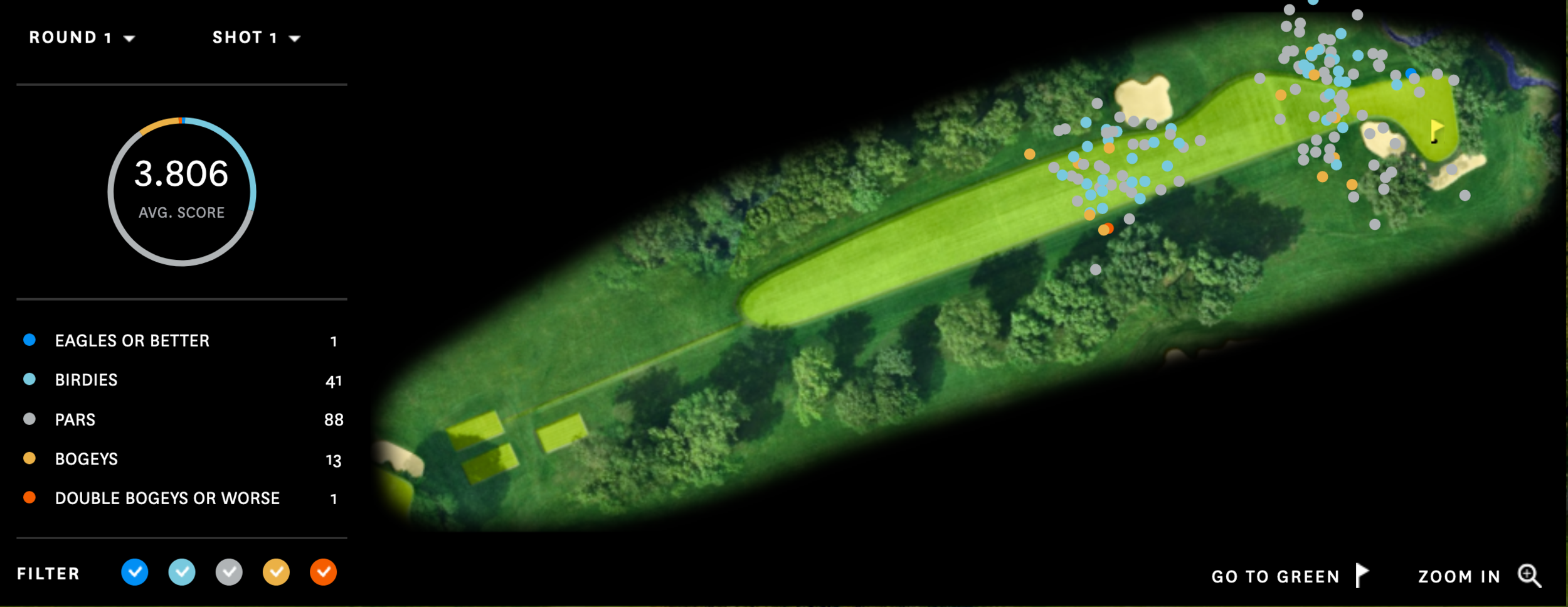
Through two rounds of the 2020 U.S. Open, notice how No. 6 played depending on the hole location. The more players tried to drive it, the worse they played it. (3.806 v. 4.028 scoring avg difference).

Screen Shot 2020-09-19 at 10.09.01 AM.png

Yet only a few who laid up in round 2 made birdie, perhaps due to the tricky angle from the fairway center. (The fairway has been moved in on the right.) Those who got their tee shot just in front of the green fared best:

Screen Shot 2020-09-19 at 10.08.49 AM.png

A close up view from round 2 where the best lay-up spot is now rough:

Screen Shot 2020-09-19 at 10.31.29 AM.png

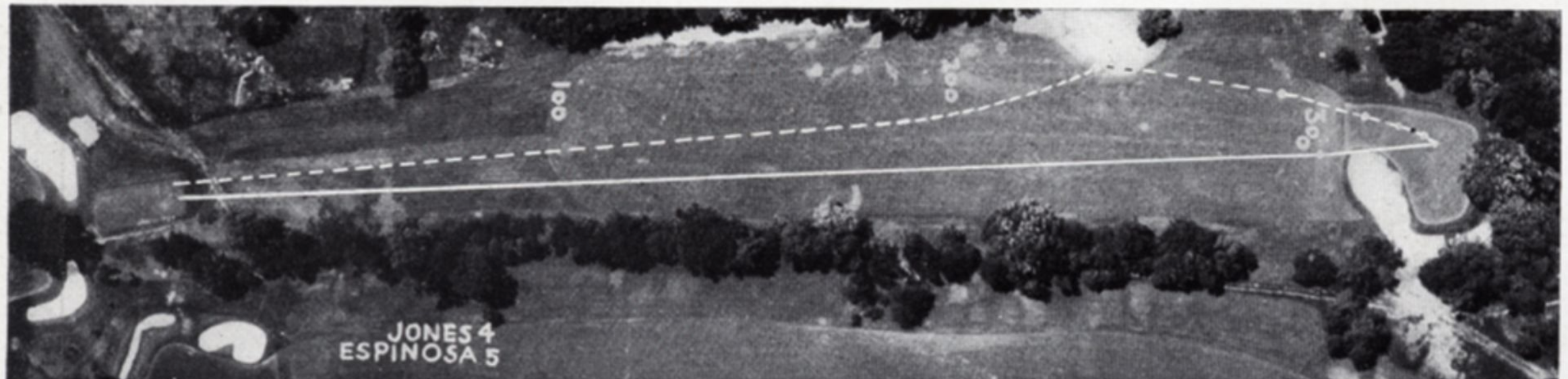
Jump back in time to one of the 1929 U.S. Open’s 36-hole playoff rounds documented by The American Golfer. You can see how much wider the course was and see the role rough plays today for those laying up in what was once fairway. You can also see that Bobby Jones hit a 300-yard drive, to which O.B. Keeler told spectators that it was all in the agronomy. Al Espinosa bogeyed the hole after a tee shot into the fairway bunker.

Screen Shot 2020-09-19 at 10.27.05 AM.png

U.S. Open: Mashers Collide In Mamaroneck; Quickly-Refuted Report Suggests USGA Hands Over Setup To Super!

Screen Shot 2020-09-18 at 8.15.21 PM.png

These guys know how to mash it! Even the golf ball!

Round three of the 2020 U.S. Open features two of the game’s elite, First Team All-American mashers of terra firma in the vicinity of their golf ball.

I bring good news: if their past run-ins with the golf laws are any indication, drama looms this weekend at Winged Foot.

Patrick Reed(-4), was called out on live TV pushing rough down behind his ball in the playoffs, and digging a canal in the Bahamas, and has a lawyer trying to silence those branding him a cheater. He’s also hitting just 38% of fairways and half the greens, so there is a sustainability question heading into the weekend.

Bryson DeChambeau (-3) came to the forefront of rules official bad dreams with incidents along the way, but nothing like this year’s combo package at Muirfield Village. While most of the footage has been taken down after takedown requests by the PGA Tour, though there remains a couple here where Bryson handles a ruling with absolutely no class. The scenes of him turning his driver into a spatula, however, sleep behind a password.

Worse news for officials: Reed loves the pairing, reports GolfChannel.com’s Ryan Lavner. What could go wrong!

For starters, this pandemic-delayed edition of the U.S. Open lacks walking officials and only TV cameras to witness any excess mashing. A belated Happy Saturday to the USGA Rules trailer. Hope you get a good pizza delivered. Then there is the whole these-guys-grow-the-game and they-are-athletes and we-can’t-taint-brands mindset that has so far prevented higher ups from telling players to stop with the lie improvement nonsense.

Mercifully, there were no incidents reported through 36 holes other than NBC’s Jim “Bones” Mackay noting the mitzvah that was Reed’s lie on the fourth. So maybe Reed and DeChambeau have gotten the message. Or they’re just waiting to liven up our Saturday. Coverage begins on Peacock and moves directly to NBC, so check those local listings if they still exist.

In other bizarre U.S. Open news, there appears to be a peculiar vibe developing between the Winged Foot set who were reportedly not pleased with the sensible USGA team attempting to present a tough, smart and efficient setup.

Following the very good round one scoring, Outside The Cut reported this assertion and I have no reason to doubt someone fairly credible in greater Mamaroneck believes this occurred, as delusional as it sounds:

Before that was up too long, Andy Johnson at The Fried Egg asked the USGA’s John Bodenhamer about this report. The reserved Bodenhamer, charged with setting up the course along with Jeff Hall and doing a stellar job, replied quickly to Johnson:

I’m not going to belabor the utter shallowness of a few hundred members of a club hoping for higher scores. But I will say this: keep an eye out in the middle of the night for any weird light and roller sounds coming from Winged Foot. Stranger things have happened.

Missing The Old Guard USGA, Files: Green Gathering Would Not Be Seen This Weekend

Screen Shot 2020-09-18 at 8.43.49 PM.png

It’s easy to poke fun at the old guard USGA and their stodgy ways. But every now and then some stodginess would do wonders for the American spirit.

Take the group of loudmouths sandwiched together during our pandemic in New Rochelle-adjacent COVID-19 hotspot. They’re not wearing masks but screaming their brains out and to cap off this coronavirus sundae, are anchored by NCAA hooligan and world famous restaurant regular/home owner Rick Pitino.

He even made the USGA post round notes in another leg of the USGA’s Barstool transformation:

  • Current Iona men’s basketball coach Rick Pitino watched some of the action from a home behind the third green. Pitino coached the University of Kentucky to the national title in 1996, and also led Providence College and the University of Louisville to the Final Four during his career.

Yes he did. Also, he and his friends—including tournament volunteers—are sandwiched together and should think about following state guidelines because they are on national TV.

Which brings me back to P.J. Boatwright.

A USGA friend saw this odd scene given the need for the U.S. Open to show it’s on good behavior. The person noted how the various old guard—pandemic or not—would have had this unsafe gathering blocked out with green-screen fencing by sunrise.

Ah, how we do miss our Hannigans, Boatwrights and Deys.

**Update: we’ve got masks today for round 3!

Screen Shot 2020-09-19 at 9.50.28 AM.png


So Sad: Great Leaderboard At Winged Foot But (Gasp!) 32 Players At Par Or Better

Screen Shot 2020-09-17 at 9.03.33 PM.png

Oh I jest. At least about the horrors of red numbers.

Because you have to step back. Savor the absurdity of 600 or so rich folks investing so much passion into protecting par, as if they will add height or portfolio heft.

Even after all these years. Par matters to the folks of means. But I’m going to predict here and now: the folks at Winged Foot will recover. Live will go on after round one of the 2020 U.S. Open’s sensible, get-the-round-in-during-early-fall-days setup which, admittedly, rendered the vaunted West Course a tad overwhelmed by today’s jock-strap wearing, former boxers who randomly discovered the Royal and Ancient game.

I offer this for those “of means” who are grieving near the blue and white awning that really doesn’t fit with Clifford Wendehack’s masterful clubhouse:

—Your course is in perfect condition.

—It’s very, very, very green, with a lot of grass on those greens supporting well struck shots, no matter how firm the soil underneath.

—Players today are armed with launch monitors (or three), coaches, video, amazing equipment, adjustable drivers, and of course, the ability to climb Mount Kilimanjaro in a single bound.

—There was almost no wind.

—A light overcast was present most of the day, ideal for scoring because of fewer shadows, better depth perception and greens remaining…green.

—It’s the U.S. Open and players have not been beaten down by the course, yet.

The USGA’s round one notes did acknowledge the sheer horror, as predicted here yesterday, of making sure the field gets around before sunset. That said, this modern athlete sure made 7500 or so yards of par-70 look awfully short.

Highlights from the excellent USGA staff notes and David Shefter insights:

  • No player in the field registered a bogey-free round.

See, the West course is stout! Have another G&T, Winthrop. You’ve earned it managing the family portfolio.

  • Louis Oosthuizen surpassed four-time champion Jack Nicklaus for the most rounds of 67 or lower in U.S. Open history (8) with a 67 on Thursday.

  • The seven birdies by Rory Sabbatini established a single-round record for U.S. Opens at Winged Foot. Eight players, including Justin Thomas, had registered six in one round. 

Okay, that’s a lot of red. Maybe the ball goes too far?

  • Davis Thompson and John Pak joined legendary USGA champions Bob Jones (1929) and Jay Sigel (1984) as the only amateurs to break par in a U.S. Open at Winged Foot.

And his Nike scripting was impeccable, take that Harvie Ward.

Top player quotes:

“The greens are very soft. I thought they'd be a little firmer, but I also understood that they need to err on this side so they can get them how they want this weekend.” – Justin Thomas

Or prevent a 5:45 round.

“I love hard golf courses. I think it separates the top golfers compared to the rest of the field. Also, I think it separates the guys who can use creativity and can handle adversity. Out there you're going to hit some quality golf shots that are either going to have a bad bounce, end bad up in a bad spot, or going to land on the green, catch a ridge, go down. How do you react to that?” – Patrick Reed  

Mash down the sand behind your ball? Just a guess!

“I thought the golf course was set up fantastic. It gave us an opportunity to make some birdies, and you look at most of the scores, and the guys took advantage of it.” – Tiger Woods

“I played great the last round at Valderrama [two weeks ago], which is a difficult golf course. You can't really afford to hit many bad shots around there. I shot 67, and I felt like I left four or five shots out on the golf course. I've built on that and fed off confidence from that.” – Lee Westwood after shooting 67 at age 47 

And what a deserving winner he would be.

“I came here to compete. I really didn’t come here to be a tourist.” – amateur Davis Thompson after shooting a 69

Oh we’ve got one liners in this one. Nice!

Finally, this gem from the guy who employed Danny Noonan for USGA social media purposes and is playing in his home region.

“It was nerve-racking. Any time you play in a major, even if there weren't any fans. It was my first U.S. Open. It was 6:50 in the morning, so it was still early. I got 4-iron into a par 3, which is very difficult. All in all, I hit it solid. I missed it in a spot that I shouldn't have, but like I said, the nerves. They're still out there.” – Fresh Meadow club professional Danny Balin on hitting the first ball off No. 10

U.S. Open Coverage Shifting To Peacock Goes About As Well As Expected

Screen Shot 2020-09-17 at 7.39.56 PM.png

As predicted some time ago, the inclusion of Peacock as part of NBC’s streaming strategy might upset U.S. Open fans. This, even though the app was free and shockingly, completely free of ads during its round one debut on Comcast’s big foray into streaming.

Todd Kelly reports on the viewer issues with Peacock, which picked up the last and first two hours of weekday coverage (more weekend windows early are looming).

Problem is, Peacock doesn’t quite have Netflix-level penetration across the U.S. and many sports fans are probably still scrambling as this story was being typed, looking for that app. NBCUniversal reported on Sept. 15 that 15 million people have signed up. It first debuted about three months ago for Comcast and Cox subscribers.

They’re probably banking on acquiring more by using a major championship to spur sports fans to jump on board.

Good news: You can find Peacock on your computer by going here. You do need to create an account but it’s free.

Reports on Twitter are that Peacock is not on the Roku. It’s been confirmed that it’s also not on the Amazon Firestick, but, there’s a work-around for that.

Nothing says well-oiled machine like a workaround and being unattached to Roku and Amazon.

But the kids love their streaming no matter how clunky it remains for sports viewing. Personally, I had no issues with Peacock working on a smart TV other than a noticeable loss of picture quality and whites looking blue, some of which was verified by many on Twitter if you hit this and read the replies:

Report: GolfChannel.com Shuttering At Year's End

Screen Shot 2020-09-17 at 8.44.01 PM.png

Brendan Quinn at The Athletic dropped a doozy of a feature that I’ll return to next week when Golf Channel’s U.S. Open coverage is over.

But among the many exclusive details: NBC (and therefore Comcast)’s dismantling of Golf Channel: the stunning end of the channel’s reliable, award-winning golf website, GolfChannel.com.

Quinn writes:

Golfchannel.com is being shuttered at the end of the year. Its content will move to NBCSports.com, where it will be found as a drop down option off the main page, like any other sport. Its staff is shrinking dramatically, weakening the focus on written content and originally produced journalism.

Now holding heaps of live programming costing countless millions of dollars, including documentary work and television series, Golf Channel is expected to dramatically reduce if not outright eliminate original productions.

Mickelson's Triumphant Return To Winged Foot Probably Ends Before It Gets Started

Not sure if you’ve heard, but to recap: Phil Mickelson did not finish well the last time Winged Foot hosted the U.S. Open, New Yorkers are just amazing in every way, and Danny Noonan caddied in the tournament practice rounds.

The only story of those that matters: 50-year-old Mickelson’s return hot off a Champions Tour win. But a 79 ended his bid to win the 2020 U.S. Open. He was gracious after a round that probably was over before it started judging by the range scene four hours prior (above).

Q. Obviously you got off to a great start.

PHIL MICKELSON: Yeah. I don't know what to say. It's a disappointing day.

Q. Something that was not right as you went along inthe round?

PHIL MICKELSON: I drove it poorly and I putted poorly. The course couldn't be set up any better. It's a spectacular golf course, great design, awesome setup, and I thought it was a good opportunity to score low today. I just played terrible.

Q. Is there anything that you can do right now to get back in a better groove for tomorrow?

PHIL MICKELSON: I'm 9-over. I'll play as hard as I can tomorrow and enjoy the round.

Golf.com’s Michael Bamberger tracked the Phil-being-Phil round and filed an entertaining account. To whet your appetite:

2 p.m. PMWFT (Phil Mickelson Winged Foot Time): Last time, in 2006, he was Big Phil. He was awshucks Phil. Now he’s badass Phil, with the shades and the calves and the bombs. Oh, he bombed one on the first hole here Thursday afternoon, lefter than left. So left he drew a decent lie. He launched-and-stuffed from there and did not do the Phil nod after making his birdie 3. Not because badass Phil doesn’t acknowledge his peeps anymore. He most assuredly does. It’s just that his people are not here. No Amy. No coach. No huddled masses. Just Brother Tim on the bag, Raja Maltbie in an NBC cart in the rough and a prop plane droning overhead. Phil’s quest, at age 50, was under way. You know what we’re talking about.

If Phil can take heart, he inspired Club Pro Guy into a particularly aggressive Thursday Night League pre-round grind session.

"A PGA veteran’s callous joke about blackface and Tiger Woods turned into a lesson on empathy"

Screen Shot 2020-09-17 at 12.02.45 PM.png

I’m not sure I would have dropped on day one of the U.S. Open and might recommend bookmarking if you want to stay focused on the tournament. But Michael Williams files a lengthy, shocking, bizarre and eye-opening piece for The Undefeated detailing something he witnessed at last year’s U.S. Open.

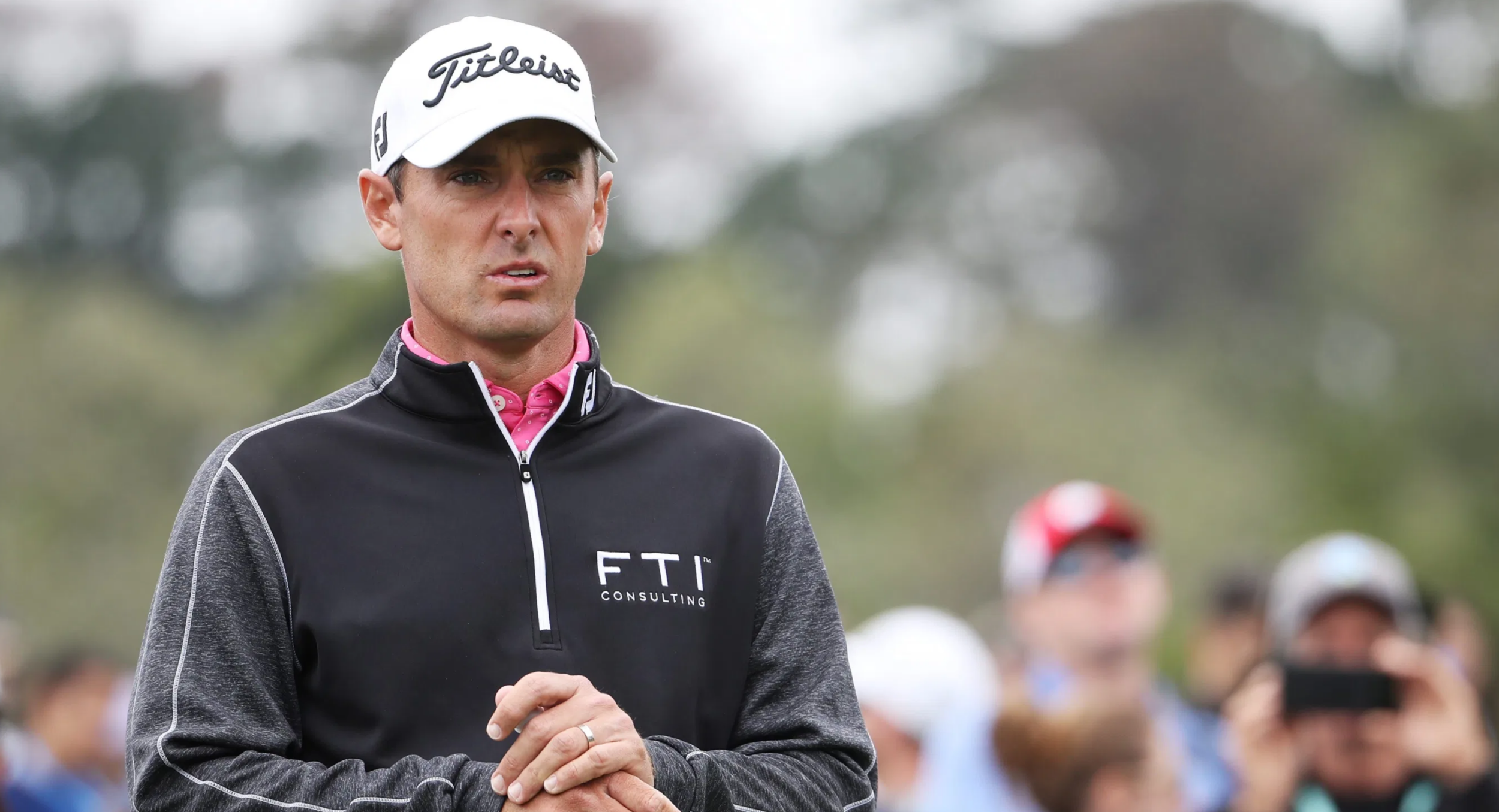
Shocking because it involves one of the best people you’ll meet in professional golf—Charles Howell—who has gone above and beyond to learn from the incident. As always, please hit the link and take all of Williams’ piece in, but below is the setup.

I’ll add this to expedite matters: picture a lot of affluent people in a Lexus tent at Pebble Beach, one that make you wonder why need to have these corporate tents in the first place (oh, right, growing the game).

Williams writes:

I had been invited to the tournament by one of the corporate sponsors of the USGA, the organization that owns and operates the US Open. One of the perks was the opportunity to attend private post-round interviews with players, including Howell, in the sponsor’s hospitality tent beside the 18th fairway. As a golf journalist, I was familiar with Howell as a player, but I didn’t know much about him personally. While he wasn’t a contender to win (Howell finished tied for 52nd, 17 strokes behind winner Gary Woodland), I decided to attend to get some insight into how a physically unremarkable guy had willed himself to a remarkable career.

Todd Lewis of the Golf Channel was slated to ask Howell and fellow pro Patrick Cantlay about how the players thought they did, what their chances were, the difficulty of the course, etc. Typically, the players’ answers would match the banality of the questions.

But after a couple of softballs, Lewis started describing a story that Howell had shared with him when asked for an amusing anecdote. “You all remember the night Tiger Woods hit the fire hydrant with his car, right?” The 75 or so people in the tent laughed nervously and nodded, unsure why the 2009 accident outside Orlando, Florida, that contributed to Woods’ tragic fall was being raised at the national championship.

Lewis continued: “Now just to set the scene, there were reporters crews, camera crews, outside the gates of Isleworth from all over the world. I mean, it must’ve been 150 to 200 people there. There were helicopters flying above, trying to get pictures of Tiger’s house, the hydrant, Tiger, whomever. And looking for [his then-wife] Elin. Well, Charles decided he’d have some fun with all of that. Charles, pick up the story from there.”

Howell then told a story about how he thought it would be funny to punk the media looking for Woods.

And then it goes in rather unimaginable places from there, but with a happy ending! I promise.

Be Careful What You Wish For Files: What Would A Winged Foot Massacre 2 Prove?

USGA

USGA

The appeal of hack-out, last-man-standing golf has always been a mystery.

The joy of seeing tour pros brought down to a lower level is deeply narcissistic. To want to watch skills reduced or nullified, to make you feel better about your lousy game is both selfish and terribly simplistic.

But it’s been a while since we’ve heard of a setup so anticipated for the carnage it will inflict. Winged Foot this year sounds legitimately cruel, with spot-fertilized rough, tight fairways, old-style rough, restored hole locations and no fans to mash down the tall stuff.

Players made very clear in pre-tournament assessments that they expect this to be a war of attrition.

The last car not to crash into turn three may prevail Sunday. That last car will have done a lot right to win, but will it be a real display of skill or just a better effort to survive than other contenders?

After some ugly early century attempts to combine old school USGA setups with modern green speeds, they got away from the attrition approach. Things changed at Winged Foot in 2006 when Mike Davis introduced staggered rough cuts and flexible tee placements, including on the par-4 6th. It all went quite well until some setup hiccups in recent years led to the USGA pulling back on some of those advances in course setup.

Many others saw the U.S. Open lose its identity. They were not totally wrong. But some of that identity loss was brought on by equipment advances which can only be offset by so much harvesting of fertilized rough.

Now, John Bodenhamer and Jeff Hall try to balance the best components of the old approaches while appeasing those wanting to see an old school U.S. Open. Not a fun task. Particularly when you factor in the headstrong Winged Foot membership that always seem a tad too bogey blood-thirsty.

The USGA’s setup team will earn their money balancing these desires while also trying to get the tournament in on time. Perhaps the specter of long rounds in early fall days will help justify a sensible setup Thursday and Friday. Because the U.S. Open pressure, Winged Foot’s many elements and a host of top players in fine form should produce a memorable week as long as things stay sane. But push it too far and there could be another massacre. A worthy winner could still emerge, but history tells us as chance enters into the equation, the winners become more surprising.

Golf Digest has been slammed over the last week for publishing a list of “underwhelming” U.S. Open winners. It was a poor choice of words and some of the selections were even worse. But I understood their point: some U.S. Open winners are more convincing than others. That doesn’t mean they are bad people or even unworthy.

But knowing what we know now about the role of setup and architecture, a place like Winged Foot does not need silliness to produce a well-earned, U.S. Open-style victory.

So for those hoping to see carnage at the expense of skill: be careful what you wish for.

Fox And NBC Initially Negotiated Landmark Rights Trade Without The USGA

Screen Shot 2020-09-16 at 4.57.55 PM.png

The next time someone mentions “ironclad” and sports rights contracts, you’ll probably think of this story by Dave Shedloski at GolfDigest.com.

He speaks to several figures, including NBC’s Jon Miller, who largely orchestrated the unbelievable swap of USGA rights from Fox back to NBC/Golf Channel by staying in touch with the Fox execs. Former USGA official and now-NBC Sports head Pete Bevacqua also played a key role in bringing the two sides back together after the shocking end to NBC’s prior deal.

Most amazing in the sequence of events might have been this revelation:

FOX and NBC had to hammer out a deal in which the two sides split nearly equally the cost of the remainder of the FOX contract. Talks wrapped up in early June. But that was hardly the end of it. FOX did not have the right to simply assign the TV rights to NBC. The USGA had to sign off on it, essentially negotiating an exit deal with FOX and closing on a new deal with NBC.

FOX representatives broke the news of their agreement with NBC to Davis at a June 17 meeting at Baltusrol Golf Club in Springfield, N.J.

Well that must have been a surprise!

The initial story broken by AP’s Doug Ferguson insinuated that Fox asked out of the deal after not coming to a resolution with USGA officials over this year’s tournament rights.

USGA News Conference Offers Insights Into The PSA's We'll Be Tired Of By Friday, Effort To Prevent Lost Balls, Distance Update

Screen Shot 2020-09-16 at 9.11.51 AM.png

The USGA’s annual U.S. Open news conference this year was a roundtable went 47 minutes and highlighted initiatives, corporate sponsors, the high rough and the distance issue.

We learned about the “cadre of social media influencers” helping to bring the tournament to everyone who can’t be there. So there was some humor.

I enjoyed this from John Bodenhamer on why the opening pairing was selected:

We can't wait for two local players, a little special start tomorrow. Brandon Wu from Scarsdale and Danny Balin from White Plains will hit the first shots off the 1st and 10th tees tomorrow morning when we start, and we're pleased by that.

Warning, there is now a brand anthem that you’ll be tired of by Sunday. From Craig Annis, Chief Brand Officer:

Rounds have been up. Golf courses are busy. And it's required us to think about the role that we play in helping to make the game more accessible and welcoming for everyone.

And so what you saw at the beginning was our new brand anthem, for all golf is and all that it can be. It really talks a lot about the special connection that golfers have to the game and what the game means to them. That's a message that we're going to continue to deliver throughout this week and beyond.

They sure love to spend money on PSA’s and early-retire good people. Charming. Wait, what, there is more?

There are two others that I want to share as well. The first is a spot that we're calling "openness," which not only talks about the openness of our championship and the history with that, but also the commitment that we're making as a leading governing body and golf organization to make the game more open, more accessible, and why that's really important.

We’re going to get a public course golfer to fill that empty seat the Executive Committee? Ah I got excited there for a sec.

And then the third is an ad that features Michelle Wie, our champion, as the narrator, and it's an advertisement that's in partnership with SheIS Sport, focused on their "women worth watching" campaign. And it just shines a light on the importance of people celebrating, tuning in, watching and supporting women in sports broadly but also specifically women in golf.

The partners at Barstool can help promote that one!

And now the winning score question…

BETH MAJOR: Another WebEx question for John. You mentioned letting Winged Foot be Winged Foot. Can we expect anything different from 2006, and do you expect an over-par winning score?

JOHN BODENHAMER: You know, I think there will be a few things different because it's September, but that question leads me back to something I read, I spent a lot of time with the club historian here, a wonderful gentleman by the name of Neil Regan, and he shared a quote with me a week or so ago that when asked a similar question back in 1929, before the U.S. Open then, and a member of the media said: Are you going to make Winged Foot tough? Are you going to put all the tees on the very backs of the tees and tuck all the hole locations in the nooks and crannies of the putting greens? And Tillinghast just turned and said: We're not going to outfit Miss Winged Foot in any different way than she otherwise would be. No fancy clothes, no special jewelry, just a simple calico dress, and no furbelows -- that's right, furbelows, I love that word -- and just wash her face up for the party, and she'll be good enough.

And that really is what has inspired us to think of Winged Foot being Winged Foot.

Not sure that pairs up with the “women worth watching” campaign…

As for the rough this week, Bodenhamer answered a logical question about efforts to mitigate lost balls with so much rough and no fans. I’m glad this has been given thought given the conditions and even fears a lost ball could decide the Open:

JOHN BODENHAMER: That's an interesting question. That's something we thought, put a lot of thought into, and we have -- we have got a good game plan. It's not entirely different from what we normally would do for a U.S. Open with volunteers, and we call them stationary marshals or ball spotters, that will be strategically positioned at certain parts of the course.

We have done research in the practice rounds leading up as to where balls are going. We have actually charted that. We know where the more difficult areas of some of the rough grass is. So we're positioning people that way.

We have got about a dozen or more bodies on every single long hole. We have got somebody signalling from the tee into the fairway, and we have got people up on the hole. We have even gone to the extent of bringing in some of the wonderful Winged Foot Golf Club caddies who are doing this on a daily basis when they're here, and they know this golf course better than anybody.

We feel great about the opportunity we have given to find golf balls this year, and we're going to do a great job of it.

That’s good news as any golfer knows there is no worse feeling and it certainly does not make for good TV.

As for Winged Foot’s future in a U.S. Open-rota world, Bodenhamer offered this endorsement:

This is not what they signed up for. And it's just been a real testament to perseverance on Winged Foot's part, and we could not be more grateful. And I assure you that will be recognized within the USGA.

Regarding the idea of “anchor” sites—American for rota—CEO Mike Davis offered this:

As I said, the USGA did research, we talked to a lot of players, we talked to past champions, and there was a consistent theme that they want to go to our greatest U.S. Open sites and they want to go there more often.

So really John and team started first with Pinehurst working on that. So I think let's let the future play out, but there are some treasured sites, as John has said. We have got Nick Price, who was a world No. 1 on our Board of Directors and sits on our Championship Committee, and he has said, you know, it does matter where you win your U.S. Open. And I think we, John and team, all of us took that to heart. And so that's what we're looking at right now. So as they say, stay tuned.

And the proceedings wrapped with a distance question. In case you didn’t know it, there’s more study and dialogue to come. Also known as, we’ll get to it.

And at the very heart of this, the USGA and the R&A do believe that, long-term, we think something needs to be done about distance, because we believe it's going to continue to increase. All the data would suggest that. We don't think that's in the best interests of the game, but we also acknowledge that there are a lot of different sectors within the industry. There's the golf courses that are really the things that have been impacted the most, that have taken the brunt, that have had to spend billions of dollars to continue to change because of what's happened with distance.

But then there's the other things, there's the elite players, there's the recreational players, there's the, you know, individual golfer. We want to make sure the game is enjoyable. We want to make sure it's sustainable. We didn't get here overnight. It took over a hundred years. And our belief is, if we collectively as an industry look at this and say, what is in the best interests of the game long-term, we're going to get there.

So essentially what we did when COVID came out is we have just delayed this project, but we believe -- or in the first quarter of next year we'll put out what's called an Area of Interest Study, which really are the topics we want to engage with the industry. We want to engage with elite players, with equipment manufacturers, with golfers, with golf courses. We want to do it on a global basis and then continue to look at this. Because, again, at the heart of this is what's in the best interests of the game long-term.


Uh, Ok Files: Old Course Hotel Claims American Golfers Less Likely To Hit One Sideways Than Scots

Screen Shot 2020-09-16 at 3.17.00 PM.png

Thanks to reader Brian for this Caroline Wilson story where the Herald writer tells us American golfers are less likely to hit balls into the Old Course hotel than Scots.

This “news” comes as the hotel has filed for netting to protect the Jigger Inn’s outdoor revelers from incoming golf balls after all these years.

The five-star hotel, which is owned by Herb Kohler, a bathroom hardware magnate from the US, has historically had a problem with wayward balls hitting its walls and it seems Scottish golfers may be mostly to blame.

According to hotel bosses it is the American golfers who are able to add enough curl in their stroke to prevent it hitting the walls of the hotel, which borders the famous 17th ‘Road hole’. Scots golfers, are said to be more likely to hit the building.

A hotel source said: “They have to hit it over the green sheds which is part of the hotel. It is famous and notoriously difficult.”

And we know those Scots all just hit it a few feet off the ground!

The story does seem to be talking about a pair of different tasks here: hitting over the faux railway sheds from the Road hole tee, versus slicing one into the actual hotel.

This all came up because The Jigger Inn is far down the hole and more in play for a shanked second. Nonetheless, to protect outdoor diners while the indoor portion is off limits, they’ve asked Fife planners for permission to safeguard folks from the wayward Scottish golfers…

Plans for a 14 metre long and 4.7 metre high safety net have been submitted to Fife Council, with applicants the Old Course Limited formally requesting a temporary relaxation of planning permission to put the barrier up until at least November.

Normally specific planning consent would be required to put up a fence or wall exceeding two metres in height.

How Playoffs Have Made U.S. Open Memories And 2020's Odd Setup (Should It Happen!)

Screen Shot 2020-09-16 at 9.23.49 AM.png

Martin Davis considers the role playoffs have played in creating epic U.S. Open memories. While I don’t agree with some of the sentiments expressed in the story questioning the end of Monday 18-hole playoffs—one unnamed voice calls it the equivalent of a pop quiz—the new format remains befuddling after so many years of lectures about the importance of 18 holes to decide a tie.

The USGA settled on two-hole aggregate playoffs when The Open and PGA Championship use three holes (The Masters remains sudden-death). The two-hole setup is especially curious this year given the natural three-hole loop and this:

If a playoff is required at Winged Foot, it will be decided by a two-hole aggregate playoff on Holes 10 (a par 3 of 214 yards with the deepest bunkers on the course) and 18 (a dogleg left par 4 of 469 yards to an elevated, well-bunkered green) immediately after play. If the playoff results in a tie, play will continue on a hole-by-hole basis on Holes 10, 11 (a short par 4 of 384 yards) and 18, repeated, if necessary, until a champion is determined.

So in the aggregate playoff setup, the 11th hole providing a natural bridge to the 18th tee will be skipped, but in sudden death it would be used. Presumably the two-hole idea is for television, but it sure chips away at the championship’s cache, particularly when it’s so obviously setup for a perfect three-hole playoff.

Above is the overhead of the holes in play, with the 10th at the bottom. That’s 10, then a cart drive to 18 tee, but in sudden death the sequence would be 10-11-18. Ok.

NY Times: "No Fans at the U.S. Open Changes Golf’s Revenue Picture"

Screen Shot 2020-09-16 at 8.52.42 AM.png

Paul Sullivan of the New York Times considers what the loss of normal U.S. Open revenue means for the various initiatives receiving USGA support. The story, as with others on the topic, mentioned a general number of $165 million in tournament revenue with $70 million in profit.

The two entities mentioned that got my eye:

Girls Golf, which works with girls to teach them golf and life skills, was hit with a double whammy in March. It receives $1 million from the U.S.G.A. and the L.P.G.A., the governing body for women’s golf, which halted its season in March.

“We didn’t really know what was going to happen,” said Nancy Henderson, chief teaching officer and president of the L.P.G.A. Foundation. “Our initial focus was our Girls Golf sites weren’t able to do programming in person, so we moved a lot of it online.”

While grants from both organizations came through, Ms. Henderson remains worried about next year. “That’s the big question,” she said. “You don’t know if you’ll be back to a new normal.”

Regarding the new normal and the sites hosting, there is a startling change in fees for 2020 host Winged Foot. According to Bryan Marsal, the chairman of the 2020 U.S. Open, the club will see only about 10% of what was expected.

“Our compensation was based on the number of fans that came to watch the tournament, plus the amount of merchandise that was sold in the merchandise tent, plus the corporate tents that were sold and the rental of the property,” he said. “We’ve had a 90 percent reduction in the revenue going to the club.”

2020 U.S. Open Flyover: Eighteenth At Winged Foot, The Putt That Changed Golf History And The Restoration

If you’ve watched early week coverage from Winged Foot, you know the 18th green just has something special going on. I don’t recall that sense the last time the West hosted in 2006. So we’ll chalk up that eye-catching quality to the restoration work reclaiming both shape, size and artistic flair to this historic location.

John Fischer takes us back to the putt that changed golf history and forced a 1929 U.S. Open playoff. Carve out a few minutes to go back to his moment, which now is easier to visuale in 2020 thanks to the green reclaiming its identical look.

The 12-foot putt that Jones faced on the 72nd hole was downhill on a fast green, with a left-to-right break. Jones took a few extra seconds to look over the putt. The gallery had swelled to 7,000, some standing back as far as the knoll in the 18th fairway to get a good view of the green.

Jones decided on his line and aimed 1½ feet above the cup. He stroked the ball amid dead silence from the huge crowd. The ball slowly rolled down the slope and seemed to hesitate at the edge of the cup. The gallery let out a collective gasp. Then, after seeming to hang on the lip, the ball fell into the cup. Thunderous cheering and applause followed. Jones had done it. He had tied Espinosa.

If you want to keep going back, why not get a little Grantland Rice in your life. His dispatch well after that day and one of the last things he authored.

The USGA also posted this nice recap of 1929 with club historian Neil Regan prominently featured.

The last flyover provided by the USGA and Deloitte to whet our 2020 U.S. Open appetite shows the 469 yarder seemingly discouraging driver off the tee due to the sharp bend left. Then again who knows in this wacky world of totally natural physique overhauls.

A good tee shot sets up a short-iron second to the masterful green, with its false front, roles, swales and difficulty. The 18th presents elements we’re not used to seeing: fairway bunker on the outside of the dogleg, and a seemingly left-to-right second where the greenside bunkering is on the outside left. A grass wall guards the right where you’d normally expect sand.

Hit pause on the flyover to soak up the green and imagined where the holes might be cut. There are some new beauties since the last time the tournament visited Winged Foot.