Latest From GolfDigest.com
Latest From Local Knowledge
Twitter
Books
  • Lines of Charm: Brilliant And Irreverent Quotes, Notes, And Anecdotes from Golf's Golden Age Architects
    Lines of Charm: Brilliant And Irreverent Quotes, Notes, And Anecdotes from Golf's Golden Age Architects
  • The Future of Golf: How Golf Lost Its Way and How to Get It Back
    The Future of Golf: How Golf Lost Its Way and How to Get It Back
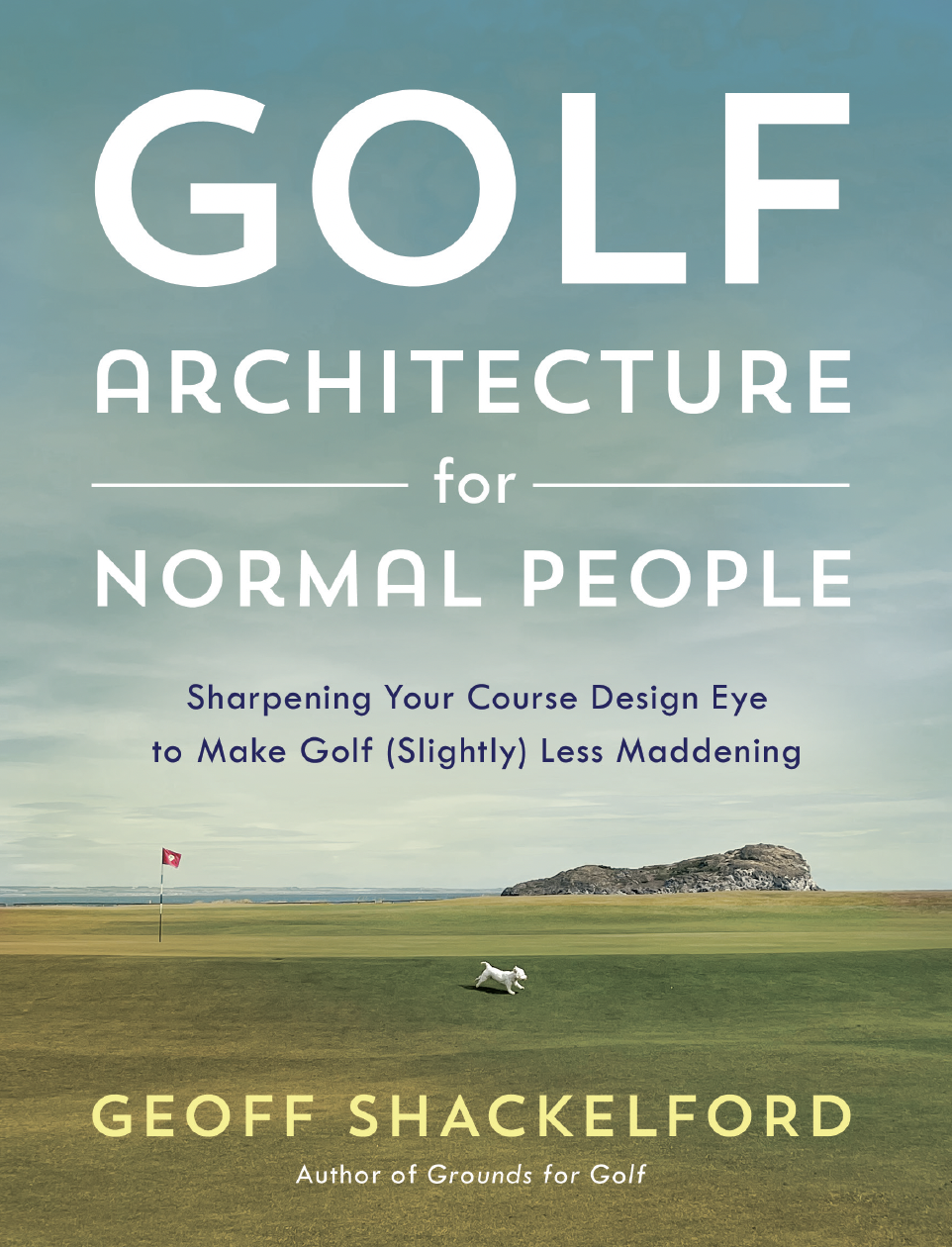
    by Geoff Shackelford
  • Grounds for Golf: The History and Fundamentals of Golf Course Design
    Grounds for Golf: The History and Fundamentals of Golf Course Design
    by Geoff Shackelford
  • The Art of Golf Design
    The Art of Golf Design
    by Michael Miller, Geoff Shackelford
  • Alister MacKenzie's Cypress Point Club
    Alister MacKenzie's Cypress Point Club
    by Geoff Shackelford
  • The Golden Age of Golf Design
    The Golden Age of Golf Design
    by Geoff Shackelford
  • The Good Doctor Returns: A Novel
    The Good Doctor Returns: A Novel
    by Geoff Shackelford
  • Masters of the Links: Essays on the Art of Golf and Course Design
    Masters of the Links: Essays on the Art of Golf and Course Design
  • The Captain: George C. Thomas Jr. and His Golf Architecture
    The Captain: George C. Thomas Jr. and His Golf Architecture
    by Geoff Shackelford
Current Reading
  • The Golf Courses of the British Isles
    The Golf Courses of the British Isles
    by Bernard Darwin
  • Don't Mess with Travis: A Novel
    Don't Mess with Travis: A Novel
    by Bob Smiley
  • Wonder Girl: The Magnificent Sporting Life of Babe Didrikson Zaharias
    Wonder Girl: The Magnificent Sporting Life of Babe Didrikson Zaharias
    by Don Van Natta Jr.

    The USGA's 2011 Herbert Warren Wind Book Award winner

  • The Big Miss: My Years Coaching Tiger Woods
    The Big Miss: My Years Coaching Tiger Woods
    by Hank Haney

    The ebook edition.

Classics
  • Golf Architecture in America: Its Strategy and Construction
    Golf Architecture in America: Its Strategy and Construction
    by Geo. C. Thomas
  • The Course Beautiful : A Collection of Original Articles and Photographs on Golf Course Design
    The Course Beautiful : A Collection of Original Articles and Photographs on Golf Course Design
    Treewolf Prod
  • Reminiscences Of The Links
    Reminiscences Of The Links
    by Albert Warren Tillinghast, Richard C. Wolffe, Robert S. Trebus, Stuart F. Wolffe
  • Gleanings from the Wayside
    Gleanings from the Wayside
    by Albert Warren Tillinghast
  • Planet Golf USA: The Definitive Reference to Great Golf Courses in America
    Planet Golf USA: The Definitive Reference to Great Golf Courses in America
    by Darius Oliver
  • Planet Golf: The Definitive Reference to Great Golf Courses Outside the United States of America
    Planet Golf: The Definitive Reference to Great Golf Courses Outside the United States of America
    by Darius Oliver
Writing And Videos
Blogs
Feedblitz
Enter your Email


Powered by FeedBlitz
« Dolch On FedEx Cup | Main | B.C. Open To Turning Stone? »
Wednesday
Jul052006

Knowing Club Selection In Advance

Heres what Phil Mickelson had to say about his club selection on 18 at Winged Foot while meeting with da medja in Chicago:

Fortunately what I have found has helped me play well or have that type of performances these past years in the majors is that I've done the prep work beforehand and I know what club selection I'm going to hit off each tee, given weather conditions, whether it's raining, whether it's hot or not. I already know and have known for weeks in advance what clubs I'm got to hit off each tee, so it's helped me approach the tee box with confidence knowing what club I'm going to hit.

It helped me when I hit the driver on 18 at Baltusrol on the last hole and ended up making a birdie. It helped me at The Masters knowing what club and what driver I was going to hit off each tee, and it helped me at the U.S. Open. Unfortunately I didn't execute the way I wanted to.

But it has erased a lot of the doubt as to the decision-making, what club am I going to hit, what club should I hit. I already know weeks in advance, and it helps me hit those shots and visualize those shots in practice before I ever show up the week of The Open.

Now, we have debated Phil's two-driver concept at Augusta here and here and here.

But I'm wondering if his ability to select clubs in advance says something about the state of the game.

This is not a technology question, but I believe one about the state of course setup and course design.

Is there something wrong with setups and designs when a player of his magnitude (and others like him) know what they will be hitting on holes well in advance of tournament time?

Or to put it another way, is the golf more interesting and testing if the design and setup create decision-making situations that can not be made in advance?

Wind and the player's philosophy play a role in this, but isn't there something seriously wrong when some spontaneity is missing from the major championship equation?

I was both elated and troubled by Mike Davis's decision to announce the alternating of tees during the U.S. Open. Elated that he was doing it, troubled that he was giving everyone advance notice.

Don't we learn who is most skilled by finding out who can handle a club selection and playing strategy question under pressure?

Enough rambling...your thoughts? 

PrintView Printer Friendly Version

EmailEmail Article to Friend

Reader Comments (16)

I may be speculating here, but I think some of this may be Dave Pelz's influence. If so, I think either Phil isn't saying everything or the strategy is not fully developed. I would guess based on reading Pelz's stuff and knowing Phil has hired him to help with preparation, that Pelz has done a really good analysis of the stats and has come up with a good strategy using the stats. Pelz has done excellent work breaking down the numbers. However, one area where golf breaks down the numbers, not vice versa, is that a competition is only 72 holes. This is a small sample so we see Phils catastophe on the 72nd hole, not the fact that he made what might be the best play if he were on that hole 10,000 times. Also, if pelz really gets into the numbers he would have to figure out a strategy for certain situations that might be less than ideal because of the short nature of the tournament. If Phil comes to the 72nd hole with a 2 shot lead, the strategy is different, in that you would look to the play that minimizes the chance of a 6 as opposed to the optimal play over time. Perhaps it isn't Pelz though, and Phil needed the security of knowing what to hit regardless of the situation. If so, I find that a bit disappointing. His preparation has been laudable, but to need to know exactly what club to hit off each tee regardless of the situation seems strange for a world class player I think.

But in general I agree with you. Golf should be something more vague than a game broken down by the stats wizards and game theory geniuses. I hope so, since I am neither of those, my brain can barely handle adding the score up. ;-)
07.5.2006 | Unregistered CommenterJPB
Phil's think-everything-through-in-advance approach actually sounds countercerebral to me. Heck, even I devise a plan for optimizing my scoring at certain local courses, but the plan is always subject to modification: What are the conditions? How am I playing? What's working, what's not... During the round I expect to THINK and adjust - and I don't even play competitively.

For someone engaged in competition, particularly near the end of the round, the greatest consideration must be: Where do I stand? I'd call it the van de Velde Principle, which should require no explanation.

Ironically, the great shortcoming to Phil's approach was that it left him unprepared to make prudent choices - to adapt to changing circumstances. Even though his driving was horrendous on Sunday (so he could have anticipated a terrible drive on 18), most observers felt his fateful decision came on his second shot. By opting for a semi-heroic play rather than a conservative one, his poor execution proved fatal rather than merely problematic.

On the other question, I agree that the USGA shouldn't determine or announce tee/pin positions in advance. For me it's not a matter of challenging the players to think "on the fly" so much as ensuring that they're forced to think a lot, period. Because a course changes daily with wind, turf, and green conditions, there's no sense in setting it up until the last possible moment. The challenge shouldn't lie in the difficulty of the shots per se but rather in the variety of shots required from hole to hole and round to round, and you can't maximize this until you know the day's conditions.
07.5.2006 | Unregistered CommenterCharlie Bell
Wasn't it Hogan who left out his 7-iron so that he could carry his now famous 1-iron ... the rational being that there weren't any 7-irons shot out on the course that day ...

Perhaps the predeposition to hit driver wasn't the problem, the real problem was that because he wasn't carrying a 3-wood, the 4-wood wouldn't travel far enough so he was left with no alternative but to hit driver ...
07.5.2006 | Unregistered CommenterMike B.
I read the transcript on another site, and thought many of the same things as all of you. The only thing I would add is, wouldn't such preparation be left almost useless at a British Open course where the weather conditions change so rapidly?
07.6.2006 | Unregistered CommenterTom G
I was about to bring up Hogan, who made a career of winning majors ahead of time by knowing what he'd need to hit. From what I understand about Hogan's prep work, he'd figure out where he had to hit his drive to give him the best iron shot in; figure out what shape of shot to hit into the green to hold the ball in the right spot for the easiest, straightest, preferably uphill putt; and then practice until he executed each and every time. But as far as I know, he wasn't above changing the club selection in the field to reflect weather conditions, how tired he was (especially after the car wreck)...

...so I guess I could have saved a lot of bandwidth by leanin' forward in my rocking chair, firin' out a wad of chaw juice into my spitoon, and saying "Phil ain't no Hogan".
07.6.2006 | Unregistered CommenterReverendTMac
I assume Phil, after all these years, is still learning about himself, his game and how to play in tense situations. But aren't we all. You never stop learning in this game, thus one of its appeals.

It is also golf lore that in later years Hogan said his biggest regret was that he didn't fire at more pins.
07.6.2006 | Unregistered CommenterLynn S.
Carrying no 3W was a stupid move. That's one club you don't leave out of the bag. For ages, players have known better. When yardage dictates, or when the big dog goes bad, 3W can often save the hole, round, tournament.

07.6.2006 | Unregistered CommenterVan
"Carrying no 3W was a stupid move. That's one club you don't leave out of the bag. For ages, players have known better. When yardage dictates, or when the big dog goes bad, 3W can often save the hole, round, tournament"

I think this criticism is unfair. Why? Because I doubt there is any evidence for the conclusion. This is where I think guys like Dave Pelz can be excellent. Pelz asks why. And as I said in my post above, we don't know exactly what they have discovered looking at the numbers. The "for ages" argument doesn't hold water. Just like looking at the numbers proved how stupid some baseball myths were, looking at numbers might make some golf theories look dumb. Or maybe not. The thing is, we don't know for sure and taking 3 wood out of the bag may have been a very good decision. You can't tell from the result on 18. You may be right, but maybe not. I doubt you can prove this one way or another, I know I can't.
07.6.2006 | Unregistered CommenterJPB
Getting back to Geoff's basic question, does Phil's ability to select clubs in advance say something about the state of our game? Perhaps it does in ways that have not been considered. Think about Phil, flying to Augusta and Winged Foot to practice and analyze, then flying home and back again to practice some more. Is there any way that Hogan could have travelled back and forth like that? Even Palmer and Nicklaus, who perfected the concept of the flying golfer, probably did not have that kind of access time in the prime of their careers.

But I also must weigh in on the no 3 wood / should have hit a 4 wood debate. I think he did the right thing. He selected clubs to optimize his scoring. On the 72nd tee, he had to believe a driver in the fairway all but sealed his chance to win. He figures if he misses in the rough then bogey is in play and par is not ruled out. His error was club and shot selection after the first miss. And maybe that is where all his planning came back to haunt him, because he hadn't planned on having that shot.
07.6.2006 | Unregistered CommenterKevin
I agree 100% with Tom G. This attitude of his is probably the main reason why he, despite having such an incredible imagination and touch around the greens, has mustered but one career top ten finish in The Open Championship. What's more, to my recllection only one of his US victories has come in a strong wind where flexible club and shot selection is necessary, and that was at Pebble last year where he nearly blew (yes, pun intended) a big lead with some questionable plays during the blustery last round.
This preparation that Phil is using makes perfect sense. I have studied what clubs I hit on each hole at my home course. I know what I'll be hitting most of the time in advance....thus, I only hit those clubs when I'm on the practice tee...why not????? Why hit 5 or 6 or 10 four irons if I'm never hitting any on the course? How about hitting lots of 8 irons...9 irons...wedges...because that is often what I'm hitting into greens....it has nothing to do with technology, and everything to do with being realistic.
07.6.2006 | Unregistered Commenterbig sage
JPB, standin' on 18 tee with only 2 fairways hit all day...that's all the proof you need.

Poor guy, he didn't have any back-up, 'cause he'd decided he wanted a 60-yard gap in his bag. Dumb.

Lefty, take that 4-wedge system out to sea, and give it the burial it richly deserves.

07.6.2006 | Unregistered CommenterVan
"JPB, standin' on 18 tee with only 2 fairways hit all day...that's all the proof you need."


And what if his chances of hitting a ridiculously narrow target with a 3 wood had been shown to be 1.5% greater by pelz's math? And the stroke difference was probably .07 or something. What then? I don't know if they looked at that, but what then?
07.6.2006 | Unregistered CommenterJPB
What if. What if. What if. And goo'night.
07.6.2006 | Unregistered CommenterVan
A 3W is crucial in golf in all situations and tournaments.
11.8.2006 | Unregistered CommenterRoger
Make an effort <a href=http://www.thecasino.co.il/>Casino</a> Games you have from the word go liberated casino games. Though, the games are sponsored nigh <a href=http://www.001casino.com/casino-reviews.html>casino</a>, so there resolution be banners on the pages. You can function bets for the purpose high spirits gambling without spondulix or reliability cards. If you click unpropitious of our web locality, you purpose be on a "repayment for natural bread" betting site, which is NOT FREE. It may have in the offing at large games, where you can bring home the bacon readies, but decipher carefully and extemporize responsibly.
02.15.2011 | Unregistered CommentersmareeSam

PostPost a New Comment

Enter your information below to add a new comment.

My response is on my own website »
Author Email (optional):
Author URL (optional):
Post:
 
All HTML will be escaped. Hyperlinks will be created for URLs automatically.