Latest From GolfDigest.com
Latest From Local Knowledge
Twitter
Books
  • Lines of Charm: Brilliant And Irreverent Quotes, Notes, And Anecdotes from Golf's Golden Age Architects
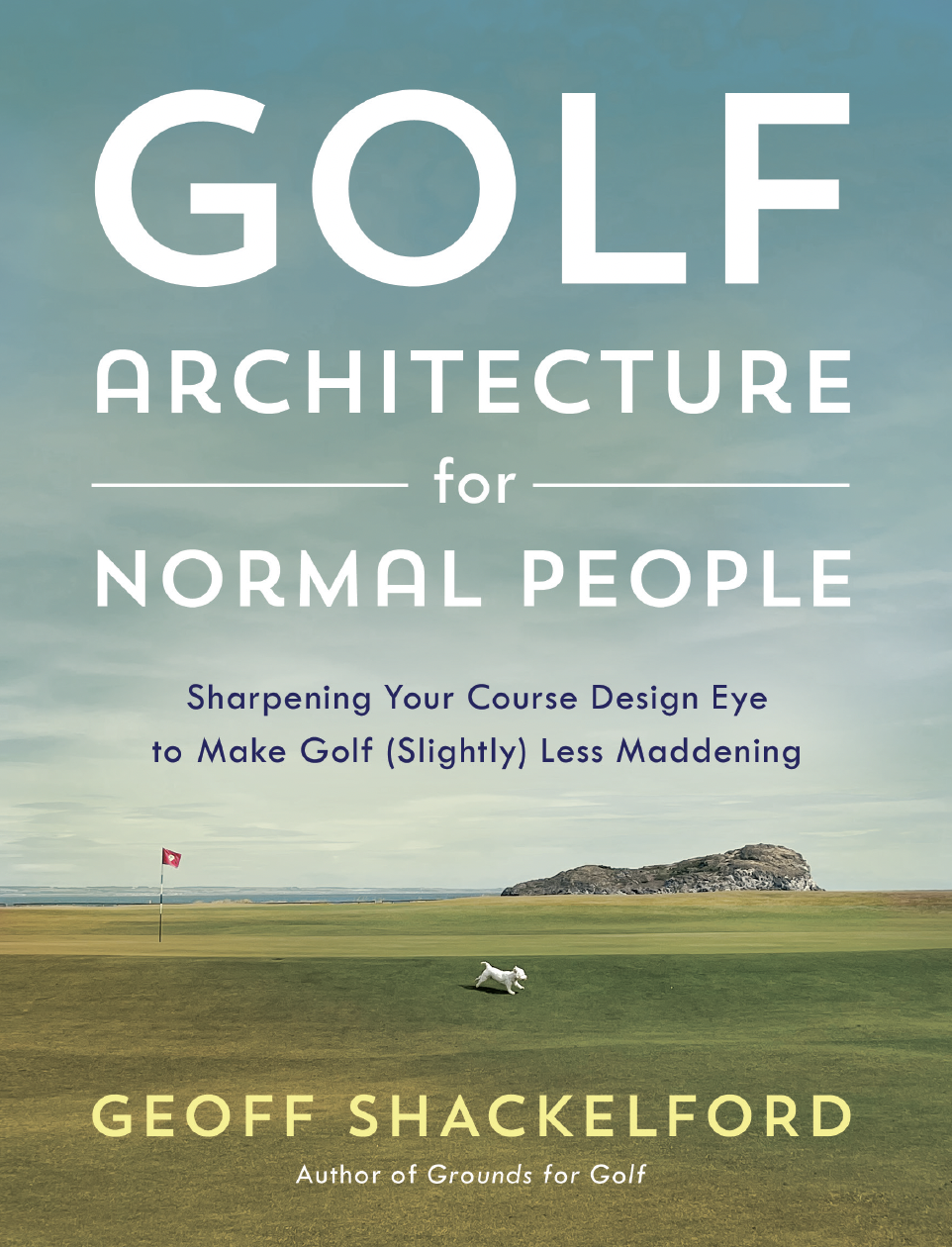
    Lines of Charm: Brilliant And Irreverent Quotes, Notes, And Anecdotes from Golf's Golden Age Architects
  • The Future of Golf: How Golf Lost Its Way and How to Get It Back
    The Future of Golf: How Golf Lost Its Way and How to Get It Back
    by Geoff Shackelford
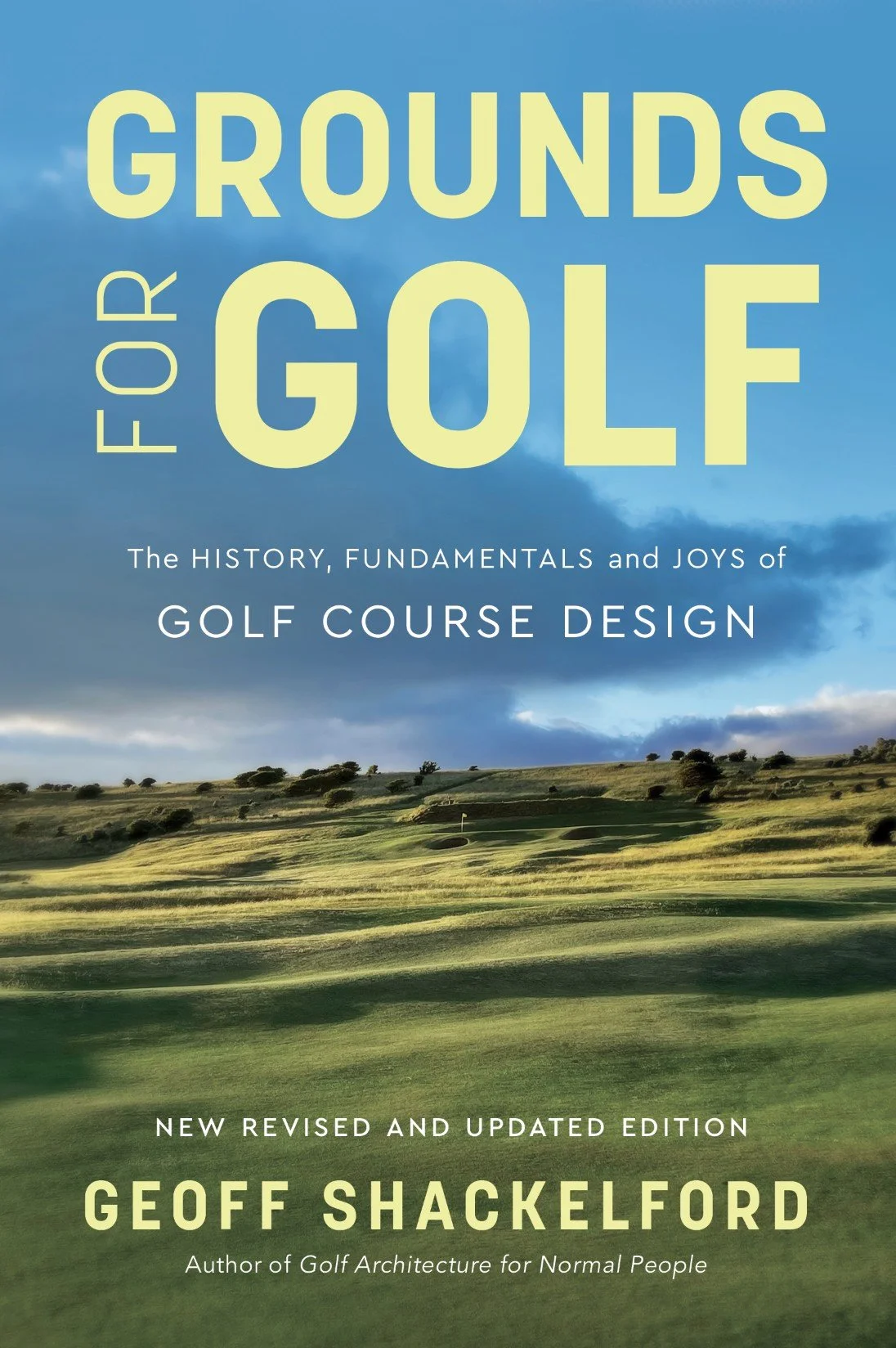
  • Grounds for Golf: The History and Fundamentals of Golf Course Design
    Grounds for Golf: The History and Fundamentals of Golf Course Design
    by Geoff Shackelford
  • The Art of Golf Design
    The Art of Golf Design
    by Michael Miller, Geoff Shackelford
  • Alister MacKenzie's Cypress Point Club
    Alister MacKenzie's Cypress Point Club
    by Geoff Shackelford
  • The Golden Age of Golf Design
    The Golden Age of Golf Design
    by Geoff Shackelford
  • The Good Doctor Returns: A Novel
    The Good Doctor Returns: A Novel
    by Geoff Shackelford
  • Masters of the Links: Essays on the Art of Golf and Course Design
    Masters of the Links: Essays on the Art of Golf and Course Design
  • The Captain: George C. Thomas Jr. and His Golf Architecture
    The Captain: George C. Thomas Jr. and His Golf Architecture
    by Geoff Shackelford
Current Reading
  • The Golf Courses of the British Isles
    The Golf Courses of the British Isles
    by Bernard Darwin
  • Don't Mess with Travis: A Novel
    Don't Mess with Travis: A Novel
    by Bob Smiley
  • Wonder Girl: The Magnificent Sporting Life of Babe Didrikson Zaharias
    Wonder Girl: The Magnificent Sporting Life of Babe Didrikson Zaharias
    by Don Van Natta Jr.

    The USGA's 2011 Herbert Warren Wind Book Award winner

  • The Big Miss: My Years Coaching Tiger Woods
    The Big Miss: My Years Coaching Tiger Woods
    by Hank Haney

    The ebook edition.

Classics
  • Golf Architecture in America: Its Strategy and Construction
    Golf Architecture in America: Its Strategy and Construction
    by Geo. C. Thomas
  • The Course Beautiful : A Collection of Original Articles and Photographs on Golf Course Design
    The Course Beautiful : A Collection of Original Articles and Photographs on Golf Course Design
    Treewolf Prod
  • Reminiscences Of The Links
    Reminiscences Of The Links
    by Albert Warren Tillinghast, Richard C. Wolffe, Robert S. Trebus, Stuart F. Wolffe
  • Gleanings from the Wayside
    Gleanings from the Wayside
    by Albert Warren Tillinghast
  • Planet Golf USA: The Definitive Reference to Great Golf Courses in America
    Planet Golf USA: The Definitive Reference to Great Golf Courses in America
    by Darius Oliver
  • Planet Golf: The Definitive Reference to Great Golf Courses Outside the United States of America
    Planet Golf: The Definitive Reference to Great Golf Courses Outside the United States of America
    by Darius Oliver
Writing And Videos
Blogs
Feedblitz
Enter your Email


Powered by FeedBlitz
« And Then There Were 15...Olympic Course Wannabe Designers | Main | Dawson: Tours Need To Open The Books On Disciplinary Action »
Tuesday
Apr192011

Someone Has Been Taking Malcolm Gladwell Too Seriously!

Thanks to reader Jeff for Michael Kruse's lengthy St. Petersburg Times story on Dan McLaughlin, an Oregonian who is testing the Gladwell-preached theory from "Outliers" that says with 10,000 hours of deliberate practice you can lift yourself from ordinary to excellence, even though McLaughlin was not a golfer prior to conceiving "The Dan Plan."

One wet, raw day last April, at the Broadmoor public golf course in Portland, Ore., Dan McLaughlin stood in the center of one of the greens. He wore running shoes, blue jeans and a yellow rubber raincoat. He wrapped his frozen fingers around a two-buck putter and hit one-foot putts, and he did that for two hours straight, stopped for a cup of hot, decaffeinated tea, then did it for two hours more. That's how this started.

On his 30th birthday, June 27, 2009, Dan had decided to quit his job to become a professional golfer.

He had almost no experience and even less interest in the sport.

What he really wanted to do was test the 10,000-hour theory he read about in the Malcolm Gladwell bestseller Outliers. That, Gladwell wrote, is the amount of time it takes to get really good at anything — "the magic number of greatness."

For those of you calculating at your workplace...

The Dan Plan will take six hours a day, six days a week, for six years. He is keeping diligent records of his practice and progress. People who study expertise say no one has done quite what Dan is doing right now.

There's a good reason for that.

PrintView Printer Friendly Version

EmailEmail Article to Friend

Reader Comments (36)

The Dan Plan is coincidentally the average US male internet porn consumption...
04.19.2011 | Unregistered CommenterTigerFanBoy
Gladwell's theory is based purely on anecdotal evidence and no statistical examination at all.
04.19.2011 | Unregistered CommenterDr. Fager
Read the book Talent Code, there is some of this hourly stuff in there, but is coincides with good training.

Good book
04.20.2011 | Unregistered CommenterJay Townsend
The 10.000-hour theory is idiocy in its purest form. After way less than 1.000 hours of bowling I averaged over 200 on a sport shot, but I could spend 100.000 hours with a hammer in my hand and still not figure out how to build a treehouse. There is this little thing called natural talent.
04.20.2011 | Unregistered CommenterHawkeye
We will find out in a few more years.
04.20.2011 | Unregistered CommenterMRP
Does Malcom mention whether or not the rule applies to singing? Because I have my doubts.
04.20.2011 | Unregistered Commenterhoghside
Hard to think of a strategy more ill-conceived & doomed than the Dan Plan. Obamacare? Bush's Iraq/Saddam invasion?
04.20.2011 | Unregistered Commenterputmedownfora6
It's Dan's approach to learning the game that I find...interesting. After digging through his blog, it appears that he's never played a hole from longer than 100 yards - and won't graduate back to hitting even short or mid-irons into the green until he's shown some level of competency at 100, 75, and 50 yards. Actually, if he's aiming to play the tour, he'll need to be as good as the average guy on the PGA Tour from each yardage, I'm assuming...and how do you gauge that accurately if your course doesn't reflect the conditions the guys on the Tour play?

Despite the questions (especially the ones around the research that's driving this), I'm very interested in the results. If nothing else, it'll speak to the effectiveness of his training methods.
04.20.2011 | Unregistered CommenterReverendTMac
Galdwell got the 10,000 hour rule from Talent is Overrated by Geoff Colvin. Colvin makes the case that to be world class at anything takes 10,000 hours of "Deliberate Practice" The key is "Deliberate Practice" To quote the book

" “Deliberate practice” designed to improve performance is the key. It includes continually stretching yourself just beyond your current capabilities. You have to identify the elements of your performance that need to be improved and work intensely on them and with repetition. That means using deep focus and concentration."

Most of us don't do Deliberate Practice, we practice what's fun. That's why you see guys "practicing" on the range hitting driver a hundred times instead of chipping and putting. Watch any tour pro practice - these guys aren't screwing around, they're deliberately working on specific parts of their games with their coaches.
04.20.2011 | Unregistered Commenter1puttit
Didn't Gabrielle Reese, a world class volleyball player, try something like this with Butch Harmon as her coach? Have not heard an update on her effort in years.
He'll need some proper knowledge to go along with his new found work ethic. Otherwise he could end up spending thousands of hours figuring out experientially what it might have taken him 2 hours to learn from the right source. No sense putting all that time in just to reinvent the wheel when it could be spent honing a sound technique.
04.20.2011 | Unregistered CommenterPJ
while he's at it he should bear in mind sean foley's latest snippet of wisdom about practicing barefoot, which "puts the weight to where he’s going to be in the safest and from there, all the mechanoreceptors in the feet, which are receiving the mechanics (cause) the legs fire better, gluts fire better, quads fire better, better stability,” (from Wei Under Par)
04.20.2011 | Unregistered Commenterthusgone
Idiot.
04.20.2011 | Unregistered Commentertlavin
As long as Dan works on the right stuff (no Stack and Tilt), he's on the right path. The proof is in the dirt.
04.20.2011 | Unregistered CommenterBob T.
That one would waste 10 minute *writing'* such crap is almost as amazing as someone reading it, and then being stupid enough to waste their liives doing it, and then actually telling people about it.. Singing is the proof, as if proof, rather that horse sense were needed.

I am reminded of an adage we told out kids growing up.

~*~*~*~"Just because you think of something, does not mean you have to say it out loud''*~*~*~*~
04.20.2011 | Unregistered Commenterdigsouth
If you want to get really good at golf you need to go back and start the game much earlier. The way to Carnegie Hall may be "practice, practice, practice" but it helps to be Issac Stern or Joshua Bell to start with. 1puttit gets it exactly right. My students tend to study what they already know because it makes them feel smarter. But that's not the way to get better.

As for Gladwell, I read one of his books once. Anecdotal claptrap enough for this and several other lifetimes.
About ten years ago there was an avearge golfer who won a sponsorship to devote an entire year become a pro. I don't think there was much progress at all and the project faded away.

I think the above reference to talent is important. Identifiy the natural talent first, and then commit to the 10,000 hrs.

Natural talent has more to do with body type, athleticism, emotion, mental fortitude etc. Screening for these natural attributes disqualifies 99% of us. The odds are overwhelming that this new guinea pig is one of us in the bottom 99th percentile.
04.20.2011 | Unregistered CommenterMarky Mark
Why all the hate? He's got three different coaches, no bad habits to break, and what, four more YEARS of 36 hour weeks of practicing? He's not saying WIN on the PGA, but simply make it. I'm betting, assuming excellent coaching, continued motivation for this six year grind and especially no injuries, he gets scrapes by to get his tour card.
04.20.2011 | Unregistered CommenterSW
Lets assume he becomes a plus handicaper. As a golfer, he would be in the top 1% of the worlds population. Thats a huge success.

His prospects as a professional still may be slim - but thats a reflection of his chosen industry not the theory.

One of the points of Gladwells work is that most of us don't put the work into our chosen profession, and are unable to capitalize when a once in a lifetime opportunity presents itself.
04.20.2011 | Unregistered Commenterdan
I think there are a few qualifiers needed here. First, my understanding of the 10,000 hours is not that the hours are required, but that there is a selection process. ( that is, in order to spend those hours a child usually has positive feedback from some success, and shows both a passion and a work ethic necessary to achieve "expert" status.) Assuming that Dan's experiment doessn't already invalidate the 10,000 hour theory 9 a big assumption, because the hours were decided upon before the sucesss, passion, etc...) it will be an interesting experiment. One has to wonder if the true purpose of this experiment is not to become an expert golfer ( again passion, committment etc.. towards golf) as much as to become an expert at self experimentation/documentation/writing about it afterwards for which i suspect he will be very expert at.

For those who seem to think the hours are a farce and talent is god given , I think that you overestimate what we are born with, and what we are able to make of ourselves, especially when our goals are simply getting better, as opposed to getting acclaim or riches. When athletes apply themselves to getting better because they are driven to do so, i think the 10,000 hour rule is excellant. If their goal is fame and fortune, not so much, as they rarely practice at acquiring fame and fortune for the 10,000 hours! in that case they are usually practicing the wrong thing!
04.20.2011 | Unregistered Commenteralan
OK, 10,000 hours is about 5 years of "full-time" work, which is probably long enough to become a competent professional at a lot of things. A neurosurgeon would still have a way to go (with full-time meaning 60-80 hours a week), this even after 12 years of school, 4 years of college, and 4 years of medical school. But neurosurgeon is an "outlier."

A more pertinent question: After looking at the picture of young Mr. McLaughlin, how many golfers with a handicap of less than 15 would be apparently leaning so far forward on a half-wedge shot and generally looking that stiff? Which is not to say he can't achieve his heart's desire. We all wish him well. And he is learning the Game from the hole back to the tee, as recommended by Harvey Penick. So he has that going for him.
Of course there is validity to the 10,000 hours of "deliberate practice." . . . Literally any kid who spends his Summers thoughtfully playing and practicing golf - with some reasonably solid advice occasionally - will become a near scratch golfer. . . (I was a club professional for 40 years and saw it happen every time.) To become a plus 7 handicapper (Tour caliber) player involves other factors (ability, focus in competition, experience etc.)

In "outliers" Gladwell writes about "unique experiences" and cites Bill Gates and Paul Allen as having more computer experience than any other math wizard teenagers in the world at that point in time (there were no personal computers when they were in high school.) . . . There are tens of thousands of kids worldwide gaining the "deliberate practice" golf experience - so glory and standing out will depend on other factors too.
04.20.2011 | Unregistered CommenterWisconsin Reader
I think I'm on SW's wavelength. It's no worse in theory than The Big Break.
04.20.2011 | Unregistered CommenterAunt Blabbie
If your doing it wrong for 10,000 hours do you have to start over?
The point of the 10,000 hour theory is that you need that much practice to become an expert. It's not that practicing for 10,000 hours will necessarily make you an expert. Those are two very different things.

Gladwell is saying that there isn't anyone that is at the top of any field that doesn't have at least 10,000 hours of experience.

As for golf, there are thousands of talented players with amble experience that aren't on the PGA Tour. (Look at the developmental tours).

As mentioned above, the right practice is critical to the success of this plan, as it would be with any profession. Of course, talent plays a larger role in arts and sport, which can only be learned to a certain degree.

Gladwell's point though is that talent alone isn't enough. That is, even the most naturally gifted golfer on earth needs 10,000 hours of practice to really know what they're doing.

As for the Gladwell hate above from AK, I don't think Gladwell ever sets out to prove any of his theories, he just looks at things from a different perspective and challenges widely accepted beliefs. I don't believe he "makes shit up" to sell books.
04.20.2011 | Unregistered CommenterAndrew
Good on 'em. Wish I had the sack to try it.


-LK
04.20.2011 | Unregistered CommenterLiquidKaos
I'm intrigued.

In the end I'd be willing to wager LARGE sums of $$$ that he will not make it to the tour but if he keeps this up for 6 years it will be highly interesting to see how good a player he can become.

Did you all know that Larry Nelson didn't start playing golf until he was 23? (stupid question, I know a lot of you know this!)
04.20.2011 | Unregistered CommenterDel the Funk
Seems that competitive experience would be needed as well, not just instruction and practice.
04.20.2011 | Unregistered CommenterMashie
Mashie, don't get ahead of yourself....that starts about the middle of year 4!!
04.20.2011 | Unregistered CommenterDel the Funk
A marketers perspective:

Only hustlers (gamblers) make a living playing golf. Tour pros are entertainers.

This guy has a platform (blog), a unique skill (his photography is amazing), a sponsor (Nike), and a speaking engagement under his belt after 1 year.

I promise he'll make a living 'playing' golf if he sticks with it for 5 more years.
04.20.2011 | Unregistered Commenterdan
LiquidKaos

"Good on 'em. Wish I had the sack to try it."

Right on.

LiquidKaos aint no bitter, lazy hater like some of you bitter, lazy haters. So it may not work even if everything goes perfect, you only have one life to live, choose well and work hard at what you choose.
04.20.2011 | Unregistered CommenterCalvin Coolidge
At least it's not Charles Barkley giving this a try.
04.20.2011 | Unregistered CommenterChuck
I've been following Dan's project for a few months now, and I'm impressed with his thoughtfulness and commitment. As one expert said (I think the guy is a psychologist), "He's the right astronaut for this mission."

That said, I think the 10,000-hours number should be viewed as a necessary but not sufficient condition for achieving mastery.

In my mid-20's I embarked on a similar journey in a different field, and I was ultimately persuaded that talent is also a necessary but not sufficient condition.

I am totally, enthusiastically supportive of the guy, and I'm dying to find out just how good he'll become. If he stays with it, I'd bet he becomes a +1 or +2, a good college-level golfer but perhaps not the best player on a D1 team.
04.20.2011 | Unregistered CommenterCBell
>>> If he stays with it, I'd bet he becomes a +1 or +2, a good college-level golfer but perhaps not the best player on a D1 team.

So where's the story in that? 10 years of non-stop practice for that? There are thousands of good college level golfers.
04.20.2011 | Unregistered CommenterDr. Fager
If you read the book - the starting point of that discussion was a group with natural talent.

The elite among them had the natural talent PLUS 10,000 hours of working hard to improve their craft. The elite in any field are the "talented" ones that worked harder than all the talented others. In most instances they are also the ones where they were presented an "opportunity" too.
04.21.2011 | Unregistered CommenterIan Andrew
That dude's quit everything he's ever tried thus far.
This will be no different.
04.21.2011 | Unregistered Commenterredneck

PostPost a New Comment

Enter your information below to add a new comment.

My response is on my own website »
Author Email (optional):
Author URL (optional):
Post:
 
All HTML will be escaped. Hyperlinks will be created for URLs automatically.