

3rd Annual Golf Channel State Of The Game Highlights
/In a bold move toward sustainability, the Golf Channel abandoned 2012's Southwestern pottery motif and 2011's bocce balls, instead buying up the stock of a local succulent nursery for the third annual "State of Tiger's Game" discussion. With concise chats about Rory's problematic equipment change and Tiger's quest to catch Jack, the discussion moved to the hot button topics of anchoring and bifurcation.
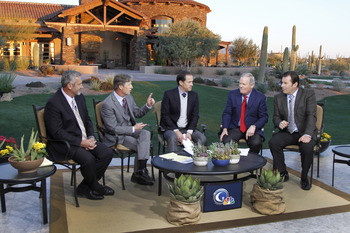 Photo: Mike MooreThe governing bodies might want to bottle some of this transcript. Dan Hicks asked Johnny Miller and he made a totally different case than he did in this week's conference call. This time, he confirmed that anchoring is in indeed an advantage for some:
There's no doubt about how The PGA of America feels about this. My question to you, Johnny: Is there any kind of scenario that you can envision, the USGA backing off this stance? It would be pretty remarkable if they did. It do you see anything like that happening?
JOHNNY MILLER: Well, it's going to be awkward for them if the TOUR decides to allow it, isn't it. It's going to be really awkward.
The belly putter and the anchored putter, does really three things for a player. The upper hand keeps the face from opening, twisting. Also with it anchored, it keeps you from going like that and pushing it and like that and pulling it. And then anchoring here gives you a perfect swing plane.
So it actually does three things for you, that when your putter is normal like this, you can do all three things wrong, and when you're anchored, it eliminates those three. So if a kid starts really young and he's got a lot of talent like a Rory or a Tiger, it probably is an advantage.
But in the spirit of game, I was the first guy to win with a putter up the arm, which is going to be legal if they keep it the way it is now. I did feel like it was not in the spirit of the game. I felt like I was sort of ‑‑ I probably shouldn't have been doing it even though it was legal. And these guys are even anchoring, and I used to just put it up the arm.
I think the game is bigger than all of this. The game is bigger, either way it goes the game is bigger.
Which I believe translates to, it should be banned and the game will move right along. Sir Nick?
SIR NICK FALDO: That's what I thought and you go back to history and it's called a golf swing, it's not called a golf hinge, or you know, so I agree with all of that.
And I thought the R&A wrote it up really well. I thought, how are we going to get this clear to us, and in 20 words they basically said you could not anchor it or hinge it. I thought they did a great job on that.
Now as time has gone by in these couple of weeks or couple of months, and we look at what's been happening over the last ‑‑ guys have been using this for 30 years. And then Keegan Bradley then Tweets the picture I then saw from the clubhouse at Riviera of a gentleman back in about 1929 with the thing anchored there (indicating touching upper chest). So, wow.
I would like us to stick with the true traditions of the game, because it's called a golf swing and that is part of the uniqueness and the skill of this game. But I can fully see that ‑‑ how, you know, as we are saying, youngsters come out of college and they put this ‑‑ they see it in the pro shop and off they go, they have never tried anything else.Now I may have softened a little bit. The one I do look at is this, fellas, it looks you ugly to me, it doesn't look like a golf swing, we are going like this. It doesn't look like a golf swing at all.
So if they are going to soften a little bit, maybe the belly ‑‑ then that's a compromise, and I don't think we are ever in this game to compromise the rules.
So we'll put Nick down as supporting the ban, too.
 Brandel Chamblee...
People that say the USGA didn't present a good enough case to say that it was, in fact, an aid. All you need to do is look at before and after of Orville Moody, who was, God bless him, a great ball‑striker and a marvelous guy, but maybe the worst the putter that ever played golf for a living. And then he led the Champions Tour in putting.
All you need to do is look at Adam Scott's history at Augusta National. He never averaged under 28 putts until he put the long putter in the bag, and he did; and he finished second. He played in 40 majors without a long putter and he's had four Top‑10s. And he's played in eight since he put the long putter in the bag, and he's had four Top 10s since then and two second place finishes.
And just even look further at who switches to it. Nobody is switching from a long putter to go from good to great. They are looking at it to go from horrible to average.
So I think the USGA if they needed to go further, they could hire an engineer, to build, to Johnny's point, to build something with multiple hinges to sort of duplicate how complicated it is with all those multiple hinges versus just one hinge. It is far easier. It should not be allowed at the professional level.
Won't it be awkard if the PGA Tour goes against the ban and you have three top commentators so vocally and eloquently calling out the anchoring method?
I wasn't sure where Nobilo stood to be honest, but here's what he said:
So I think most people agree, that this was wrong 30 or 40 years ago; that they should have done something about it and they didn't. So here we are 2013, and we have an opportunity, especially the professionals of today, to be remembered for more than guys just playing in this great age where they are playing for a lot of money. They can be remembered, their legacy can be: They put the game back on track.
Then the discussion turned to bifurcation of the rules and Dan Hicks tried his best to figure out where Johnny and Nick stood, but the man can only do so much...
What are your feelings on two separate groups of rules for amateurs and professionals now?
SIR NICK FALDO: I agree with Frank. If somebody came down from space and looked and said, this is our ‑‑ and we presented this is our game of golf, and we have got this amazing history we go back from 1860 from when the first Open Championship was played and Tom Morris and all those boys and where we are now. I think we are all so proud of our game and would like to be the custodians and look after it and pass it on in the spirit of how it really was, not spirit is not the right word; in the way it was deemed to be played.
DAN HICKS: So we go by the same rules?
SIR NICK FALDO: I would have thought so.
We had a really good case for ‑‑ with Gary McCord and Peter Kostis a couple weeks ago, and Finchie and David Feherty, and they were all very much leading their case.
It's a mess. The bottom line is it's a mess. They have got themselves in a real mess of a situation.
DAN HICKS: Johnny, what about you on bifurcation? It's a sensitive, very sensitive subject.
JOHNNY MILLER: Sort of like changing the Constitution, one state, like Texas or something, you know.
DAN HICKS: Other sports have different rules, there's the aluminum bats in college baseball.
SIR NICK FALDO: Same shaft, same swing.
DAN HICKS: Isn't that something special about the game of golf, that you compete with somebody, share a USGA handicap and then go about it in kind of the same fashion. You think you're kind of playing with a professional in the same kind of level.
SIR NICK FALDO: A good old Pro‑Am. You have one guy doing this and an amateur can't do that.
DAN HICKS: That's the mess you're talking about.
JOHNNY MILLER: What about the majors? You have The PGA of America saying, we would like to be able to do whatever you want with the long putter, and the USGA and R&A decide not to do it, you are playing majors and ‑‑
SIR NICK FALDO: The amateur, can all do whatever he likes, and then professional do whatever he likes, and the amateur has to play by the rules. And that means men then the major would have to overrule it, say, because we are open to amateurs and professionals. Well, we are going to have to make our own ruling for the week.
Okay, well back to the coherence world, Brandel makes his case.
People say that the best thing about golf is it's governed by one set of rules. That's an opinion. It's not a fact.
The fact is that golf is flat. Growth is flat. The fact is that golf is too expensive, takes too long. It's too elitist and it's too complicated. If in one foul swoop, if you add bifurcation at the professional level, you could roll golf equipment back and you could roll the core back, the Coefficient of Restitution. You could roll it back and you could disallow the anchored putter.
You could allow all those things at the amateur level. You could shrink golf courses back to two decades ago. You make golf cheaper, you make it faster, and I promise you, nobody quits golf because two different sets of rules govern it.
Nobilo then dared to suggest the topic no one wants to touch, that the equipment manufacturers have not made the game more accessible or affordable, so why should bifurcation change that?
It basically supports the theory that we have let manufacturers take the game to a different level. That's the thing. Manufacturers used to make incredible equipment. I think the late Carlson Simon (ph) did a great job for the average player to bring the price of equipment down and make sure the average amateur was fitted like the best pro but it's just taken off to a new level.
That's why it has become more expensive but personally I believe that's more of a public golf discussion; that we should have more public golf courses but that's totally different.
Maybe we'll get to that next year! I'm sparing my readers of the Vijay discussion. Because I'm a nice guy.









