Kroichik On Distance, Masters Ball Possibility

Ron Kroichik looks at the possiblity of a ball rollback, a "Masters ball" and offers all sorts of interesting tidbits about a distance rollback:

Sandy Tatum barely hesitates before answering in the affirmative. Tatum, the former United States Golf Association president and patriarch of Harding Park's renovation, joins Jack Nicklaus in suggesting the USGA "roll back" the distance the ball can travel. Woods and his big-hitting colleagues on the PGA Tour routinely smack drives more than 300 yards, taking golf into once-unimaginable frontiers.

It's either a thrilling joyride (many fans), a fundamental affront to the game (traditionalists such as Tatum) or an unwelcome threat to booming business (elite players and golf-ball manufacturers).

Tatum begins his sermon with this premise: The ball goes too far. The faster a player swings, the greater the benefit from technology. Drivers with club heads triple the size they were 15 years ago collide with balls specifically designed to soar into the stratosphere.

"It puts the game seriously out of balance," Tatum recently said. "You get more emphasis on power and less on shot-making. The stats will tell you, accuracy is no longer anywhere near as important as distance."

And...
These kind of numbers help explain why Chairman Hootie Johnson felt compelled to try to keep Augusta National "current with the times." He lengthened the course for the second time in five years, but only after hinting club officials might force players to use a "uniform ball" in the Masters, one unlikely to travel such prodigious distances.

That option still exists for Johnson and his colleagues in Augusta, but even then it would apply only to the Masters. The USGA and Royal & Ancient Golf Club, the game's governing bodies and rules makers, do not favor the idea of a uniform ball.

"That's not in the cards, for the same reason a baseball player doesn't have the same bat as any other player," said Dick Rugge, the USGA's senior technical director. "It's personal equipment suited to each player."

Rugge nonetheless elevated this long-simmering debate into another realm in April 2005, on the day after Woods won the Masters. Rugge sent an e-mail to manufacturers, inviting them to participate in a research project by making balls that travel 15 and 25 yards shorter than current models.

This would not be a uniform ball, because players still could arrange their own specifications (launch angle, spin rate, etc.). But the ball would not fly as far, exactly the kind of rollback Nicklaus and Tatum are advocating.

Rugge, in a phone interview last week, said the USGA expects to receive prototype, reduced-distance balls from manufacturers "very soon." Rugge and his staff -- 18 people in all, including six engineers -- will then embark on extensive research to determine how those balls would affect the game.

"To some people, it's as simple as a shorter ball," Rugge said. "I can tell you from our research, it's a much more complex issue than that."

 And...

Top players, not surprisingly, are cool to the idea of limits on technology. Woods, asked earlier this year about the ongoing chatter about a uniform ball, practically scoffed, saying, "I don't think it's realistic at all. Do you realize what that would do to the golf-ball industry?"

Gee, think he has a lucrative endorsement contract?

Mickelson similarly downplayed the possibility of a uniform ball. As for rolling back the ball, he said, "I don't think we'll ever get to that point," though the USGA's impending research project suggests it's possible. Woods, interestingly, seems open to rolling back the ball.

For now, technology rolls forward on several fronts. The USGA recently proposed a "liberal limit" on so-called moment of inertia, to address the modern drivers that create good shots even with imperfect contact. Rugge said a final decision will be made in the coming months.

In the coming days, all eyes will turn to Augusta and the stretched-out course awaiting Woods, Mickelson and their brethren. They will arrive armed with the finest equipment available, ready to tackle the beast. There will be much talk about those 4-plus miles of Georgia landscape -- and not as much talk about the little white balls at the center of the action.

The Donald Comes To Aberdeenshire

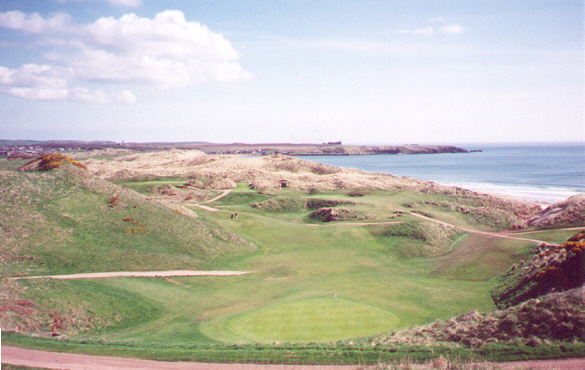
It reads like an April Fool's Day joke (£14 million pounds to build 36 holes on dunes!?), but here are the gory details on The Donald's plans for his Scottish development:

The development, which will be known as Trump International Golf Links, Scotland, will be comprised of two championship golf courses, a five-star hotel with associated facilities, a state-of-the-art golf academy and a turf grass research centre. The development will also include a mixed use residential element.

The courses will be Donald J. Trump Signature Designs, in association with Tom Fazio, nephew of the legendary American golf course architect Tom Fazio, and his firm, Tom Fazio II, LLC. The land, which is set among towering dunes beside the North Sea, has been acquired. Planning and permitting is underway and work is scheduled to commence by September 2006, with a course opening scheduled for spring 2008.

"Mr Trump was committed to identify a world-class traditional links site in the Home of Golf and Menie Estate was chosen because it satisfies all of the strict project criteria set out by The Trump Organization," said Ashley Cooper, executive vice president, Acquisitions and Development for The Trump Organization. "Our goal is to create the greatest links golf courses in Scotland as part of a golf development that will become the finest in Europe, if not the world."

And this, courtesy of reader Steven T.:

The final cost of the project is estimated to be more than £287million, although that will depend on the outcome of a planning application to be submitted to Aberdeenshire Council in May.

The company said last night that the Menie Estate had been chosen ahead of 200 other sites in Europe, reviewed by the billionaire property mogul himself over the course of five years.

Mr Trump is said to have been "overwhelmed" by the sand dunes and coastline, which he hopes to turn into "the greatest golf course in the world".

Senior figures in the golf and leisure industries, as well as Aberdeenshire Council and other economic organisations, called it a major coup and an "unbelievable" opportunity for the north-east.

Scottish Enterprise Grampian said the project would contribute an estimated £157 million to the economy over the next 10 years and create up to 400 jobs.

But Scottish Natural Heritage, which was consulted about the site late last year, has already expressed concerns because it is a protected area of special scientific interest.

The Trump Organisation promised the finished article would "set new standards in the home of golf".

And...

Geoff Runcie, chief executive of Aberdeen and Grampian Chamber of Commerce, described the news as "fantastic", adding that it would boost visitor numbers, raise the region's profile and rectify the absence of a trophy golf course.

"This will put the region in line to host high-profile championships in the future - having a course that could secure the British Open would be excellent," he said.

The Peper Files

Another gem from the "When Good Editors Move To St. Andrews and Don't Care Anymore" Files, has Links Magazine columnist George Peper dismantling the claim that Jones and MacKenzie would approve of recent Augusta National changes.

This appears to be another sign that the club's pre-tournament media offensive has backfired.

Let’s face it. If Jones and Mackenzie had been cryogenically preserved and brought back to life, they’d take one look at what has happened to their course and head straight back to the freezer. Augusta National is no longer a Jones/Mackenzie course—it’s a Jones/Mackenzie/Clifford Roberts/Perry Maxwell/ Robert Trent Jones/George Cobb/John LaFoy/George Fazio/Joe Finger/Byron Nelson/Jay Morrish/Bob Cupp/Jack Nicklaus/Tom Fazio course—and in the process of all that revision the guys at the wheel have, to borrow a Scot’s expression, lost the plot.

Hootie, if you think your founding architects would approve of what you and your predecessor chairmen have wrought, it’s time you started reading something other than putts. Pick up a copy of Mackenzie’s The Spirit of St. Andrews, written in 1932, the year he completed Augusta National.

Peper goes on to look at various holes, contrasting the changes that have taken place with MacKenzie's own writings.

Hansen On Treviso Bay

Tom Hansen writes about the latest Florida TPC course at Treviso Bay:

Gray leans over his dusty, green Land Rover and expands the rolled-up drawings. [Arthur] Hills and [Hal] Sutton have already collaborated on the layout of the course. They used aerial photos to create the potential masterpiece.

That's a new one...I wonder if they've ever met?

Gray explains that the 1,050-acre project is actually four parcels of land. One parcel, called B, won't be developed for several years.

"People don't realize how big this development is," he said.

The 7,200-yard course will occupy the south end of the project. It stretches almost to State Road 951. The golf course will be separated from most of the housing development by the wetlands. Only 40 estate sites will be for sale on the golf course.

"It's going to be pretty core golf," Gray said.

We had core golf, now we have "pretty core."

Tiger On Sawgrass Setup

More from Tiger Woods after Sunday's final The Players Championship, before it becomes THE PLAYERS:

TIGER WOODS: Since I've played here, I've never liked the way they've set it up with the rough high because the golf course wasn't meant to be played that way. I've talked to Pete Dye, and it wasn't meant to be played that way. It's supposed to be hard and fast and all the palmetto bushes are supposed to be coming into play. When we played the Amateur here in '94 that's the way it was, but they've cleaned it up and changed the golf course and changed, I think, how Pete wanted it initially to be played.

Hopefully when we come back here in May, it will be playing like that. Hard and fast is great, but six, eight inch rough, I don't think that's the right combo.

Whitten: Augusta 2006 v. 2001-2002

Golf Digest's Ron Whitten criticized recent changes to Augusta National in the same story featuring the comments of Arnold Palmer and Jack Nicklaus. His criticism is not that astonishing to most given that the same remarks have been uttered by big mouths like me since 1998.

However, when you see where Whitten stands now compared to where he stood just four years ago, the contrast is pretty amazing.

Here's what he wrote this year: 

But sheer yardage is not what has gotten Jack, Arnie and others of the Old Guard riled up. They're mostly upset about the tightening of many holes, through the use of expanded bunkering, transplanted trees and the introduction of rough, what Augusta National calls, in delusional parlance, "a second cut of fairway."

This is where Jack and Arnie are absolutely right. Far from maintaining the integrity of the design that Jones and Mackenzie envisioned, the changes undertaken since 1998 have abandoned their philosophy of multiple options and different lines of attack.

And...

Gone are Augusta's wide corridors that allowed every competitor to play his own game off the tee, to pick the spot he thought provided the best angle of approach for his trajectory and shot shape. Squeezed-in fairways now dictate the manner of play on every hole. It's as if the Masters Committee thinks it's now running the U.S. Open.

Which makes one wonder just how much research Augusta National has really done regarding the original Mackenzie-Jones design. Mackenzie believed that if a good player hitting good shots couldn't post a good score on one of his courses, then there was something wrong with his design. Jones once wrote that he never intended Augusta National to be a punishing golf course.

Jones and Mackenzie believed in rewarding risk on the golf course. Most of that is gone now.

And...

The best course designs challenge different golfers on different holes. Augusta National used to do that. It no longer does.

The club planted many mature loblolly pines along the left of No. 7, too, just because it can, I guess.

The irony, of course, is that Augusta National used to be the trendsetter in matters of course design. But now it's well behind the curve.

The older pines at Augusta traditionally had a bed of pine needles beneath them, which allowed players to attempt all sorts of recovery shots. The newer pines have rough underneath, deeper than the "second cut," and are planted so close together that the only recovery available is usually a pitch out. It's one more example of how Augusta has stifled some playing options.

Now, here's Whitten in a 2001 Golf Digest preview:

The new look of Augusta National--the one with a buzz-cut of rough around each fairway and most greens--was first introduced in 1999, but few noticed a big difference. Last year, however, it had players playing defensively, pundits writing offensively and TV viewers adjusting their contrast. Few cared for it, and many blamed it for the lack of drama.

Wrong. Cold weather and high winds were responsible for the conservative play in 2000. Augusta National's grooming is just another attempt to Tigerproof the course, although club officials will never admit it. They won't even call it rough, preferring to label it a "second cut" of fairway.

Rarely has so much fuss been made about so little. The rough is just 1 3/8 inches deep, not the sort that causes anyone to pitch out sideways. Sure, it's enough to cause a knuckleball that has no chance of stopping on a rock-hards green. But Masters competitors are smart, talented and well equipped. They can pick a ball cleanly out oflight rough, use the grooves on their irons--or avoid the rough in the first place.

What Augusta's rough has done is make the Masters more of a test of drives and second shots, and less of a putting contest. Last year's winner, Vijay Singh, had three three-putts, more than the combined total of the previous seven Masters champions. But he lead the field in greens in regulation, and won by three shots. For the 2001 Masters, the strategy will be the same: fairways and greens.

And in the 2002 preview story for Golf Digest he wrote about the sweeping changes being made, including the tree planting and narrowing that he's currently criticizing...

What impressed me was the thought process that came up with new strategies for the course, a thought process that started right after Tiger Woods' record-setting first Masters victory back in 1997. Since then, Augusta National officials, working with consulting architect Tom Fazio and his team of associates, have tracked shots on selected holes during every Masters. The resulting data convinced them that they shouldn't simply push tees back to gain length, they should also move tees left or right to force players to hit certain shots on certain holes.

So last summer, using four separate construction crews, the club added nine new back tees. They also regraded some fairways into new sweet spots. They pushed some fairway bunkers farther out, so they can't easily be carried.

Augusta National will be much more of a shotmaker's golf course from now on. It won't automatically favor the long hook as it did in the past. The first, eighth, 11th and 18th holes now require fades off the tee, then draws into the greens. The ninth, 10th, 13th and 14th still reward draws from the tee, but on 13 and 14, fades are the preferred approach shots (though it's hard to hit a fade on 13, because the fairway provides mostly hook lies).

And...

I was pleased to see the 18th has been stretched to 465 yards, adding 60 yards to the uphill finishing hole. As a major-championship finish, it finally measures up.

Have all these changes "Tigerproofed" Augusta National? Not at all. But they may have Hal Sutton-proofed the course. Long hitters will continue to have the advantage on holes like nine, 10 and 14, where, even with new back tees, big bombers will still be hitting no more than 9-iron approach shots into greens where Arnie and Jack used to routinely hit 6-irons.

Long hitters at Augusta will work harder to hit fairways from now on, especially on the tight, tree-lined seventh and ninth, where, as one Augusta National employee put it, "It's like trying to hit through the neck of a Coke bottle."

What club officials wanted to do at the seventh, now 45 yards longer, was take the 3-wood out of players' hands and force them to hit a driver down the narrowest fairway. (It's just 35 yards wide from tree line to tree line, with the fairway a scant 28 yards wide.) The club also leveled the fairway to eliminate a slingshot effect offered by old ripples in the center, and added a few more pines left of the fairway.

It's not likely many players will take the bait. Most will continue to thread the needle with something less than driver and hit an 8- or 9-iron (instead of sand wedge) onto the perched green.

The real additions to the ninth are newly transplanted pines to the right and a mat of fluffy pine needles beneath them. A loose lie in pine needles may be the worst lie you can find at Augusta National. There's already a lot of that "pine straw" to the right of the 14th hole, where the fairway slopes from left to right. I was told that for this year's Masters, there won't be any cut of rough along that right side of either nine or 14. They don't want anything saving errant drives from rolling into pines and needles.

Mark it down. Augusta National is no longer just a hooker's paradise, or a second-shot course or a putting contest. It's now a complete test of golf, from tee to green. It's now a shotmaker's course.
It is great to see someone like Whitten change his mind and use his position in Golf Digest to voice those views. It's just unfortunate that he did not recognize the damage when it was first inflicted on Jones and MacKenzie's national treasure.


Augusta v. Sawgrass Renovations

Golf World's Bill Fields looks at the complaints surrounding Augusta's latest renovation and seems prepared to join the critics questioning the rationale and execution of the changes.

At what point does an icon, instead of aging gracefully and naturally, get his face stretched so taut that he becomes a parody of his former self?

Ouch. After citing Mike Weir's reasoned critique as reported last week by Ken Fidlin, Fields has this interesting quote from Mark O'Meara:

To add intrigue, 1998 Masters champion Mark O'Meara is against a reflex to add yardage. "The most talked about holes in golf in the last two years," O'Meara says, "are the shortest holes in golf. They create the most havoc with the best players. Sixteen at Doral, 10 at Riviera, 12 at Augusta. It's the short holes that make a player have to think. If you want to mess with the pros, make them have to make a decision."

Regarding Sawgrass, he picks up on a subject discussed here earlier this week:

In addition to the better turf that will come with Sawgrass' renovation, Woods, for one, would like to see the course much like it was when it first opened. "I've talked to a lot of guys about this," Woods said a year ago at the Players, "and we've all come to the same conclusion: It would be a lot better if there was no rough at all, like how it used to be played … but they've kind of changed that and gone to a U.S. Open-type setup."

And he sums it in a way that gives the impression he's not too optimistic about the chances of Augusta removing its second cut:

With so many young players, who because of their tools, technique and temperament are swatting the ball one way -- hard -- there is all the more reason to offer variety in the courses they encounter. An Augusta National -- without rough, with options -- was the beau ideal. New applicants are now welcome. 

A Blueprint For...?

Steve Elling talks to Arnold Palmer about possible changes to Bay Hill in response to modern day driving distances, something that first came up in his Sunday NBC interview.

Also on Palmer's might-do list is an overhaul of the sixth hole, a par-5 that curls like a semicircle around a large lake. After watching a couple of players blow 300-yard drives across the pond and hit short-iron approaches into the 558-yard hole, he wants to move the green back a few yards. "I think he'll mess that hole up if he does," Retief Goosen said. "I don't think he should mess with 6 -- it's a great hole as it is. It's all about excitement and going for that green [in two] and you'd see more guys laying up."
And this...
His two-year experiment with longer rough seems to have been a mixed bag. By forcing long hitters to play from the fairway, he placed a bigger value on shotmaking. But he also widened the number of potential winners.

Sunday, Palmer wasn't necessarily buying the argument that he had opened the door for pack of middle-tier players at the expense of the big boys like Woods, Vijay Singh and Ernie Els -- all long hitters with lengthy pedigrees at the course. Nor did he necessarily agree that he had retreated to a setup that could produce more winners such as Paul Goydos and Andrew Magee, journeymen who each claimed their lone and biggest tour titles, respectively, at Bay Hill.

If Palmer reins in the bashers, on balance, he likely will have to accept a few middle-tier players as winners.

"You are saying that, I'm not saying that," Palmer said when the notion was posed. "I can't answer that. I don't know. I honestly thought that Tiger would do well [he finished 20th], that this would be a good week for him."


Was Palmer Kidding Around?

Did anyone catch the Jimmy Roberts interview where a grinning Arnold Palmer talked about changing two of Bay Hill's par-5s to 4s and moving the sixth green based on Bubba Watson's play?

I thought he was joking, but the NBC crew seemed to think he was serious.

It would be somewhat ironic that he criticizes Hootie Johnson for so radically altering Augusta in response to the ball, while doing the same at Bay Hill.

Ermergence of Tribal Courses

Bruce Selcraig writes about the emergence of tribal courses in the New York Times. Included was this quote:

"I think the tribal courses are probably the single most impressive force in golf architecture over the last 10 years," said Ron Whitten, Golf Digest's architecture critic. "I've been impressed with every one."
I smell a new list!  America's Best (Native American) Tribal Courses?