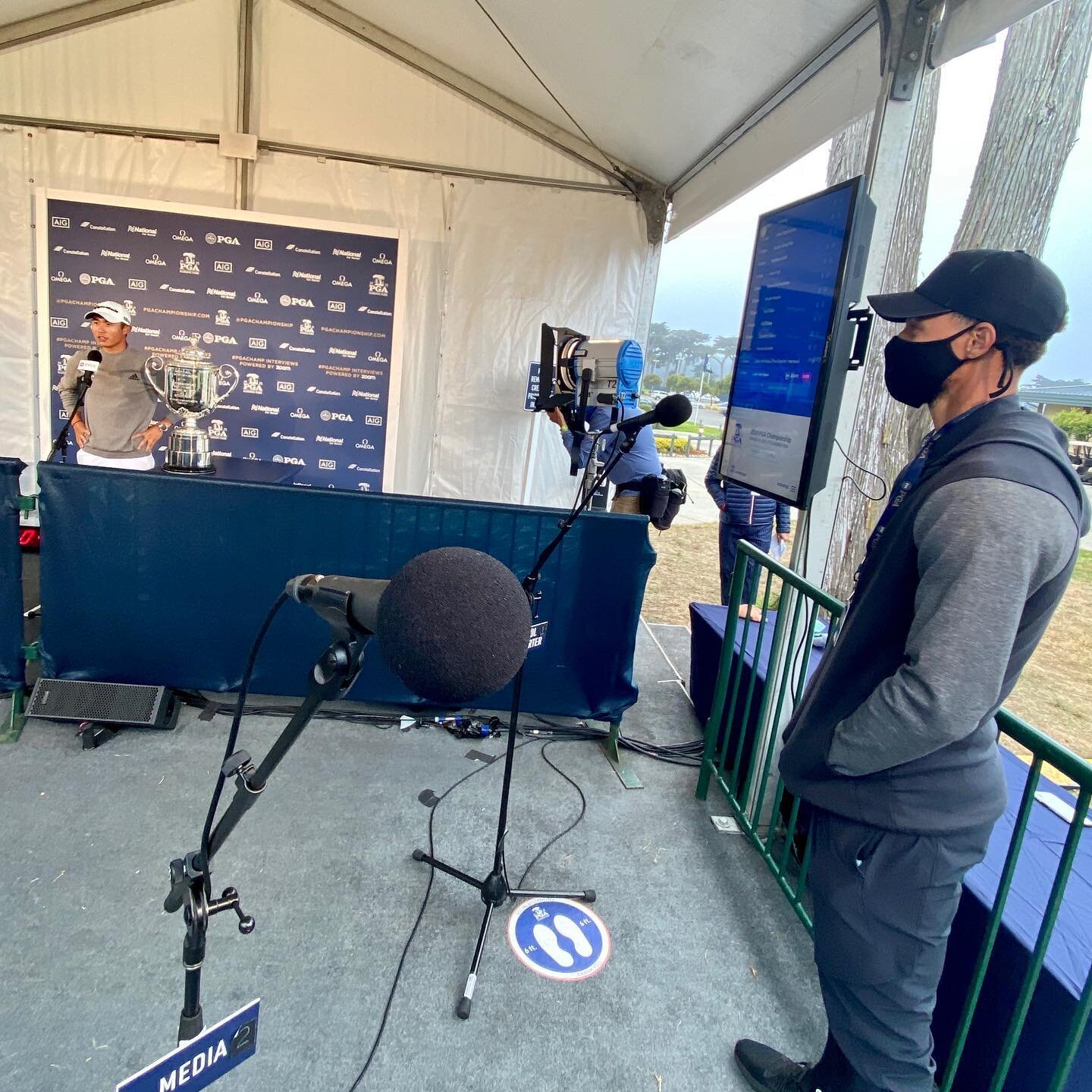
Ernie's Press Conference

Thought this exchange was interesting from Ernie Els's sitdown with the scribblers:

Q. Kind of curious just where you are in your overall life right now. We've seen with a lot of great players that they transition at some point; Nicklaus moves into the design business, Arnold Palmer moves into the business. Can you talk about that? Not the specific ventures that you're doing, but if you're finding it a challenge to balance that with your golf, et cetera?

ERNIE ELS: Yeah, it's true. You get other interests at some point, and I would say the last two years those interests have become kind of a business, you know. You've got to be careful.

Golf is still my life. That is the core of my life. And without golf I couldn't see myself sitting in an office right now and doing those other things that we are busy with. I've got people in place that are running those different interests. I'm basically sitting back and they're reporting back to me, which is kind of a nice situation to be in. But before I got to this situation where I am now, you had to set it up. And it takes time and it takes a bit of concentration. I wouldn't say that it affected my game. I would say the time that I had off away from the game gave me a lot of time to do those different things.

So I think it's pretty well set up right now, and as I said, golf is everything for me now. I've got a good ten years to do what I've always wanted to do. I'm really just 100 percent playing golf right now.

Q. 100 percent golf?

ERNIE ELS: Yeah.

 

H.S. Colt Dream 18

230136-396979-thumbnail.jpg
(click on image to enlarge)
SI
has given me the okay to reproduce the Golf Plus "Dream 18s" for your limited viewing pleasure here.

(Limited, because my copying and scanning and resizing skills aren't very good).230136-396996-thumbnail.jpg
(click image to enlarge)

And trust me when I say that Gil Hanse's maps look better in print, but you get the idea here with his H.S. Colt style drawing.

For SI subscribers, the full text is available online. 


R&A Bites Back

David Hill, the R&A's director of championships, on Ron Whitten's Golf Digest critique of Hoylake:

"It would have been nice if he had played the course. We would then have had more respect for the comments he made," said Hill.

"I think the week of the championship will tell if his comments were inaccurate or accurate.

"We would not have come back if we didn't think it was of the highest standard. It's in first-class condition and the top-class players coming here will enjoy it.

"Obviously, we're hoping for the variation in the weather that is the main protection of all links courses and what makes them such great challenges."


And Hill's defence of Hoylake was seconded by BBC golf commentator and former leading player Ken Brown.

"Nearly all traditional links courses are old-fashioned. That's not derogatory in my mind, it's traditional - how golf should be played," said Brown.

"It's an unsung, wonderful links course."

You may recall it was Brown who confronted Tom Fazio at Augusta this year about the changes made there. 

Spontaneity

After Phil Mickelson's comments last week about knowing in advance what clubs he would be using off of tees, I tried to raise the question of whether this is a sign of the times, or a statement about course setup and design.

And as interesting as it was to read the Phil-hitting-driver-on-18-debate, I'm still curious what you think of the notion of "spontaneity" in course setup.

Is it a better test of a player's skill if they are forced to adapt to either via (A) weather conditions or (B) radical day-to-day changes in tee/hole location placement?

Obviously, by the leading nature of that question, I think we see true skill when players are asked to adapt and execute shots "on the spot."

When a player is made uncomfortable by an unexpected decision (as opposed to a 25-yard sliver of fairway), and overcomes that doubt to pull off a shot, again I think we find out who the better all-around player is.

So if they are asked to hit 3-iron on a hole for two days before surprisingly finding a tee up with a 7-iron the shot to a difficult hole location, it would seem that such a departure genuinely would tell us who can "hit all of the clubs in the bag."

Do you agree that spontaneity in course setup is a good thing, or would you view it as a form of trickery trying too hard to match the unpredictability of links golf (and that can only be created without a backlash by Mother Nature)?

To Play The Scottish Open?

John Huggan wonders if it's a good idea to play the Scottish Open on mushy Loch Lomond before turning to links golf at the Open Championship.

Famously, Tiger Woods has never felt inclined to make his way to the bonnie banks, preferring instead to warm up for the game's oldest and most important event on the links of Ireland with various friends and assorted millionaire bookmakers. And many have followed suit, or are going to. Take Michael Campbell.
"For about the past five to six years, I have been playing the Scottish Open the week before the British Open, but not this year," said the 2005 US Open champion only the other day. "Unfortunately, Loch Lomond is not the ideal course to hone your game in readiness for a British Open.

"It is just common sense to warm up by either practising on a British Open host venue or on a similar links-type course. Phil Mickelson has already been over to Hoylake getting used to the course and that's what I will be doing."
And... 

...it is the softness and invariable wetness of the beautiful Tom Weiskopf-designed layout that is keeping them away. Four days of hit-and-stick golf is hardly the best preparation for the fast-running links that is Hoylake. Think chalk and cheese.

Add in the fact that top-level golf is these days hardly ever played by the seaside and the case for absenting oneself from the undoubted charms of Loch Lomond is a tough one to answer. Like it or not, the game's best players are increasingly a one-dimensional bunch. It isn't that they are not capable of playing the wide variety of shots called for on a humpy-bumpy links; they are. It is more that, on circuits and courses that more and more offer the exact same challenges and shot-values week after tedious week, they are simply not called upon to do so. With neglect comes less competence.

Huggan On Doak

John Huggan visits with Tom Doak and chats about his latest project in Scotland. Thanks to reader Mark for the heads up. This was interesting...

"I really try to ignore the advances in equipment when it comes to my work. The truth is that it has no effect on the vast majority of golfers. If you are more than say 10-handicap, the new clubs and balls have made little or no difference to your game. Your technique isn't good enough or your swing fast enough to derive any real benefit.

"Then again, if you spent every weekend watching the tour players, you'd be convinced everyone hits the ball 350 yards, and that par-4s need to be almost 600 yards long to make them hit more than a mid-iron into greens. That's not 99.9% of the golf business. But, unfortunately, a lot of my clients watch television and they think that, should the tour players come to their course, they want Tiger Woods to respect it."


Crenshaw On Prairie Dunes, Minimalism

Ben Crenshaw at the Senior Open Saturday:
Q. Jim Thorpe mentioned that you talked a lot at breakfast today about how the greens used to be here until they made the changes, about how this course actually was early on.

BEN CRENSHAW: There haven't been any changes on the greens, really. The first two greens we redid in 1986, but it's so minor. The contours themselves have been here. One nine was built in' 37, the other nine was in '57, so they're original. They're fascinating. Nobody would have the heart to touch these. They're magnificent.

Q. Would anybody build a golf course like this these days? I mean, even

BEN CRENSHAW: If anybody got a piece of property like this, I hope they would. I hope they would try.

Q. (Inaudible.)

BEN CRENSHAW: No, it's not. And they could still, you go out and look at the course and it's it shows you how timeless his work is and how much he did not want to impose himself into this piece of land. It's fascinating how he routed this. How he routed the original nine. You look at that and you go, wow, that's unbelievable.

Q. But don't you think architecture has changed back to this style of golf course?

BEN CRENSHAW: You have a lot of

Q. With dunes and sand hills?

BEN CRENSHAW: Well, you're right. You have a lot of young architects that are seeing the value in it, and that's an understatement. Because if you do it like this, it's economical. It's vastly economical.

Q. Less land, less moving dirt.

BEN CRENSHAW: Yeah. Take a good piece of land and work with it. It's going to be economical and it's going to be more natural.

Q. Are you finding owners coming to you asking you to look for land more and more?

BEN CRENSHAW: Yes. Yes. Not in droves, no. Not in droves. But we have some calls that people want sort of a quiet golf club on a nice piece of terrain and not much else, which is nice. After all, that's why we play golf. And so we just that's what we try to do is try to pick good pieces of property and then have hopefully have the freedom to do a nice routing before anything happens. That's what we enjoy doing.

Q. How much do you limit yourself to the amount of work that you guys are involved in at a certain time?

BEN CRENSHAW: Oh, quite a lot. We do one or two at a time, so. Two is plenty for us. We have a little small crew and we like to go around, but that's what we enjoy spending the time on.

Q. When you're working now, I mean do you almost try to even though you have all the equipment at your disposal, do you almost try to envision what it was like with the mules and that?

BEN CRENSHAW: Yes, very much so. You get the movement. I mean we talked, you know, until we're blue in the face about getting the movement.

Knowing Club Selection In Advance

Heres what Phil Mickelson had to say about his club selection on 18 at Winged Foot while meeting with da medja in Chicago:

Fortunately what I have found has helped me play well or have that type of performances these past years in the majors is that I've done the prep work beforehand and I know what club selection I'm going to hit off each tee, given weather conditions, whether it's raining, whether it's hot or not. I already know and have known for weeks in advance what clubs I'm got to hit off each tee, so it's helped me approach the tee box with confidence knowing what club I'm going to hit.

It helped me when I hit the driver on 18 at Baltusrol on the last hole and ended up making a birdie. It helped me at The Masters knowing what club and what driver I was going to hit off each tee, and it helped me at the U.S. Open. Unfortunately I didn't execute the way I wanted to.

But it has erased a lot of the doubt as to the decision-making, what club am I going to hit, what club should I hit. I already know weeks in advance, and it helps me hit those shots and visualize those shots in practice before I ever show up the week of The Open.

Now, we have debated Phil's two-driver concept at Augusta here and here and here.

But I'm wondering if his ability to select clubs in advance says something about the state of the game.

This is not a technology question, but I believe one about the state of course setup and course design.

Is there something wrong with setups and designs when a player of his magnitude (and others like him) know what they will be hitting on holes well in advance of tournament time?

Or to put it another way, is the golf more interesting and testing if the design and setup create decision-making situations that can not be made in advance?

Wind and the player's philosophy play a role in this, but isn't there something seriously wrong when some spontaneity is missing from the major championship equation?

I was both elated and troubled by Mike Davis's decision to announce the alternating of tees during the U.S. Open. Elated that he was doing it, troubled that he was giving everyone advance notice.

Don't we learn who is most skilled by finding out who can handle a club selection and playing strategy question under pressure?

Enough rambling...your thoughts? 

High Praise For Prairie Dunes

Harold Bechard in the Hutchinson News says the players love Prairie Dunes talking to Bob Charles, Tom Watson and Ben Crenshaw.
"It's just a work of art, nothing short of a work of art," said Crenshaw, the tour's resident historian. "It's so unique. There's nothing like it in this country, really. With this course, any person from the British Isles would come and say, 'Oh My God, I'm home' with all these undulations and sandhills."
I'm not so sure about this though...
Crenshaw, like Tom Watson, loves the setup of the course with its narrow fairways, high rough and slick, unforgiving greens. Now the only thing missing is the wind, which kicked up to about 20 miles per hour at midday but was about half that strong in the early evening when the players and fans were called off the course because of the threat of severe weather.

Lorne On Links

Lorne Rubenstein shares a few thoughts on Hoylake and also writes about some favorite links holes in Canada.