The Bridge: "more of an overflow from Atlantic"

Alex Williams writes about The Bridge for the New York Times' Sunday Styles section. The story focuses on The Bridge's anti-country club attitude, complete with appearances by rappers and Smokey Robinson and a hideous looking clubhouse to prove the point.

country.395.jpg(Yes that's it in the top half of the photos linked from NYTimes.com.) Williams writes:

The 18-hole golf course gets an arty, postmodern treatment: ruins of the old racetrack, including guardrails and flag stations, pop up around the lush fairways. Discarded tires line the cart paths.

And forget about blue blazers. At the Bridge backward ball caps, jeans and even tattoos or face piercings (typically on guests in the music business) attract no steely stares.

In short, the Bridge — despite $600,000 membership fees, which make it one of the most expensive clubs in the country — is an anti-country club of sorts. It is not just the first high-end club in America that dares to be hip but, seemingly, the first one that cares to be hip. Hipness, after all, is not a sensibility typically associated with the sort of middle-aged Gulfstream-flying plutocrat who can write a half-million-dollar-plus check to join a private club. To many a traditional mogul, joining a country club is a statement that he has arrived on the inside. Who would want to spend all that money to look like an outsider?

And this is debunks the myth created by the story...

Not everyone in the Hamptons, however, accepts the notion that style is why people are joining the Bridge. Andrea Ackerman, the manager of the Brown Harris Stevens real estate offices in Southampton and Sag Harbor, said that the Atlantic Golf Course in Bridgehampton “was the answer to every golfer’s prayer who wanted to belong to a great golf club and couldn’t,” but now even the Atlantic is full, and moneyed golfers are simply clamoring for the next open spot they see. “The Bridge is more of an overflow from Atlantic than Shinnecock or Maidstone,” she said.
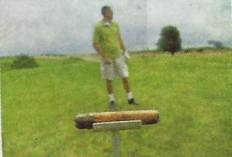
cigarholderSadly missing online is the photo of the driving range cigar holders.

But thanks to my scanner, I've included the coyote turd holder for your viewing pleasure. 

Dawson To Carnoustie: Get Brown

Mike Aitken writing in The Scotsman:
Carnoustie has been instructed by the Royal and Ancient to turn off the sprinklers and prepare a links for next summer's 136th Open championship which echoes the brown of Royal Liverpool rather than the lush greenery of Augusta.

Well aware the last Open held at the Angus course in 1999 was the most controversial of recent times - the test was so difficult the players dubbed the links "Carnasty" and Paul Lawrie's winning score of 290 was six over par - the R&A has also pledged to monitor the conditioning of the course over the next 12 months and ensure there is no repeat of the penal high rough which lined narrow fairways at the 128th Open.

At Hoylake yesterday morning, Peter Dawson, the chief executive of the Royal and Ancient, was asked if he shared the concerns of those who regard the presentation of the Angus links as the polar opposite of the fast, running course which hosted the most recent championship. Although it looked beautiful, Carnoustie was perhaps too verdant earlier in the season. It almost seemed as if the links had become a venue better suited to hosting the US Open, the pinnacle of narrow fairways and high rough, rather than the seaside game played on the ground at the Open.

Dawson replied: "Interestingly, we have had conversations with Carnoustie on exactly this point. They've turned the sprinklers off for us over the past few weeks and we're going there next week to see how brown it is.
 
"We think Carnoustie is a terrific venue, a great golf course which will put on another fantastic Open. But I must be honest and say we have a view that it could be a bit drier. Not that it's soft. It's just not as hard and fast as one would traditionally like to see."

And what's our favorite in-house architect for a governing body doing at Carnoustie?
Dawson also confirmed the changes at Carnoustie to the third, sixth and 17th holes. "We've worked on three holes. The third has been re-configured quite substantially. On the 17th, the right hand side of the driving zone has been mounded. At the last Open there that was a flat area covered by rough. Since the rough has been taken away and re-turfed, it didn't grow back very well. So we put in mounding. And the bunkering on Hogan's Alley has been adjusted."

Tell Me What You See

I promise, that's the last obscure Beatles reference in a post title.

230136-404284-thumbnail.jpg
Aerial View Of No. 17 (click image to enlarge)
Anyway, the miracle that Google Earth is, the Hoylake aerial photo is not out of focus as I originally thought, but very much in tact and showing...yes, the old 17th green that was taken out by Donald Steel a few years ago.

Playing as the first hole in this year's Open Championship, the original 17th was an H.S. Colt-designed number perched on Stanley Road, where the occasional putt on the back portion of the green could conceivably roll out of bounds.

SI Golf Plus readers know that we featured it as the finisher on our recent Colt Dream 18, in part to highlight one of the great architectural crimes of the new century.230136-404293-thumbnail.jpg
No. 17 and Stanley Road (click on image to enlarge)

230136-404297-thumbnail.jpg
No. 17 up close (click on image to enlarge)
Imagine how fun it would be if they returned the original routing at Hoylake to not only put back the infamously difficult finish written about by Darwin and company, while also returning a genuine road hole that would give Hoylake the classic hole that it currently lacks.

Key word there, imagine. Because it probably won't happen. 


Watson On Links Golf

Someone is obviously working on a story about links golf. Tom Watson after finishing 2-under for the first 36:

Q. Chris DiMarco was talking about the state of the course, and compared to the courses in the U.S., the courses in the U.S. are so soft; you can hit a driver and no way it's going to stop. And hit a wedge over here, you can't hit a driver?

TOM WATSON: You have to think on this golf course. You have to think where you want to put the ball. And there are certain holes where length really is important, length that I don't have. But there is a game plan that everybody has to have, that everybody uses on this golf course. The number one game plan, stay out of the bunkers.

Q. Do you think courses like this are the way to tackle the greater length that players are getting at?

TOM WATSON: Well, I think so, I do. I think to a degree. But if you're a little bit off on a golf course like this, it can eat you for lunch. You don't recover from the fairway bunkers. That's the leveler in this golf course, the bunkers.

Q. Chris was saying it's the first time in a long time he can remember hitting 3 wood off the tee. Normally on the PGA Tour he hits driver 14 times out.

TOM WATSON: This is different golf. This is a hard, firm golf course. That's the way The R&A would like it to be. When they had the greens like they had on Monday, we were really seeing some funny scores out there. They were tough on Monday. They decided to soften those greens up a little bit.

Q. Did the rain hurt you at all?

TOM WATSON: No.


DiMarco On Links Golf

After his impressive opening 36:
Q. In an ideal hypothetical annual schedule for you golfers, what would the ratio of these kind of courses to typical American courses be to your schedule?

CHRIS DiMARCO: I'd like to see more of these in the States, I really would. It's so much fun to play. I know TPC was meant to be played like this course, hard and fast, the ball running into the pine straw and into the trees and into some of those moguls they have out there, instead of the rough being seven inches and you just chop it out. Tampa plays a lot like that. Tampa is a great course, one of the favorites of all the players because of that. It's such an equalizer, because it doesn't favor the bombers if the fairways are hard and fast, because it makes the ball run into the trouble.

And when we're playing courses where the ball is hitting and literally your ball mark is a foot from your ball, it makes the fairways that much wider. And Vijay said it last year or year and a half ago, whatever, he said he has to hit it as far as he can on every hole because then he can hit a wedge on the green from the rough.

Until we do something about it, it's not going to make any difference. Until you have the balls go 20 yards off line, they might not hit drivers. For me, I was just telling Geoff today, Ogilvy, I said, it seems like it's been a long time since I ever hit a 3 wood off a par 4 tee. I feel like I hit 14 drivers, every round of golf we play, every course we play, because it seems every course we play it's 300 yards longer and the fairways are soft. And when you've got six par 4s over 470 with no roll, you have to hit driver.

Ernie's Press Conference

Thought this exchange was interesting from Ernie Els's sitdown with the scribblers:

Q. Kind of curious just where you are in your overall life right now. We've seen with a lot of great players that they transition at some point; Nicklaus moves into the design business, Arnold Palmer moves into the business. Can you talk about that? Not the specific ventures that you're doing, but if you're finding it a challenge to balance that with your golf, et cetera?

ERNIE ELS: Yeah, it's true. You get other interests at some point, and I would say the last two years those interests have become kind of a business, you know. You've got to be careful.

Golf is still my life. That is the core of my life. And without golf I couldn't see myself sitting in an office right now and doing those other things that we are busy with. I've got people in place that are running those different interests. I'm basically sitting back and they're reporting back to me, which is kind of a nice situation to be in. But before I got to this situation where I am now, you had to set it up. And it takes time and it takes a bit of concentration. I wouldn't say that it affected my game. I would say the time that I had off away from the game gave me a lot of time to do those different things.

So I think it's pretty well set up right now, and as I said, golf is everything for me now. I've got a good ten years to do what I've always wanted to do. I'm really just 100 percent playing golf right now.

Q. 100 percent golf?

ERNIE ELS: Yeah.
 

H.S. Colt Dream 18

230136-396979-thumbnail.jpg
(click on image to enlarge)
SI
has given me the okay to reproduce the Golf Plus "Dream 18s" for your limited viewing pleasure here.

(Limited, because my copying and scanning and resizing skills aren't very good).230136-396996-thumbnail.jpg
(click image to enlarge)

And trust me when I say that Gil Hanse's maps look better in print, but you get the idea here with his H.S. Colt style drawing.

For SI subscribers, the full text is available online. 


R&A Bites Back

David Hill, the R&A's director of championships, on Ron Whitten's Golf Digest critique of Hoylake:

"It would have been nice if he had played the course. We would then have had more respect for the comments he made," said Hill.

"I think the week of the championship will tell if his comments were inaccurate or accurate.

"We would not have come back if we didn't think it was of the highest standard. It's in first-class condition and the top-class players coming here will enjoy it.

"Obviously, we're hoping for the variation in the weather that is the main protection of all links courses and what makes them such great challenges."


And Hill's defence of Hoylake was seconded by BBC golf commentator and former leading player Ken Brown.

"Nearly all traditional links courses are old-fashioned. That's not derogatory in my mind, it's traditional - how golf should be played," said Brown.

"It's an unsung, wonderful links course."

You may recall it was Brown who confronted Tom Fazio at Augusta this year about the changes made there. 

Spontaneity

After Phil Mickelson's comments last week about knowing in advance what clubs he would be using off of tees, I tried to raise the question of whether this is a sign of the times, or a statement about course setup and design.

And as interesting as it was to read the Phil-hitting-driver-on-18-debate, I'm still curious what you think of the notion of "spontaneity" in course setup.

Is it a better test of a player's skill if they are forced to adapt to either via (A) weather conditions or (B) radical day-to-day changes in tee/hole location placement?

Obviously, by the leading nature of that question, I think we see true skill when players are asked to adapt and execute shots "on the spot."

When a player is made uncomfortable by an unexpected decision (as opposed to a 25-yard sliver of fairway), and overcomes that doubt to pull off a shot, again I think we find out who the better all-around player is.

So if they are asked to hit 3-iron on a hole for two days before surprisingly finding a tee up with a 7-iron the shot to a difficult hole location, it would seem that such a departure genuinely would tell us who can "hit all of the clubs in the bag."

Do you agree that spontaneity in course setup is a good thing, or would you view it as a form of trickery trying too hard to match the unpredictability of links golf (and that can only be created without a backlash by Mother Nature)?

To Play The Scottish Open?

John Huggan wonders if it's a good idea to play the Scottish Open on mushy Loch Lomond before turning to links golf at the Open Championship.

Famously, Tiger Woods has never felt inclined to make his way to the bonnie banks, preferring instead to warm up for the game's oldest and most important event on the links of Ireland with various friends and assorted millionaire bookmakers. And many have followed suit, or are going to. Take Michael Campbell.
"For about the past five to six years, I have been playing the Scottish Open the week before the British Open, but not this year," said the 2005 US Open champion only the other day. "Unfortunately, Loch Lomond is not the ideal course to hone your game in readiness for a British Open.

"It is just common sense to warm up by either practising on a British Open host venue or on a similar links-type course. Phil Mickelson has already been over to Hoylake getting used to the course and that's what I will be doing."
And... 

...it is the softness and invariable wetness of the beautiful Tom Weiskopf-designed layout that is keeping them away. Four days of hit-and-stick golf is hardly the best preparation for the fast-running links that is Hoylake. Think chalk and cheese.

Add in the fact that top-level golf is these days hardly ever played by the seaside and the case for absenting oneself from the undoubted charms of Loch Lomond is a tough one to answer. Like it or not, the game's best players are increasingly a one-dimensional bunch. It isn't that they are not capable of playing the wide variety of shots called for on a humpy-bumpy links; they are. It is more that, on circuits and courses that more and more offer the exact same challenges and shot-values week after tedious week, they are simply not called upon to do so. With neglect comes less competence.

Huggan On Doak

John Huggan visits with Tom Doak and chats about his latest project in Scotland. Thanks to reader Mark for the heads up. This was interesting...

"I really try to ignore the advances in equipment when it comes to my work. The truth is that it has no effect on the vast majority of golfers. If you are more than say 10-handicap, the new clubs and balls have made little or no difference to your game. Your technique isn't good enough or your swing fast enough to derive any real benefit.

"Then again, if you spent every weekend watching the tour players, you'd be convinced everyone hits the ball 350 yards, and that par-4s need to be almost 600 yards long to make them hit more than a mid-iron into greens. That's not 99.9% of the golf business. But, unfortunately, a lot of my clients watch television and they think that, should the tour players come to their course, they want Tiger Woods to respect it."


Crenshaw On Prairie Dunes, Minimalism

Ben Crenshaw at the Senior Open Saturday:
Q. Jim Thorpe mentioned that you talked a lot at breakfast today about how the greens used to be here until they made the changes, about how this course actually was early on.

BEN CRENSHAW: There haven't been any changes on the greens, really. The first two greens we redid in 1986, but it's so minor. The contours themselves have been here. One nine was built in' 37, the other nine was in '57, so they're original. They're fascinating. Nobody would have the heart to touch these. They're magnificent.

Q. Would anybody build a golf course like this these days? I mean, even

BEN CRENSHAW: If anybody got a piece of property like this, I hope they would. I hope they would try.

Q. (Inaudible.)

BEN CRENSHAW: No, it's not. And they could still, you go out and look at the course and it's it shows you how timeless his work is and how much he did not want to impose himself into this piece of land. It's fascinating how he routed this. How he routed the original nine. You look at that and you go, wow, that's unbelievable.

Q. But don't you think architecture has changed back to this style of golf course?

BEN CRENSHAW: You have a lot of

Q. With dunes and sand hills?

BEN CRENSHAW: Well, you're right. You have a lot of young architects that are seeing the value in it, and that's an understatement. Because if you do it like this, it's economical. It's vastly economical.

Q. Less land, less moving dirt.

BEN CRENSHAW: Yeah. Take a good piece of land and work with it. It's going to be economical and it's going to be more natural.

Q. Are you finding owners coming to you asking you to look for land more and more?

BEN CRENSHAW: Yes. Yes. Not in droves, no. Not in droves. But we have some calls that people want sort of a quiet golf club on a nice piece of terrain and not much else, which is nice. After all, that's why we play golf. And so we just that's what we try to do is try to pick good pieces of property and then have hopefully have the freedom to do a nice routing before anything happens. That's what we enjoy doing.

Q. How much do you limit yourself to the amount of work that you guys are involved in at a certain time?

BEN CRENSHAW: Oh, quite a lot. We do one or two at a time, so. Two is plenty for us. We have a little small crew and we like to go around, but that's what we enjoy spending the time on.

Q. When you're working now, I mean do you almost try to even though you have all the equipment at your disposal, do you almost try to envision what it was like with the mules and that?

BEN CRENSHAW: Yes, very much so. You get the movement. I mean we talked, you know, until we're blue in the face about getting the movement.