The Future: Relatable Golf?

On the news that ratings were actually up for this hardly satisfying 2007 Masters, I've heard from a number of people that they argued with friends over the weekend about the setup and the joys of watching great players suffer.

There is a sizeable audience of the viewing public that enjoys watching the best players struggle. They like seeing them humiliated and brought down to a lower level of skill.

"They know how I feel now."

This mentality has been around a long time and many of the games lesser-informed writers have celebrated the notion of pro golfers serving as modern day gladiators served up for the people to devour in humiliating spectacles. 

So I'm wondering if championship golf is going to go the way of everything else in our society. Will it have to become "relatable" (as the marketing folks like to say) for big-time golf to succeed? In other words, will professional golfers eventually serve at the pleasure of the people, with major events played to publicly humiliate millionaire golfers on overcooked layouts in order to make the average man feel better about his lousy game?

Personally, I find it to be an incredibly selfish way to view golf. It's a lot more fun to see the talent of these great players exposed, celebrated and savored. But maybe that's old school?  Thoughts?

L.A. Times Public Golf Special Section

230136-763160-thumbnail.jpg
Colorization of a historic Griffith Park clubhouse photo by Tom Naccarato (click to enlarge)
The L.A. Times has published a meaty special section today on L.A. public golf. It includes my plea for a restoration of George Thomas's Griffith Park restoration and my architectural critique of 10 great values. and five overrrated layouts.

There's also Daniel Wexler's guide to historic courses and his look at desert golf.

There's also Tiger's memories of SoCal golf and Thomas Bonk looks at the renovated Torrey Pines South.

Peter Yoon covers the impact of internet-based tee time reservation systems.

Glenn Bunting talks to Dave Pelz.

And the editors make their picks for the best of SoCal golf.

"The course was certainly as firm as most (British) Open venues"

I don't know what these guys watched, but the last four days, the fairways at Augusta didn't look that firm and fast to me.

The greens did, but not the fairways.

Anyway, Brian Hewitt at TheGolfChannel seems to be reaching with this one:

It’s my contention Jones and MacKenzie gleefully would have told the second-guessers that this 71st Masters played much more like an Open Championship than a U.S. Open.
 
This notion began incubating in my brain early in the week when defending champion Phil Mickelson came off the course and explained the difficulty of the green complexes and their putting surfaces. It’s not so much reading the break that’s hard, Mickelson said. It’s figuring out exactly where the ball is going to stop rolling.
 
This, of course, is exactly what links golf is all about. And the more of this Masters I watched, the more I became transfixed by the troubles the best players in the world were having getting their golf balls to stop where they wanted them to stop on and around the greens.

"The course was certainly as firm as most (British) Open venues," Doak informed me. "Some people think it's impossible to keep it that firm and have it green, too. But it is possible if you have enough money to hand-water the dry spots. And Augusta certainly has the resources to follow through.

Well, I suppose if you think some British Open venues of late have been way too soft and green, yes! 

"This is what we've been looking for," Fazio said.

Ed Hardin looks at Tom Fazio's changes to Augusta National in light of this year's setup and shares two very revealing quotes.

First, from Ben Crenshaw:

"You feel like the course is going to get you somewhere," the two-time champion said. "It doesn't matter who you are."
Translation: way too much chance is involved. The course is playing the players, instead of the players playing the course (with apologies to Walter Hagen).

But this is just sad: 
Above it all, standing near the spreading live oak atop the grand course, Tom Fazio had a gleam in his eye.

"This is what we've been looking for," Fazio said.

And there you have precisely why I have no respect for Tom Fazio as an architect. We have a tournament where the focus is on him, the committee, the setup and the changes, not the players and the joy of the patrons.

It's all about him.

And we know the great architects do not want it to be about them. They want it to be about the players and in the case of Augusta, a celebration of the game. That's what Bobby Jones and Alister MacKenzie were all about. That's why they're still revered, and why Tom Fazio's place in the game will not looked upon kindly. 

Master Plan

Now posted at thegolfchannel.com of all places is my Links Magazine feature on how some of today's up-and-coming architects would approach and Augusta National master plan. If you don't subscribe to links, you should, because you missed the gatefold spread showing some of the different architect renderings. There's also a version of the story on the Links site.

Trees Have A Habit Of Growing...

I remember walking Augusta in October of 2003 and noticing that not only would the new trees between 15 and 17 look silly and trample all over Jones and MacKenzie's vision, but based on the planting locations, it appeared that no one considered what would happen when the trees actually...grew!

Well, here we are four years and Lord knows how many man-hours spent handwatering them, and the pines have grown.

Imagine what they'll be like in another four years.

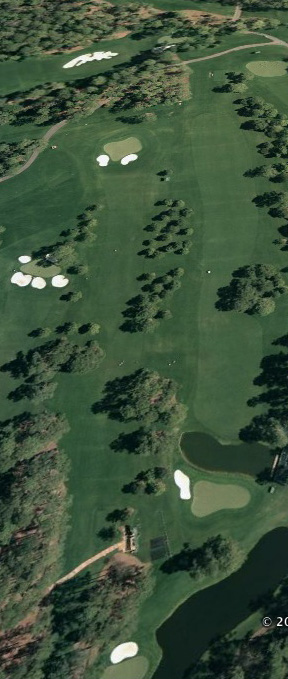
augusta15_17above.jpg augusta15_16.jpg

Above Augusta, No. 11 Then and Now

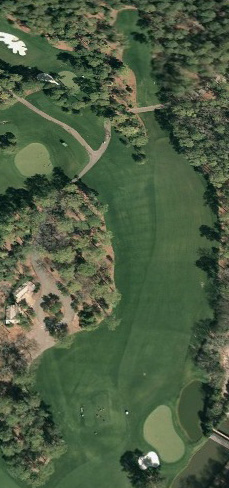
Reader Andrew suggested on another post that we check out Google Earth's Augusta National images for an eye-opening look at the recent changes. The Google photos appear to have been taken in 2005 before last year's horrific new grove on No. 11 debuted, but after the decision had been made to force tee shots down the left side. (I still say this is the easier side to approach the green since you are hitting over and away from the worst trouble...)

Anyway, here are the now and then views courtesy of Google Earth and Golf Digest's recently posted photos:

augusta10_11.jpgaugusta11above.jpg 

Huggan, Ogilvy Declare Their Love For Augusta Course Changes

That's the closest you're going to get out of me for an April Fool's Day shtick.

augusta10_11.jpgActually, John Huggan uses his Scotsman On Yet Another Dreary Sunday Scotland On Sunday column for a nice trashing of the dismal course changes, but with so many new fresh insights thanks mostly to guys named Ogilvy/Ogilvie.

In what is nothing less than a direct and disrespectful contravention of Mackenzie's and Jones' original and delightful philosophy, the Augusta National that will this week host the world's best golfers resembles nothing more than just another one-dimensional country club. Aerial photographs published in the April issue of Golf Digest graphically portray the tragedy that is the modern Augusta National. In place of what were once spacious and tightly cut fairways, rough has been grown and trees have been planted. What was once the most democratic of courses - one that allowed every standard of player to figure out his own way of playing each hole - has become a golfing Zimbabwe, a misguided dictatorship that has all but eliminated freedom of thought and expression.

Ah, we're just warming up.

Where once professionals as diverse as, say, Tom Kite and Seve Ballesteros - the scientist and the artist - could compete on equal terms at Augusta by playing almost every hole in ways that had almost nothing in common, today every player stands on almost every tee attempting to answer the same question and, in turn, hit the same shot.

In other words, virtually every semblance of strategy has been removed.

Today, the paucity of the landing areas, rather than the player, decides how each hole will be played. At Augusta, the spirit of St Andrews is no more.

"I couldn't understand why, at the Masters last year, [former chairman] Hootie Johnson said that he wasn't sure that Augusta National should be fun," says US Open champion Geoff Ogilvy. "That was a very strange thing to say! He is just not right."

Now now Geoff, you forgot. It was all about Hootie. And fun for Hootie was protecting his pride with a high winning score. It's okay, you were a rookie last year.

"Augusta has a lot to answer for, getting the whole world obsessed with really fast greens," contends Ogilvy, who grew up within walking distance of Royal Melbourne. "They have lost a lot of pin positions with that policy. I bet they used to have a lot more variety.

"I would like to see Augusta's greens - even if only for one year - maybe two feet slower. Then they could use some of the front pins that have basically been eliminated. And you wouldn't need the rough. I think everyone would be comfortable with getting rid of it. It's just not necessary. The course is all about the greens. You don't even need the trees. If you put the pin in the right place there is only one good spot on the fairway.

See, that's just way too much to understand for an architect of T...oh we won't go there. Been there, done that.

"I think Augusta is paradise, but the whole golf world tries to follow their lead too much. And all the recent changes certainly haven't been improving the place. I mean, for 60 years not a bad word was said about the place and for the last five a lot of very important people have been very critical. Which is a shame. That course isn't a national treasure, it's a world treasure. It needs to be preserved. And I hope it will be from now on; they'll get it right."

That's a great point, so great I'm going to bring it up again in tomorrow. Why interrupt the fun?

"It's like if you have a beautiful woman, but after her 20th or 30th plastic surgery she doesn't look as good," quips American professional Joe Ogilvie, neatly summing up the feelings of many.

Hmmm...that's a keeper!

Oh, now isn't this fun. Yet another post for tomorrow too.

Most damning is the news that Ogilvy, a big strong boy and a major champion to boot, is seriously considering laying up short and left of the par-3 fourth green, so ridiculously penal does he consider the punishment for even the narrowest miss at this much-lengthened hole.

"I think the 4th is going to be a two-shot hole for me this year," he says. "From short left it is a relatively easy up-and-down; the only pin that is hard is the one way back right. The chip to the front is easy as you can use the slope.

"It's just too risky a tee-shot to go for. If they put the tee where they did last year and the wind gets to swirling, you will see guys hitting it on to the 5th tee or into that stuff on the right. Even the front bunker is not great; it is hard to spin it out of that sand. So the lay-up to the front left is a legitimate play. Even if the ball rolls back a bit it isn't too bad. You can get to every pin except that top right one. So there is a case for it."

Hey, Mike Clayton and I had a blast talking about all of the great long par-3's in golf really become far more interesting as short 4s. Somehow, I don't think that's what Jones and MacKenzie had in mind here. But just think, if Ogilvy plays it like that, then he'll actually get to play No. 6 at Winged Foot as it was intended!

"Two important aspects of modern golf have gone in completely the wrong direction," says the Australian. "Most things are fine. Greens are generally better, for example. But the whole point of the game has been lost.

"Ben Hogan said it best. His thing was that you don't measure a good drive by how far it goes; you analyse its quality by its position relative to the next target. That doesn't exist in golf any more.

"The angle of attack and the shape of the shot mean nothing nowadays. It is 'can you hit it through the goalposts' on every hole. And so the game becomes a one-dimensional test of execution, time after time."

Those humming noises you hear in the background? Both Mackenzie and Jones spinning wildly in their graves.

"I played the members' tees. I can't play the back tees anymore"

Does anyone know when Nicklaus made these comments? From an unbylined report from South Africa's Pretoria News:

Nicklaus played a social round at Augusta recently and came off the course disgusted with its new length.

"I played the members' tees. I can't play the back tees anymore," he told reporters. "Every tee I stood on I saw 73 to 91 yards before the back tee.

"The members tees at Augusta used to be 18 or 27 yards in front, which was a normal distance. It's so far now it is ridiculous, but every golf course is that way."


For Sale: A Donald Ross For $1.6 Million

Ray Finger reports on the city of Elmira, New York possibly putting Mark Twain Golf Course up for sale.

Elmira is looking for investors interested in buying and operating the Mark Twain Golf Course if the city decides to sell the facility that is valued at $1.6 million.

The municipal golf course is among several city assets that include a former post office building and vacant parcels on Hudson Street that officials are considering selling to help eliminate a $3 million deficit, City Manager John Burin said.

As of Thursday, six information packages were being mailed to people who have expressed interest in the possible purchase of the golf course, Burin said during Elmira City Council's biweekly workshop. Interest is coming from California, North Carolina and the local area, he said.

When City Council meets Monday, it will amend an earlier resolution that starts the process for officials to explore the possibility of selling the golf course. The meeting is to begin at 7 p.m. at Elmira City Hall.

"This is another step in the process that we have to take to be able to make the decision whether or not we will be selling the golf course," Burin said.

And... 
The 204-acre, 18-hole golf course located in the town of Horseheads was designed by renowned golf course architect Donald Ross. Its potential sale would include equipment storage buildings and the 8,166-square-foot clubhouse that has an apartment, snack bar and men's and ladies' locker rooms.

"That's a steal, $1.6 million," said Councilman John Corsi, R-3rd District, retired manager of the golf course. He asked whether state approval was needed to permit the sale and how long that might take.

TPC Boston Update

Jim McCabe checks in with Gil Hanse and the gang at TPC Boston for a construction update, and the Globe's golf writer sounds excited.
"If it feels older and looks more rustic, then we've done our job. That would be a great compliment," said Hanse, whose work at TPC Boston is a convenient starting point to a local golf season ready to blossom. After a brief blast of snow, slush, and ice, brown grass and soft, mushy turf is at our feet, and golf courses are slowly, but surely coming out of winter hibernation.

TPC Boston isn't quite ready for play, but soon it will be. In the meantime, Hanse and his colleagues have the place virtually to themselves.

His star in the world of course architecture was considered bright by those within the sport's inner circles years ago, but thanks to his exquisite work at The Boston Golf Club in Hingham, Hanse is no longer a secret. He and Wagner -- a vice president and design partner in Hanse Golf Course Design, Inc. -- are involved in projects in California and Nebraska, and just returned from Scotland. Still, their commitment to TPC Boston has been nothing short of consuming, given that they jumped into the project within two weeks of Tiger Woods's victory last Labor Day and are still there, almost on a daily basis.

"When people ask what we're doing, it's been said that we're trying to New Englandize it, if that's even a word," said Hanse, who was busy Tuesday shaping a bunker at the 11th hole. Somewhere on site, Wagner was busy with another bunker, because if this project is about anything, it's bunkers.
This ought to catch and infuriate some dumb unprepared Tour player:
Hanse did that by combining a series of small bunkers in some spots, such as to the left of the first hole, which is now a large, rugged-looking hazard. But in some cases, a bunker was added, which brings us to the hole story in the 18th fairway.

"One of the really cool things they've done with the bunkers is to bring back some places where you really have to think before you swing," said Baldwin, acknowledging what has been a critique of the course, that it was more of a blast-away course and less of a shot-maker's dream.

Wagner gets credit for putting more strategy into the 18th with the shaping of a steep, links-like pot bunker in the middle of what would be the layup area at the long, par-5 18th. Long hitters will still rip for the green in two, but those playing it as a three-shot hole must take caution because that 20-by-25 feet of sandy real estate will put a bite into your score.

"It's just a cool pot bunker," said Brodeur. He concedes that he's overwhelmed by some of the changes, one of his favorites being the par-4 17th. It was a hard dogleg left that benefited long hitters who could cut the corner, but it now puts a premium on the approach shot, with a new green that is a mere 3,300-square feet.
And...
Hanse also has overseen a handful of sweeping changes, such as the cross-bunker at the par-5 seventh, a large expanse that begins roughly 140 yards from the green and runs 40 yards deep toward the green. And the stonewall work done at the par-3 16th and behind the green at the par-3 third? Baldwin and Brodeur think they add a mature, distinctive look that courses as young as TPC Boston (it opened in June 2002) rarely have.

The Donald: "Golf Digest is a disgrace to their profession."

trump1.jpgTrump in today's New York Post, talking about Trump International's not-so-stunning departure from the Top 100:

"Golf Digest is a disgrace to their profession. They should be ashamed of themselves," Trump told Page Six. On its last list, Golf Digest, published by Conde Nast, placed the 27-hole West Palm Beach course on 200-plus acres at No. 84. This year it was banished, he said, as a result of a tense Nov. 28 meeting he had at Trump Tower with the magazine's publisher, Thomas Bair.

"Bair came to my office and told me the only way I'll get the ratings I deserve was if I advertised. I said, 'No thanks' and sent him on his way," Trump recalled. "Can you believe it? The magazine had already told me that I have built the best new courses in this country in years - but then they say I have to advertise to make it in? It's unbelievable." Trump said Golf Digest honchos have also been down on him because he featured the editors of rival Golf Magazine in episodes of "The Apprentice."
Yes, that's something to envy.
Bair refused to comment, but Golf Digest editor Jerry Tarde said of Trump, "I think he's kidding. He knows it never happened. Nobody can buy their way on the list."
Shoot, no one understands the list either! Nice Post typo here:
Gold Digest flack Andrew Katcher said the ratings were tabulated from the opinions of 800 players, and insisted, "It just came down to the numbers and nothing that Trump International did wrong. In fact, Trump International missed by just a few hundredths of a point."

And this is interesting:

Trump was further infuriated when he learned that Golf Digest had gloated about his course's demise in a story pitch it made to Page Six. In that e-mail, Katcher crowed: "I suspect Mr. Trump will be extremely displeased when he learns of this . . . Depending on what he says, we thought this could be a fun - and potentially biting - piece."

Trump responded to that: "They are using my name to try to get publicity for themselves. It's despicable they send out a release to announce Trump is not on their list. For shame!" The club, where memberships go for $350,000 and up, was rated by Florida Golf Magazine as "the best course in Florida."

Oops. Almost makes you feel sorry for The Donald that they're sending out releases to Page Six. Almost. 

Ron Whitten Has The Best Job In Golf Now That He Doesn't Have To Deal With Panelists

Ryan Young of the Kansas City Star profiles Golf Digest Architecture Editor Ron Whitten. Highlights:
The last time the U.S. Open came through Oakmont in 1994, the story was Ernie Els winning his first major championship and Arnold Palmer playing in his final U.S. Open. But Whitten’s story was about an overgrowth of trees that had sapped the once mostly barren course of its character.

“The membership was so (angry) at me that they wanted to jerk my U.S. Open media credentials,” Whitten said. “But after the tournament there was a group that took that article and slowly, quietly persuaded members that there needed something to be done. So they had a midnight chainsaw massacre where they’d go out, literally at 4 in the morning, and cut down three trees and clean them up. … They’ve now taken 5,000 trees out, and the place is back to looking where you can stand there and look at this sweeping, gnarly landscape.”

If he’s not scouring the site of the next major, he’s just as likely to be paying his way onto a public course. One week Carnoustie, Scotland, the next the local sand greens course.

“I get really tired of playing with the pro, the superintendent and the club president, who are just lobbying the hell out of me,” he said. “I’d just as soon play with real people … who don’t know squat about me. It’s fun to interact and find out what real paying customers are looking at.”

And what has he learned?

Not everybody is counting the number of trees. Not everybody appreciates golf from his perspective.

“The average golfer doesn’t give squat about architecture,” Whitten said. “Condition, that’s everything. … Now everything is climate-controlled. Now everything has life-support systems, and we all expect our golf course on the opening day in March to be in the same condition that it will be in July, August and October. And that’s not realistic.

“I’ve written about it for 30 years. It’s a losing battle. We’re used to air conditioning. We’re used to cushy seats, and we’re used to having our golf carts with our ice chests and ball washers on them. … It’s crazy. So I’m sounding like an old man, ‘Back in the good old days …’ ”

Have Agency, Need Architect

I guess you really aren't a sports agency without an in-house architect to serve your clients need$.

And now we have agencies stealing other agency architects! Isn't this fun.

Terry Baller Joins Gaylord Sports as In-house Course Architect

Spent last nine years in the field worldwide with IMG

SCOTTSDALE, AZ. (March 26, 2007) -- Terry Baller, who for the past nine years worked as a staff golf course architect at IMG, has joined Gaylord Sports Management as the Director of Golf Course Design. Gaylord Sports currently represents Hale Irwin, Phil Mickelson, Dave Pelz, Rick Smith and David Toms in the area of course design and real estate development.

“As we continue to broaden Gaylord Sports’ services, Terry gives us the opportunity to extend our reach in the golf course design segment and provide outstanding service for our clients,” said Gaylord President David Yates. “His worldwide experience with a company the stature of IMG will be a huge help in growing our clients’ course design and real estate business.”

Baller, 34, has a wide range of experience. He led the team that developed the IMG Golf Academy practice facility at Bradenton, Fla. He worked with Mark O’Meara on the Talisker Club’s Tuhaye Course in Deer Valley, Utah, currently on Golf Digest’s list of the top 10 new private courses in the country. Baller collaborated with designer Bernhard Langer on Le Toussrok, a spectacular course on an island off Mauritius in the Indian Ocean that debuted at No. 10 on Golfworld International’s list of the world’s best courses. And with designer Colin Montgomerie, Baller executed Zhuhai Golden Golf Club in China, ranked as that country’s best new course of 2003.

“I’m really looking forward to bringing my experience to Gaylord Sports and helping take our business into a new dimension,” said Baller, who has earned a degree in civil engineering at Cleveland State University and certification in turfgrass management at Penn State University. “We have ambitious plans in this area and I’m absolutely delighted to be a part of the team.”

Part of Baller’s responsibility will be to coordinate projects for the clients and the development partners. He will report to Tim Ummel, Gaylord Sports’ Vice President of Business Development.

“We now have an internationally accomplished in-house architect who can provide a range of services to our clients, developers and real estate partners,” said Ummel. “That opens a world of possibilities for us and we think it separates us from other groups in our industry.”

.

Augusta National Tree Planting Looks Just As Bad From The Air As It Does From The Fairway

The April Golf Digest features several aerial overviews of Augusta National, and while the "second cut" continues to make the once wall-to-wall tight grass layout look like a thousand other inland American courses, it's the tree planting that says, this could be any country club you see flying into O'Hare.

Most shameful of all is the 15th/17th corridor, which I had to look at twice to convince myself that it wasn't the super narrow 7th hole, but in fact the 17th on the left. Look how narrow those landing corridors are.

augusta15_16.jpg