Another Castle Stuart Video

The previous making of videos for Scotland's Castle Stuart resort are posted here, here, here and here. Volume 5 looks at the heather "chunking" work taking place. That does not sound very interesting, I know, but it's the best one yet, especially in showing how little about this natural looking links style course is shaping up to be quite...natural.Oh, and I have no idea who the fellow is who is talking throughout the video.


"I don't understand golfers one lick"

PT-AG420_Golf1_20070914142035.jpgJohn Paul Newport profiles Pete Dye and his new course just 30 miles from Manhattan. Thanks to reader John for this.

Never formally trained as an architect, he calls excessive dependence on computer-aided design "rubbish," pointing out that all the classic courses, including nearby ones like Winged Foot and Baltusrol, were built essentially by feel. He says his primary goal is to create a pleasing and surprising variety of looks and challenges.

Why are his courses so hard? "You might as well ask why people who are members of perfectly good golf clubs fly to Scotland and Ireland to play golf in the rain for a week and never come close to breaking 90," he said. Most of his designs are for destination resorts that people will only play a handful of times a year -- and difficulty seems to be what they are after.

"I don't understand golfers one lick," he said. "Personally, if I couldn't break 90 on a course, I'd probably never want to play it again."


The Donald Gets Approval...Maybe

Now, last week we learned that Martin Hawtree had been hired to do Donald Trump's future Open Championship host site course in Northern Scotland.  Well it seems the project has been approved according to the Times, or has it?

Of 432 letters received by the council, 105 objected and 327 supported the proposal. A 28-signature petition against was also received. Objectors said that it was the whim of one rich individual; it would increase house prices; and most of the jobs would be seasonal and low-paid. It was inappropriate in scale and would destroy wildlife and the rare sand dune system.

Those in favour, however, described it as the best thing to happen since North Sea oil; it was vital economically; and no other country would pass up such an opportunity.

Raymond Reid, Aberdeenshire Council’s head of development, said that the golf resort proposal was an occasion where the social and economic benefits were of national importance and these did override the adverse environmental impacts.

Tom Fazio, a leading American golf architect, has been appointed to design the courses around the dunes, which will be stabilised by planting marram grass.

Since Tom Fazio was never involved and Tommy Fazio was dumped in favor of Martin Hawtree so that The Donald could lure an Open, I'm not sure how much validity this story has. 

"Restoration is the narrow-minded substitute for imagination."

I only had time to peruse this, so I need to go back and read it more thoroughly, but Ron Whitten pretty much shoots down the notion of golf course restoration even though so many courses have reported increased playing pleasure after undergoing a pure restoration (and I bet Inverness and Oak Hill wish they got the same treatment!).

Restoration is the narrow-minded substitute for imagination. It doesn't honor Ross (below), it insults him. It presumes the man never grew, never evolved as an architect in his 50-year career.

It would also presume there are architects talented enough today to put themselves in Ross's shoes and then take his designs to another level.  

I Wonder If...

TPCBoston4rearview.jpg...the brand platforming experts down in Ponte Vedra will note TPC Boston 4th hole's impact on day one Deutsche Bank play. Tiger Woods's double bogey 6 and Phil Mickelson's eagle 2 were run on sports highlight shows across the country.

I did notice that TGC/NBC showed it quite a bit more than any other front nine hole.

Here's what first round leader Camillo Villegas said about the hole:

Q. You talked about the new hole at No. 4. Can you give me your general impressions of that hole beyond the birdie?

CAMILO VILLEGAS: Tricky one. It's a tricky one. There's obviously -- the green just goes away. I think we should play that hole from the front tee all week, just because from the back tee it's a little too funky. You're going to be hitting maybe a 5-wood into a very narrow space, and it's going to be hard to even hold the green from 100 yards, and then if you hit driver and you get it up there where you have 50 yards, you can be in the middle of the fairway and I don't think you're going to be able to hold the green.

It's a tricky one. It's a good hole from the front, I believe, and I'm just trying to get it over that green somehow and just chip it back up. 

Here's what Tiger said about his surprising double...


Q. Can you talk about the 4th hole?

TIGER WOODS: Yeah, the 4th hole I was telling Stevie, we've got to be committed to hitting the ball right of the green. I could hit the ball 50 yards right of the green. I was just trying to hit the ball right, right, right, and I just pulled it about five yards left of the flag. I was in the bunker, the only place you can't be.

Q. We couldn't see it from where we were standing. What were you trying to do with that shot?

TIGER WOODS: I was just trying to keep the ball on the green. Trying to keep it on the green.

Q. Runs away from you?

TIGER WOODS: Yeah, big-time. I wasn't even trying to get cute with it. I said, well, if I make a mistake, make this mistake long, hit the ball over the green, chip back and try and make par that way. It just came out soft and buried under the lip.

 Q. Still in the sand?

TIGER WOODS: It was actually underneath the lip, so I couldn't get it out. 


And here's what Mike Weir said after his 65:

Q. So you liked everything?

MIKE WEIR: I liked everything, yeah (laughter).

I heard that No. 4, that that was kind of a narrow tee shot and a big -- I like the drivable par 4s because you miss it in the wrong spot with these firm, fast greens, and you're going to be struggling for par. Good risk-reward hole.

Q. As an example, and I could ask this of someone who had an eight-foot eagle putt, where could you miss it where you do get in some deep doo-doo?

MIKE WEIR: Left. I played with J.J. and he hit it left, and he had to hit it just right to get it barely on the green, and he hit a good shot and it rolled all the way down the hill and he had to make a really good up-and-down for par. That's a really good hole. If you miss it in the wrong spot, even though he was in the fairway you don't have much. Even if you miss it right, you can pitch it up the green. 

Weighing Options On TPC Boston's 4th

As expected, the Hanse-Faxon-Wagner redesign of TPC Boston's 4th hole is generating the most discussion, fueled in part by the possibility that officials may play the 356-yard tee for two rounds. Since that tee was never intended to be used for Deutsche Bank tournament play, it appears the Tour officials have decided to play it at around 300 yards all four days.

Until we see actual tournament play, we won't know which option players will most often chose to take. Just from observing some play on it, the hole looks like a Redan merged with elements of Riviera's 10th. It seems that a few will lay-up with a four or five iron, most will hit three wood at the front opening or into the front bunker, while some will take driver and err on the long side of the green.

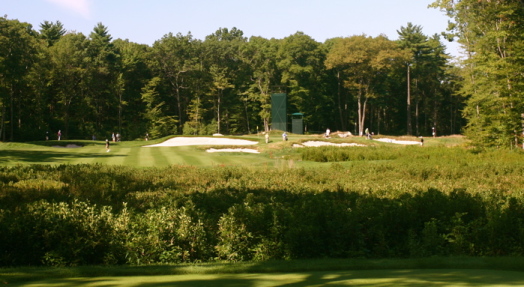
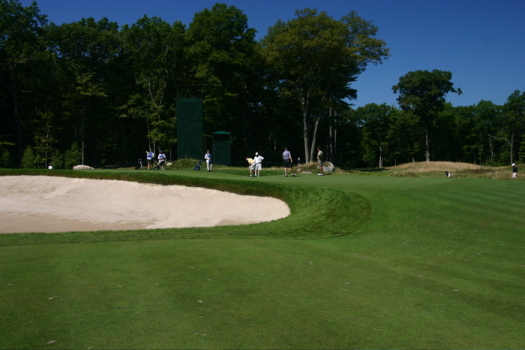
A few images, starting with the view from the tee.

TPCBoston4teeview.jpg 

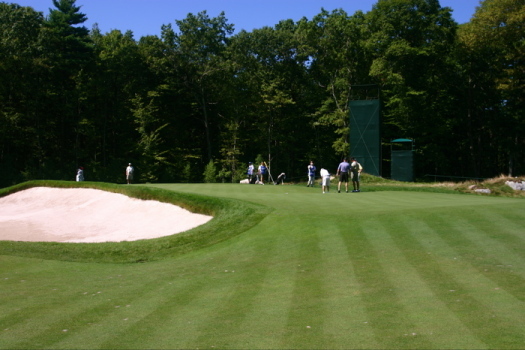
And the view from the left center of the fairway...

TPCBoston4centerview.jpg 


And the view from the right center, which is the ideal layup angle.

TPCBoston4layupviewright.jpg 

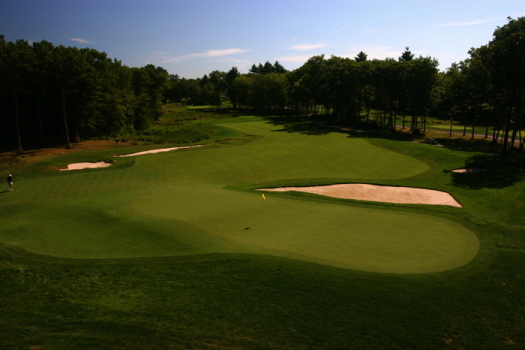
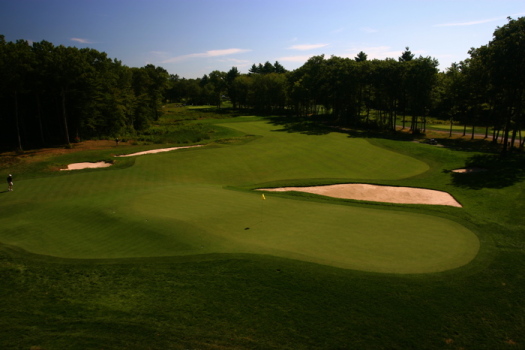
Finally, the rear view which flattens out some of the neat features over the green (fall off, bumps, etc...) that may make the player driving it long think twice. There are some small mounds meant to look like the old style New England bumps that are often found in this area when crews would bury large rocks instead of trying to cart them off property. 


TPCBoston4rearview.jpg

Picking Favorites and Riviera's 10th**

asset_upload_file444_2705.jpgTom Cunneff picks his nine favorite holes in golf. The piece also includes a link to Tom Doak's dicussion of Riviera's 10th, which I don't believe appeared online earlier this year. It's worth reading, and I say that not because I was included. Just a good read.

Golf.com also includes their 18 favorites with many killer photos. It was done in conjunction with the new Golf Magazine ranking. Lo and behold, Riviera's 10th made their list as the penultimate hole. Unfortunately they ran a photo of Riviera's 9th green in its place. 

**With working links now... 

"Even an idiot can't mess this up"

bildeTiger announced and new design in North Carolina Tuesday, and while I haven't seen many detailed articles, reader did find this video clip of the press conference where he refers to what "Perry" did at Southern Hills (so much for Mr. Maxwell!) and of course a proverbial it's "right in front of you" comment.

Pete Iacobelli writes:
Woods wants the scenic land to dictate the proposed layout and hopes the course give golfers a fair test and a chance to connect with nature. He visited the location earlier Tuesday and raved about the land.

"Even an idiot can't mess this up," he said. "I think I'm a little above that."

Woods took his time before launching his design business, he said, because he wanted a feel for what makes the best courses by playing the top layouts from around the world.

He said he likes layouts where golfers can the hole ahead of them along with well-placed bunkers that require careful shot selection.

Woods described himself as a "minimalist" designer and repeatedly said he didn't expect to move a lot of dirt during construction.

Woods and The Cliffs' owner Jim Anthony said they wanted High Carolina to be a walking-only course during the news conference. Afterward, Woods clarified they'll "strongly encourage" golfers to walk, but won't require it.

Anthony had Woods' drawings of a proposed golf course he mapped out at age 11. "I don't believe there's any golfer that has more desire," Anthony said. "He takes us to another level."

Woods' company took on a project in Dubai for his first course. He expects to gradually grow his golf design business, selecting projects that fit within his crowded schedule as a competitor and father.

Ed Seay R.I.P.

One of the game's great characters has left us...

Golf Course Architect Ed Seay Dies at Age 69
 
ASGCA Past President and Winner of ASGCA Distinguished Service Award
Was Design Partner to Arnold Palmer for 35 Years
 
Ed Seay, a past president of the American Society of Golf Course Architects, died August 14, 2007 at his home in Ponte Vedra Beach, Fla., after a long battle with cancer and related health problems.  He was 69.
 
Born in Dade City, Fla., Seay served as ASGCA president in 1976-1977 and was given the ASGCA Distinguished Service Award during the organization of golf course architects’ 2006 Annual Meeting. During a career that spanned five decades, he was responsible for nearly 300 new golf courses and more than two dozen golf course renovations, including Bay Hill Club. Most of his designs were created in partnership with golf legend and ASGCA Fellow Arnold Palmer, with whom Seay began working in 1972 and formed Palmer Course Design Company in 1979. Designing a golf course in Communist China in 1981, Seay was among the first American golf course architects to work outside the United States.
 
Among Seay’s representative golf courses are Sawgrass C.C., Ponte Vedra Beach, Fla.; The Tradition G.C., LaQuinta, Calif.; The K Club, Straffan, Ireland; Four Seasons Resort at Peninsula Papagayo, Costa Rica; Kapalua Village Course, Maui, Hawaii; Aviara, Carlsbad, Calif.; Old Tabby Links, Spring Island, S.C.; Tralee C.C., Tralee, Ireland; and Adios G.C. in Coconut Creek, Fla.
 
“ASGCA is saddened with the loss of Ed,” said President Steve Forrest, ASGCA.  “He was one of a kind as a person and did so much for the profession of golf course architecture.  For 40 years, he was one of ASGCA’s great leaders and contributed greatly to the growth and recognition of ASGCA.  He will be missed.”

A graduate of the University of Florida and a retired Commissioned Officer of the United States Marine Corps, Seay began his work in golf course architecture in 1964 near Pinehurst, N.C., where he worked for ASGCA Past President, Ellis Maples, a noted golf course architect Seay called one of the finest golf course architects ever knew.
 
Seay is survived by his wife, Lynn, and adult children Mason Seay and Tracy Raymond.
 
A memorial service is scheduled for Saturday, August 18, at 10 a.m. at Christ Episcopal Church in Ponte Vedra Beach, Florida. It will be followed by a reception at the Ponte Vedra Inn and Club at 11 a.m.
 
In lieu of flowers, ASGCA members may make donations to the ASGCA Foundation, 125 N. Executive Dr., Suite 106, Brookfield, WI 53005. Others making donations are encouraged to donate to the Marine Corps Law Enforcement Foundation, P.O. Box 37, Mountain Lakes, NJ 07046.
 
More information on Mr. Seay’s career, as well as video clips of him discussing his work, is available at the ASGCA “Architects Gallery” on the internet. Simply visit www.asgca.org and click on “Inside ASGCA” then “Architects Gallery.”