In golf construction art and utility meet; both are absolutely vital; one is utterly ruined without the other. GEORGE THOMAS
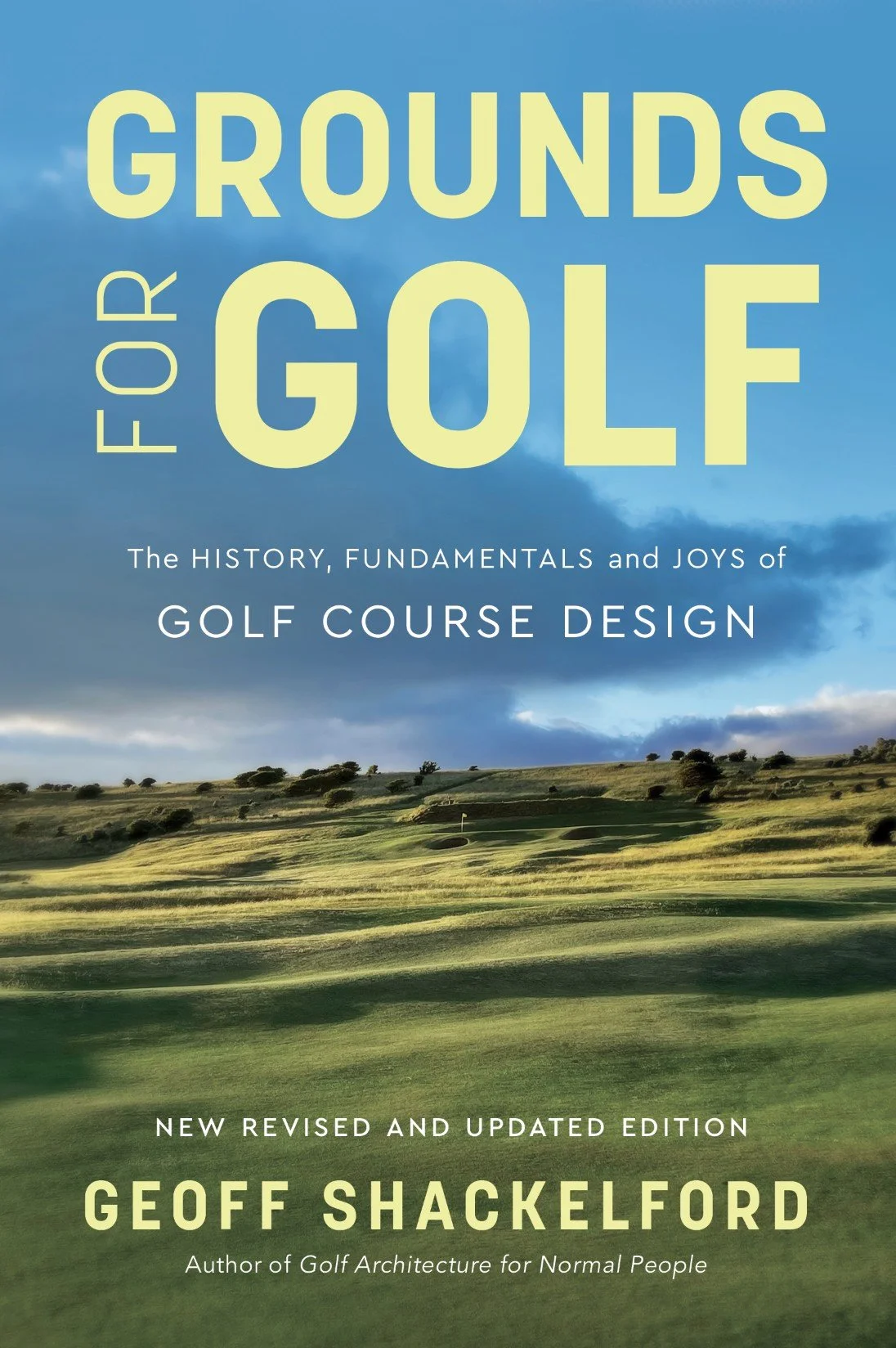
It’s back!
Twenty years later Tatra Press has kindly allowed me to bring back Grounds For Golf now that golf architecture is of more interest to the masses. A new Introduction looks at what’s driven the interest growth and two new chapters I had a blast adding (plus a few edits to keep things up-to-date).
The Amazon purchase page for the book arriving June 15, 2026.

"Bad dates doomed Turning Stone tourney"
/Eventually the details behind the Turning Stone event's abrupt departure would be revealed and Chris Wagner reports on CEO Ray Halbritter's stance.
Halbritter hinted as much Friday when he explained the reasons he was opting out of the tournament contract after four years. Saddled with sketchy fall-weather dates the first three years and an opposite-field, time-share date this year, Turning Stone’s CEO spelled out his requirements to the PGA Tour: Provide a stand-alone date in either June, July or August — two weeks before or after a major — or the contract was over.
That made it essentially a choice between Greenbrier or Turning Stone and the tour went with Greenbrier, seemingly a great idea at the time. However, the more we read about Jim Justice's lawsuit issues, including the latest news of Lester George adding to his complaint, the less glamorous the place looks.
2010 Best New Slideshow
/Accompanying Golf Digest and Ron Whitten's modified "Best New" for this year is a slideshow worth checking out. The photos of Castle Stuart and Prairie Club are very nice, but I'm really fascinated by the short par-4 at Arthur Hills' Chicago Highlands captured in a Dom Furore shot. Talk about a "skyline green."
Read More"Sorry, folks, that's called progress."
/I enjoyed your comments on the first part of Ron Whitten's "rant" about the lack of modern architect originality. The second and more disconcerting comments I saved for today:
Read More"If phone engineers thought like golf architects, our cell phones would still be attached to the wall."
/It's a slow time for golf news, so let's dine on Ron Whitten's provactive "rant" from the November Golf Digest. Tom Dunne read it a few weeks ago and went all Benihana chef on it in one post.
Read More2010 Best New Courses...Whitten Only Edition
/ With only 24 courses opening this year and even fewer on the horizon, Golf Digest's Ron Whitten offers a summary of the best stuff he saw in 2010. Included was Gil Hanse's Castle Stuart and a nice mention of our H-O-R-S-E course at Prairie Club.
"How do I get my course nationally rated?"
/Besides being really, really nice to panelists?
Golfweek's Brad Klein answers the question "How do I get my course nationally rated?"
Golfweek Debuts Top 40 Best New Courses List
/Who knew there were enough courses for a list? Actually, forty may be the entire list of new courses which looks hefty considering next year's will be a much shorter list.
What struck me more than a couple of startling slights was the sheer comedic value of some of the course names. And I'm not referring to the ones named after their developers. In the interest of kindness, I won't name names.
Greenbrier: The Flower Beds Were Toxic!
/Jim Justice is countersuing in between explaining why some lien-filing contractors will get paid and back surgery.
Read MoreR.I.P. Robert von Hagge
/Cybergolf publishes a very nice remembrance of an architect who certainly took chances and was by no means dull! I always had a particular fondness for the work he and Bruce Devlin did in transforming TPC Woodlands into one of the more compelling and fun TPCs.
Read MoreLook Out Jack And Annika: Shark And Ochoa Issue Press Release With Olympic Design In Sight!
/I don't know about you, but they do skew a lot younger than Jack and Annika, the other previously announced Olympic design wannabes!
Read More"It's all still there."
/Ron Green Jr. visits with Ben Crenshaw during the Pinehurst No. 2 rehab.
"You may get a great lie or be up against a pine cone or against wire grass," Crenshaw says. "You wonder why Ross was so enamored with what he saw. It's just sandy, impoverished soil but it's ideal for golf."
The fairways are wide and follow the original lines created by Ross. More than half the sprinkler heads have been removed at No.2, leaving the restored natural areas to take what the weather gives them.
There is an art to bringing back the natural look of No.2. Crenshaw stands in a sandy area, recently cleared and now being cultivated. He talks about the fun of placing clumps of wiregrass so that there's no pattern to it, spreading them like the wind might, and the options that will evolve over time when weather and fallen pine needles fill in off the fairways.
Green also talks on this video about what he's seeing, allowing us to get a glimpse of the work behind him.