
Canadian Open Blues
/Jeff Mingay points out that (yet again) a governing body has not placed enough importance on architecture, thus undermining their event.
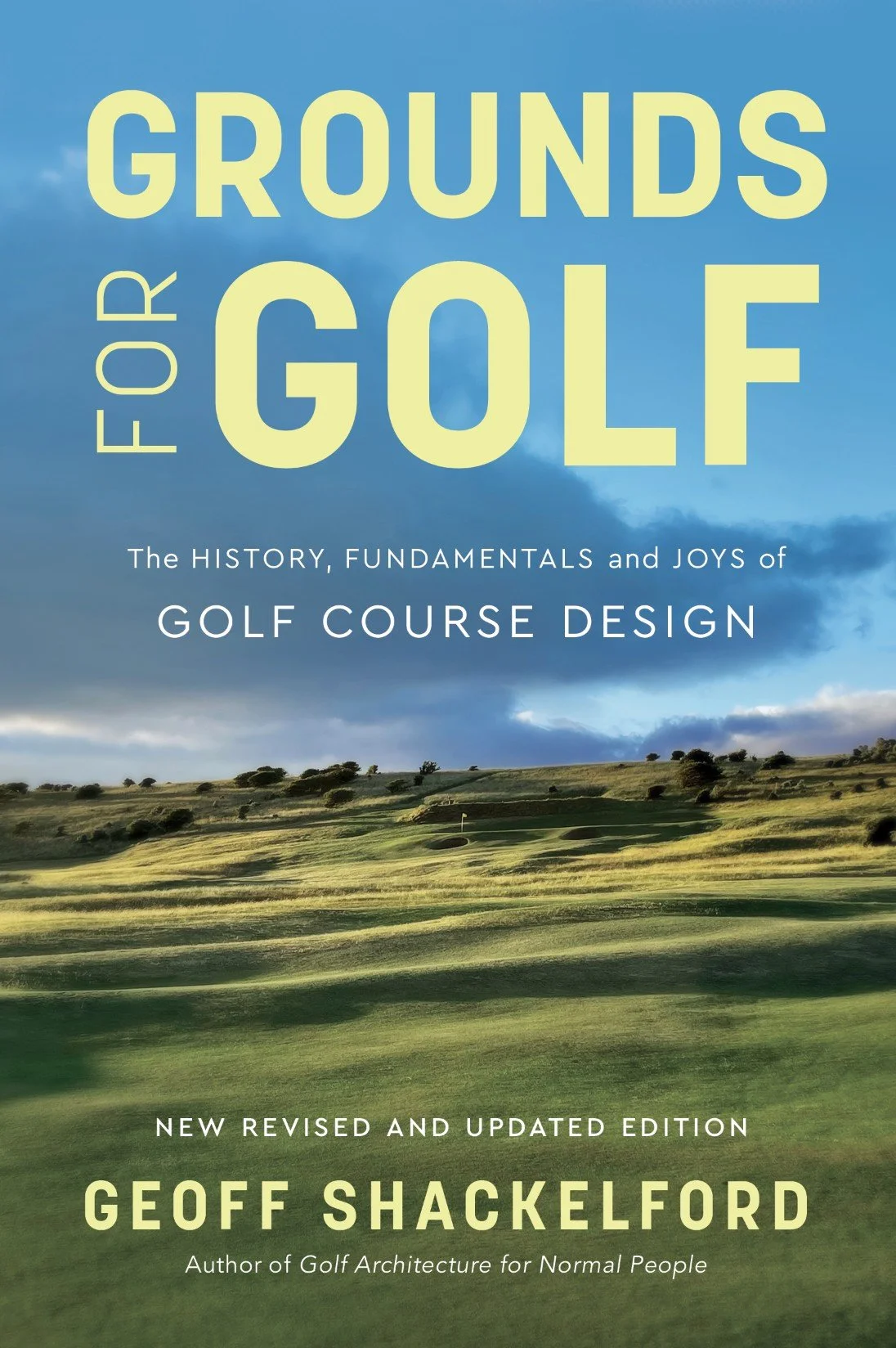
It’s back!
Twenty years later Tatra Press has kindly allowed me to bring back Grounds For Golf now that golf architecture is of more interest to the masses. A new Introduction looks at what’s driven the interest growth and two new chapters I had a blast adding (plus a few edits to keep things up-to-date).
The Amazon purchase page for the book arriving June 15, 2026.

Jeff Mingay points out that (yet again) a governing body has not placed enough importance on architecture, thus undermining their event.
Rick Arnett at SI.com received an "avalanche of e-mails dared to oppose my stance on golf being the most honest sport.” He writes that “the responses made me wonder if I'm completely unaware of the public sentiment regarding the game” because many “mirrored this comment":
You dummy! Golf's cheating is embedded in the sport like no other. It lies in the "technology." All the cheaters race to get the next "edge" in equipment others do not possess. The cheating has gotten so extreme that venerable golf courses are rendered obsolete. You are too close to the sport, dummy!
Arnett goes on to recite the usual there’s no going back and so be it if some courses are as obsolete as old Stadiums argument. Fortunately, the USGA, R&A and PGA of America believe their overall credibility, ratings and championship results are greatly improved by going to classically designed venues. And the PGA Tour does not have nearly as many course options as people think, so the "we'll just go to the 8,000 yard courses" argument isn't feasible.
Anyway, here’s the interesting thing to note. A majority of Arnett’s readers perceive that an excessive embrace of technology is viewed as cheating.
Remember what Tim Finchem warned in 2003 should this perception become reality.
"There is some point--nobody knows where it is--when the amateur player feels divorced and really doesn't appreciate the game at this level, just because it's so different that it doesn't become particularly relevant. The second thing is, if everybody is driving every par 4, it's not particularly interesting to watch.
"We are anxious, because we are continuing to see some distance enhancements in a short period of time. Unless something happens, we may have to move to-ward bifurcating the equipment specs for amateurs and professionals. In that case, we would be more involved."
Looking at the driving distance increases in recent weeks along with plenty of behind-the-scenes feedback via ShotLink, you wonder if Finchem will act. Or perhaps he just has too much on his plate with the TV negotiations. But isn't fan perception key to the negotiations?
To his credit, Arnett does go on to suggest that the Tour needs to have a drug policy. It’s almost unthinkable that they don’t have one.
Greg Norman lends his helicopter to support the New Orleans relief effort.
Chris Lewis at SI on the efforts of David Toms and Hal Sutton to help hurricane Katrina victims.
Melanie Hauser talks to New Orleans resident and Tour player Kelly Gibson.
Jim McCabe talks to Tour players about what rules in golf they'd change. Naturally, intense self-interest come roaring to the top of their lists. Shorts, sand filled divots, etc...
How do you hurt youself playing Ping Pong? Vijay did.
A nice story on Michael Putnam's impressive debut in Hartford.
 AP's Doug Ferguson gets the latest
on the 2007 schedule and new TV deal from Tim Finchem. I'm not really
sure what all of this means except that they still haven't figured out
what they're going to do.
AP's Doug Ferguson gets the latest
on the 2007 schedule and new TV deal from Tim Finchem. I'm not really
sure what all of this means except that they still haven't figured out
what they're going to do."You want to grow," Finchem said. "To compete effectively - even if you weren't going to grow, just to maintain your position - you look at who you're competing with. And everyone you're competing with is changing to get better, sometimes dramatically."
Finchem says there are still "a number of options," but two sources who are privy to the discussions said last week that the tour is focused on a playoff race that would begin shortly after the PGA Championship and include four tournaments that lead to the Tour Championship.
"You need to challenge yourself every few years and say, 'Are we taking all the steps necessary to allow us to compete effectively?'" Finchem said. "It may develop that you say, 'You know what? There's no better way to do it, so let's just leave it alone.' It's certainly easier to do that. But I think it's been good to challenge what we're doing, and I think the likelihood is we'll make some changes."
"It's taken a lot longer than we thought," Finchem said. "It's going to be very late in the year before we get to television (negotiations). I would be concerned about that, because we don't like to be within a year of starting the next season. But this year is a little different in the sense we've extended so many title sponsors."
 ...is the distance issue. Right? Naw. During the NEC's final round Art of the Monotone
demonstration by Commissioner Tim Finchem, CBS's Jim Nantz appeared to
be headed for a question about the most talked about issue in the game.
What was I thinking?
...is the distance issue. Right? Naw. During the NEC's final round Art of the Monotone
demonstration by Commissioner Tim Finchem, CBS's Jim Nantz appeared to
be headed for a question about the most talked about issue in the game.
What was I thinking?JIM NANTZ: Commissioner, one thing we've talked about really on every one of our telecasts this year...is this remarkable Drive to a Billion. You can't shout it loud enough for the sports fan for it to maybe sink in.Finchem went on to predict (admirably) that this was a product of the efforts of the individual tournaments, and that the Tour will reach the billion dollar mark this year (gosh, you think it'll be the Tour Championship?). Nantz then asked if Finchem had any "special memories" of 2005 to this point.
TIM FINCHEM: We had such a great start with the media focus on the "Big 4." And three of those guys have won four times each. And of course Ernie is laid up now which is very sad for the President's Cup not to have Ernie [very nice plug]. But you know I think that there have been so many playoffs, so many tournaments coming to the last hole, that has been terrific this year. It's really helped keep viewers at home tuned into the telecasts.The only time he broke from his monotone was to emphasize the first of three "young" mentions.
And the other thing I think is more and more really good young athletic players are coming. These young guys are really something and there seems to be more and more of them every year. And they're good, attractive, positive thinking young men that I think will add a lot to what the PGA Tour is going to be about for the next 20 years.
Geoff Shackelford is a Senior Writer for Golfweek magazine, a weekly contributor to Golf Channel's Morning








Copyright © 2022, Geoff Shackelford. All rights reserved.

