
Fidlin on Finchem
/The Toronto Sun's Ken Fidlin won't be getting a First Tee brick in his name from Tim Finchem after this column, which looks at the dreadful date given to the Canadian Open and other PGA Tour activities of late.
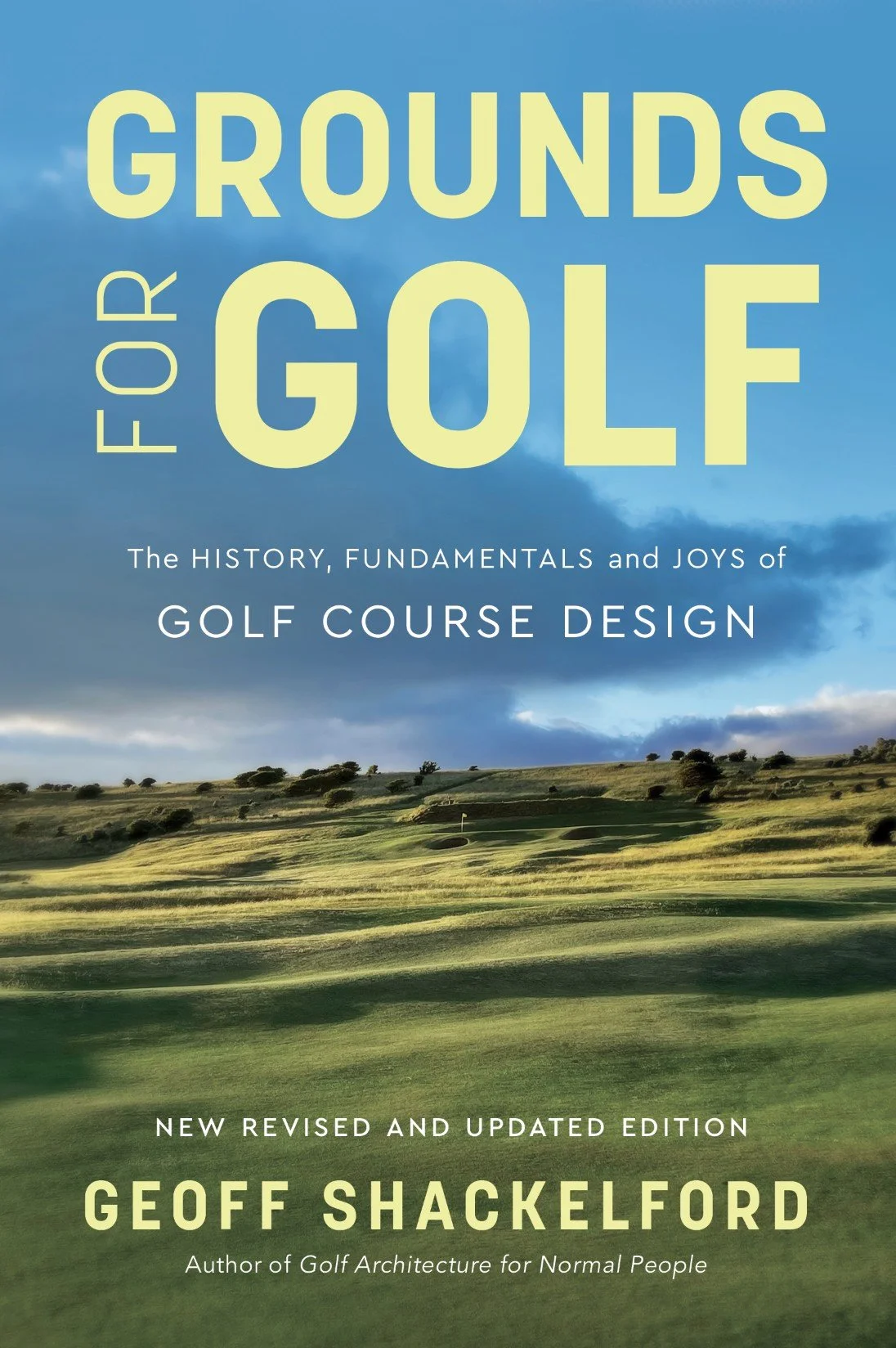
It’s back!
Twenty years later Tatra Press has kindly allowed me to bring back Grounds For Golf now that golf architecture is of more interest to the masses. A new Introduction looks at what’s driven the interest growth and two new chapters I had a blast adding (plus a few edits to keep things up-to-date).
The Amazon purchase page for the book arriving June 15, 2026.

The Toronto Sun's Ken Fidlin won't be getting a First Tee brick in his name from Tim Finchem after this column, which looks at the dreadful date given to the Canadian Open and other PGA Tour activities of late.
Stopped taking Ambien? Well, I have just the organic cure for your sleep disorder.
But first, Commissioner, congratulations on the new 6-year deal. That's your 6-year deal at $4.5 million per year.
And now, the reason you get the big bucks. The floor is yours. Let's get the inevitable fifth major question out of the way:
Stature is something that we don't determine, others determine. At some point along the way in the '50s, stature meant calling The Masters a major. At someplace along the way earlier than that, the Western, which had been called a major, wasn't called a major anymore. Sometime around 1960 when Arnold Palmer wins at St. Andrews and the modern Grand Slam was sort of inaugurated, people sort of started talking about the British Open as a major, although it wasn't until the 1990s that we recognized the British Open as official money on this Tour and took steps to recognize it greater, even though it was clearly recognized as a major. So these things move around.
The British Open sort of was not a major until they sort of recognized it in the 1990s by sort of adding it to the money list. Take that Old Tom!
We were watching a film last [night] at the Past Champions Dinner about the shotmaking that these champions have conducted over the years, and I continue to believe that stature also has to do with people growing up watching things.
Whoa! A Champions Dinner. How original. What's next, azaleas, a champions locker room, a par-3 tournament?
And when a player like J.B. Holmes was 13 watching Freddie Couples make eagle at 16, and that generation grows up, I suspect that that will also impact on the stature of The Players. Where that leads, at least at this point, I'm not in a position to predict.
For those of us who can't remember one Players from another, I'm glad he mentioned how old J.B. was. The 1996 Players? Oh right...Freddie made eagle. I remember it like it was 1996.
Ah, now the fun begins.
Q. Is it your sense on TOUR that there's a feeling among players of helping rebuild the city's efforts by participating in this year's tournament (in New Orleans)?
TIM FINCHEM: There were two things we were focused on there. One was trying our best to be able to play when a lot of other sports, for whatever reasons, losing their stadiums, were not going to be in a position to play.
But then, secondly, we started to focus on the opportunity to tell a positive story through the tournament about the future of what's going to happen in New Orleans, and that's why we moved our Commissioner's Cup early in the week, which is the CEOs of 50 companies that do business with us, major companies, and we will do a half a day. We will do a half a day briefing is that right?
BOB COMBS: Yeah.
See, that's why Bob gets the big bucks.
TIM FINCHEM: I have to get up to speed.
Oops. Interrupted too soon.
We do a half day briefing with state and local folks so that these companies can understand the vibrancy of what's happening in New Orleans and what the upside is, instead of what we see in the newspaper all the time, whether the dam has really been fixed and isn't it a shame how the Federal Government bungled dealing with it. You don't really see the activity that's going on.
See, it's that liberal, Eastern media elite focusing on the negative. That's what's ruining America!
Oh, and not to be picky or anything Mr. Commissioner, but they were levees, not dams. Sorry, continue...
We want, through that briefing, and have Rudy Giuliani as our guest speaker for that, seminar if you will, to talk about what can happen. And then on the telecast that week, we will sort of tell that story. And so we want it to be an upbeat, positive message, and we're delighted to be able to participate in that.
Q. But do you feel a sense that the players by their participation feel that they can help rebuild or help the efforts of the City of New Orleans?
TIM FINCHEM: I think so. The quality of the event will also send the right message, too, that business as usual is returning to New Orleans. We're all worried about the tourism side of the equation in New Orleans, and not just the infrastructure getting rebuilt. That tourism needs to come back and be able to demonstrate we've got good quality golf facilities through the golf tournament, which is a big reason we have the tournament there anyways, is an important message as well.
See, it's really all about money telling that positive story.
Hey, time for a question similar to one suggested on this site:
Q. This course by modern Tour standards is not very long as Fred Funk proved last year, and this tournament has a history that you don't have to be a bomber to win here. Why hasn't this tournament followed the trend of extending courses to extreme length?
TIM FINCHEM: Well, I'd say the fundamental reason is that we recognize that the fans like watching this field play this golf course. To me that's the fundamental. And you have to be sensitive to that as you look at, you know, making this change or that change or where the ball is going or the fact now that we may have firmer, faster conditions. And so we have been we have been, I would say, knowledgeably and aggressively reticent, if you will, to make those kind of changes. That's the number one thing.
Knowledgeably and aggressively reticent. Wow, that could be the title of someone's biography!
The second thing is, I think we do like the notion that we have the deepest field in the game from A to Z, and virtually every one of those players can win. We would not want to move drastically away from that.
Craig Perks agrees.
Having said that, we have been looking at changes for a number of years, and we have made a few changes. I mean, we've moved a few tees over the years. But when we move a tee, we're not moving a tee because we're exasperated that a player is hitting a 7 iron versus a 5 iron.
Ouch, take that Hootie!
The other thing is that we don't want another answer to your question, frankly we're not excited about changes in the golf course being the story at any point in time. We want the golf course and the history of the golf course to be the story and not that myself or some group of people or some group of players got together and decided that it was a golf course that needed to be significantly changed. We don't see that.
Hootie, Hootie, Hootie. Even the Commish is saying you've gone too far and made it all about you. Wish I could be there when you two have your annual Masters stop and chat.
Q. The new schedule in 2007, have you given any thought to the introduction of a drug testing regime, and if not, why not?
TIM FINCHEM: Have I given any thought to?
Q. The introduction of a drug testing regime on the PGA TOUR, and if not, why not?
TIM FINCHEM: We have given a lot of thought to drugs.
Cialis, Levitra, Viagra. You know, potential tournament sponsors. Oops, sorry...
You can't not think about drugs with what is going on in today's sports. Our policies currently are if you're talking about steroids as an example, steroids are an illegal drug. I have authority of my board to require a test of any player who I have reason to believe or our team has reason to believe is using illegal steroids.
We are not opting for and by the way, I have no material information that that is the case with any player. We see no reason to jump into the testing arena at this point without having any credible information that we have issues.
In golf, a player is charged with following the rules. He can't kick his ball in the rough, and he can't take steroids. We rely on the players to call rules on themselves, and if you look at our Tour over the years, many players have, to their significant financial detriment. That's the culture of the sport.
Having said all of that, if, if, if we were to develop any basis upon which it was reasonable to assume that we had widespread steroid use or steroid use of any significance, we would not hesitate to engage, but it would not be a program that you and the public would look at and say, well, this is sort of a halfway program. It would be a program that would determine for sure that we did not have a problem.
If, if, if...speaking of if's, the Commissioner was asked about Fed Ex points...
I think that two things will happen. I think you will see some players play more in the base season. I think the players who have historically played in the fall will play in the fall. I think we'll see probably less European players in the fall because some of their bigger events are going to move back into the fall in Europe, and THE TOUR Championship isn't there to pull them back.
Other than that, I think the fall will probably be as good as it's been. There may be some more starts in that base season; I suspect there will be.
The fall has been so as "good as it's been," that it's being totally revamped and stuck behind the "base season."
Q. Can I just follow up on a very provincial question? Do I take it to understand that Washington is now in danger of not having a PGA TOUR event in 2007?
TIM FINCHEM: I wouldn't call it in danger. Every tournament has to have a sponsor, and we went through the period of talking to Booz Allen and we had very positive discussions with Booz Allen. We maintained a very solid relationship with them there and I think it was excellent of them to offer and commit, actually, to be a million dollar supporting sponsor.
Solid relationship? Can you imagine what the no-so-solid relationships are like?
Now we have to arrange for a title sponsor position. I have every reason to believe we will do that, but until it's done, it's not done.
Got that?
Until it's done, it's not done.
Actually, that was a special coded message to Bob Combs. Translation: these questions are veering coterminously toward a trajectory I find platform unfriendly.
BOB COMBS: Ladies and gentlemen, thank you very much.
TIM FINCHEM: Thank you.
No really, thank you.
Thanks to reader Pete the Luddite for these graphs from the PGA TOUR's 2005 statistics on money leaders, driving accuracy, driving distance, and ball striking. He writes:
Distance v. Accuracy (click to enlarge) The graphs show, not surprisingly, that there is a strong link between distance and accuracy. The long hitters rank very low in accuracy and the opposite holds true for the accurate drivers - they're short off the tee.The best examples are the two extremes, Tiger Woods (Distance -2nd, Accuracy - 188st) and Fred Funk (Distance - 197th, Accuracy - 2nd). When you graph up the data for the Top 25 Money Leaders for 2005 (I had to pick a subset), you see that only 3 players in the Top 25 for money rank in the Top 100 for both distance and accuracy.
Graphing distance vs. ball striking shows that the long hitters who win the money also know how to use their wedges.
Distance v. Ball Striking (click to enlarge)Graphing accuracy vs. ball striking shows that the short hitters who win the money also have good iron games.Yes, the overall picture is that Grip It and Rip It is a fact - accuracy doesn't matter if you can use your wedges.
Accuracy v. Ball StrikingBut I don't think the war is lost yet. 10 of the Top 25 Money Leaders for the year were in the bottom 100 for distance, but are still up there with the bombers.
 PGA Tour Commissioner Tim Finchem is convening the scribblers Wednesday for his annual state of
 the The Players Championship news conference. Knowing a few of the attendees are regular readers and assuming they make it to the press center by 9 am, I thought I'd offer a few questions for consideration.
And feel free to join in with your questions in the comments section.
Jim McCabe puts to rest rumors reported in Golfweek that The Country Club was looking to join a Deutsche Bank rotation with the TPC Boston (just typing that was difficult). He also reports that the 2013 U.S. Open at TCC is highly unlikely.
'We definitely want to do some sort of celebration of the 100th anniversary of Ouimet's victory, but it's highly unlikely it will be a US Open," said John Cornish, a longtime TCC member who is on the club's Tournament Policy Committee and was instrumental in pulling off the 1999 Ryder Cup, a spectacular event. ''An amateur event would be more appropriate. We've always been a big supporter of amateur golf."
Rex Hoggard wonders if the Tour is making it too difficult for young players to break through. And this is 2006. Starting next year, it's going to get even tougher for Q-school grads to play a full schedule.
Golf World's March 17 issue is reporting that Greg Norman is threatening legal action against the PGA Tour.
In a story by Tim Rosaforte that first appeared on ESPN.com(!?), Norman says he wants to see the books and the minutes of all meetings.
"It's their fiduciary responsibility," he said. (He also has a business relationship with the tour as a golf course architect for a handful of sites that host tournaments.)
"The past never goes away," Norman said last Friday from his office in Jupiter, Fla. "Even now Scott McCarron stays at my beach house and we work out last night and the conversation comes up about the FedEx Cup. The wound gets ripped wide open."
Okay that's waaaaayyyyyy more detail than we needed!
Anyway, Rosaforte also writes:
Decof, the longtime legal nemesis of the tour -- he represented Ping in the famous square-grooves case -- believes so as well. The posturing has been ongoing for months, but Norman decided to go public after his demands were circulated in a memo to members of the Players Advisory Council, Policy Board and Independent Board of Directors.
PGA Tour co-COO Ed Moorhouse confirmed the tour has been in touch with Norman and Decof. "We've offered to sit down and answer any specific questions," he told Golf World Monday. "To this point he has not availed himself of that, but we are ready to sit down and discuss any questions he has."
See, the Tour is trying to cooperate. They would be happy to sit down in a windowless room with no one taking notes and discuss any questions Greg has, completely off the record and without any documentation!
You can't make this stuff up.
"They're looking for a way to compromise," noted Decof. "They want us to submit our questions, and they'll answer them. That's not what we want. Under law, every person has [the] right to access the books. It's an absolute right. The players don't know what's going on. They go to those meetings and they get mumbo-jumbo. Greg wants to know what's going on in a corporation that he's a member of. You can't do that by answering questions."
Alan Campbell in the Sunday Herald may have to pay for a Tour media guide after this little WGC inspired column:
...what is despicable is the conduct of PGA Tour commissioner Tim Finchem. Not content with ruling the roost over a circuit which is the Premiership to Europe’s Coca-Cola Championship, this myopic golf controller has annexed the so-called world golf championships for the greater good of Uncle Sam. Next year all three WGC events will be staged in the United States, just as they will in 2008, 2009 and 2010. Finchem’s defence? “They’re staged at a level which can pay significant prize money,” said the PGA Tour commissioner. “That costs money.”And...
Pausing only to let this staggering sliver of logic sink in, Finchem continued: “The American marketplace is best suited to generate those kind of resources. I think that’s why, historically, three of the four Major championships are in the United States.”
Finchem is talking bunkum, as the American marketplace wasn’t involved in the evolving of the Majors. He compounds his error by inviting the question: given that the United States already has the cream of world golf’s championships, why does it need to selfishly syphon off the next tier?
The unwillingness of the Phil Mickelsons and Davis Loves to rack up transatlantic air miles is, along with the financial muscle of US corporations and the dictates of the American television networks, the reason why the world golf championships have become almost as big a misnomer as the World Series in baseball.
John Daly and Woods are just about the only two high profile Americans prepared to leave the country for anything other than the Open Championship. While both are paid handsomely in appearance money, they see the bigger picture. “There should be at least one [WGC] every year somewhere other than America,” said Woods. “Obviously the market is huge here, but it is a world game and any opportunity to get the best players to other parts of the world is a great way to grow golf.”
The PGA Tour have cemented the WGC events into their revamped schedules, which start from next year. It stinks, but then money usually does.
SI Golf Plus published their 5th annual players poll (subscription req. for link to work).
Some of the more interesting questions and answers:
Who is the second-best player?
Vijay Singh ...... 68%
Ernie Els ...... 12%
Phil Mickelson ...... 8%
ALSO RECEIVING VOTES: Joe Durant, Sergio García, Retief Goosen, myself, Annika Sorenstam
Annika and Joe Durant? So much for the players liking that question!
Did the U.S. make a mistake by invading Iraq?
Yes ...... 12%
No ...... 88%
That thinking may help explain the 56% on this question:
Is having early-round coverage on the Golf Channel instead of ESPN good or bad?
Good ...... 56%
Bad ...... 44%
LOOSE LIPS: "[The Golf Channel] is going to have to get better."
Do you know any pro golfers who have used steroids?
Yes ...... 1%
No ...... 99%
Should the Tour have a written policy expressly forbidding performance-enhancing drugs?
Yes ...... 73%
No ...... 27%
Overwhelming player support, so why doesn't the Commissioner agree? And finally...
Do you favor a rolled-back ball for tournament play?
Yes ...... 28%
No ...... 72%
In 2003, 60% said yes.
Mark Garrod looks at the contrasting takes on scoreboard watching, weighing the experiences and thoughts of David Toms and Tiger Woods, who each used different approaches during Sunday's Doral finale.
Reader Frank pointed out something that caught his eye in the story about Tucson receiving the WGC Match Play. Greg Hanson reported that:
"The Gallery is expected to pay something in the $500,000 to $750,000 range to play host to the Match Play Championships."
Contrast that with Bob Harig's story on the struggle to get a deal finalized between Innisbrook and the Suncoast Golf Classic (non-profit running the Chrysler event moving to the March Florida swing).
Deals between tournaments and their host venues vary. At the TPCs, tournaments get the course for free. But most tournaments pay a base rental fee and that may or may not include office space, rounds of golf for entertaining, catering, outings, etc. The tournament and the venue may share in revenue, such as concessions and merchandise sales.
But that has proved to be challenging. Tournament director Gerald Goodman said the event will pay a "significant" increase to Innisbrook for course rental in a new contract that would begin in 2007 and run through 2012.
The PGA Tour understandably prefers to go places that pay them to host an event, instead of paying places like Innisbrook or Riviera or Westchester substantial sums.
So The Gallery pays to host a WGC, while most venues are paid to host a PGA Tour event.
This trend, while understandable from a pure dollars and cents perspective, may explain why the Tour plays so many mediocre layouts in locations far away from population centers.
Who says there's no Christmas in February?
After Commissioner Tim Finchem thanked more people than an Oscar winner, he took a few questions from the assembled scribblers:
Q. The commitment to Tucson, how long is that for, is that through the sponsorship? 2010?Judge, can you direct the witness to answer yes or no.
COMMISSIONER TIM FINCHEM: Virtually all our agreements are linked to our cycles, a sponsorship cycle and television cycle. All of our agreements dovetail; in this instance they dovetail in four years.
Q. The other part, do you think the World Golf Championships are meeting the stated aim of developing developed to enhance the competitive structure of World Golf worldwide?
COMMISSIONER TIM FINCHEM: Yes, I think the first and primary reason for the World Golf Championships was to create a vehicle whereby the fans could enjoy the opportunity to watch all of the best players in the world assembled, a more frequent number of times during the course of the year. Heretofore, that was primarily the major championships and THE PLAYERS Championship.
Heretofore? Mr. Commissioner, we're not dictating a memo to Candace. You are talking to people. Well, members of the media. Please, continue...
Today we have, with the World Golf Championships, another group of tournaments where all the best players in the world play. There are others, as well, but as a constant flow with Ryder Cup and Presidents Cup competition included in that. And that was the primary mission.
The secondary mission was to continue to grow interest in the game by focusing on the International and global aspects of the game. And that's why we've had such a great relationship with a company like Accenture, because they have a global focus. And I think that secondary mission is being met, as well.
See, Accenture has a global focus, so the events have had a worldly flavor! That answers the question, right?
Nope, it's about to get awwwwkwaaaarrrd.
Q. I think 39 of the 64 players in this week's field come from overseas. Can you part one of my question, can you explain why so many of these championships are played in the United States? And part two is don't you think that you have a responsibility to take these tournaments elsewhere in the world and to grow interest in the game elsewhere in the world?
COMMISSIONER TIM FINCHEM: Where the players come from is frankly not of too much import. Our system is such that from the start of the system...
Q. I'm trying to point out that it's a global game, golf is a global game.
COMMISSIONER TIM FINCHEM: I understand that. I'm remarking that I had questions during the course of the week, and they're disturbed that over half of the field is not from the United States.
Q. That was not my question.
COMMISSIONER TIM FINCHEM: I understand that. To the second part of your question, yes and no. We would like to see World Golf Championships played around the world, and we have seen that the first eight years. I think we've played on five different continents. Today the World Cup continues to be played this past year in Portugal, and this coming year in Barbados as part of the World Golf Championships. We may add another World Golf Championship. That is a nice thing to do.
That is a nice thing to do? Uh, let's back to the MBAspeak...
I think the fundamental, however, is not that. The fundamental is to bring to the world via incredible television capability, to 145 countries, all the best players in the world playing. The reality is that frankly Sergio Garcia is seen who is not here, is seen when he's played in a World Golf Championship by more people than typically any other event he plays, regardless of where it is, whether in Europe or Asia or anywhere else.
See, it doesn't matter where you play. It's about the television capacity. This is why they should just build one golf course in Orlando with stadium seating and a big parking lot. Construct a 6,000 foot runway (for the G5s, of course), some player housing, and just play all of the events in one place. You can maximize margins and just let that television capacity do its thing!
Ernie Els gets more global television exposure when he plays here this week than he does when he plays in China or Hong Kong.
Imagine if he won a match how much capacity he would have maximized!
But I think the important thing is not that, it's that who are we reaching through World Golf Championships, are we reaching just as many people, and we think the answer is absolutely. Not to say we won't continue to work with having tournaments around the world. We are proud of the fact that we play on five different continents, and we will continue to play somewhere around the world, as well.
I think he meant the past tense there, "played on five different continents." But hey, we're going to throw an event to China so we'll still be playing around the world. Quit your complaining!
And now it's time for the Commissioner's intermission so the Accenture suit can out-MBA the Commish (the audacity!):
Q. Mr. Murphy, was Australia that much of a failure for you when it was played down there? If you were to continue your relationship with this World Golf Championship, would there be any scenario in which you'd be willing for one year to take this tournament abroad?
JIM MURPHY: The Australian tournament in many ways was a huge success for us, because we relaunched our new brand from that place. And Australia happened to be the major continent in the world where our brand was new, because in the time zones that's how it worked out. We changed our name from an older name to what we have now on midnight that day, and we played that week.
Ah those fond memories of the brand relaunch. Amazing how these WGC's just warm the heart.
But it's not all about relaunching the brand for Mr. Murphy...
From a timing point of view, it worked out great. We were somewhat disappointed in the field; some of the top players didn't come. The television coverage was great, we had great client entertainment there, and we saw it as a plus.
Would we do it again? Well, we'd consider it. Certainly we'd talk to the PGA TOUR about it. The PGA TOUR and other Tours drive this process, and we're sort of in a reactionary mode.
A reactionary mode? Scribblers, was Finchem making a note of that one? That's a peach, hon!
We can influence what happens, but they're the experts on golf, and we're experts in managing and selling technology services. We recognize our roles.
Oh, nice, subtle plug. I was wondering what the heck Accenture does.
Okay, enough of him. Back to the Commissioner...
Q. Based upon your knowledge of The Gallery, what were your impressions of the course specifically, and anything you feel The Gallery needs to do to be fully prepared for that event next year?
COMMISSIONER TIM FINCHEM: We've been engaged for months, and our team has, with everyone related to The Gallery, many of whom are here today. We have a good, solid working relationship on the short term and long term planning that will relate to the conduct of the Accenture Match Play in Tucson. There are, obviously, in any instances like this, a lot of things that need to be done. We're very, very comfortable with the working relationship we have.
Uh, that's a no, he hasn't seen the course.
Q. What's your feel for the State of golf worldwide at this time, is it growing or is it receding, both in terms of the PGA and in terms of..
COMMISSIONER TIM FINCHEM: I gather the question is what is my perception of the state of the game in terms of its growth globally; is that correct? Well, that's an interesting question, because it's an interesting question, the answer of which has been perhaps many times in the media misanalyzed to some extent.
Pausing here to allow you to go back and read that one more time. After all, it's an interesting answer to an interesting answer.
And by that I mean here in the United States, for example, there is a focus on the total number of rounds played as it relates to golf courses. And in today's society the regular golfer is playing a few rounds less than perhaps he played he or she played five or ten years ago.More people playing less. At least he's honest about it.
On the other hand, there's been each and every year an increase in the number of participants in the game. So from a total participant standpoint we've seen regular growth here in the United States.
Q. I realize it's not done yet, Commissioner, on the FedEx Cup points, but where do you see the World Golf Championships positioned with that series going on next year?
COMMISSIONER TIM FINCHEM: It would be premature for me to say. We're evaluating different processes. It will be a process that goes to June. But whether or not it's a process that relates to strength of field or a process that relates to purse or a process that relates to stature of events, under any of those scenarios World Golf Championships will fare well, and fare well in that configuration.
And it's a process that we'll be processing for quite some time since no one can really process how this FedEx Cup process is going to be processed.
John Davis writes about the WGC Match Play's move to Tucson and features this quote from PGA Tour Commissioner Tim Finchem:
PGA Tour Commissioner Tim Finchem said recently that he hopes to schedule a WGC event in Asia within the next year. Last month the tour hired former LPGA Tour Commissioner Ty Votaw as executive vice president of international affairs.
That could mean that the WGC events, including the Match Play, will be rotating to other markets.
"I do think it's a transition phase," Finchem said. "That's one reason we brought Ty Votaw aboard, to allow us to get some top-level energy for these international questions."
Top level energy? Is that coterminous with...ah, forget it.
 Alistair Tait calls the PGA Tour's original pledge for the World Golf Championships "hogwash" while looking at the power struggle won this time by Tim Finchem.
Another week, another bordering-on-silly final round setup. Reviewing the tape after hearing Gary McCord's raised-eyebrow comment about some of the hole locations, I went looking for any player comments on the setup.
"Obviously, the greens were a lot firmer today, they had some pretty amazing pin positions out there," Sabbatini added. "A couple of them I'm still bewildered at, but, you know, they made the course definitely tougher for us today."
Now, not to take away from Arron Oberholser's win, because it was well deserved and he is a huge talent (not to mention the kind of character the Tour needs more of).
But I noticed while listening to the audio and staring at the dolphins going by that there were very few cheers, and seemingly fewer opportunities for anyone to post a few birdies in a row.
I know this has been asked here many times, but why can't we let the U.S. Open be its own thing. Why is the PGA Tour turning Sunday's into train wreck days instead of letting the players create a little more to cheer about?
Geoff Shackelford is a Senior Writer for Golfweek magazine, a weekly contributor to Golf Channel's Morning








Copyright © 2022, Geoff Shackelford. All rights reserved.


