"But it felt like I was always just a foot into the deep stuff and a foot away from having a perfect lie, and it wore on me."

Steve Elling looks at the concept of PGA Tour players fleeing for the European Tour and includes this more detailed version of Robert Allenby's suggestion that course setup is influencing his decision.

Next week, while the Disney event will be mostly filled with journeymen seeking to retain their cards for next season, the HSBC field is expected to include Mickelson, Padraig Harrington, Adam Scott, Kim, Henrik Stenson, Sergio Garcia and Trevor Immelman. To be sure, the European Tour allows players to receive appearance fees, but the imbalance of power is pronounced.

Allenby said he's looking for variety, too, and took a thinly veiled shot at the PGA Tour's prevailing bomb-and-gouge mentality.

"I joined because I wanted to expand my golf, I wanted to play a different style of golf," said the Australian, who has lived in Florida for nearly a decade. "I thought I was getting a little bit stale. The golf courses (in the States) are set up the same way every week. I kept getting injuries over here, pretty much because the rough was so high, and I got sick of it.

"I got sick of playing out of six-inch rough every week. I'm not bitching or moaning about it. I know I am a great ball-striker, and I drive the ball very straight. But it felt like I was always just a foot into the deep stuff and a foot away from having a perfect lie, and it wore on me."

Fair enough. But like they say on the police shows, if you want to find the real reason behind the mystery du jour, follow the money.

"As a professional golfer we have to adapt to that by playing more internationally because that is where the opportunities are and that's where they will continue to grow."

Martin Parry reports that Phil Mickelson really likes the idea of playing overseas. Why do I think Tim Finchem reads this and says, "why weren't you so eager to play overseas when we played WGC's on foreign soil?"

Phil:

"Certainly, the dollar weakening over the past few years has made foreign currencies much stronger, which makes the purses much larger, so there's been a lot of international wealth being created," he said.

"The US golf industry has been stagnant for quite some time so all of our growth has been occurring on a global basis.

"As a professional golfer we have to adapt to that by playing more internationally because that is where the opportunities are and that's where they will continue to grow.

"So I look forward to having opportunities to continue to play more internationally and I understand that that is going to be an important part of being an international golfer."

The 38-year-old, who has won twice on the US Tour this year, added that he hoped other golfers recognised the importance of not just playing more overseas but helping popularise the game in under-exploited markets.

"The States' market is stagnant so the more opportunities we can have where top players play throughout the world and expose those places to golf I think will help grow the game," he said.

"That's an important part of what we do. The (season-ending) FedEx Cup ending in September has given us much more opportunity to do that now."

“The contract is ironclad.”

Jon Show reports that Jeld-Wen wants out of its $9 million annual commitment to the tour, The Players Championship The PLAYERS and one of the nine senior majors (but apparently that number does no include the free window frames for the VP's, which pushes the value of the deal to $15 million). Show also reports the Ginn and Mayakoba sponsors want out of their deals in light of the real estate crisis.

It also comes on the back of fallout in the auto and financial industries.

The tour is faced with a tough sell given the unsold inventory it already has in the marketplace, including a $3 million annual title deal for a new Fall Series event in Georgia and two $7 million annual sponsorships of the Presidents Cup.

Now here's a tour attitude I've noticed in a few articles...

There is still no decision on what brand will be attached to events in Ohio and Charlotte after their lead sponsors, Merrill Lynch and Wachovia, were bought by Bank of America and Wells Fargo, respectively. Despite speculation, the new banks will automatically assume those deals unless the PGA Tour and the acquiring companies mutually agree to part ways.

“There’s no technical ability to get out,” said Jon Podany, head of sales for the PGA Tour. “The contract is ironclad.”

Now, I can understand talking that way so that other sponsors don't get any funny ideas about renegotiating. Still, you would hope that privately they are far less assertive about that language if a sponsor wants to re-work their deal. I know, I know, I don't understand how business works.

Oh wait, Adam Schupak talks to former PGA Tour and Golf Channel exec Gary Stevenson, who offers this sage advice:

I suspect that the PGA Tour, LPGA, the governing bodies, are taking two giant steps back and making sure that the value they deliver is consistent with what they are asking – and if it’s not, they should be making adjustments to those packages so that the value is there. I’m of the mind that title sponsors, once they take a look at what they get for their money compared to other money they spend, will determine the value in golf is better.

If I was a golf tournament director, I would be less concerned about my title sponsor than I would those sponsors that were spending between $50,000 and $250,000. Those are the hardest to find. If there was a way of creating a different value and locking them in for three years, I’d do that right now.

Just Wondering...

A few of you complained that I didn't focus on the substance in Tim Finchem's spellbinding SF Chronicle interview. Which of course, is a victory for the Commish. After all, doublespeak is a distraction tool and I fell for it!

Alright, here goes:

Q: The PGA Tour has a reserve of money it can call on in tough times. Would you tap that if you did have a decrease in sponsorships?

A: It's pretty simple. Through team sports and alliances, a big percentage of our revenue is derived from the communications side - broadcasts, etc. When we do our longer-term arrangements with television, and to some extent new media, we project out of that period so that right now we are in a six-year term with our network partners.

Our strategy is to grow our operating reserve during those years so we can withstand some negativity in the next cycle. We've done that for 20 years and it's worked well. We've grown in all those years. The question now is can we grow that reserve a little bit more aggressively to protect against what we were just talking about, namely retrenchment.

Anyone care to guess just how much is in the PGA Tour's rainy-day retrenchment fund?

"Some of the industry sectors that gravitate to our platform have imploded, some of them are struggling and some are actually doing OK."

I've always thought it would be fun to see what happens when Tim Finchem goes into doublespeak mode in front of non-golf folks. Well, courtesy of reader Kevin, my dream came true last week when it seems the Commish sat down with some editorial types at the San Francisco Chronicle. The poor bastards In attendance were Chronicle Editor Ward Bushee, Deputy Managing Editor Stephen Proctor, Business Editor Al Saracevic, Sports Editor Glenn Schwarz, reporter Ron Kroichick and editorial assistant Steve Corder.

Brace yourselves...we're going to get some oldies-but-goodies and a couple of new, convoluted thoughts.

Q: The economic downturn definitely poses some issues for the PGA Tour and the golf industry. Recently, you discussed sponsorships with companies like Wachovia and Morgan Stanley, which find themselves in the middle of the mess on Wall Street. How is that impacting the PGA and is that a serious concern for you?
A: It's certainly a concern. It's too early to tell about the impact, though. Some of the industry sectors that gravitate to our platform have imploded, some of them are struggling and some are actually doing OK.
I just feel privileged to be watching a master at work. Some of the industry sectors that gravitate to our platform have imploded. Poetry I tell you.
Thus far, the ones that are doing OK and the ones that are reorganizing and merging tend to be on our list (of partners). The ones that have imploded are not on our list. We sort of dodged the bullet thus far.
 That said, there is an awful lot of stress on some of our key industry sectors - financial services and autos, etc. We'll see how that plays out over the next couple of years.
It's not like GM will go belly...oh wait, I better not write that.
A lot of these companies are enlightened sponsors.
Translation: big suckers!
By that, I mean they take advantage of what we tend to refer to as the three major value streams, one of which is branding. Barclays and Deutsche Bank get a lot of mileage out of our demographic.
Secondly, they can take advantage of business-to-business activity on-site during tournaments. Third, and increasingly, companies are taking advantage of the relationship between our charitable focus and its impacts. That's what we call our qualitative branding.
Please Tim, we all know about qualitative branding! Why do you insist on talking down to us? Everyone knows about qualitative branding.
From a broader perspective, if you look back over the last 20 years at other downturns, companies challenge their cost structure much more aggressively than they do when times are good. That impacts the way they evaluate sports marketing sponsorships.
We've typically come out of these things better off than we were going in. Now that remains to be seen this time around.
If this thing doesn't last too much longer, I think we can weather the storm without any retrenchment of our overall delivery to players and fans.
Whoa Nellie! Say what? I think that may be the all-time classic. I think this is a man who has sat in on one too many FedEx meetings.
Q: You've used that word - "retrenchment" - in a few recent interviews. What do you mean by retrenchment?

A: Whether it's good news or bad news, at a moment like this, we've grown in output in major areas of our business, which is generating financial benefits to players, raising money for charity and helping to grow the game. The first two are the major focus of the PGA Tour. We've grown every year for years. When I say retrenchment, a dead flat-line (in growth) would not be something we are used to. If we go down, that would be unique.
Got that?
Q: The PGA Tour has a reserve of money it can call on in tough times. Would you tap that if you did have a decrease in sponsorships?

A
: It's pretty simple. Through team sports and alliances, a big percentage of our revenue is derived from the communications side - broadcasts, etc. When we do our longer-term arrangements with television, and to some extent new media, we project out of that period so that right now we are in a six-year term with our network partners.

Our strategy is to grow our operating reserve during those years so we can withstand some negativity in the next cycle. We've done that for 20 years and it's worked well. We've grown in all those years. The question now is can we grow that reserve a little bit more aggressively to protect against what we were just talking about, namely retrenchment.
This really a painfully longwinded way of saying, we have a nest egg.
Q: Would you grow that through investment vehicles?
A: We need to try to find more revenue with a reduced cost structure. We don't have a lot of flexibility on the cost-structure side because we like to think we're pretty efficient.
That's right, just this year all of the VP's are only leasing 5 series' instead of 7 series'.
Q: In this country, is the demographic getting younger or older in terms of golf play?
A: I think it's flat. I think it's going to be another 10 years before we'll start to see movement. When we talk about overall golf play, you have Baby Boomers coming into the population in post-retirement numbers in the tens of millions. That fuels a lot of growth at that end of the age spectrum. It's good news in the sense that those are people that will have more time to spend and that will help fuel growth in rounds.
Didn't know a demo could be flat?
Q: Sounds like the time commitment has really held back participation. I've read some stories where writers talk about dividing a course into three six-hole segments. Someone could then play in 1 1/2 hours if so inclined. Is that a viable option?

A: I don't know how viable that is. There are a number of factors, one of which is the golf course itself. Is it a golf course that the average player can get around and play? Harding Park is a golf course that you can go out here and you're not going to lose a golf ball. There are golf courses that don't fit that model. They take longer to play.

In Europe, if you go to Scotland and Ireland in the summertime, people go out after dinner and they play alternate shot, they play in two hours, they play nine holes in an hour and 20 minutes. I think the mind-set needs to be changed a little bit in the U.S. so that people understand why you can enjoy the game without the need to post this 18-hole score and compare it to the other 20 times you played last year.

Maybe if the lugs on the PGA Tour could play in under 5 hours on Thursday and Friday, it would set a nice example? Sorry...
Q: How much did it cost to have Tiger Woods out of action this year with his leg injuries?

A: A day or two after the announcement, I stated that we were going to lose television ratings in the weeks that he played last year versus not playing this year, and we did. He brings a lot of soft viewers - people that don't watch our product all the time, but they do watch him.

The good news is it created this window for everybody to see our other players. Today, Anthony Kim and Camilo Villegas are very different in the psyche of our fans than they were when Tiger stepped out, and I guarantee you they could have played exactly the same, but if Tiger was out there, they would have had significantly reduced exposure.

Going forward, we know there's going to be this speculation. Can he play? Is the leg going to hold up? Can he turn on it? Can he win?

You also have a whole different story: How is Tiger going to fare against these guys? They are really good. It's a short-term negative and a long-term positive. I would not have wished this to happen, by any means. Tiger is phenomenally impactful. Given the situation, we were hoping we would get something out of it, and I think we have.

He's phenomenally impactful, that's for sure.

"I love it; I'm taking 50 percent of his earnings"

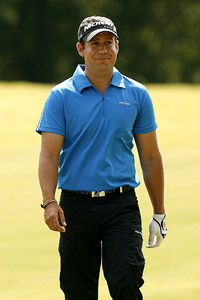
Bob Harig reminds us of a special feather in Tim Finchem's plume: the Casey Martin episode and the precedent it set for Erik Compton to receive a cart at Q-School this year.

Martin, now coaching at Oregon:

"Seriously, I'm pumped. I'm pumped because I know Erik, and he's got a serious condition that justifies this. He is seriously good. He can really, really play. It's not like some guy on some mega-pipe dream trying to get recognition. This guy is a great player who could literally play the tour for a long time. I'm ecstatic that what I went through can help somebody else out."

"How concerned is Camp Ponte Vedra about America’s financial crisis?"

Jeff Rude offers this in a Golfweek.com column:

• How concerned is Camp Ponte Vedra about America’s financial crisis? Well, the PGA Tour is fortunate that virtually all of its title sponsors are signed through 2010 and the vast majority through 2012, said PGA Tour executive vice president Ty Votaw.
Timing is everything. So the Tour is not putting on a sad face.
“When the deepest advertising recession since the Great Depression hit in 2001-02, we renewed 21 title sponsors and signed 18 new ones in a 20-month period,” Votaw said. “We’ll come through the trouble this time because we offer fundamental value–brand building, business-to-business opportunity, positive image, charity, international growth.”

Is fundamental value different than say, value? (I'm just trying to learn!).

Also in the column his this item, which I ran by a tax attorney who chuckled and said it was definitely not accurate (others are welcome to chime in...):

• A PGA Tour player, low-ranking at that, told me that if Barack Obama is elected president, he’ll have to pay 56 percent in income taxes. And you wonder why Tour players are close to 100 percent Republican?

"I thought I would have been itchy to get back..."

While Doug Ferguson analyzes the PGA Tour and LPGA Tour's various soft spots in light of the recent economic collapse, I think Tiger's answer in the Today Show interview to the question about getting away from the game is more disturbing.

Check out the video here.

He was asked if it has been good to get away and replied that he: "thought I would have been itchy to get back but after going through it I'm really not that itchy to get back," then cites the inability to rotate on his knee as the reason he doesn't have the itch.

Villegas Considering Euro Tour Options

Mark Reason reports on George O'Grady probably saying more than he should. But either way, add Camilo to the growing list mulling more European Tour appearances.

George O’Grady, chief executive of the European Tour, told The Sunday Telegraph, that the Gulf States were about to flex their financial muscles in terms of pulling in the world’s top golfers. The inconceivable prize money that such oil-rich countries can offer has started to arouse the interest of the glitterati of the American Tour.

O’Grady said: “We’ve been talking to Phil Mickelson for some time. I talked personally to him at the Scottish Open and to his management at the Ryder Cup. Villegas is also managed by IMG and they have been making inquiries on his behalf.

“Sergio Garcia has said that he will play more on the European Tour next year and he is close friends with Camilo. Sergio’s and Camilo’s management are keen to get to the Latin-speaking audiences. So will Camilo play in Sergio’s tournament [the Castello Masters] next year?

"If things don't improve in the car industry by the end of 2009, there may be further attrition."

Jim McGovern at golf.com offers an interesting analysis of the PGA Tour's relationship with auto manufacturers and where it may head.

Companies that are sufficiently capitalized, have a national audience of customers who fit golf's demographics, maintain a multilevel distribution network and can afford to develop a broad array of television ads are few and far between. Throw in a minimum entitlement fee of $3 million or more depending on the purse, a requirement to buy $2.5 million to $4 million in commercials, then add the cost of sponsorship activation (pro-am spots, hotels, food and beverage for customers), and the list begins to shorten rapidly. All in all, you're looking at roughly eight million bucks a year, with a minimum duration of four years, for a total commitment of around $32 million. And that's just for run-of-the-mill tournaments; World Golf Championships and some thoroughbred events are higher yet.