Save Musselburgh Links
/ My latest Golfobserver.com column is posted.
If you are interested in the efforts to save the world's oldest continually played course, here's their "get involved" page.
And here's the official club site.
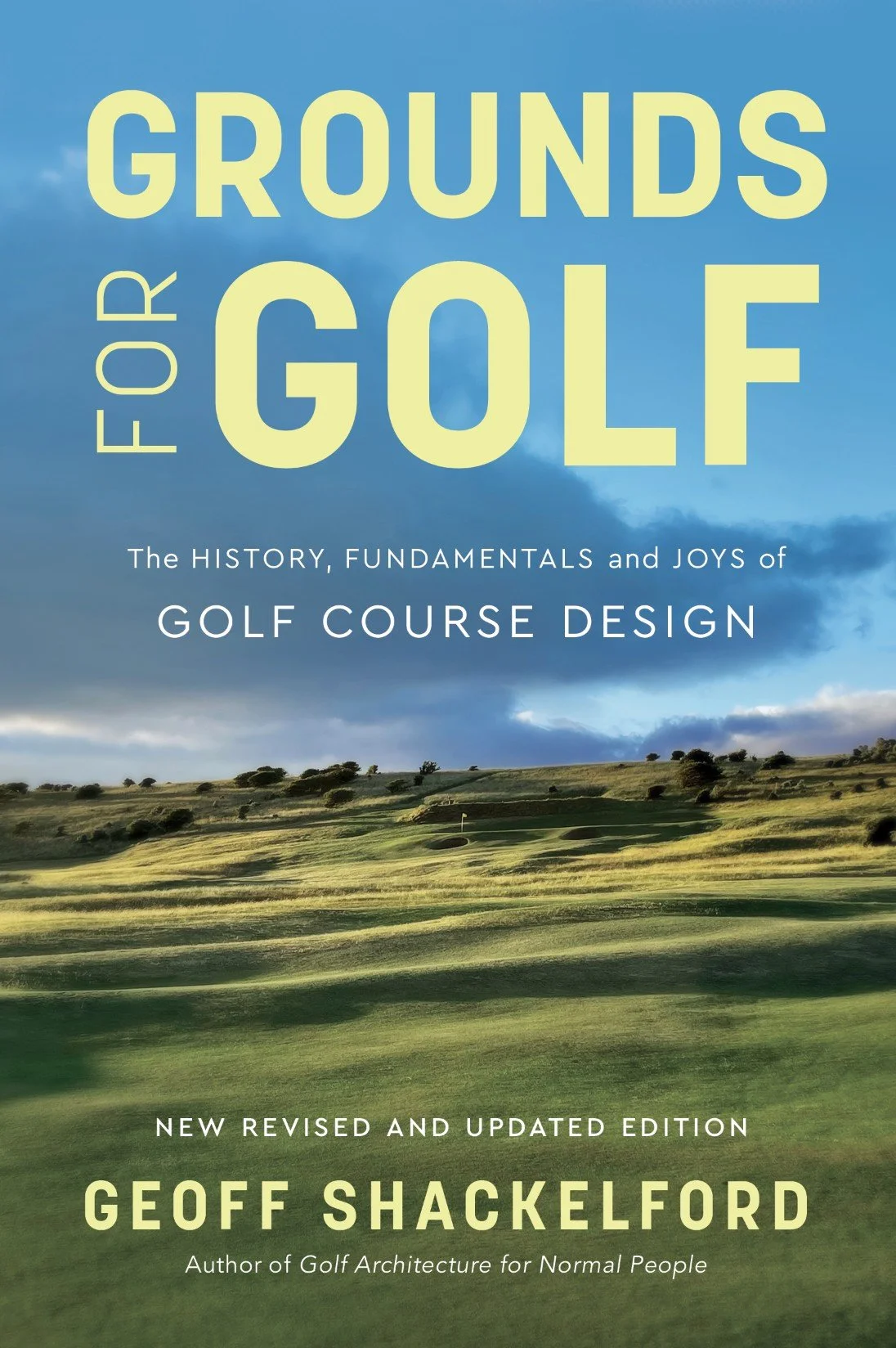
It’s back!
Twenty years later Tatra Press has kindly allowed me to bring back Grounds For Golf now that golf architecture is of more interest to the masses. A new Introduction looks at what’s driven the interest growth and two new chapters I had a blast adding (plus a few edits to keep things up-to-date).
The Amazon purchase page for the book arriving June 15, 2026.
My latest Golfobserver.com column is posted.
If you are interested in the efforts to save the world's oldest continually played course, here's their "get involved" page.
And here's the official club site.
Tim Sullivan looks at the "perpetual" battle for Torrey Pines and what's at stake.
The love letters are rolling in over my latest Golfdom column.
Steve Elling talks to Frank Thomas about his recent study and also offers a sidebar of Thomas's ways to grow the game. Plenty of great ideas and a wonderful message.
But it's hard to understand how he can lament the commercialization of the sport while also suggesting that the answer to increased distance is in restricting course setup or lowering the 14-club limit, not through sound rulesmaking.
"We've completely lost touch with why we play the game," Thomas said.
Other highlights from Elling's story:
The survey revealed nothing that will shock the cropped socks off most golfers but bolstered every theoretical notion about the drain of players from the game. Most golfers play from the wrong tees, vastly overestimate how far they can hit the ball and spend five hours enduring their masochism. Then they go home and put the clubs away for a month.
Thomas' fundamental fix will cause golf developers and course owners to recoil. Simply put, he wants to build or modify existing courses to more capably -- if not forcibly -- suit the everyman, not the .55 percent of the population that are scratch golfers.
He mentioned to designer Jack Nicklaus at the Father/Son Challenge last month that he'd like to see more courses built at a maximum of 6,500 yards in length, not the 7,500-yard monsters carved for tour-quality players. That way, John Q. Publinks would have more fun and play from more reasonable tees, likely at a lower cost.
It's insanely logical, to coin a phrase.
"He laughed and said, 'Frank, if I built a 6,200-yard course, I wouldn't have any more clients,' " Thomas said.
And...
As it stands, new courses have turned into a veritable arms race, with designers and builders often trying to out-glitz the next guy. The average player needs the opportunity to roll the ball onto the green and should not be asked to execute a 5-iron to an elevated green over a yawning bunker complex into a stiff headwind.
"We've got to turn this corner because commercialism has taken a severe toll on the game," he said.
The results of Thomas' survey are posted at franklygolf.com, with honest suggestions and his analysis of current trends set to be unveiled over the coming months.
"The object is to get people to enjoy the game more," he said. "The work we're doing, we hope to accomplish that."
He's just getting warmed up. Given his old pedigree as the USGA's equipment gatekeeper -- no legal balls or clubs reached the market without his department's say-so -- he's been mulling the hot-button technology issues of the day, too. You think his course-design ideas sound like heresy?
"I am going to propose that tour players compete with only 10 clubs," he said.
Bill Nichols in the Dallas Morning News talks to Lanny Wadkins about the next generation of 20-somethings. He echoes what many have noticed about Tuesdays at a PGA Tour event: European and Australians out playing money games, Americans beating balls.
"They all look like worldbeaters, but when they go on the golf course, they have that same practice-tee mentality," said CBS golf analyst Lanny Wadkins of Dallas, winner of 21 PGA Tour events.
And...
Wadkins theorizes that many current prospects are suffering paralysis by analysis. Armed with space-age technology, some young players spend too much time breaking down videos and too little time playing. He doesn't discount the competitive edge he developed playing for lunch money at Wake Forest.
"If I beat my buddies in school out of six bucks, that meant I got an extra meal at McDonald's or Itty Bitty Chicken," Wadkins said. "We learned on the golf course how to hit shots, make things happen, play with imagination, curve the ball. These kids today go stand on the practice range and hit 7-iron after 7-iron. I don't think it's enabling them to learn the game that it takes to win."
 Thanks to reader Steve for this see-if-you-can-not-roll-your-eyes press release.
DENVER -- When the USGA changed Rule 16-1a(i), it meant a sweeping change for PUTT PAL USA - literally.
PUTT PAL™ and POCKET PAL™ are the only greens brushes permitted by the USGA and the R & A. The PUTT PAL is available in two models. The first can be clipped onto the bag for easy access and is a retractable brush in a tube.
The second is the POCKET PAL. It is a slim, retractable brush, shaped like a deck of cards that can be easily carried in the pants pocket. The PUTT PAL and the POCKET PAL weigh only 2 ounces each.
The third in the threesome is the PUTT PAL Shaft version. This is a PUTT PAL brush attached to the end of a True Temper shaft with a Golf Pride grip on the other end. It eliminates having to bend down to sweep loose impediments from the green surface and will be available in the Spring.
True Temper shaft? How 20th century. Where's the Fujikura?
"With the new rule change, we have three products that make perfect sense for the golfer," said PUTT PAL USA CEO and founder Steve Wicklas. "It not only sweeps away loose impediments, it does it quickly. Before the rule change, golfers had to remove loose impediments by hand which was a time taking chore. Now, the golfer can sweep them away in short order without affecting the pace of play."
Thrown in a distance measuring device, and I tell you, they're going to have this slow play thing licked.
David Davies in the Telegraph writes about the "explosion" of "huge hitting" in golf, focusing on Bubba Watson's recent exploits. Lots of the numbers I've hit you over the head with here.
This was an interesting perspective:
Pat Ruddy, the eminent and amiable Irish golf course architect, is appalled by all this. "After these guys have driven the ball they have consumed over 70 per cent of the golf course. There's nothing left. The entire values of the game are being attacked by one club, the driver.
"What are we, as architects, to do? How about growing long grass from the green back towards the tee, so that they have to hit a wedge first and then a three-wood into the green? Or have 10-mile long courses?
"These tee shots have wiped out five or six clubs from the bag."
Bubba Watson won't care, of course, and neither will Jason Gore, but the rest of us should be mighty concerned about the threat to golf as we have known it.
 Anne Kornblut of The New York Times looks at the lousy image that golf has acquired in Washington thanks to the Jack Abramoff scandal.
Golf is bad. The ominous warning can almost be heard echoing across the greens of the political establishment, where the game is not only a cherished pastime but has increasingly become a critical cog in the wheels of campaign financing and lobbying. Lavish political fund-raisers are built around golf tournaments. Fact-finding Congressional trips are tailored to cross paths with golf resorts. Candidates and their supporters spend tens of thousands of dollars on golfing costs each campaign cycle - more and more each year, it turns out - as part of the cost of doing political business.
But now, as the Abramoff ordeal in Washington unfolds, golf is acquiring the whiff of scandal, its exclusive fairways and cozy clubhouses redolent of an improper commerce between money and influence.
And this:
Until golf entered the picture, the ethics scandal surrounding Tom DeLay was hard for many to fathom. It involved complicated transactions between obscure political action committees.
After writing about how the modern golf ball is all things wonderful--and no one can argue with its amazing design and construction--Jim Achenbach's gets to the heart of the matter:
Touring pros, aided primarily by technology and greater athletic ability, have become longer because they have learned how to outmaneuver golf ball testing standards. The U.S. Golf Association's Overall Distance Standard now reflects a maximum combined carry and roll distance (under normal test conditions) of 320 yards.
Some players have been known to carry the ball farther than that.Now, you'd think this notion would outrage the USGA and R&A, right?
So when is enough enough for the bombers of the PGA Tour? It may be sooner rather than later.
If the USGA rolls back the golf ball – in a drastic alteration to the rules – it should reimburse golf ball manufacturers for the expense of adapting to the new distance standard.
You laugh, but I can't think of a more appropriate headache for all sides in this caper!
The USGA handing out millions of dollars to ballmakers? Absolutely. It is the only fair thing to do.
With a shorter golf ball, golf courses will move the tees up. Golfers can play shorter courses. Older layouts can regain some of the muscle they lost in the era of golf ball expansion.
Well, no one is going to move tees up. But if they stop wanting to move them back, that would be a nice, nice start.
Tim Rosaforte writes:
If you stayed up late Sunday night to watch David Toms blow out the field at the Sony Open, you were looking for something to keep you from going asleep. Nothing against Toms, who won by five strokes; it just wasn�t much of a final round for drama.
Thankfully, there was Bubba Watson. The purists may think distance is ruining the game. In truth, distance drives the interest in the game.
Distance drives interest in the game? Hmm...so is that why ratings are in the toilet and play is way down? I knew it!
Watson is more than a circus act experiencing his 15 minutes. He is the reason why Tiger Woods went to graphite and why Mickelson was experimenting with a 47-inch shaft this off-season. Watson is the future. He is 6-foot-3, 180 pounds of elasticity, and he didn't appear the least bit nervous on the weekend, finishing with an eagle on Sunday for a check of $244,800 that represented job security.
Bubba is the reason Tiger went to graphite?
Huh, wonder why Tiger's never credited him? Shameful Tiger, shameful.
The Ladies Golf Union released the results of a research project on golf in Great Britain and Ireland.
Questioned on barriers to more women playing golf the top responses from both lady golfers and golf club secretaries were: lack of time 53.9%, lack of TV coverage for ladies’ golf 42.2%, clubs too male dominated 41.6% and too expensive 40.5%. Clubs seen as unfriendly polled 28.9%, lack of family atmosphere 24.9% and dress code 16.1%.
Lack of TV coverage for ladies' golf, 42.2%?
How about that newsflash from the city!
At the sixth annual Golf 20/20 Conference last fall, attendees heard a variety of presentations on how to deepen the connection between the game and its best customers, as well as how to further golf among the corporate community...Among the presentations was a detailed look at a survey of avid golfers presented by Jon Last, vice president of research and development for the Golf Digest Companies. According to Last, there are a number of key factors that affect participation by golf's best customers – those defined as avid and core golfers. (Avid golfers play 25 or more rounds a year, core golfers play 8 to 24 rounds.) Among those factors, the work of golf course superintendents ranked right at the top. When these groups were asked, "Do you generally prefer to play a course that is very challenging, not top condition" or one that is "challenging but in very good condition," 88 percent of them said they'd choose the course in very good condition.
Really? You don't say? So hard-and-lousy condition lost out to not-as-hard and in great shape. Okay.
They were also asked to rank conditioning against course design in a decision to pay 25 percent higher green fees. The two key groups selected "better course conditioning" twice as often as "better architectures and layout."
Better architectures?
Finally, golf's best customers ranked the factors that drive their enjoyment of the game on a scale from 1 to 7. The conditions, people and their own performance received the following mean scores:
Well maintained greens & bunkers - 6.34
Well maintained fairways & tees - 6.28
The people you play with - 6.24
Playing well on the course - 5.84
Availability of practice facilities - 5.68
Beautiful surroundings and scenery - 5.74
Scoring well - 5.65
Challenging course - 5.65
Fast pace of play - 5.39
Knowledgeable marshals and starters - 5.38
And they forgot to ask about the design of the course...score another one for architecture(s).
So conditioning is why everyone is going to Bandon? We know it's not because of the weather.
Thanks to reader Josh for this.
Alistair Tait gets plenty of reader feedback on the subject of walking, which he wrote about last week.
Golfweek's Alistair Tait is thinking of no longer playing courses that require carts. And he's not buying the idea that carts speed up play.
 Strolling around Sherwood on a cloudy, cool (gosh it never hit 70!) day, I took in some of the Target World Challenge. This is the first time in six years I've seen tournament play at Sherwood after never missing the 11 Shark Shootouts played there.
The late 80s Nicklaus-designed greens, while generally reflective of the dreadfully overdone stuff he built in that era, feature some interesting backslopes, tiers and other banked features that allow the player to play away from the flag to funnel a shot down to corner hole locations.
While not exactly a stellar example of architecture (and certainly not conditioned like it used to be), Sherwood has always been a fun spectator course thanks to the greens. Players have traditionally used the supporting features to work balls down to the hole, allowing the crowd to root balls down a slope and to see players occasionally show flashes of creativity.
Several hole locations today provided fine opportunities for the creative shotmaker to throw a ball to a safe spot away from the hole, and then let it find it's way toward the cup. And every time a player had the opportunity to use these features, they passed.
The most painful example came when Padraig Harrington missed it right of the par-5 fifth green in two, and then he attempted to lob it next to the hole. He ran his third shot right past the hole and off the green. If he had played ten yards right of the hole, a backstop would have slowed his ball down and then sent it toward the hole, leaving him a 10-footer for birdie.
Afterwords, I asked a veteran writer if the players just weren't as creative as they used to be, or if it's a lack of local knowledge. He believes the players are just used to playing shots straight at holes and having them hold. They don't know any other way of playing anymore.
So there you go architects. Are you hoping to separate shotmakers from the rest? Then create wing and peninsula hole locations that require the placement of a shot landing in a certain spot away from the hole.
Brian Silva suggested that he'd love to see more of this concept on TPC for a Links story, and his observation is looking wiser by the day.
Geoff Shackelford is a Senior Writer for Golfweek magazine, a weekly contributor to Golf Channel's Morning






Copyright © 2022, Geoff Shackelford. All rights reserved.