Golf Version 2.0
/Dave Zinkand pens a guest post at Tom Dunne's site about ways to rethink the golf experience and included are several photos, including a before/after set from Rustic Canyon supplied by yours truly.

It’s back!
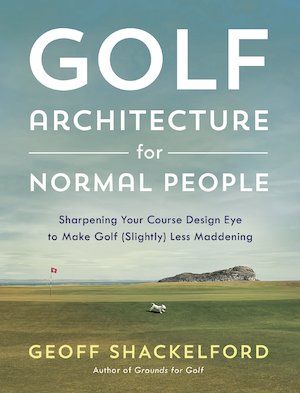
Twenty years later Tatra Press has kindly allowed me to bring back Grounds For Golf now that golf architecture is of more interest to the masses. A new Introduction looks at what’s driven the interest growth and two new chapters I had a blast adding (plus a few edits to keep things up-to-date).
The Amazon purchase page for the book arriving June 15, 2026.
Dave Zinkand pens a guest post at Tom Dunne's site about ways to rethink the golf experience and included are several photos, including a before/after set from Rustic Canyon supplied by yours truly.
Interviewed by Robin Barwick using questions questions from Mark Reason, there was an entertaining round table to promote the Ballantine’s Championship. The participants were Paul McGinley, Ernie Els, Henrik Stenson and Fred Couples. Plenty of highlights, including talk of Bethpage, golf in the Olympics, Stanford Financial (awkward!) and this technology exchange:
In the arena of equipment technology, is the golf ball flying too far now?
McGinley: I think the horse has bolted. The problem should have been addressed 10 years ago, when the scientists that the USGA and R&A had were not as good as the ones the manufacturers had. The manufacturers basically broke through the gates and went too far with the ball.
Els: I am against stopping technology, but people also need to be careful how they set-up golf courses. Look at Oakland Hills last year [in the US PGA Championship]. Some of those fairways were un-hittable. Look at Shinnecock Hills. A great golf course, but they were scared of the technology and scared of a low score winning, and they screwed up the golf course.
Stenson: Longer is not always better.
Els: Exactly. They need to be careful not to take a great, classic golf course, and just for the sake of stopping someone going low, screwing up the golf course.
McGinley: In fairness, over the last couple of years we have started to see that the USGA, R&A and Augusta are starting to see the picture. Augusta was great this year, Torrey Pines was great last year and Birkdale was great last year, so they are starting to get it now. Mistakes have been made in the past though, no doubt about it.
Stenson does point out that not everyone thought Birkdale was so great last year. But more importantly, it is interesting that when this topic comes up, almost no one suggests that improved athleticism was the cause. Even better, you have folks like Els openly making the connection between over-the-top setups and poor regulatory practices. Just a few years ago only select players like McGinley understood the connection.
I'm not sure what I enjoyed more, John Paul Newport's look at the return of white belts and shoes, and the resulting attention drawn to the matter by Phil Mickelson's fashion choices, or the fact that John Daly responded to Newport's piece on Twitter:
@jpnewport you will see me sportin white belts & white shoes on tourabout
24 hours ago from web in reply to jpnewport
Thanks to reader John for Lorne Rubenstein look at all of the reasons why the Royal Canadian Golf Association can't consider some classic venues for the Canadian Open. Actually, there's only one reason in Lorne's view.
Last week's announcement that the RBC Canadian Open will return to Shaughnessy Golf and Country Club in Vancouver in 2011 should be cause for celebration. After all, it's a classic old course, the kind tour players say they love. And it will mean the tournament will have been played at a grand spot two years in a row. (St. George's in Toronto will be the venue in 2010.) So why did I feel some sadness upon hearing the news? It had nothing to do with the choice of course or the Royal Canadian Golf Association's commitment to taking the tournament, as often as possible, to traditional layouts. It had everything to do with what's happened in the world of pro golf tours.
The issue is that few older courses are capable of staging the Canadian Open. This is because the United States Golf Association and the R&A dropped the ball in allowing the golf ball to go so far that it's made superb courses that have held the Canadian Open obsolete for the tournament.
Here's something even the governing bodies understand, without telling it to some of the modern masters to their faces.
At least the RCGA realizes this. Its executive director, Scott Simmons, made it clear last week during the Shaughnessy announcement that the commitment isn't to a fixed rotation, but simply to quality courses. He said that could include new courses, but the message remains clear that tour players prefer traditional layouts.
"We have been on a journey of renewal," then-RCGA president Andrew Cook said last June, when it was announced St. George's would play host to the 2010 Canadian Open. "We want the tournament to get back to the stature it once held on the world stage."
The RCGA is trying. But it would have a better chance of reaching the goal if the courses of the past weren't so ill-suited to the tournament game and demands of the present.
Such are the unintended consequences of "progress."
Well they could look to the R&A solution: proudly alter the courses.
John Hopkins reports this in his current Spike Bar column:
The latest news is that the North Shore Country Club on Long Island, New York, is in financial trouble after one third of its members, many of whom were clients of Madoff's, resigned, unable to afford the $16,000 annual membership. As a result the club has laid off 20 part-time employees and, having been in existence for 95 years, is struggling to reach its centenary.

Michael Buteau filed a comprehensive Bloomberg story on the struggles of the golf car industry. Meanwhile Golfweek.com posted the results of a Club Car funded "white paper" titled "Golf Car Vandalism: No Joyride," which estimates that operators are losing $8-10 million a year due to...
• 72 percent of courses reported vandalism or golfers playing extra holes without paying a green fee.
• 27 percent said they had retrieved a vandalized golf car from a lake or creek.
• 48 percent reported unauthorized use of golf cars.
• 42 percent reported golf cars being driven in restricted areas.
• 21 percent reported theft of golf cars.
The only solution to all of this bad cart news? Just ban the carts. Yep, I know, shocking. But it's the only way can eliminate this wasteful behavior.
What with the exclusive board meeting video and all of this talk about clubs, I suggested in Golfdom that clubs need to start locker room or bulletin board postings to fund the buyouts of less desireables. What do you think?
Thanks to Dave who forwarded this insider's view of a board meeting at Missouri's Sikeston Country Club. The sensitive subject of tree removal is in play. I think it is safe to say that anyone who has spent time on a club committee will relate to this. The video is also a fine introduction to Overstream.com.
Frank Thomas pens a guest opinion piece for the Sunday New York Times and blasts his former employer over the groove rule change. He notes bifurcation without using the "B" word:
This means that for the first time, golf will have different rules for different levels of players. Golf is different in that the finest professionals and middling amateurs can compete side by side, as they do in tournaments like the AT&T National Pro-Am. For many golfers, part of the game’s appeal is knowing that they are playing the same game on the same courses as the world’s best.
Didn't that really go out the window about 10 years ago?
No matter where you come down on the grooves issue, I do think Thomas's statement about transparency is worth considering, though I'm not sure how accurate it is considering the documentation posted online.
The U.S.G.A. has not shared its evidence that a problem exists, nor has it demonstrated that this solution addresses the problem while doing the least damage to the golfing population as a whole. Never has a change of such consequence been made with such a lack of transparency or without appropriate input from those affected.
Here's the problem I have with Frank's argument:
Golf participation is declining, and we have yet to hear of people quitting the game because they found it too easy. We do not need equipment rules aimed specifically at making it harder for Tiger Woods or anyone else.
His solution in the past was to advocate reducing the number of clubs in the bag to ten and to grow more rough. And I don't think either of those ideas will bring too many new players.
Thanks to reader Chris for this Mike Aitken and Craig Brown story on the latest change in the name of growing the game in the British Isles: denim.
A campaign called "Love Golf? Join the Club", aimed at filling 10,000 vacancies across Scotland, has been launched with an emphasis on customer service and a more relaxed dress code.
The scheme was announced at Hilton Park, near Glasgow, by Scottish Golf Union (SGU) officials wearing jeans and T-shirts.
And...
Michael Williamson, an Edinburgh golf consultant, believes flexibility is the key to increasing membership. "Most clubs have a variation of 'smart casual', and a lot are being ever more flexible on the issue," he said.
"I think it comes down to definition: I've seen golf clubs were the code is jacket and tie, and you have old guys with soup-stained ties and jackets with patches.
"I don't think it's exactly what you specify, it's all to do with attitude. Tiger Woods wears a collarless T-shirt and he's the best golfer in the world, so why shouldn't people be allowed into golf clubs wearing that?"
Geoff Shackelford is a Senior Writer for Golfweek magazine, a weekly contributor to Golf Channel's Morning







Copyright © 2022, Geoff Shackelford. All rights reserved.