Jack's Fantastic Slow Play Rant: It's The Golf Ball
/Kathy Bissell with a splendid Jack Nicklaus
Read More
It’s back!
Twenty years later Tatra Press has kindly allowed me to bring back Grounds For Golf now that golf architecture is of more interest to the masses. A new Introduction looks at what’s driven the interest growth and two new chapters I had a blast adding (plus a few edits to keep things up-to-date).
The Amazon purchase page for the book arriving June 15, 2026.

The preview clip--with an unfortunate ad fronting the ad--for the latest episode of In Play With Jimmy Roberts focuses on pro golfers going to Israel and another talking about their "signature" wines, but the segment of real interest appears to be on water usage. Stone Phillips gets the call to handle one of the most pressing issues in the game.
In Play airs Tuesday, July 30 at 10:30 ET, 7:30 PT. The preview:
• Golf Course Water Usage and Conservation Concerns – One of the bigger concerns in the golf course industry today is water usage. Whether driven by higher costs, the lower availability of municipal water, or environmental conservation, golf course superintendents and architects around the country are stepping up their efforts to manage water. Former NBC journalist Stone Phillips examines the ways golf course architects are building courses with water usage and conservation heading into the future.
Last time we had Matthew Goggin fresh off a solid showing at Merion in the U.S. Open, this time we managed to get Geoff Ogilvy to chat from Scotland during his pre-Open Championship leisure golf. Topics covered include Muirfield, the state of Geoff's game and of course, the state of the game.
We kept him too long but the discussion was great until the cell phone Gods said enough! Hope you enjoy either via iTunes or hitting play on the the player below...
Doug Ferguson's game story on the Monday news dump reminds us that Commissioner Tim Finchem said in February the tour was opposed to the new rule because there was no "overriding reason to go down that road."
And now we've gone down that road with his blessing!
Though judging by the intial poll results, not many of you buy into the idea of extending the use of anchored putters for the amateur game, as the tour suggested.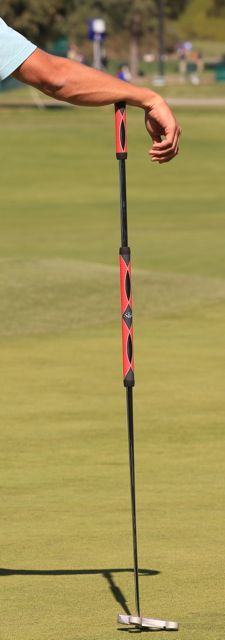 Jason Sobel feels the PGA Tour's announcement pointed to political maneuvering, but what that is remains murky.
What can’t be argued is that there was indeed a political agenda at play here. Finchem is well versed in the strategies involved in such issues. He’s implemented them in the past with similar success and this matter was no different, as he planned three, four, five steps ahead at every checkpoint throughout the process.
It may not explain everything about this decision, but it does serve to explain how an organization that outwardly opposed an anchoring ban just a few months ago is voting in support of it this week.
Scott Michaux had less trouble interpreting the decision, saying "the tour couldn’t stop itself from sticking its nose in where it doesn’t belong and sounding pompous in the process."
It's a transparent attempt to strong-arm influence any future policy regarding equipment.
The tour clearly believes that the game and its millions of golfers around the world revolve around its hundreds of tour professionals.
I've pondered the press release for a few hours now and would conclude that Michaux has it right, with the caveat that there was also an element of face-saving in this awkward language that followed the policy board decision.
Finchem knew all along from the person he has on the USGA Rules committee that the proposed ban was going to happen, yet seems to behave as if he was surprised, prompting this absurd statement in the press release:
“It is not inconceivable that there may come a time in the future when the Policy Board determines that a rule adopted by the USGA, including in the area of equipment, may not be in the best interests of the PGA TOUR and that a local rule eliminating or modifying such a USGA rule may be appropriate."
Translation: we know from our representative on the ball and implement committee that you have a ball spec and overall distance standard rollback in mind and we can't make up our mind if we like that or not, so we'll mention something about the everyday game to show we care and to appease our friends at the PGA Of America who are opposed to any kind of distance regulation.
Which then makes this largely a blatant attempt to confuse those who are not aware of the amount of access the PGA Tour has to USGA/R&A deliberations...
“Having said that, we have been assured by the USGA that as we move forward we will have an open and effective communication process on a number of levels with the decision makers at the USGA,” Finchem added. “Importantly, this will include a direct communication between the Commissioner’s Office of the PGA TOUR and the USGA Executive Committee. Such a process will ensure that our position is fully and carefully considered and addressed in future rule making.”
Apparently the Commissioner's interactions with the USGA and R&A at the USGA Annual Meeting, PGA Show, Masters, International Golf Federation conference calls, World Golf Foundation/Hall of Fame/Players Championship meetings, Golf 20/20 meetings, First Tee gatherings, U.S. Open, Open Championship, PGA Championship and assorted other points during the first nine months of the year are not enough?
Good grief.
The USGA was asked for a comment on the PGA Tour press release and declined. Frankly, who can blame them?
**Gary Van Sickle kicks off his always fun mailbag by taking issue with Tim Finchem's actions, writing that "Finchem and the Tour aren't there for the players. The players are there for Finchem and the Tour."
He played both sides of the fence. Like lawyers often do. Using words is just a game. You know, like the whole famous routine about the definition of the word, "is."
I'm not surprised. I know one thing about the PGA Tour: It talks a big game about how much it has raised for charity; its tournaments are a tremendous vehicle for community fundraising and, yes, they're working on their second billion. That is amazing. One of its old slogans was, "Anything's possible." There were dozens of feel-good commercials.
And then, when a player came along with a disability -- a withered leg, say -- and made it to the Tour, the Tour responded by trying to sue him into oblivion instead of making him the poster boy of hope and "Anything's Possible." Casey Martin needed a cart to play golf. He was a true underdog, a true feel-good story, and the courts upheld his right to use a cart in competition under the Americans with Disabilities Act (ADA).
So the PGA Tour didn't back up Martin, either. It talked the talk but didn't walk the walk. It fought him every step of the way and did everything it could to stop Martin. Jack Nicklaus and Arnold Palmer and others who should be embarrassed filmed depositions speaking out against Martin. Finally, against the advice of the Tour's legal experts, Finchem appealed the case to the Supreme Court. The justices sided with Martin, proving the Tour's lawyers finally got something right.
Finchem and the Tour aren't there for the players. The players are there for Finchem and the Tour.
**Garry Smits has the Florida Times-Union take including this reminder:
With the Tour accepting the ban on anchoring, a number of its stars will have 30 months to find another method of putting. The list includes Masters champion Adam Scott, current British Open champion Ernie Els, 2012 U.S. Open champion Webb Simpson, 2011 PGA champion Keegan Bradley and 2010 Players champion Tim Clark.
Andrew Rice was "handed a pristine collection of older model Titleist golf balls" that included Tour Balata 100's, Professional 90's and early model Pro V1's.
 He enlisted a consistent driver in Atlantic Golf Club's Zack Brady and had him hit six shots with the old balls and the current Pro-V model on the Trackman. And guess what they found?
"The huge leap in distance off the tee on the PGATour in 2000 is due to only one thing – the introduction of the Pro V1." An increase in distance of almost 10% over the scuff resistant Professional.
The Tour Balata averaged 261.6 yds, the Professional 90 262.1 yds, the Pro-V1 392 286.4 yds and the current Pro-V1 298.4 yards.
Mathew Goggin joined the gang to talk about all things Merion after his fine showing (T21) in this year's U.S. Open. Besides talking about how the setup and logistics worked form a player's point of view, we also learned about Goggin's day with Tom Watson in the final round of the 2009 Open Championship, a subsequent round the two played and the golf course project he's developing in Tasmania.
As usual, you can download the show or listen through iTunes, or in the player below.
 Deadspin's Tom Ley reports the finding of the Chester Valley Country Club's board on denim in the dining room, an investigation of sorts going on out at undoubtedly many clubs across the land struggling to appeal to a younger demographic.
But to those who haven't seen the club world at work, it does sound rather, well, weeeeeird.
Great stuff on Morning Drive today exposing the AJGA's pace of play work as part of Golf Channel's push this month. Namely, the AJGA getting to explain their check point and time par system that is working. It's a sharp contrast to the USGA's glossy campaign that is not backed up by the implementation of a time par system at the U.S. Open.
The most interesting thing I learned from AJGA executive director Stephen Hamblin and player representive Nicole Morales is their abandonment of the honor system and the 17-minutes a round saved by asking players to walk ahead to the next tee when they've holed out first. They also recently set a time par of 3:58 at an event and rounds averaged under that.
I also was intrigued by Hamblin's mention of this as a "safety issue" by keeping everyone out of midday hot weather an hour less a day. Considering the length of the days at the recent U.S. Open at Merion, that's not a bad point!
You may recall that prior to the 2013 U.S. Open at 6,996-yard Merion, former USGA Executive Director David Fay told Golf Digest contributing editor David Fay that "of course" this would be a referendum on the question of distance and its impact on the modern game.
Since then we saw high scores at Merion thanks to a combination of the difficult architecture and restrictive setup.
The USGA Member Clubhouse hosted an engaging, standing-room only roundtable Monday afternoon as persistent spring rains pelted the tent just off of the USGA's main "Spectator Square." Hosted by Jimmy Roberts, the hour-long discussion featured guests Curtis Strange, Merion historian/member John Capers, USGA Executive Director Mike Davis, architect Tom Fazio and '13 U.S. Open General Chairman Rick Ill.
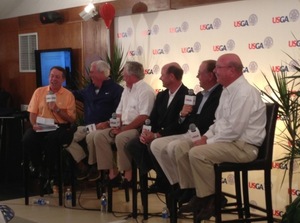 The program kicked off a series of daily events in the clubhouse that include a Rich Lerner interview of Ray Floyd (Tuesday), a 2009 Walker Cup reunion Wednesday with Rickie Fowler (among others), Billy Casper Thursday and tantalizingly, a Thursday chat called the "USGA's Position On Technology And Golf Equipment" featuring Championship Chair Tom O'Toole and Managing Director of Equipment Standards John Spitzer.
But the real bombshell in the Merion conversation was dropped by Ill, who revealed after a discussion of Merion's decade long restoration (tree removal, bunker work, etc...) that following the 2013 U.S. Open, several of the "restored" bunkers--which were actually shifted to pinch landing areas on holes like 2, 15, 16--will be restored to their previous positions.
Also of note was Fazio's prediction that after this week, the world of golf will be having a "very different" debate about the ball because of his belief that Merion will show that a course under 7,000 yards is plenty relevant in today's game. Relevant, that is, until the restored landing area bunkers are unrestored.
Jack Nicklaus launched his team learning leagues "powered by SNAG" at today's Memorial Tournament, with a roll-out planned in parks in Columbus, New York, Miami, Chicago and Los Angeles.
 For Immediate Release:
Jack Nicklaus Learning Leagues, powered by SNAG® Kick-off in Five Major Cities
Golf Icon Takes Bold Step to Energize Youth Participation in Golf
North Palm Beach, FL (May 29, 2013) — To coincide with the 2013 Memorial Tournament, the new Jack Nicklaus Learning Leagues, powered by SNAG, will be introduced at select local park and recreation facilities in the Golden Bear’s hometown of Columbus, Ohio, as well as in New York, Miami, Chicago and Los Angeles. The Jack Nicklaus Learning Leagues (JNLL) marks the first time that golf will be made available to youngsters as a team sport through local parks and recreation facilities. The innovative concept, combined with SNAG’s well-established, first-touch development program, will provide a golf learning experience for children, ages 5 through 12, in a safe, affordable and accessible environment.
Nicklaus has been an important advocate for growing the game and he envisions that with SNAG’s modified equipment and support, and the active participation of local park and recreation agencies through the National Recreation and Park Association, golf can have a competitive footing with such team sports as soccer, basketball and football. In an effort to supplement other growth-of-the-game initiatives, JNLL has sought the input and support of organizations such as the PGA of America and The First Tee.
“There are so many sports—team sports—played in the park system today,” Nicklaus said. “Kids start playing athletics when they are as young as 4 or 5 years old, and by the time they are just 7, 8 or 9 years old, many of them have picked the two or three sports that they might want to play in the different seasons. If golf is not part of the sports introduced and available to them at their local park and recreation facilities, they will play other sports and not golf. So we need to get golf in their local parks and have them play our sport, and I think the team concept is the way to do it.”
“The idea is to bring kids into the game, keep them in the game, have them learn, let them have fun, have fun with their friends, and then they can advance to the next level where they get on a golf course and develop. I just hope these leagues create the same enthusiasm for golf that I discovered at their age.”
Some 100 Jack Nicklaus Learning Leagues are planned for 2013 and an estimated 300 are projected to launch in 2014.
Terry Anton, founder and CEO of SNAG Golf, is enthusiastic about the leadership position of Jack Nicklaus in the establishment of the Jack Nicklaus Learning Leagues.
“Jack Nicklaus’ vision to bring golf to the same venues where other organized sports thrive will make it easier to develop our future golfers,” Anton said. “These leagues will introduce millions of new players to the sport and will help nurture children developing their motor skills and do it in a fun way. SNAG is honored to have been selected to participate with history’s greatest golfer and the NRPA in the Jack Nicklaus Learning Leagues. Our task is to make his vision a reality by implementing SNAG’s programming in the parks and directing this feeder system into all on-course golf programs. This is an important stepping stone for the industry to capture interest in golf early so that youngsters will transition with confidence to play with actual golf equipment on a traditional course. The more fun we make golf for children, the more chance they have to play the game for a lifetime.”
The use of parent-coaches and turning soccer and other playing fields into venues for this golf competition will be pivotal to the implementation of the Jack Nicklaus Learning Leagues, through the auspices of the National Recreation and Park Association.
“Local parks and recreation are the go-to places where children can learn to play sports and develop a connection to healthy activities,” says Barbara Tulipane, president and CEO of the National Recreation and Park Association. “We are so proud to be bringing the Jack Nicklaus Learning Leagues and SNAG to park and recreation agencies across the country, because not only is it a great program but it means more children will have the chance to participate in the sport of golf in a fun and unique way and develop a connection to a healthy activity that will last them a lifetime.”
The NRPA will administer grants to park and recreation facilities across the U.S. to underwrite the costs associated with providing Jack Nicklaus Learning Leagues equipment, coaching and programming. A 501©3 entity, G.O.L.F. (the Global Outreach for Learning Foundation), is being established to raise the necessary funds. G.O.L.F.’s mission is to help people develop golf skills and have fun through developmentally appropriate programs. The goal is to ensure retention and provide a sustainable model for transition to other programs at golf facilities, in order to increase participation for current and future generations. (For information on G.O.L.F. visit www.thegolffoundation.org.)
The Jack Nicklaus Learning Leagues are separated by age groups: 5-6 and 7-8-year-olds with the intention of expanding to 9-10 and 11-12 in the near future. Each league will have a set number of children per team and incorporate a specialized, age-appropriate format and learning curriculum.
Nicklaus talked about the leagues in his annual state of Jack press conference at Muirfield Village.
**A couple of key comments from Nicklaus today:
From my standpoint, it's 100 percent nonprofit from anything that I do, so everybody knows that.
Secondly, trying to figure out how this thing got started. We're trying to figure out how do we get the kids? And the kids today are all going to the parks. Matter of fact, a lot of the parents are not playing golf anymore, that's part of the issue we talked a lot about earlier. They're taking their kids to the park to play football, basketball, soccer, lacrosse, whatever the sport might be. I said guys, we've got to get to the parks in talking with the PGA of America, and they talked to Terry about it, because they're familiar with SNAG, and the success he's had with kids in the approach to starting the game of golf for kids.
And...
So we're trying to get where golf becomes one of those sports, whether it's getting kids started, learning the basics, getting a way they can have fun. And this is a team sport. You're going to go out and have ‑‑ coaches will draft the kids like they do with every other park sport. And it's a very simple thing. It's basically a plastic club with a tennis type ball and a Velcro‑type hole, which is not a hole, it sticks to the Velcro. And it's actually kind of fun to play. If I have fun playing it ‑‑ that's the only thing I can play anymore (laughter). If I have fun playing it, I know the kids are going to have fun playing it. We had some kids the other day playing it with Gary and me, and we had a good time.
Alex Miceli with a report on the PAC members meeting at Muirfield Village and joining in by phone. The takeaway? A variety of emotions on anchoring, bifurcation and rules, though he suggested more players were again in favor of the ban for reasons unknown.
According to one participant, some PAC members who were on the fence now seem to be going back to supporting the ban.
Anchoring on its own has unique issues: the potential for limiting high-profile players from competing as they have for years, potential litigation and how the Tour might be perceived if it goes against the anchoring ban.
“We’ve got a process we follow as a Tour, and we're going to let it play out,” said PAC member Bo Van Pelt. “I think that’s what you get with 144 guys. Everybody has a differing opinion.”
Geoff Shackelford is a Senior Writer for Golfweek magazine, a weekly contributor to Golf Channel's Morning



Copyright © 2022, Geoff Shackelford. All rights reserved.