More MOI
/E. Michael Johnson and Mike Stachura analyze the USGA's decision on "MOI" and what it means for all types of golfers.

It’s back!
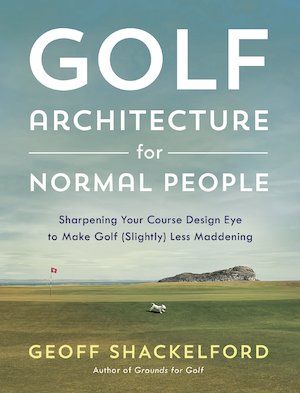
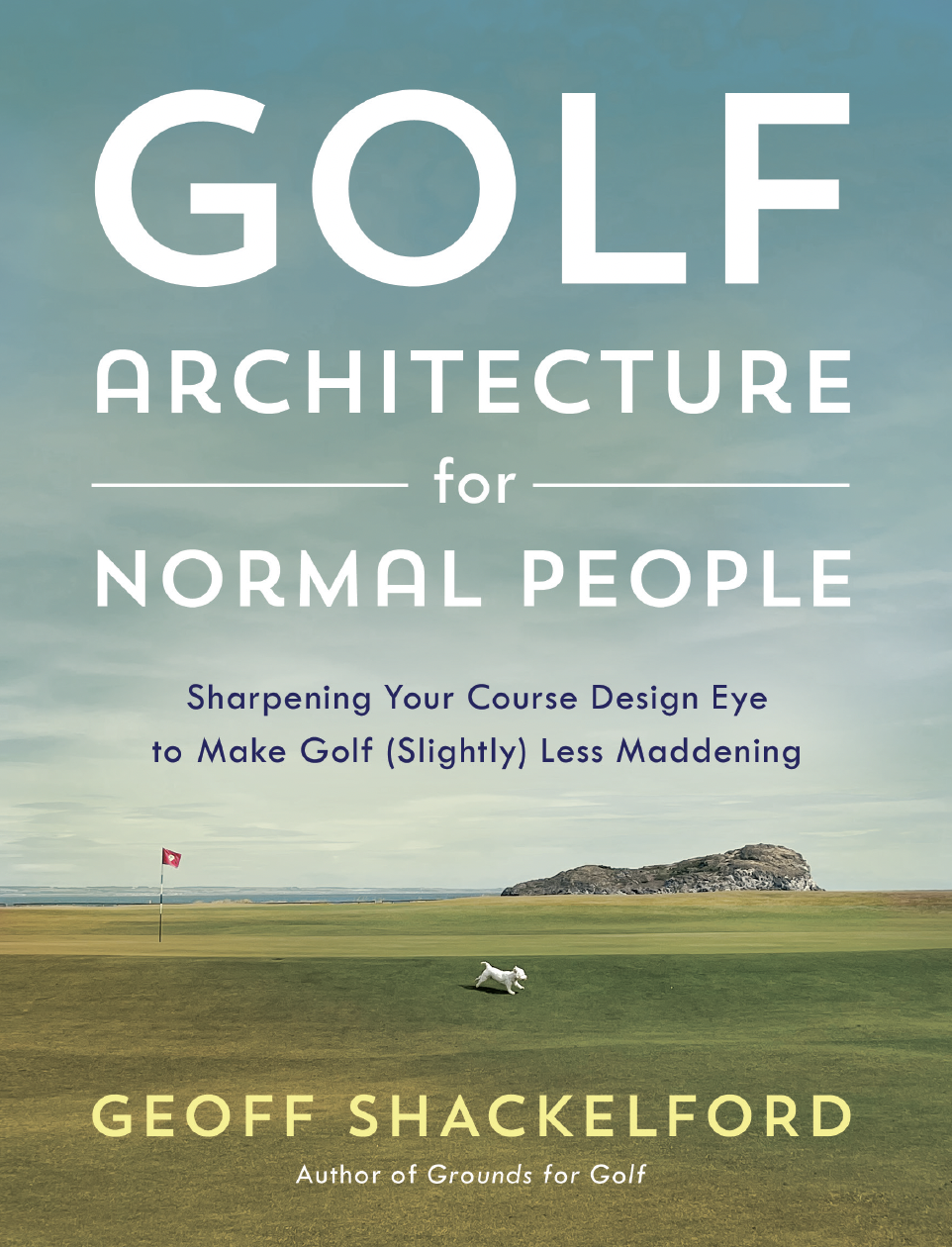
Twenty years later Tatra Press has kindly allowed me to bring back Grounds For Golf now that golf architecture is of more interest to the masses. A new Introduction looks at what’s driven the interest growth and two new chapters I had a blast adding (plus a few edits to keep things up-to-date).
The Amazon purchase page for the book arriving June 15, 2026.
A reader who is a respected national golf writer had this to say about Phil and his two driver concept:
Mickelson using two drivers and one swing supports the argument against technology. It used to be that tour players had to learn to work the ball either way and many were unable to do so with any degree of consistency. Those that could had an advantage. In other words, it's a lost skill, since you can just carry two drivers and let the club work it for you.
In his Golfonline column, Peter Kostis writes:
It used to be that players carried a standard set that included a couple of woods, the standard number of irons plus a pitching and sand wedge. Whatever shots they could hit with that set were the shots they had to play. But today’s player is different. They see a shot that is required and then get their club maker to produce a club that will let them hit that shot. Can you say 60° wedge, hybrid iron, 7-wood, 9-wood or gap wedge? When players saw Tiger’s 2-iron fly driver distance with 7-iron trajectory, they knew they had to do something!
Going forward, I think we will see more and more players looking at the courses they are about to play and thinking about what shots they’ll need to hit. Then, based on their needs, players will put clubs in their bag that will allow them to hit the necessary shots without changing the way they swing. Develop a repeatable swing, and let the equipment adjust the shot.'
I'm still finding myself seeing both sides to this argument. Though when it was revealed (by Phil) that one driver gave him a 25-yard turbo boost, somehow the concept seemed less like something reverting back to the days of the brassie, and more like a strange symptom of the launch monitor.
Thoughts?
I received a complaint from someone who said my recent Golfobserver.com column on Hootie was unfair. Why? Because this well-meaning soul said that Hootie shares the same feeling about the distance issue as folks like myself.
But actually there is a big difference. Well, several. First, most of us who like classic golf courses wouldn't hire Tom Fazio to mow them, much less alter them based on his track record.
But the primary point relates to something Olin Browne touched on in Rex Hoggard's Golfweek.com column:
"The powers that be have become offended by the big hitters."
This view came through loud and clear in Hootie's press conference ("If Hogan were hitting a damn pitching wedge.."). His anger over the situation is directed at the players, almost as if this were baseball and he was having to deal with juiced players.
But as comedian Robert Wuhl pointed out a few weeks ago, in golf the equipment is juiced, not the players.
Hootie and those trying to offset eye-opening driving distances need to direct their frustration toward the governing bodies, not the players or even course designers.
The "big hitters" and manufacturers are simply doing what they are allowed under the rules.
The rulemakers--many of them members at Augusta National--are the ones who have let the game down.
And some of the results may surprise you. Others may be crying media bias!
The New Zealand Herald's Peter Williams writes about the Ohio Golf Association's competition ball:
The Ohio Golf Association (OGA) is boldly going where no golf body has gone before. It's ordering competitors in one of its tournaments to use a certain ball - although they haven't actually decided which one.And...
The OGA, which runs the game in the state where Jack Nicklaus was born and raised, says they are taking a stand against the eroding playability of our old courses due to the length of the modern golf ball.
So, when the OGA hosts the Champions Tournament in August, every player will be required to use a lower-compression ball chosen by the tournament committee.
The impact of the long-distance, modern golf ball is one of the hottest discussion points in American golf.
The R&A and USGA are the only bodies which can legislate against the manufacturers to stop the ball going further. There are already many restrictions on equipment. A ball must be a certain size and weight, driver heads must be no larger than 460cc, while there has to be a certain angle between the club face on an iron and the grooves. So the game's rulers haven't been afraid to put restrictions on equipment, even if they've been sued by manufacturers as a consequence.Well...
But the major reason elite players hit the ball further is the advance in ball technology. The revolution started in 1996 with Spalding's first high-performance two-piece ball, the Top Flite Strata. Manufacturers followed suit with two-piece technology and since equipment companies like Titleist and Callaway put their R&D efforts into ball technology, there's been no stopping increased performance.
But while the elite can hit the ball up to 100m more - 320m par fours on the PGA Tour are now considered driveable - average club players don't get the same advantage.
That was actually a quote from Dick Rugge in this Gerry Dulac story about the USGA possibly curbing some technology, even as a "distance myth" memo is making the rounds.
There are several interesting quotes from manufacturers types in this piece, and it was nice to see Rugge getting to explain and defend some of the recent USGA moves on Moment of Inertia.
Make no mistake, the USGA is intent on curbing the distance the ball travels. In addition to the cap of clubhead size, the USGA also is close to implementing a limit on clubhead moment of inertia (MOI), or the head's resistance to twisting. The less a clubhead twists, the greater the "forgiveness," giving players a greater chance to hit the ball straight.
For example, the USGA tested a wooden driver on its Iron Byron swing machine and deliberately set the machine to produce off-center hits (7/8-inch from the center of gravity). The result: The ball traveled 45 yards less than a ball hit "on the screws."
When the same test was performed with a new titanium driver, the ball traveled only 10 yards less.
"Enough," Rugge said, "is enough."
And again, here's another reason rules bifurcation may ultimately be the easiest solution to all of this madness:
Curiously, such a restriction likely would have a greater effect on amateur and weekend players who have trouble hitting the ball straight and need a high MOI. PGA Tour players don't necessarily need or want such a quality, though the USGA is concerned better players will be able to swing harder without fear of a poor result if the MOI isn't restricted.According to Rugge, the MOI in a club has nearly tripled in the past 15 years.
"That's always our dilemma with any of our equipment rules," Rugge said. "What's good for me [as a player] isn't necessarily good for what's on tour. We don't want to make it so you can't play anymore, but we have to be careful what's going on on tour. It's always a juggling act."
Adam Van Brimmer of the Morris News Service reports on a USGA release apparently handed out at the Masters.
The USGA recently released a list of eight myths about golf equipment and performance. The scientific findings, at the least, cast doubt on whether something significant should be done to rein in the equipment advances many say are changing the way the game is played.
"We thought that people who are avid golfers would be interested in actual facts and measurements with respect to the performance of golfers in today's world with new technology," said Walter Driver, USGA's president and an Augusta National member. "We want to give people access to some of the facts and dispel some of the myths that develop around every golf era, and new golf technology in particular."
Note that Walter Driver was available for a quote on this document. The myths are not available on the USGA website. Here they are, according to the USGA:
MYTH 1: Golfers with faster swing speeds hit today's advanced golf balls farther than they did balls introduced before 2000.
MYTH 2: Golf-ball distance is not currently limited.
MYTH 3:Driving distance on the PGA Tour is rapidly increasing.
MYTH 4: The long hitters on the PGA Tour finish higher on the money list.
MYTH 5:Most PGA Tour players swing at 120 mph or more.
MYTH 6:The USGA ball test doesn't control ball distance well enough because pros' swings are different than the test method.
MYTH 7:The average distance for 5-irons on tour is more than 200 yards.
MYTH 8:You get more distance by putting topspin on a drive.
Van Brimmer offers these rebuttal points:
- Though the golf-ball distance is limited, the USGA's overall distance standard limit made a quantum leap from 296.8 yards to 320 yards in 2003 to account for advances in club technology. The swing speed used in the test increased from 109 mph to 120 mph to reflect these changes.
- Though driving distance has flattened out in recent years, as the USGA statistics show, it certainly grew unabated throughout the 1990s and earlier this decade. For example, 29-year-old John Daly led the PGA Tour in driving distance in 1995 with a 289-yard average. Seven years later, an older and heavier Daly led the tour at 306 yards off the tee - a whopping 17-yard increase.
- While fewer long hitters reign on the money list, most of the top players average 300 yards or better. Half of 2005's top 10 money winners, including the top 3 of Tiger Woods, Vijay Singh and Phil Mickelson, crush the ball.
Top players rely more on length now than two decades ago. In 1985, none of the top 10 money leaders ranked among the top 10 in driving distance. In 1984, only three did.
The lengthening of Augusta National and other courses is an architect's way of keeping up. Augusta has added nearly 500 yards since 2002, about the same time the increase in driving distance leveled off.
Now, contrast this with the two speeches USGA's Jim Vernon has given (Annual Meeting and Arizona).
Talk about sending mixed messages.
 Warning: more biased anti-technology agenda stuff from that cess pool of liberal anti-corporate journalism.
That's right, Reed Albergotti in the Wall Street Journal(.com) analyzes whether $50,000 simulators and $4,500 sensor vests "are driving a wedge between haves and have-nots."
Golf already has an elitist reputation, but a new generation of expensive high-tech tools is stoking a costly arms race among players looking for an edge. Pricey golf simulators can now be rigged to play matches over the Internet, while an increasing number of weekend duffers are investing in $3,000 "launch monitors" that use infrared beams to measure a ball's angle, speed and backspin. At the renowned David Leadbetter Golf Academy near Orlando, two-day courses in a new biometrics lab, where sensors attached to various muscles detect swing flaws, will cost $7,500 -- compared with the $3,000 tab for three days of old-fashioned instruction. And gearing up for tournaments from this weekend's Masters in Augusta, Ga., to the U.S. Amateur Championship, players are turning to laptop computers and digital video cameras to help hone their swings.And...
The result is a widening digital divide that's drawing new lines in the golf world. Traditional equipment makers are squaring off against upstart high-tech companies that hail from the world of Hollywood special effects. Courses are split on whether to take the high-tech route to woo new golfers or hew to more time-honored ways. And golfers who say the sport is founded on basics like practice and focus worry that turning golf into a kind of rocket science could ruin it.
All of this poses some risk for an industry that has seen little growth in recent years: The number of golfers has stayed at about 28 million since 2001, according to the National Golf Foundation, a trade group. With more complicated tools flooding the market, newcomers may wind up feeling that the sport takes too much time to master even before they get on a course.
But industry experts say much of this stuff tends to help experienced duffers far more than beginners. While overall spending on training and equipment hit $2.6 billion last year, up 73% from 1994, according to the National Sporting Goods Manufacturing Association, a trade group, average scores and handicaps have remained fairly flat over the last decade. "A better club will help Tiger Woods more than it helps me," says Marty Parks, a spokesman for the U.S. Golf Association.
I'm not sure what's more disappointing: that former USGA technical director is advocating more rough and 10 clubs, or that the New York Times continues to print his pieces, even putting the latest column on the main Op-Ed page.
In an email sent out to his subscribers, the headline read "THOMAS PROPOSES TEN CLUB SOLUTION FOR TOUR," and the subheader said, "Limiting club selection and focus on course set up can help allay technology fears."
In "Golf's Power Failure," Thomas writes:
Now officers and elders of the golf association — which, along with the Royal and Ancient Golf Association of St. Andrews, Scotland, writes the game's rules — have asked manufacturers to study the feasibility of a ball that would travel on average 25 yards less than those used now.
This idea is wrongheaded in several ways. To begin with, mandating such a ball would affect all players, and the vast majority of golfers don't hit the ball too far. (Nor do we hit the ball nearly as far as we think we do; well-supported data indicates that the average golfer hits a driver 192 yards — while thinking that he hits it approximately 230.) It's safe to say that for most of us the great layouts created a century ago still provide plenty of challenge.
Which is why Thomas is advocating change, but not before questioning recent action taken by the USGA to mop up for many of the things that got by his watch:
Even before addressing the ball, the rule-making bodies took several foolish steps. They instituted limits that allowed some spring-like effect from the club faces of high-tech titanium drivers (a phenomenon that let the club itself enhance the ball speed at impact for the first time), while restricting both the length of a driver (which will affect few players) and the permissible height of a tee (which is downright silly). They have also explored limits on how much a club can resist twisting at impact; such a change, like the reduced-distance ball, would have a much greater effect on the average golfer than on those who play for prize money.
Ah, so since this debate has always been part of the game and we should relax a bit, Thomas suggests doing something about it:
The goal should be to keep professionals from mindlessly bombing away while not unnecessarily hurting the average player. I have two suggestions. First, tournament courses should be set up to punish long but wayward hitters by narrowing fairways and growing higher rough (the longer grass along the margins of the hole).
Yes, it's worked so well and cures many sleep disorders. And really, when you consider that fairways are now 20-25 yars, they have so much room to get narrower. I saw the width of a ball would be fair.
The other major change would address the imbalance that today seems to favor power so strongly over touch and finesse. To place greater emphasis on the old skills required to work the ball and to hit less-than-full shots, professional players should be restricted to 10 clubs in their bags instead of the current 14.
What do you think manufacturers would hate more, a ball rollback that doesn't impact anyone under 110 mph, or Tour pros only uh, "branding" 10 clubs instead of 14?
And they say I'm anti-technology!
Monty at the Masters...
The one big change is 11, that's the big change that I find. That's become a very, very difficult hole. If it was hard before, now it's become very difficult. But the rest of the course, I agree with the changes. I think we have to keep going, provided that if we never change the golf ball, we have to keep changing the course and if we change the golf ball, we'll have to change courses. Wish we had done this 15 years ago in 1990 that you found a ball that was good but you can't go backward in this world, you have go forward. If the golf ball doesn't change, the courses have to.
Q. Specifically, what's the difficulty on 11 for you?
COLIN MONTGOMERIE: Generally holes that start with a 5 and it says par 4, are generally the problem, yeah. (Laughter) So that tends to be that one.
And...
Q. Phil Mickelson is using two drivers in his bag this week.
COLIN MONTGOMERIE: Yes, he is, yes.
Q. What's your reaction to that?
COLIN MONTGOMERIE: Well, I think with the manufacturers now being able to do that, I think it's sensible. He's sort of caught everybody on the hot, really, I think and good luck to him. He tried it last week as an experiment and it certainly worked. Won by, what was it 14 or something crazy. I think you'll find, and not just on this course, you'll find a lot of people using two drivers now. Why try and change one swing to accommodate a hole. Why not if the club is designed to go left or right or whatever, why not use that? We have a number of courses that you can think of immediately that would favor both and certainly used more than a 3 iron or 4 iron in a round of golf. There's no reason why that can't be the same. It will give him an advantage of hitting the fairways around here which we all know is crucial. The rough isn't long, but we need control from the fairways and distance.
Is anyone else intrigued by the notion that Phil Mickelson is using two drivers, one to shape the ball right to left (the "gamer"), and another for the opposite shot shape?
Golf World's E. Michael Johnson has the details in this story.
In the "skill" debate, I wonder if this will come up as an example where equipment is supplementing skill?
More power to Mickelson for doing what he has to do to win within the rules, but I guess this brings me back to Max Behr's quote about the role of equipment:
I do not think we will go far wrong if we define a true sportsman as one who endeavors to adjust his implements down to a point where they will just sustain his skill, in order that upon skill, and skill alone, must depend the decision of the contest.
A strong case could be made that good players used to use drivers with slightly open or closed faces to create a certain ball flight or to offset a swing flaw.
And I suppose you could say there is skill in determining that you get different reactions from different clubs. But it seems that the real skill in this case was in the club fitting?
Montgomerie then considered how useful the two clubs would be at, say, the 17th and 18th at Wentworth and, again, at the last two holes at the Belfry. "The best thing about the idea," he continued, "is the way you can do away with the need to come up with two different swings."
Thoughts?
Ron Kroichik looks at the possiblity of a ball rollback, a "Masters ball" and offers all sorts of interesting tidbits about a distance rollback:
Sandy Tatum barely hesitates before answering in the affirmative. Tatum, the former United States Golf Association president and patriarch of Harding Park's renovation, joins Jack Nicklaus in suggesting the USGA "roll back" the distance the ball can travel. Woods and his big-hitting colleagues on the PGA Tour routinely smack drives more than 300 yards, taking golf into once-unimaginable frontiers.And...
It's either a thrilling joyride (many fans), a fundamental affront to the game (traditionalists such as Tatum) or an unwelcome threat to booming business (elite players and golf-ball manufacturers).
Tatum begins his sermon with this premise: The ball goes too far. The faster a player swings, the greater the benefit from technology. Drivers with club heads triple the size they were 15 years ago collide with balls specifically designed to soar into the stratosphere.
"It puts the game seriously out of balance," Tatum recently said. "You get more emphasis on power and less on shot-making. The stats will tell you, accuracy is no longer anywhere near as important as distance."
These kind of numbers help explain why Chairman Hootie Johnson felt compelled to try to keep Augusta National "current with the times." He lengthened the course for the second time in five years, but only after hinting club officials might force players to use a "uniform ball" in the Masters, one unlikely to travel such prodigious distances.
That option still exists for Johnson and his colleagues in Augusta, but even then it would apply only to the Masters. The USGA and Royal & Ancient Golf Club, the game's governing bodies and rules makers, do not favor the idea of a uniform ball.
"That's not in the cards, for the same reason a baseball player doesn't have the same bat as any other player," said Dick Rugge, the USGA's senior technical director. "It's personal equipment suited to each player."
Rugge nonetheless elevated this long-simmering debate into another realm in April 2005, on the day after Woods won the Masters. Rugge sent an e-mail to manufacturers, inviting them to participate in a research project by making balls that travel 15 and 25 yards shorter than current models.
This would not be a uniform ball, because players still could arrange their own specifications (launch angle, spin rate, etc.). But the ball would not fly as far, exactly the kind of rollback Nicklaus and Tatum are advocating.
Rugge, in a phone interview last week, said the USGA expects to receive prototype, reduced-distance balls from manufacturers "very soon." Rugge and his staff -- 18 people in all, including six engineers -- will then embark on extensive research to determine how those balls would affect the game.
"To some people, it's as simple as a shorter ball," Rugge said. "I can tell you from our research, it's a much more complex issue than that."
And...
Top players, not surprisingly, are cool to the idea of limits on technology. Woods, asked earlier this year about the ongoing chatter about a uniform ball, practically scoffed, saying, "I don't think it's realistic at all. Do you realize what that would do to the golf-ball industry?"
Gee, think he has a lucrative endorsement contract?
Mickelson similarly downplayed the possibility of a uniform ball. As for rolling back the ball, he said, "I don't think we'll ever get to that point," though the USGA's impending research project suggests it's possible. Woods, interestingly, seems open to rolling back the ball.
For now, technology rolls forward on several fronts. The USGA recently proposed a "liberal limit" on so-called moment of inertia, to address the modern drivers that create good shots even with imperfect contact. Rugge said a final decision will be made in the coming months.
In the coming days, all eyes will turn to Augusta and the stretched-out course awaiting Woods, Mickelson and their brethren. They will arrive armed with the finest equipment available, ready to tackle the beast. There will be much talk about those 4-plus miles of Georgia landscape -- and not as much talk about the little white balls at the center of the action.
From the March 31 "Real Time with Bill Maher," talking about the latest steroid controversy in baseball and how America's favorite pasttime should emulate golf:
ROBERT WUHL: In golf, the players are straight but they juice the equipment!
BILL MAHER: That's actually very true! [Laughing]
I guess they didn't get the memo that agronomy is the cause of 350-yard drives!
Bill Huffman in the East Valley Tribune:
Like you, I enjoy driving the ball as far as I can. But I was bothered by comments from USGA official James Vernon, who was the guest speaker at last week’s Arizona Golf Association awards dinner at Moon Valley Country Club in Phoenix.And...
Vernon is the 2006 chairman of the Equipment Standards Committee. He also is in his first year as vice president of the USGA after serving as a member of the Executive Committee for the past three years.
In other words, Vernon knows golf. And what he said about the high-tech ball in relation to how far it’s traveling these days deserves our attention.
For instance, Vernon mentioned how all of this bombing of the ball has led to a “de-skilling of the golf swing.’’ And he’s right, as Tiger Woods doesn’t resemble Bobby Jones or Ben Hogan in any way, shape or form.
And face it, everybody wants to be like Tiger. If that means hitting it a mile and then searching for it, so be it. That Woods ranks No. 9 in distance (302.9 yards per drive), No. 140 in accuracy and No. 3 in money ($2.16 million) says it all.
According to Vernon, higher swing speeds are “more about athleticism’’ and less about rhythm and tempo.
“Today, there is no correlation — none — between driving accuracy and winning on the PGA Tour,’’ Vernon said. “But there is a clear increase (in money won) for players who drive it over 300 yards.’’
Vernon said it’s gotten to the point where the Tour’s motto — “These guys are good!” — is debatable.
“Maybe,’’ he said of the Tour’s claim. “But more and more, they’re hitting it off-center and getting away with it.’’
Vernon sees the impact of the high-tech ball on the “No Fear” generation, and it troubles him. He said unless the ball gets brought back by 20 yards or so, we’ll be forced to bulldoze our way into the future.
“The lengthening of golf courses is costly, and in many cases, impossible,’’ Vernon said. “That’s why we need everyone’s cooperation on this (issue).’’
The textbook case is Augusta National, which this year has been lengthened — for the third time in five years — to 7,445 yards for the Masters. And it’s a crying shame, Arnold Palmer and Jack Nicklaus told Golf Digest.
Trust me, it’s not like Arnie and Jack are old fuddy-duddies lashing out at change. It’s more like golf has become “Star Trek,” with Captain Tiger and his crew powering the ball at warp speed to destinations unknown.
So Huffman wasn't bothered by Vernon, but by theme of his speech.
Here's the lowdown on Vernon's speech to the USGA Annual Meeting earlier this year spelling out what was likely talked about in Arizona.
I must say it's most encouraging to hear that the USGA is letting Vernon speak to groups like this to explain its findings. Not only does it restore some balance to the argument, but enlightens those are curious about the ramifications, but were afraid to ask.
It also demonstrates that the Executive Committee is not paying much attention to the position put forth by David Fay earlier this year: that the USGA really governs more for the average man than the elite player.
 For over a year now flogging (or Tigerball) has been a much-debated topic on this site and written about on Golfobserver.com, so it was nice to see the Golf World cover story on this radical new approach that younger players are taking.
Ryan Herrington and Tim Rosaforte explore the concept with excellent sidebar support from Dave Shedloski, Matthew Rudy and E. Michael Johnson, focusing on the how the players are able to power the ball via equipment and improved physical conditioning (though in lumping J.B. Holmes in here, they appeared to ignore his comments earlier this year that suggest physical conditioning has little to do with his prodigious length).
The main story is a solid overview with several interesting anecdotes. Though I was disappointed that they didn't explore the role that course setup may be playing in all of this. (The narrower they get, the more pointless it becomes to worry about hitting it in the short grass...).
Loved this from Bubba Watson:
My goal is to hit it inside the white stakes. No matter where it is, fairway, in the trees, as long as I have a swing [I'm happy].
More worth your time is Herrington's blog post on the story. He looks at who in college golf will be the next wave of floggers ("big bangers" just doesn't quite work).
He includes more comments from a coach quoted in the story who talks about the mindset of younger players:
“A lot of people look around and say, ‘that’s really different,’ ” says Georgia Tech coach Bruce Heppler. “Well, not to [them] it’s not. It’s second nature. [They've] done it [their] whole life.
“It’s just crank it on down there and deal with it,” he continued. “Because I think they feel like short shots, no matter how hard they are, they’re really not that hard any more. You heard growing up ‘Don’t get that in between yardage. Don’t get that finesse shot.’ Well they laugh at that now. There are no hard shots if you know what you’re doing. They’ve figured out how to get it up and down and how to hit the flop and how much better the wedge is. How much more spin … now you’re reading you can get too much spin. So there are no hard shots if you know what you’re doing. So it just becomes an absolute birdie fest.”
“I think it’s a culture. Guys just play different. I mean I can go up and down my team and it’s little guys and it’s big guys. To see where we play from … that’s one thing about being at a place where you play the same place all the time. We’ve been at Golf Club [of Georgia] for eight years, nine years now. I can’t tell you how different it is. There were par 5s initially they didn’t go for. And longer par 4s now that they just try to knock it on, shorter ones now. Or just get it up there around the green and get it out of the bunker rather than with a wedge.”
And Herrington ends his post with this:
One last point … this philosophy of play in many respects is much like baseball catering to home runs and basketball evolving into dunk contests. Yet while people dig the long ball, that doesn’t mean it’s good for the game. Just as each of the coaches said that the Big Bang theory is practiced in college golf, they all each lamented this fact, longing for the time when shot-making was still important. I have to say I agree with them. By becoming infatuated with distance, players aren’t necessarily better, just longer.
Oh boy, another one to the add to the converted list. This media bias is contagious!
Geoff Shackelford is a Senior Writer for Golfweek magazine, a weekly contributor to Golf Channel's Morning






Copyright © 2022, Geoff Shackelford. All rights reserved.