No. 16 Then and Now
/The short par-3 16th at Riviera in the late 1920s and today...



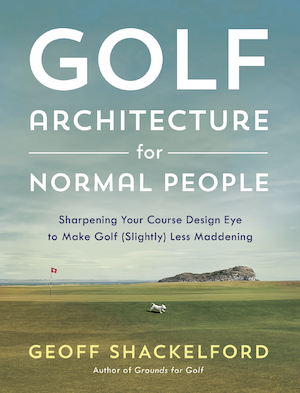
It’s back!
Twenty years later Tatra Press has kindly allowed me to bring back Grounds For Golf now that golf architecture is of more interest to the masses. A new Introduction looks at what’s driven the interest growth and two new chapters I had a blast adding (plus a few edits to keep things up-to-date).
The Amazon purchase page for the book arriving June 15, 2026.
The short par-3 16th at Riviera in the late 1920s and today...
Dave Shedloski on PGATour.com:
If it seems like TOUR members aren’t concerned with a little thing like hitting fairways, you’re right. Since 2000 the number of players who have hit at least 70 percent of their fairways has been on the decline. There were 75 guys hitting 7 of 10, on average, in 2000, but the number fell to 67 in ’01, then 61, 40, 24, 19, and, so far in this young season, there are only 16 players finding 70 percent (up from seven the previous week – thank goodness for generous fairways on the Monterrey Peninsula).
The last three years the driving accuracy leader has been below 78 percent. Since stats were first monitored in 1980, only five other times has the leader in that category been below 80 percent – and only one other time has the leader been below 78 percent (Calvin Peete, 77.5 percent, in 1984).
Want more? On the other end of the scale, there are 105 players hitting fewer than 60 percent of their fairways thus far in ’06. That’s up more than 100 percent from the 52 such wayward whackers last year. As recently as 2001 only five players failed to hit at least 6 of 10 fairways for the entire season. It doesn’t mean players aren’t as good today; in many ways they’re better. But no doubt they play with different priorities.
It’s likely the winner will not get away with such untidy play on the narrow avenues of Riviera (but because the fairways are narrow, hitting them is always chore).
The question is, how much is this decline a result of flogging, and how much of it has to do with the excessive narrowing of fairways?

Hey, if it's any consolation, we're supposed to have below-normal temps Thursday through Sunday. Anyway, a few observations

Riviera has long served as a classroom for those interested in golf architecture.
It continues to serve as a place for study, though at the current pace, study of a different kind.
Namely, how not to "restore."
As Thomas Bonk outlined in the LA Times, Riviera management, superintendent Matt Morton and Tom Fazio's firm have overseen the expansion of three greens: No. 3, No. 9 and No. 12. The changes have been described as a restoration of the original George Thomas-Billy Bell design.
While the idea of expanding greens back to their original size is nearly always a great idea on older courses, Riviera is sadly serving as a case study in how not to go about it.
In their defense, the problem is extremely complicated: trying to add green space onto existing USGA spec greens. It's a bit like trying to expand an aquarium while keeping the tank full. In this case they are attempting to tie into a sand substructure while also working into the surrounding terrain.
As difficult as the task is, it is manageable.
The current expansions of No. 3, No. 9 and No. 12--a precursor of even more changes to come this summer--was ultimately unsuccessful because of the failure to account for the nearly 80 years of top dressing build up that elevated the green floors above the surrounds.
Ah, but for those of you whose eyes haven't glazed over at this point, you might be saying, "the greens were rebuilt in 1993, how can their be topdressing build up?"
When the greens were rebuilt, they were not lowered the 4-5 inches that would have taken the greens down to their original height. A mistake? Perhaps, but Bill Coore and Ben Crenshaw were not attempting to restore the greens to their original sizes. They were adding some lost hole locations, but in general, trying to not disturb the evolved course.
Therefore, today you have the original green areas (slightly expanded in '93), and then these newly "restored" areas that are sloping down and away from the elevated, primary green space. The effect is Donald Ross/Pinehurst-like. Unfortunately, Thomas-Bell were not into the crowned green look (and Donald Ross wasn't either if you look closely at the evolution of Pinehurst).
 Now, all of this would seem to be a minor technicality except that nearly all of the "restored" green space on No. 9 and No. 12 does not tie-in with the primary green, and worse, is unpinnable in tournament conditions because of the noticeable tilt away from the main green floor.
(Well, unless Tom Meeks was handling the setup, then this quibbling is all irrelevant!)
The approach to No. 9's front hole location has long been extremely difficult. But the expanded putting surface should make the shot much easier with such an inviting target and less difficult recovery pitches for those missing the green.
Most noticeable is the front expansion on No. 9, which will help players landing short of the green. (Before, the chip shot over kikuyu to the small green surface was incredibly demanding...now those misses will be putting.)
 In this historic photo of No. 9 taken from the third tee, notice how the green in the front area has a backstop of sorts (the approach comes into this green from about 2 o'clock in the photo).
Also notice how that banking has changed to today's look (above), which is a false drop off. Then look at the photos taken today where you can see the border of the old green, and the new surface in the lighter shade. That entire "restored" area of new surface falls off gently toward the left of this photo.
With a bit more attention to this type of detail, I suspect that these green expansions could have tied in better with the existing green and served to restore the original design.
Unfortunately the green expansions appear to do a disservice to the original design.
They fail to add more hole locations, while also not adding any strategic interest, which was always the number one priority for Captain Thomas.
 Alistair Tait calls the PGA Tour's original pledge for the World Golf Championships "hogwash" while looking at the power struggle won this time by Tim Finchem.
Thomas Bonk writes about Riviera's latest changes.
The greens on three par-four holes — the third, ninth and 12th — have been brought back to their original size and shape, all of them slightly enlarged to take away the encroachment of the Kikuyu over the years and to come up with pin placements that had been lost since the club opened in 1926.
It opened on June 24, 1927, but hey, no worries.
"We're restoring them to recover the flexibility that Riviera had in the very beginning," said Michael Yamaki, the club's general manager. "Mother Nature has been the one who kind of grabbed those greens. We fought back."
Mother Nature? We fought back? Hopefully Captain Thomas doesn't get the L.A. Times where he is now.
Tom Fazio, the architect who oversaw Riviera's previous round of changes in 2003, which basically involved the lengthening of the course, was again at the head of this latest project with the greens.
A half-day visit en route to the desert constitutes heading a project? Poor Tom Marzolf does all of the work and gets no ink. Then again, looking at the 7th, 8th, and 15th holes, maybe that's not such a bad thing.
Todd Yoshitake, Riviera's head pro, said the pin placements now reflect what was available in the past.
"We're getting back to our heritage," he said.
The insights you glean in the Times!
Looking through club archives and maps of the layout and studying aerial views of the course from the 1930s helped Fazio discover the original shapes of the greens that Yamaki targeted for restoration. Computer enhancement of the aerial photographs provided nearly precise dimensions of the greens. In their research, the revisionists discovered that the Kikuyu had moved in more than three inches on the greens.
The revisionists discovered that the Kikuyu had moved in more than three inches.
Priceless.
Another must read column from Frank Hannigan on Golfobserver. He looks at Jim Vernon's USGA Annual Meeting address and comes to many of the same conclusions that were drawn here. But as usual, Hannigan takes the analysis a bit further and as always, does it with a sense of humor.
What Vernon wrote and said indicates the USGA is finally committed to rolling back distance after a decade of fakery as the best golfers, the members of the PGA Tour, were gaining on average 27 yards of driving distance whether they lifted weights or ate Dove bars and Twinkies.
Hannigan lays out three options for the USGA at this point, based on the Vernon speech.
Option 1 — Do nothing. Stay right where they are with the pretense that it ain't gonna rain no more than it has, that the horse has not quite left the barn, that they have drawn the ultimate line in the sand when it comes to distance, and they can go on presenting 7400 yard courses as par 70s for U.S. Opens.
They can go on fooling most of the people most of the time while being admitted to the promised lands with memberships in the Augusta National Golf Club and the Royal and Ancient Golf Club of St. Andrews.
The problem with Option 1 is that it is a sham. Every week more golfers understand the USGA has utterly failed and are laughing at the erstwhile "governing body." At the same time, much as they don't want to do it, Finchem and his boys inch toward acting on their own.
I used to like this next option, but when you start to realize how simple it would be to slow down the core of the ball, it looks too complicated and potentially fractures the game.
Option 2 — Use the device of local rules whereby committees can invoke more restrictive equipment regulations while still remaining under the broad umbrella of the USGA.
There are plusses to the local rule contrivance. It offers the opportunity to cut back on BOTH the club and the ball. To restrict the driver the local rule spec would offer a lower maximum of correlation of restitution (COR) — the spring-like effect of modern drivers.
The USGA has invented an ingenious little device to measure COR. Those of us who could never change the oil in a car could measure COR with this machine. The COR could be adjusted to cut back l0 yards or so, another l5 yards taken off the ball and there you have it — back to l995.
A second advantage is that a local rule would not get real golfers mad at the USGA, a fear that has paralyzed the USGA. Real golfers think they have been pulled along with the pros in terms of distance. They haven't and the USGA has been unwilling to whisper the truth: "Move the tee markers up a few yards and nobody will ever know the difference."
And finally, the option that never seemed possible with the USGA's old stance, but which seems more plausible now. Except for the issues pointed out by Hannigan:
Option 3 — Make basic changes on equipment in the Rules of Golf proper. Although the USGA has said it needs more surveys, more testing and needs to do grooves all over again, the answer is quite simple. All they have to do is pick a number and announce that as of Jamuary 1, 2008, that famous line in the sand will be, say, 25 yards shorter.
But whoops, any roll back in the ball will render virtually every brand we now use as non-conforming.
That seems like a huge impediment for ball-makers, who have dwindled down to a precious few in the United States. Acushnet dominates the wholesale market with 53 percent of sales. Its percentage of profit is likely higher.
Why then should a Callaway not want to start all over again to compete against Acushnet from a new starting line? The golf equipment business is nothing but a fight for market share. The market itself is stable. Tiger Woods has not created new golfers.
Hannigan sums up the sea change that has taken place, and the possible reasons for what appears to be a monumental shift within the USGA:
The USGA was captured during the last l0 years by Fred Ridley, who just left office as president, and his successor Walter Driver. But with an annual turnover of two or three executive committee members a year a new majority may have dawned.
Or it could be that Ridley and Driver are just sick and tired of being blistered about distance wherever they go.
Driver made an inaugural speech so banal as to defy description other than to note that he used versions of the first person singular "I" or "me" 68 times. Everything was about him.
In a departure from tradition, the new president was introduced by a celebrity — Arnold Palmer himself. Driver loved it.
This is the same Arnold Palmer who sold his failed equipment company to the late Ely Callaway. Arnold then lobbied for two sets of rules so that Callaway's ERC2 driver would be OK. The ERC2 had a COR beyond even the USGA's soft regulation.
The ERC2 driver bombed. But the myth of Arnold is eternal.
Another week, another bordering-on-silly final round setup. Reviewing the tape after hearing Gary McCord's raised-eyebrow comment about some of the hole locations, I went looking for any player comments on the setup.
"Obviously, the greens were a lot firmer today, they had some pretty amazing pin positions out there," Sabbatini added. "A couple of them I'm still bewildered at, but, you know, they made the course definitely tougher for us today."
Now, not to take away from Arron Oberholser's win, because it was well deserved and he is a huge talent (not to mention the kind of character the Tour needs more of).
But I noticed while listening to the audio and staring at the dolphins going by that there were very few cheers, and seemingly fewer opportunities for anyone to post a few birdies in a row.
I know this has been asked here many times, but why can't we let the U.S. Open be its own thing. Why is the PGA Tour turning Sunday's into train wreck days instead of letting the players create a little more to cheer about?
My latest Golfobserver.com exclusive is now posted...
 Jim Nantz told viewers to put another log on the fire, sit back, and enjoy the Pebble Beach scenery.
Well, I searched for a piece of driftwood down at the beach, but figured it was a little too hot here in the Home of the Homeless to start a fire. 85 degrees today. Brilliant, as Bobby Clampett might say (I was torturing myself listening to the audio feed).
Hey, and you east coasters who had to shovel snow, remember, you get to enjoy the seasons. We don't have them.
Anyway, they must have measured drives on some pretty interesting holes at the AT&T, because in spite of Monterey's record temps Thursday, the PGA Tour driving distance average dropped nearly 3 yards, to 286.08 yards despite what seemed like a whole lot of wedges hit into 450-yard+ par-4s.
Of course, some big bombers weren't playing and bums like Tiger aren't even eligible for the list right now, which might just influence the numbers.
In the 350-yard or longer drive category, the tally was boosted by 7 tee shots, pushing the season total to 488. There were 2059 drives of 350 yards or more in 2005.
Blue Blazer said I left out something on the Anti-Flog Rough post. That's where I pointed out the silliness of the USGA trying to grow rough to different heights depending on the hole.
Apparently the theory goes that taller rough on shorter holes will somehow negate the advantage of long hitting floggers, even though it's on the long par-4s where the dump-and-chase approach works best.
I suggested that it is a peculiar idea for the USGA to be manufacturing lies (of the playing surface variety) even though the organization has admirably been a proponent of "play it as it lies."
Then there's the idea that the USGA, which has denied altering course setups to counteract the benefits of equipment deregulation, is actually doing exactly what it denies by using different rough for different holes idea. They appear to be trying to counteract changes in the game.
But Blue Blazer thought I should have also pointed out that the USGA has gone to great lengths to improve the consistency of conditions throughout its Open courses: same green firmness, better bunker sand consistency, etc... and here they are actually forcing inconsistency into the setup equation.
Why? It seems the only logical conclusion one can draw is that this is an effort to eliminate flogging, a symptom caused largely by modern equipment and ridiculously narrow fairways.
So, can anyone think of a way that super high rough on a short par-4 like the sixth at Winged Foot somehow enhances strategy or rewards skill that a normal setup would not?
 MikeWeir.com's Chris Cook does a nice job sharing key historical information from the Riviera club history to preview the Nissan Open.
The plot thickens.
Applying for a patent, Titleist is. The product:
A high performance golf ball having a reduced overall distance while maintaining the appearance of a high performance trajectory. The golf ball includes a combination of low CoR core and cover materials coupled with a less aerodynamic dimple pattern that achieves a reduction in carry and overall distance of 15 and 25 yards versus a conventional golf ball, while still providing the look, sound, feel and apparent flight of a conventional golf ball. A high performance golf ball having a reduced distance is also achieved by controlling dimensionless coefficients of lift/weight and drag/weight at certain Reynolds numbers and spin ratios for various CoR.
And here's what Tiger has been suggesting for some time now, slowing down the core:
One golf ball component, in particular, that many manufacturers are continually looking to improve is the center or core. The core is the "engine" that influences the golf ball to go longer when hit by a club head. Generally, golf ball cores and/or centers are constructed with a polybutadiene-based polymer composition. Compositions of this type are constantly being altered in an effort to provide a targeted or desired coefficient of restitution ("CoR"), while at the same time resulting in a lower compression which, in turn, can lower the golf ball spin rate and/or provide better "feel."
Here's where they acknowledge that some ball-driver combos are outsmarting the current USGA testing:
On the new USGA standard: Advances in golf ball compositions and dimple designs have caused some high performance golf balls to exceed the maximum distance allowed by the United States Golf Associates (USGA), when hit by a professional golfer. The maximum distance allowed by the USGA is 317 yards.+-.3 yards, when impacted by a standard driver at 176 feet per second and at a calibrated swing condition of 10.degree., 2520 RPM, and 175 MPH with a calibrated ball.
Yes, this is probably just a technicality related the USGA ball study.
But I still say that the first company coming out with such a ball and if it finds its way to classic, respected courses, has a better chance of establishing dominance in the "competition ball" or "classic course ball" market. Or even the overall market, should the USGA act.
And if that company is Titleist, they not only solidify their well-earned place atop ball sales, they earn huge points for doing the right thing from traditionalists/purists/above average golfers, a sizeable portion of their Pro V1 customer base.
Randell Mell looks at the Tour's efforts to upgrade the Honda Classic at the expense of the foundation that has run the event for the last 34 years (and taken us to so many wonderful venues).
Harry Hurt in the New York Times looks at exclusive Emerald Dunes, where they try to maintain a sense of humor. Frank Chirkinian is Hurt's host.
He also examines the concept of super high-end clubs.
Oh, and isn't Sebonac spelled, well the way I just spelled it instead of the New York Times version?
Geoff Shackelford is a Senior Writer for Golfweek magazine, a weekly contributor to Golf Channel's Morning







Copyright © 2022, Geoff Shackelford. All rights reserved.