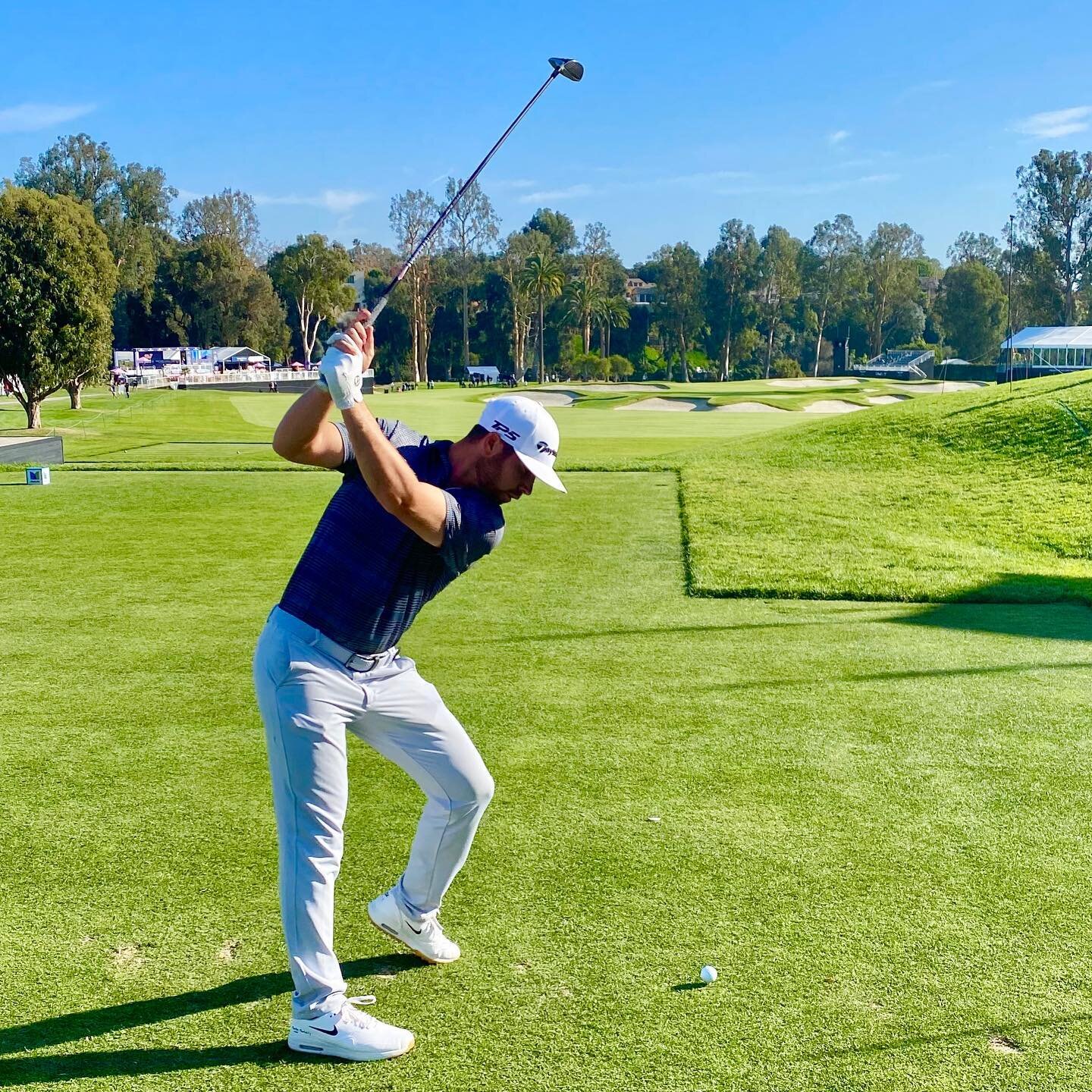
PGA Tour Driving Distance Watch, Week13

PGA Tour logo.jpgThe PGA Tour Driving Distance average rose just a bit from 288.12 after the BellSouth to 288.6 yards. That's nearly 9 yards longer than last year at this point.

There were 12 over-350 or longer drives, bringing the season total to 844. The average percentage of over-300 yard drives rose from 23.8% to 24.04%.

With ShotLink coming to the Augusta National for the first time, it will be interesting to see if the PGA Tour includes the Masters in this year's statistics. 

Post BellSouth FedEx Cup Watch

Reader MacDuff gives us his latest breakdown of a possible FedEx Cup points race.  Here is a look at the points system he uses. Points and events played are listed next to the player names.

1    Mickelson    12846.87        8
2    Toms    11871.87        7
3    Singh    11609.37        8
4    Sabbatini    10891.66        7
5    Petersson    10233.33        9
6    C.Campbell    10200        9
7    Glover    9854.16        7
8    Donald    9589.37        6
9    Furyk    9587.5        7
10    Pernice    9437.5        7
11    Gf. Ogilvy    9387.5        6
12    Van Pelt    9127.5        9
13    Olazabal    9075        6
14    T.Woods    8859.37        5
15    Lehman    8350        7
16    Weir    8334.37        6
17    Verplank    8187.5        6
18    Oberholser    8137.5        7
19    Villegas    8025        7
20    Rollins    7675        7
21    Parnevik    7567.5        8
22    Z.Johnson    7537.5        7
23    D.Wilson    7425        8
24    Chopra    7424.5        8
25    Goosen    7362.5        5
26    Mayfair    7191.66        7
27    Warren    7112.5        7
28    Bohn    6995.83        7
29    Gay    6925        8
30    Franco    6800        7
31    JB Holmes    6695.83        6
32    Imada    6692.5        7
33    G. Owen    6662.5        6
34    Barlow    6657.5        7
35    Appleby    6650        6
36    Garcia    6550        5
37    Bertsch    6550        7
38    Ames    6500        5
39    Choi    6400        6
40    Funk    6337.5        7
41    Pat Perez    6262.5        7
42    Palmer    6166.66        6
43    Fischer    6150        8
44    Cink    6083.83        6
45    F.Jacobson    6050        5
46    Love III    6037.5        6
47    Rose    5966.66        5
48    T.Clark    5922.5        7
49    JJ Henry    5875        5
50    M.Wilson    5852.5        5
51    J.Ogilvie    5845        6
52    Pampling    5792.5        5
53    Baird    5680        6
54    Bjornstad    5655        6
55    J.Byrd    5500        4
56    Jobe    5392.5        5
57    Vn Taylor    5362.5        5
58    Langer    5354.16        6
59    Hoffman    5332.5        5
60    Jerry Kelly    5325        4
61    N.Green    5262.5        6
62    Els    5200        5
63    Westwood    5187.5        5
64    Calc    5150        7
65    Bub Watson    5075        5
66    Purdy    5037.5        5
67    Couples    5025        6
68    Allenby    5012.5        5
69    D. Howell    4987.5        4
70    Hart    4987.5        5
71    DiMarco    4984.37        4
72    Branshaw    4937.5        5
73    Leonard    4895.83        5
74    RS Johnson    4875        4
75    Bryant    4862.5        5
76    A.Scott    4800        4
77    Triplett    4750        4
78    Watney    4737.5        6
79    Senden    4625        4
80    Beem    4618.75        6
81    Matteson    4600        6
82    J.Smith    4512.5        5
83    Harrington    4487.5        4
84    Olin Browne    4487.5        6
85    Gore    4387.5        4
86    Crane    4345        4
87    Atwal    4312.5        4
88    Howell III    4300        8
89    Sluman    4287.5        8
90    Flesch    4255        6
91    Frazar    4187.5        6
92    Br.Davis    4162.5        6
93    Waldorf    4037.5        5
94    Cook    4000        4
95    Dickerson    3975        7
T96    Veazey    3962.5        4
T96    Kenny Perry    3962.5        4
98    Barron    3943.75        4
99    S.Jones    3912.5        5
100    Curtis    3875        5
101    Faxon    3787.5        5
102    Estes    3775        3
103    Gove    3750        4
104    D.Clarke    3725        3
105    Slocum    3725        6
106    Lonard    3662.5        5
107    Herron    3657.5        4
108    Immelman    3650        4
109    Maggert    3625        6
110    Kaye    3550        4
111    Kent Jones    3537.5        4
112    Micheel    3500        4
113    Cabrera    3475        4
114    Lowery    3462.5        5
115    Geiberger    3287.5        4
116    Sean O'Hair    3287.5        6
117    Stankowski    3265.5        5
          T118    Azinger    3112.5        4
          T118    Petrovic    3112.5        4
120    Gronberg    3062.5        3
121    H.Stenson    3012.5        3
122    S. Maruyama    3000        5
123    Lickliter II    2912.5        3
124    Ridings    2912.5        4
125    Gamez    2887.5        4
126    Garrigus    2880        4
127    Kevin Na    2875        3
128    Poulter    2875        4
129    WMacKenzie    2837.5        3
130    JL Lewis    2800        5
131    Huston    2762.5        3
132    B. Quigley    2750        3
133    Points    2737.5        3
134    Brehaut    2712.5        6
135    Mahan    2662.5        5
136    Levet    2662.5        6
137    Celka    2645        6
138    Dawson    2500        4
139    M. Cambo    2437.5        2
140    Allen    2400        4
141    Goggin    2387.75        3
142    Pavin    2362.5        3
143    Sindelar    2325        5
144    Stricker    2225        2
145    Driscoll    2175        4
146    Leaney    2125        2
147    Katayama    2121.87        3
148    Baddeley    2100        4
149    Ws Short Jr    2062.5        5
150    Bren Jones    2050        2
151    Durant    2037.5        6
152    Andrade    2032.5        3

David Toms Sighting...

Reader Scott can't explain why he was perusing the Waffle House web site, but his time wasted is our gain since stumbled on this list of individuals who have been caught seen dining at the Waffle House, which appear to be on every other block in Augusta (yet I'm sure Georgians would make fun of our excessive number of Starbucks here in the Home of the Homeless).

Anyhow, David Toms has been seen at the Waffle House, though somehow I have a hard time imagining him going for some of Bert's Chili after a round at Augusta.

Flashback: 2001 Course Changes Preview

masterslogo2.gifThanks to reader Sean for this enlightening flashback to 2001, in advance of the first wave of significant course changes.

Augusta National Golf Club will undergo a major facelift to make the Masters a tougher test next year, club chairman William "Hootie" Johnson said on Wednesday.

Johnson said four or five of the par-fours on the course would be lengthened and strengthened to respond to improvements in golf ball and club-making technology that have helped players hit longer than ever.

"We do plan to make extensive changes," Johnson said on the eve of the 65th Masters.

"It's just that we think that several of our par-fours are a little weak, and we are going to try to strengthen them."

Bunkers may also be altered or moved and some teeing areas could be shifted to require a more difficult shot off the tee, he said.

Johnson, who would not specify which holes would be changed under the direction of architect Tom Fazio, said the club needed to keep up with technological advancements.

"This equipment is making a huge difference, and we are going to make an attempt, as we always have, to try to keep the golf course current with the times," he said.

A new ball being used extensively on the tour this season has made long hitters out of players regarded as short hitters, noted Johnson, who was worried the trend could render classic courses such as Augusta National obsolete for the professionals.

"I hope that the equipment can be addressed," he said.
No, this is not a late April Fool's post. Why do I have the bad feeling he'll be saying that again in 2008? Sorry...continue:

"We can't go on like we are going. Another decade or two, I don't know where we might be and I don't know the answer to how that is going to be approached."

Johnson said toughening-up Augusta was not in response to scoring, even though Tiger Woods set new standards for low score (18 under par) and margin of victory (12 strokes) with his Masters triumph in 1997.

"It is not in response to scores," the club chairman said. "It's just that we, and I think any of us, probably hate to see people hitting sand wedges to 425-yard par-fours."

Ah, and the comments from players:


Six times Masters champion Jack Nicklaus and 1976 winner Raymond Floyd said changes were necessary.

"You need to make changes if people are hitting nine-irons and wedges into the par-fours," said Floyd.

"They've always made changes and have tried to stay ahead of the curve. But this time I think the curve got ahead of them."

Nicklaus said tournament officials have to do something because the new balls being used are changing the face of the game.

But Nicklaus said he wished restrictions would be placed on the balls instead so that classic courses like Augusta National would not have to alter their design.

"It's absurd," said Nicklaus. "It's so simple to just restrict the golf ball. If they don't change it soon, they'll have us teeing off from downtown somewhere and hitting up to here.

"There is nothing wrong with Augusta National. It shouldn't be diminished by a golf ball."

Short hitters have benefited from the technological advances by drawing closer to the big hitters in terms of distance, but stretching Augusta National further could put them at a distinct disadvantage.

"I think it will only benefit the longer hitters," said Loren Roberts.

Gee, where would he get an idea like that!?

Hal Sutton agreed. "Bobby Jones intended players to hit five-irons into some greens," he said.

Sutton also said that moving back tees, rearranging bunkers and the like would take away one of the charms of the Masters, which has been staged at Augusta National since its inception in 1934.

"If you keep changing the golf course, I'm not sure how you can compare results over time. The course is truly set up for the big hitters."

Rocco Mediate also believed the long hitters would benefit. "It takes a lot of people out of the running because it's just too long. On number one, if you can carry the bunker, 285 yards, you've got a seven-iron in. But guys who can't, have to hit a three-iron. You try going into number one with a three or four-iron and you have no chance."

Bivens Brand Not Flying In NY

Selena Roberts, in a New York Times sports column:

But a colorful personality to most seems nothing more than a product line to Bivens, who has revealed an unnatural love for the word "brand."

"Our overarching theme for the next three years is going to be building the L.P.G.A. brand," said a rambling Bivens, who has no discernible love of golf. "We're going to build that brand by continuing to build on the fans first and the five points of celebrity. We want to make sure that our rookies, from this point on, have that same base, because building our brand going forward requires that we go forward on that foundation. Some of the first initiatives is we are doing a lot of work and having an individual branding coach available for the women."

An individual branding coach? What does that mean? Meg Mallon Bars and Karrie's World Wide Webb?

Don't give Bivens ideas like that! 

Instead of setting the tone for substance — letting these women shine without slick packaging, letting rivalries fresh on the scene help rally the Tour — she is establishing a foundation of superficiality.

As everyone is aware, the unspoken ad slogan for the L.P.G.A. goes something like, "This is not your lesbian mom's tour anymore," but Bivens has gone head over hetero to remake its image. She sent six players to be seen at the Academy Awards parties (no sock tans, please).

"It was a lot of fun seeing celebrities mix and mingle with other celebrities," Bivens said. "And we're getting an awful lot of mileage out of that."

She is all about mileage. Bivens is cross-promoting with Nascar, which means we'll soon hear victorious golfers say, "I just want to thank my Nike CPR Rescue club for making this possible."

Bivens also admits stealing star strategies from everyone, whether it's commissioner David Stern of the National Basketball Association or the empress of all gilded good, Oprah.

"From an entertainment standpoint, I would say Oprah is the best we know," Bivens said. "She is a great personal brand."

Someone stop this woman. Bivens should realize what Oprah knows: a brand is nothing without a million little pieces of credibility. Integrity is in the product, and Bivens's product is golf.

There is nothing wrong with women on the L.P.G.A. Tour finding joy in marketing their sexy sides and pushing the envelope on fashion, but that's what overwrought agents are for, not starry-eyed commissioners.

Whoa!

There are a lot of wannabe models, actresses and pop stars in America's celebrity-obsessed culture. But how does a gal gain separation from the milieu? People don't just flock to Wie's every tee box because she was interviewed by Elle magazine; they come seeking the thrill of her swing.

And as she crushed a drive on the 11th hole Friday, well beyond Fred Funk range and closer to Tiger Woods's territory, the gallery gasped with delight.

Wie has beauty and youth, but more important, a unique opportunity to grow up before our eyes as a woman defined by her power. Or, as Bivens might brand, "Wie: the next Oprah."

Where's The (Design) Balance?

John Boyette looks at the impact of the course changes, and considers different players views on whether long hitters will be favored.

Stewart Cink offered this succinct characterization of the changes that fellow Georgia Tech alum Bob Jones might have appreciated:

"Now they've taken the creativity out of it and made it more of an execution-style course, where there's no question where you have to hit it off the tee and what club you have to hit."

Kroichik On Distance, Masters Ball Possibility

Ron Kroichik looks at the possiblity of a ball rollback, a "Masters ball" and offers all sorts of interesting tidbits about a distance rollback:

Sandy Tatum barely hesitates before answering in the affirmative. Tatum, the former United States Golf Association president and patriarch of Harding Park's renovation, joins Jack Nicklaus in suggesting the USGA "roll back" the distance the ball can travel. Woods and his big-hitting colleagues on the PGA Tour routinely smack drives more than 300 yards, taking golf into once-unimaginable frontiers.

It's either a thrilling joyride (many fans), a fundamental affront to the game (traditionalists such as Tatum) or an unwelcome threat to booming business (elite players and golf-ball manufacturers).

Tatum begins his sermon with this premise: The ball goes too far. The faster a player swings, the greater the benefit from technology. Drivers with club heads triple the size they were 15 years ago collide with balls specifically designed to soar into the stratosphere.

"It puts the game seriously out of balance," Tatum recently said. "You get more emphasis on power and less on shot-making. The stats will tell you, accuracy is no longer anywhere near as important as distance."

And...
These kind of numbers help explain why Chairman Hootie Johnson felt compelled to try to keep Augusta National "current with the times." He lengthened the course for the second time in five years, but only after hinting club officials might force players to use a "uniform ball" in the Masters, one unlikely to travel such prodigious distances.

That option still exists for Johnson and his colleagues in Augusta, but even then it would apply only to the Masters. The USGA and Royal & Ancient Golf Club, the game's governing bodies and rules makers, do not favor the idea of a uniform ball.

"That's not in the cards, for the same reason a baseball player doesn't have the same bat as any other player," said Dick Rugge, the USGA's senior technical director. "It's personal equipment suited to each player."

Rugge nonetheless elevated this long-simmering debate into another realm in April 2005, on the day after Woods won the Masters. Rugge sent an e-mail to manufacturers, inviting them to participate in a research project by making balls that travel 15 and 25 yards shorter than current models.

This would not be a uniform ball, because players still could arrange their own specifications (launch angle, spin rate, etc.). But the ball would not fly as far, exactly the kind of rollback Nicklaus and Tatum are advocating.

Rugge, in a phone interview last week, said the USGA expects to receive prototype, reduced-distance balls from manufacturers "very soon." Rugge and his staff -- 18 people in all, including six engineers -- will then embark on extensive research to determine how those balls would affect the game.

"To some people, it's as simple as a shorter ball," Rugge said. "I can tell you from our research, it's a much more complex issue than that."

 And...

Top players, not surprisingly, are cool to the idea of limits on technology. Woods, asked earlier this year about the ongoing chatter about a uniform ball, practically scoffed, saying, "I don't think it's realistic at all. Do you realize what that would do to the golf-ball industry?"

Gee, think he has a lucrative endorsement contract?

Mickelson similarly downplayed the possibility of a uniform ball. As for rolling back the ball, he said, "I don't think we'll ever get to that point," though the USGA's impending research project suggests it's possible. Woods, interestingly, seems open to rolling back the ball.

For now, technology rolls forward on several fronts. The USGA recently proposed a "liberal limit" on so-called moment of inertia, to address the modern drivers that create good shots even with imperfect contact. Rugge said a final decision will be made in the coming months.

In the coming days, all eyes will turn to Augusta and the stretched-out course awaiting Woods, Mickelson and their brethren. They will arrive armed with the finest equipment available, ready to tackle the beast. There will be much talk about those 4-plus miles of Georgia landscape -- and not as much talk about the little white balls at the center of the action.

"Properly Restored The Hole To That Which Jones Intended"

masterslogo2.gifAugusta Chronicle sports editor John Boyette got club chairman Hootie Johnson to "answer questions" on the eve of the 70th Masters. Interruptions supplied by yours truly.

Question: Are you satisfied that the course changes reflect what the club set out to do, which you said was to maintain the integrity and shot values of the golf course?

Mr. Johnson: We are satisfied that the changes made this year, together with those made in recent years, are appropriate for today's game. I think we met our objective of maintaining the integrity and shot values of the golf course as envisioned by Bobby Jones and Alister Mackenzie. We also continued our goal of placing a premium on accuracy off the tee. I think one example is No. 4, where in 1959 Bobby Jones said that this shot is usually a strong iron or even a 4- or 3-wood. I do think we have returned the hole to the way it was meant to be played.

For a review of Jones's comments not taken out of context by Mr. Johnson, head here or here.

Q: Was there one shot or particular moment that prompted the latest changes (i.e., Phil Mickelson's drive on No. 11 a few years ago)?

Mr. Johnson: No, there really wasn't one specific shot. We evaluate the performance of every hole every year. I do think it's telling that in two of the last three Masters an amateur has led the field in driving. We strongly believe this is the future of the game.

Ugh...

Q: Player reaction has been critical of some of the changes, particularly Nos. 7 and 11. Are the players overreacting?

Mr. Johnson: These are the best players in the world, and I'm certain they will figure out a way to play the holes that have changed.

Like they have a choice? Ah, choices are bad, I forgot.

Q: No. 11 has been changed three times in the last five years, with numerous trees planted and the hole lengthened. Are you satisfied you have it right now?

Mr. Johnson: Originally, No. 11 was a drive followed by a relatively easy pitch shot. In the early 1950s, Bobby Jones added a pond and moved the tee adding 35 yards to the scorecard. Later, in Golf Is My Game (written in 1960), Bob described the second shot on 11 as one "... usually played with a 3-iron or a stronger club" when the pin is to the rear of the green. We think that the recent changes to the 11th have properly restored the hole to that which Jones intended - a demanding tee shot followed by a long-iron second, played to a well-guarded green.

Halftime intermission here. If you own The Making of The Masters by David Owen (and if you don't, check out the link on the left of this page...Amazon is selling it cheap), you know Jones originally placed a blind pot bunker in the middle of the fairway and it remained for a long time. You also know that there was always water next to the green, they simply changed it from an extension of the river to a pond.

And if you own Golf is My Game, you know that Jones wrote of No. 11:

The tee shot to this hole is blind in that the fairway upon which the ball is to land is not visible from the tee. Nevertheless, the limits of the fairway are sufficiently well defined by the trees on either side. A drive down the left side provides better visibility of the forward portions of the green, but slightly to the right of center is better should the pin be located on the promontory of the green extending into the water hazard on the left. The pin location on this projection of the green is often reserved for the final round of the tournament. The second shot is usually played with a three iron or a stronger club, and a player must be bold and confident indeed to go for the pin when it is in this location.

I can see the length helping on the properly restored part, but the narrowness aspect? Hmmm...

Q: If conditions are firm and dry this year, what range would you expect for the winning score?

Mr. Johnson: I wouldn't want to guess on a score, but it is important to remember that we have never been worried about scores. As Bobby Jones said, "...we are quite willing to have low scores made during the tournament. ... It is our feeling that there is something wrong with a golf course which will not yield a score in the sixties to a player who has played well enough to deserve it." Our greatest concern has always been that the course be kept current with the times.

Ah maybe this was done via email!

Q: Fourteen holes have changed under your watch as chairman. What can we expect for Nos. 3, 6, 12 and 16 in the future?

Mr. Johnson: The golf course is the way we want it to be this year. We will continue to study possible improvements.

Buick's Slide

John O'Dell in the L.A. Times looks at the demise of Buick and mentions Tiger Woods a few times. Considering Tiger's 5-year, $40 million endorsement deal and Buick's sponsorship of three significant PGA Tour events, this is not good news for some in golf. (Though I'm not worried about Tiger finding a replacement uh, vehicle.)

Now as GM faces the threat of bankruptcy, Buick has emerged as an emblem of the auto giant's broader woes. GM sold nearly a million Buicks in the U.S. in 1984. By last year, sales had sputtered to 282,288, a 70% decline over two decades, the biggest of any major auto brand.

Buick has broken down in U.S. showrooms for the same reasons that Americans deserted GM brands such as Chevrolet, Pontiac and Olds in favor of Toyota, Honda and Nissan.

Buick offered bland designs and ignored consumer demand for pickups, minivans and SUVs. Buyers' shift toward snappier styling, snazzier features and — most of all — higher-quality cars left Buick vulnerable in the late 1980s when Lexus, Infiniti and other foreign luxury models invaded its home turf. Even using golf superstar Tiger Woods as pitchman hasn't helped Buick.

And...

Since 1999, Buick has used Tiger Woods, whose name and face are known globally. But the golf tournaments that carry Woods' endorsements don't reach out to young buyers because they are largely watched by older men, some of whom might already gravitate to Buicks.

"While you can sell a hot car designed for younger buyers to an old guy, you can't sell a stodgy old car to a young guy," said Bill Porter, Buick's design chief from 1980 until 1996.

"The average Buick buyer is 69, the oldest demographic in the industry, and there aren't many new buyers coming in to replace them," said George Peterson, president of AutoPacific market research in Tustin.

Early Augusta Previews: Jack and Arnie's Comments

masterslogo2.gifThe recent changes to Augusta National pale compared to 2002's massive overhaul, yet on the eve of the 2006 Masters the hits just keep on coming. The difference this time around? 

Several past champions bemoaned the latest work, and more importantly, questioned how the work reflects the Jones-MacKenzie design vision that the club says they are maintaining.

The Sunday previews from the British Isles provide more evidence that Augusta National's fall media offensive may have backfired.

First, John Huggan in his Sunday column:

Although arrogant beyond imagination, Johnson is no fool. He could see the outrage coming. Which is why a series of no doubt carefully-selected golf writers have been invited to visit the hallowed grounds over the past few months.

Their brief, at least ostensibly, was to form an opinion on the sagacity or otherwise of the course changes. But the reality was simply Johnson looking for public validation. He was spinning more than a crisply-struck Tiger Woods wedge from a tight lie.

Disappointingly, but expectedly, most of the resulting articles have been a mixture of ignorance and/or forelock-tugging. Obviously flattered by their being summoned from 'above', the chosen few behaved more like paid flunkies than free thinkers.

James Corrigan in the Independent reviewed the pre-tournament criticism while Andy Farrell made an important point in the lead to his story reviewing the comments of Nicklaus and Palmer:

It used to be a Masters tradition for players and caddies to arrive for their first practice round at Augusta National and wonder whether the first tee had been moved - or the clubhouse. The evolution of the course was constant, if often undeclared. Under the chairmanship of Hootie Johnson, the pace of change has increased dramatically, and everyone knows about it.

O'Meara...Rough or No Rough?

Mark O'Meara jumps on the Augusta National criticism bandwagon while bemoaning the power game in a guest commentary for Scotland on Sunday:

The game is changing. Creativity doesn't seem to be as important as it once was.

The power game is more dominant than it has ever been. And guys who hit the ball as far as me have little or no chance to beat the bombers.

While I think the ability to hit long drives should always be rewarded, any advantage gained should not be overwhelming.

More length and more rough at Augusta National - so far, at least - hasn't really scared any of the big-hitters. The rough isn't so deep that you can't play out of it and it also has the effect of slowing the course down. Where wayward tee-shots used to run into the trees, they are now more often stopped from doing so by the longer grass. To me, that runs contrary to the way the course was originally designed.

Specifically, I think holes like the first and the now not so-short fourth would have been better left alone. Now, our opening tee-shot has to fly more than 330-yards just to make it over the bunker at the top of the hill. So a guy who carries the ball about 275 yards has really been taken out of the equation. That's just one example of where the power player 'who already has an in-built edge' has his advantage multiplied by the extra course yardage.

The sad thing is, I'm not sure any of the changes were really necessary. If I was in charge at Augusta I would have kept the course at around 7,100 yards and I would have eliminated any and all rough.

Instead, I'd cut the fairways tight, all the way to the tree lines, where the ball would run onto the pine needles. You'd either be in the fairway or on the pine needles under the trees. That would neutralise the power player enough that the shorter-hitter could compete.

Or you could just address the equipment that has helped fuel the distance disparity?

The Donald Comes To Aberdeenshire

It reads like an April Fool's Day joke (£14 million pounds to build 36 holes on dunes!?), but here are the gory details on The Donald's plans for his Scottish development:

The development, which will be known as Trump International Golf Links, Scotland, will be comprised of two championship golf courses, a five-star hotel with associated facilities, a state-of-the-art golf academy and a turf grass research centre. The development will also include a mixed use residential element.

The courses will be Donald J. Trump Signature Designs, in association with Tom Fazio, nephew of the legendary American golf course architect Tom Fazio, and his firm, Tom Fazio II, LLC. The land, which is set among towering dunes beside the North Sea, has been acquired. Planning and permitting is underway and work is scheduled to commence by September 2006, with a course opening scheduled for spring 2008.

"Mr Trump was committed to identify a world-class traditional links site in the Home of Golf and Menie Estate was chosen because it satisfies all of the strict project criteria set out by The Trump Organization," said Ashley Cooper, executive vice president, Acquisitions and Development for The Trump Organization. "Our goal is to create the greatest links golf courses in Scotland as part of a golf development that will become the finest in Europe, if not the world."

And this, courtesy of reader Steven T.:

The final cost of the project is estimated to be more than £287million, although that will depend on the outcome of a planning application to be submitted to Aberdeenshire Council in May.

The company said last night that the Menie Estate had been chosen ahead of 200 other sites in Europe, reviewed by the billionaire property mogul himself over the course of five years.

Mr Trump is said to have been "overwhelmed" by the sand dunes and coastline, which he hopes to turn into "the greatest golf course in the world".

Senior figures in the golf and leisure industries, as well as Aberdeenshire Council and other economic organisations, called it a major coup and an "unbelievable" opportunity for the north-east.

Scottish Enterprise Grampian said the project would contribute an estimated £157 million to the economy over the next 10 years and create up to 400 jobs.

But Scottish Natural Heritage, which was consulted about the site late last year, has already expressed concerns because it is a protected area of special scientific interest.

The Trump Organisation promised the finished article would "set new standards in the home of golf".

And...

Geoff Runcie, chief executive of Aberdeen and Grampian Chamber of Commerce, described the news as "fantastic", adding that it would boost visitor numbers, raise the region's profile and rectify the absence of a trophy golf course.

"This will put the region in line to host high-profile championships in the future - having a course that could secure the British Open would be excellent," he said.

They Juice The Equipment!

From the March 31 "Real Time with Bill Maher," talking about the latest steroid controversy in baseball and how America's favorite pasttime should emulate golf:

ROBERT WUHL:  In golf, the players are straight but they juice the equipment!

BILL MAHER:  That's actually very true! [Laughing]

I guess they didn't get the memo that agronomy is the cause of 350-yard drives! 


Week In Review, March 26-April 1: The Bivens Brand

WeekInReview2.jpgAnother weird week in golf, kicked off by the Sabbatini-Faldo feud and debut of Amy Sabbatini's Spring Collection t's for Tour wives. Faldo took the early lead for 2006's funniest quote in response to Amy's "Keep Up" t-shirt.

Besides the painful fifth major debate, The Players Championship brought attention to the concept of rough and whether it works at all, especially on courses not intended to have tall grass lining the fairways (hint: no well-designed course uses rough as a design ploy). The TPC mess prompted reader Carl to write, "lets face it, the golf ball has taken all of the imagination out of the game, and has taken the imagination out of golf course design. The high quality of different shot selections and the high quality of course design is bending over backwards to accomedate a golf ball."

Tom Kite's comments in Golfweek's Forecaddie prompted the debut of The List, which is a look at recent statements from well known figures in golf on the distance issue.

MacDuff provided us another updated look at a mythical FedEx Cup points race. It's becoming clear that someone like Vijay will win it by playing often and playing well. MacDuff suggest that the Tour consider "putting a cap on the number of events to score, but not weighting upward for those that play fewer events. Base it on your top 20 performances of the year, and winner take all."

Martin Kaufman blasted the Ohio Golf Association's retro ball invitational, prompting reader Hannibal Smith to ask "Why don't they let one of the more talented writers like Brad Klein or John Steinbreder who are more traditional when it comes to the ball issue write an opposing viewpoint?"

And Smolmania noted, "The best players want the ball reigned in, so that talent will prevail over athleticism. Us bunters want it reigned in so that the game played at the highest levels isn't simply irrelevant to the game we play. The only people who don't want these changes are the manufacturers, and people who don't have a clue. . . in my patently 'unbalanced' opinion."

After watching players struggle out of the TPC Sawgrass' rough-on-steroids, I floated the possibility of a player getting seriously injured by such a harvest. That prompted reader RM to question my sanity: "Your imagination is running wild today. Must be Bellsouth week."

Ned Ludd made me feel a lot better by not completely shooting down the possibility: "There are two parts to every lawsuit: liability and damages. Assuming a player like Woods could prove liability ( as in the Tour created a foreseeable risk of injury by implementing such rough ), and that he could survive an incurred risk defense (that he willingly and voluntarily took the swing knowing the probability of injury), IMAGINE the number his lawyers would blackboard and that a jury could award with respect to his damages, especially if the injury had any permanency to it. Even the South Park 'Chewbacca' defense would not carry the day."

Andrew Both wrote this week about the Tour's astounding pension projections. Reader Carl responded that it's "quite interesting that the Tour would be rolling out the big numbers again with regard to retirement, especially with players like Sean [Murphy] questioning the whole process."

Ryan Ballengee chipped away at Tim Finchem's eye-opening new 6-year, $27 million deal. Reader Brett noted, "Now we know why Greg Norman is asking for the minutes to every meeting. There is a lack of accountability involved here. Who is making all the decisions on the Fed Ex Cup? I've read where Paul Azinger said that the membership to his knowledge had never been asked for any input. That would mean that the Commissioner is making all the decisions. Scott are the players working for Commissioner Finchem or is Commissioner Finchem working for the players?"

Reader RThompson wondered, "Is it just the handpicked independents that are setting (staging) Commissioners Finchems contract, salary and benefits, or do the 4 player directors on the 9 member policy board have a say in the Commissioners agreements. If it is only the independents, and Commissioner Finchem has hand picked them, then this would basically be justified as self-dealing."

Golf World's "Big Bang" story on flogging and working-out prompted an interesting discussion on shotmaking between JohnV, Sean Murphy, J.P., Steven T. and Smolmania.

The Australian Open will now be headed by Paul McNamee, who made some Bivens-like comments in his first interview with The Age. But as reader Hux noted, "have a talk with Mike Clayton before judging McNamee. Mike has been pushing for this appointment for years, which is good enough for me. Give him a chance."  Alright, alright, I can't argue with that!

Bill Huffman wrote about a recent speech given by Jim Vernon, another encouraging sign that the USGA is laying the groundwork for doing something about regulating distance.

And finally, LPGA ommissioner Carolyn Bivens' first major and the ensuing coverage has not been pretty.

Doug Ferguson looked at an LPGA major and wasn't impressed. Reader Scott Stearns noted, "you know its a major when you see members hitting balls on the practice tee right next to the players."

Leonard Shapiro of the Washington Post and Peter Yoon of the LA Times devoted significant space to evaluating the Bivens era.  Frank Hannigan weighed in too.

Bivens talked to the media and it wasn't pretty. Her April Fool's Day-worthy comments, while entertaining, also means that there are ramifications for the emerging LPGA Tour. Reader Pete the Luddite noted: "she is singlehandedly setting back the development of the game, women's golf, and dare I say feminism in general with this powderpuff approach."

Augusta here we come...