The Bridge: "more of an overflow from Atlantic"

Alex Williams writes about The Bridge for the New York Times' Sunday Styles section. The story focuses on The Bridge's anti-country club attitude, complete with appearances by rappers and Smokey Robinson and a hideous looking clubhouse to prove the point.

country.395.jpg(Yes that's it in the top half of the photos linked from NYTimes.com.) Williams writes:

The 18-hole golf course gets an arty, postmodern treatment: ruins of the old racetrack, including guardrails and flag stations, pop up around the lush fairways. Discarded tires line the cart paths.

And forget about blue blazers. At the Bridge backward ball caps, jeans and even tattoos or face piercings (typically on guests in the music business) attract no steely stares.

In short, the Bridge — despite $600,000 membership fees, which make it one of the most expensive clubs in the country — is an anti-country club of sorts. It is not just the first high-end club in America that dares to be hip but, seemingly, the first one that cares to be hip. Hipness, after all, is not a sensibility typically associated with the sort of middle-aged Gulfstream-flying plutocrat who can write a half-million-dollar-plus check to join a private club. To many a traditional mogul, joining a country club is a statement that he has arrived on the inside. Who would want to spend all that money to look like an outsider?

And this is debunks the myth created by the story...

Not everyone in the Hamptons, however, accepts the notion that style is why people are joining the Bridge. Andrea Ackerman, the manager of the Brown Harris Stevens real estate offices in Southampton and Sag Harbor, said that the Atlantic Golf Course in Bridgehampton “was the answer to every golfer’s prayer who wanted to belong to a great golf club and couldn’t,” but now even the Atlantic is full, and moneyed golfers are simply clamoring for the next open spot they see. “The Bridge is more of an overflow from Atlantic than Shinnecock or Maidstone,” she said.

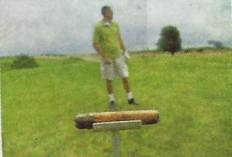
cigarholderSadly missing online is the photo of the driving range cigar holders.

But thanks to my scanner, I've included the coyote turd holder for your viewing pleasure. 

Huggan Reviews The Open...

After praising the R&A for their general wonderfulness, John Huggan slips this in:

Perhaps the only murmur of discontent came over some of the weekend pin positions. Although the overall course set-up confirmed the impression that the R&A are relatively unconcerned with the winning score, there is still a line to be drawn.

Prior to the championship, Scot Graham Brown of the host club, a former club champion, asked R&A chief executive Peter Dawson if the old formula of "six hard, six medium and six easy" was still followed. Dawson laughed. "No," he said, "today it is more like 15 hard and three impossible!"

That estimate was borne out by the experience of former European Tour pro Mike Clayton. The Australian, now a successful course designer, toured the links on the eve of the championship with Retief Goosen's caddie, Colin Byrne. On each green, they tried to find the yellow dot marking the following day's hole location. It wasn't an easy task, given the colour of the greens. But it became easier when they decided simply to walk around the edge of every putting surface - for almost every dot was within four yards of the fringe.

Still, on that count it is hard to be too hard on the R&A. In the almost total absence of wind - only on the final day did it blow with any sort of significance - tucking the pin positions actually rewarded the tactics employed by Woods. Just about the only way to get anywhere near the flags was by playing from the correct position/angle, even if that meant hitting much longer clubs into the greens.

While the 'floggers' were invariably much closer to the hole after one shot, the firmness of the turf combined with the difficulty of the flag locations meant that they were, more often than not, playing away from their ultimate target. Or that they had no chance of getting close, no matter how lofted the club in their hands. Not only is Tiger the best player, he's also the smartest.

And this is something that few other Open stories pointed out:
Then again, for all the magnificence of Woods' play and ball-striking, it was difficult to leave Hoylake without feeling just a little depressed at the direction that golf is headed at the highest level. First, the biggest reason that this Open was so enjoyable is that it was nothing like anything else we will see in golf this year. Amid a week-to-week diet of courses and tournaments that are basically indistinguishable from each other, the world's oldest and most important event stood out like a 160-pound lemon, or Sergio Garcia.

This was proper golf that asked a variety of questions, some of which didn't really have an answer, which is as it should be on a links. Part of playing well by the seaside is realising when there is no reasonable shot available, and proceeding accordingly.

Then there are the now laughable distances that leading players are capable of hitting the modern ball. Before the championship, Ron Whitten, the architecture editor of Golf Digest magazine, caused something of a furore with his less-than-charitable comments on the Hoylake links. While most of his comments proved to be laughably inaccurate, one did strike a chord with this reader.

"Best that members of Royal OB [Hoylake] enjoy this Open as its last hurrah," wrote Whitten. "Sooner or later, every Open course will become obsolete, the Old Course at St Andrews included. Some day the R&A will quit clinging to that which its name evokes, and finally move on."

Now, maybe it's just me, but that little paragraph is more than a little frightening. If Whitten is correct - which, given his recent track record, is admittedly a bit of a stretch - then the time for action on new technology is surely now. If the thought of links like Hoylake and the Old Course at St Andrews being reduced to pitch-and-putt doesn't galvanise golf's authorities into action, surely nothing will.


North Speaks!

Looks like Gary Van Sickle's caddie stint inspired Andy North to speak his mind, as evidenced by this Rob Schultz piece in the The Capital Times looking at Milwaukee's PGA Tour stop:

Madison's Andy North, who has played an important role over the years to help the tournament succeed, hopes he can continue to help draw good-sized galleries and satisfy its sponsors. He is here playing on a sponsor's exemption this week, and tournament officials had him busy playing in and emceeing Tuesday's celebrity pro-am shootout and emceeing a pro-am draft dinner Tuesday night.

North believes the U.S. Bank Championship might be wise to consider other options other than the usual PGA Tour setup. One option he'd like to explore is teaming senior golfers with regular-tour golfers. That would take advantage of the interest top seniors like Loren Roberts and Fred Funk have for the Milwaukee tournament.

"Let's have 64 teams of one senior tour player and one regular tour player," North said.

If the setup remains the same, North said the U.S. Bank Championship should offer an invitation to Michelle Wie, the 16-year-old phenom from Hawaii who has already played in several men's events but has yet to make a cut in any of them. The U.S. Bank's Brown Deer Golf Course might be the perfect setup for Wie because, at 6,759 yards, it's the shortest regular stop on the PGA Tour.

"She would be the ideal person to get here to play," said North, who plans to discuss inviting Wie with tournament director, Dan Croak. "It will be two weeks before the women's British so that could be a possibility.

"We'll see what happens," added North. "Our commissioner (Tim Finchem) doesn't always do us the biggest favor."

"The PGA Tour needs to get real"

Peter Williams, writing in the New Zealand Herald on the need for drug testing in golf:

Golf's attitude to drugs historically has been one of "we don't see it, therefore it's not happening." That's how the cancer spreads through countless other sports.
 
Yet an IOC report which came out last year showed that golf had the highest percentage of anti-doping violations in 2003.
 
The IGF is to be commended for what they're doing in South Africa. The PGA Tour needs to get real.

And this is interesting...

But the testing will be only for substances on the World Anti Doping Agency (WADA) banned list. That list does not include, for golf, the drug which many people believe is the game's most effective performance enhancer - the beta blocker. The most common type of this class is propranolol. It's an anti-anxiety drug which slows your heart rate and has virtually no side effects.

 
A golfing anaesthetist, who's been a scratch player, told me that beta blockers are great for golfers who suffer from nerves in pressure situations - and that surely includes everybody who's ever played at a competitive level. He reckons that you become calm and relaxed over important shots and therefore have a better chance of making a smooth swing. He's in no doubt propranolol is a far more effective performance enhancer for golf than any kind of strength-building steroid.

Week(s) In Review, July 15-29: The Open

WeekInReview2.jpgA busy two weeks but your comments were focused largely on just a few key stories: drug testing in golf, Hoylake/links golf, and Tiger's 2-iron/3-wood strategy.

(For all of the Open Championship coverage, you can go here, and if you missed the IM interview with SI's Michael Bamberger, check it out here.)

Regarding drug testing and the R&A's plan to test players at the World Amateur Team Championship, reader Dave writes: "The oldtimers played with massive hangovers all the time, we're switching gears today, instead of alcohol it's human growth hormone. Love AC's approach to the topic of illegal, AC i believe the author was talking illegal in the sense of DEA and no prescription. One has to love these golf egoists, they really believe the sport they love is above the laws of the land. See the Casey Martin US Supreme Court decision."

Ryan writes, "When is the bloody damn equipment testing going to be concluded? It's been 3.5 years already, wankers! Golf has evolved into a Herculean sport, exponential advantages are favored to the crushers, what's in their blood, we already know what's in their clubs?"

Lefty: "Golf is very much about flexibility, particularly in the torso and spine. A little while ago, Sammy Sosa injured his back during the peak of the steroid scandal in baseball, and many said that back injuries and loss of flexibility in that area can be attributed to steroid use. Therefore, why would a golfer take steroids. The beauty of golf is that flexibility is more useful than muscle (look at Flabby Phil, who hits the ball 300 yards, purely because of how much he can twist his spine)."

Regarding drug testing and the PGA Tour's odd stance, Steve writes, "the PGA Tour started down this slippery slope when it implemented testing of equipment to ensure fairness, now they must do the same with drug testing. Anything less than testing for drugs would be highly hypocritical on the Commissioner's part. Which way do you think Commissioner Finchem will go? On second thought, don't answer that."

On the subject of Tiger Woods only hitting driver once en route to his Open Championship win, Rick says this "is all the evidence the RnA USGA need. The distance disparity has become a joke, and rendering famous golf courses obsolete. If there really is a problem between the governing bodies and the manufacturers, and lawsuits are waiting in the wings, bifurication is the simplest solution...Evidence, evidence, evidence......there has been so much evidence the past few years that all of you have egg on your face."

Van says, "He's been fighting drivers for a while. It's been too obvious in 2006. I believe the iron strategy for this Open was formed immediately after the Winged Foot cut. Nike's gotta step up. I don't think this player wants to continue his career as an Iron Byron.

Smolmania responded, "Amen Van. That Sasquatch monstrosity just ain't doing the job. . . I don't know how he can stand to look at that blocky thing behind the ball. Wanna bet that Tiger hasn't had one of those 905s on the back of the range at Isleworth? It will be very interesting to see if he can just hit it in the fairway with 2 iron and 3 wood at Medinah."

On another post, ReverendTMac writes, "When you put the strategy in context of rule number one of Hoylake - don't put it in the bunkers - and the fact that he said he was driving it 400 yards in his practice rounds - it's just pure logic...I don't put a lot of creedence in Player's comment that the fans want to see him hit driver, either. I'd like to think that the fans wanted to see him hit good shots, and the club is almost immaterial at that point."

Kevin: "It was interesting in today's round that unless you were in perfect position in the fairway, you could not get much closer to the hole with a wedge than you could with a long iron. Tiger beat 'em between the ears."

Andrew: "I don't think Hoylake tested Tiger with the driver--don't get me wrong, I liked the course okay. But I'm not sure that it was the ultimate test either. I don't mind -18 winning but at the same time I wouldn't want the US Open to turn into a birdie route like this was for the better part of 3 days either. Each is fine in it's turn."

RM: "For the life of me I can't understand why there can't be a ball roll back. Tiger adjusted his game in 1 week to playing a different way, although with his clubs not balls. But it should not be a tough transition back for any level player. And the manufacturers are going to sell balls one way or another. We buy balls, we lose them and then we buy some more. We each buy the best ball available at the time to suit our needs. If all the manufacturers care about is money, then why would they care if they sell 25 million units that fly 300 yards versus 25 million units that fly 275 yards?"

On Hoylake's deliciously crunchy playing surface, JPB wrote: "In the US I think people will have to get used to drier conditions, and I am looking forward to it. Changing weather and stress on the water supply, at least out west will dictate drier golf. I would love to see new grasses and maintenance practices that lead to firmer conditions. Where I live there hasn't been much water for a few years and the court battles to shut people off are starting...Perhaps the last few years of no water is waking people up a bit. Particularly in the west I think things will have to change in terms of what golfers accept. The game will improve too.

I asked if the R&A's borderline hole locations over the weekend artificially inflated Hoylake's stock. Scotty: "When a course rewards a variety of different playing styles for strong play and separates the class players to the top of the board, what more does anybody want? That was a helluva fun course, if not the most beautiful, and I hope it becomes a rota regular (and I will bet you anything it's par 71 next time)."

John Gorman: "Gary Player's comments were spot on. For a player (even the best) to be able to hit 3-woods and 2-irons all week and lap the field on a 7,200+ yard course is insane. A few years ago 7,200 yards was diabolical! As for Hoylake specifically, it did fine, but not great. It'll be interesting to see how some of the other courses on the Rota hold up to technology in the next few years. Some of them haven't been tested yet, as the Open hasn't visited the courses in several years."

A bizarre Carlos Monarrez column complaining about links golf (who has done some fine reporting on the distance issue), got plenty of people riled up.

cmoore: "That's like me, a lawyer, trying to write an opinion on whether a bridge meets engineering standards. In the end, the author seems to suggest that the world would have been better off without golf at all. Someone please take his laptop away."

a.c.: "and people wonder why Americans are often perceived as "ignorant".

Glyn: "What in the world is wrong with watching play on a different type of golf course once in a while? I can watch the "normal" kind every day of the week. I like seeing something different for a change."

So did I. It's rather sad to think we have to wait a year to see golf like we saw at Hoylake. Hey there's always the Ryder...oh wait, what was I thinking! 

TV Boost For Sustainable Golf?

ra_header_title.jpgFrom the R&A: 

TV BOOST FOR SUSTAINABLE GOLF 

The campaign by The R&A to promote sustainable golf courses worldwide received a major boost from the Open Championship at Royal Liverpool Golf Club, Hoylake – with television’s multi-million audiences a key factor.

For several years, the televising of major tournaments such as The Masters has led many club golfers to ask for “greener greens and fairways”, requiring the application of huge quantities of water and chemicals.  At this year’s Open, however, spectators watched one of the most successful championships ever, played out on dry, brown fairways which had not been watered at all during the long weeks of drought and record temperatures running up to The Open.

Hmmm...firing a little shot at their friends in Augusta! 
The excellence of Hoylake’s sustainable course led to many tributes: 

“I think it’s a fantastic test.  With the golf course being this fast, it lent itself to just amazing creativity.  This is the way – how it all started and how I think that it should be played.” Tiger Woods.

"I wish our fairways in the States were like this.  It’s nice, it’s golf, instead of trying to grip it and rip it.” Chris DiMarco. 

Agronomists and greenkeepers confirmed that Hoylake was a shining example of The R&A’s definition of the sustainable course: “Optimising the playing quality of the golf course in harmony with the conservation of its natural environment under economically sound and socially responsible management”. 

Robert Webb, Chairman of The R&A Golf Course Committee, which spearheads the drive for sustainable courses, said:  “We have had to work hard to get the message of best practice course management across to many amateur golfers and their club administrators, so The Open has helped our cause significantly.  People watching television coverage around the world – or on the course itself – must have heeded the message that best practice course management, with conservation of water, minimum use of pesticides and enhancement of the natural environment makes for more pleasurable golf and, at the same time, demonstrates greater social responsibility. 

“We’re thrilled with this boost to our work and like to think it will lead even more golfers to turn to our website, www.bestcourseforgolf.org which has already attracted registration from nearly 2,000 clubs worldwide”.

Did any of you know about the aforementioned website or the R&A "drive?"

Naturally, the hypocrisy here is breathtaking, yet predictable. The R&A is busy suggesting changes to rota courses, introducting costly changes to offset faulty golf ball regulation. They are surely aware of the liability issues and other costs making the everyday course less sustainable, all because of their complacency.

MEDIA ADVISORY: "Bivens Fully Aware That She Will Be Asked Tough Questions"

From The Golf Channel:

LPGA Commissioner Carolyn Bivens to Answer her Critics on Friday’s Sprint Post Game on The Golf Channel

WHO: Carolyn Bivens                      Commissioner, LPGA Tour

Steve Sands                          Sprint Post Game Host
Brian Hewitt                           Sprint Post Game Analyst

WHAT: Carolyn Bivens will appear on Friday’s Sprint Post Game news program on The Golf Channel, following the conclusion of the third round of the Evian Masters.  Fully aware that she will be asked tough questions, Sprint Post Game will provide a forum for Bivens to answer her critics, explain her positions and to defend her record.

Yes, fully aware that they'll be doing something unusual, like actually asking tough questions!
WHEN: Sprint Post Game

Friday, July 28, 9:30 – 10:30 p.m. ET
WHERE:The Golf Channel

This ought to be fun. I mean, to see if The Golf Channel asks tough questions...

26!

Gary D'Amato reports on Corey Pavin's front nine 26 at Milwaukee:

"I've never done anything like that before," Pavin said. "It was pretty exciting for me. It was quite a front nine and rumor has it it's a scoring record on the Tour, which is nice. It was just kind of a magical nine."

Pavin birdied the first six holes, missed a 40-foot birdie putt on the par-3 seventh and then birdied Nos. 8 and 9.

"I kind of messed up (No.) 7, didn't I?" he said.

His 26 broke the Tour's nine-hole record of 27, shared by four players, including Andy North of Madison. Robert Gamez recorded the most recent 27 in the third round of the 2004 Bob Hope Chrysler Classic.

Pavin had a legitimate chance to become the fourth player in PGA Tour history to shoot a 59, but missed a 7-foot birdie putt on the par-3 14th and failed to get up and down for birdie from 40 yards on the par-5 15th.

Here's Pavin's scorecard, with that lone par on the front nine.

And how long before this prompts a post on Bomb and Gouge or you know where about how all is well because the Tour's shortest hitter just shot 61?  

"What is your favorite color?"

Thanks to reader Charlie for submitting this year's leader in the clubhouse for Rally Killer of the Year Award.

Q: Your father is not your caddie anymore. Do you miss having him on the bag?
MICHELLE WIE: Honestly, not really. (laughter)

Q: What don't you miss?
MICHELLE WIE: Umm, well he is in the room. No, but it was fun when he caddied for me, but he is getting old. He cannot carry that big bag around. He wouldn't make it around. (laughter)

Q: What is your favorite color?
MICHELLE WIE: I like all different kind of colors, purple, pink, blue, green. Pink I like, obviously because I am a girl. I really like all different kind of colors. It really depends on my mood. When I am really, like morbid, I really like black. But I like all different kinds of colors.


Taking AIM With Michael Bamberger

AIMDarwin.jpgSports Illustrated writer Michael Bamberger has authored this week's cover story on Tiger Woods's win at Hoylake as well as a new book on director M. Night Shyamalan and his new film.

After returning from Hoylake, Bamberger kindly took a few minutes chat about The Open Championship for this site's occasional Taking Aim series.

GeoffShac:    Your game story focused on Tiger, but I'm curious what you thought of Hoylake

MBamberger:    I thought Hoylake looked dull, and there was nothing about it that would make me want to play it. But when you heard the players talking about, especially Tiger, it was a reminder that they see courses completely differently.

GeoffShac:    so even after seeing how it rewarded thought, you still can't get excited about it?

MBamberger:    I'd play it in a minute, because I think you can understand these courses only if you've played them yourself. But no dunes, no sea, no wind--nothing to get too excited about.

GeoffShac:    What did you think of the weekend hole locations?

MBamberger:    Excellent. Kept the players on their toes. The R&A did a superb job of setting up the course.

GeoffShac:    Andy North and Nick Faldo hinted that some were a bit over the top, with many seemed to be designed to induce pars after the low scoring over the first 36. No?

MBamberger:    I didn't feel that--just progressively harder over the course of the week, which I think is appropriate.

MBamberger:    The greens were puttable--if that's a word--so that you could put the hole most anywhere.

MBamberger:    But to chip it and pitch it you needed big-time game.

GeoffShac:    Where does this performance of his rank among his best and others you've seen?

MBamberger:    It was a stirring performance because of his father's death, his year, the leaderboard. But hitting one driver, and playing links golf in little wind, it's not the complete test an Open sometimes is. Still, an inspiring thing to be around.

GeoffShac:    Do you view it as a weakness of Hoylake that it did not force him to hit driver?

MBamberger:    No, not Hoylake's fault. Damn ball goes too far.

GeoffShac:    Ah, good answer!
GeoffShac:    Did you play any golf over there, or was it all work?

MBamberger:    Usually I play, but this time I didn't.

GeoffShac:    Have you ever played or seen links golf in conditions like the players saw at Hoylake?

MBamberger:    I wans't there, but when I asked Tiger about his win at St. Andrews win 2000, when I was writing him up as Sportsman of the Year for the magazine, he kept going back to how still it was.  I couldn't get him off that.

GeoffShac:    And finally, I have to ask about your new book...
GeoffShac:    how did that come about?

MBamberger:    The Night book?

GeoffShac:    Yep

MBamberger:    I met him, was struck by him, asked if I could hang out with him. He said yes and I wrote it up as I saw it.

GeoffShac:    This is two non-golf books in a row (basically, not including your fine anthology from last year)...will you be getting back to golf or sports with your next?

MBamberger:    I appreciate the question, Geoff, but I'm looking forward to just working my day job for a while--no plans at all.

GeoffShac:    Cool. Keep up the great work and thanks for taking the time to answer a few questions

MBamberger:    A pleasure, Geoff, and thanks for all you're doing to help keep the game sane. You play Sebonack yet?

GeoffShac:    no, but I sure hope to see it soon...I'm sure it's interesting, though maybe not as interesting had Doak been able to do it by himself :)

Rubenstein: Don't Forget Nicklaus In '66

Lorne Rubenstein writes in his latest column (if the first link doesn't work, try this Google Canada search page) about a similar no-driver strategy employed by Jack Nicklaus in 1966.

Jack Nicklaus did something similar when he won the 1966 British Open at the Muirfield Golf Club in Gullane, Scotland, except that he used his driver 17 times out of 56 opportunities.

The ball didn't fly as far then, even for Nicklaus, so the strategies are comparable.

Nicklaus, then 26, and golf's powerhouse as Woods is today, used his driver on most holes during his first practice round. He used the driver fewer and fewer times in subsequent practice sessions, until, as he wrote in The Greatest Game of All, his early autobiography, he came to a conclusion.

"By the eve of the championship there was only one hole, the long fifth, where I planned to drive with my driver in any wind, and there were only a handful of other holes, all lengthy par-fours, where I planned to take my driver in certain kinds of wind," Nicklaus said. "Everything considered, this amounted to the best preparation I had ever given a tournament in terms of learning a specific course."

Rubenstein also shares some of his email exchanges with Donald Steel on the Hoylake and his design career. 

"You don't see shots like that in the U.S."

Gary Van Sickle in this week's SI Golf Plus, writing about Hoylake and helping to make up for the Monarrez debacle:
Yes, Royal Liverpool had issues: The traffic was terrible, with the worst backups at any major since the 1993 U.S. Open at Baltusrol, and daily crowds of 40,000-plus made spectating difficult. But the course itself was a winner. It was resistant to scoring, especially considering the weather and the lack of wind, the main defense of a links. Colin Montgomerie said the course was so fast that it must've been playing at "about 5,500 yards in real terms" rather than the 7,258 yards on the scorecard. Plus, with four par-5s reachable for everybody -- even short-hitting Fred Funk eagled the 18th -- par was really 70, if not 69. Knock two strokes off par and Woods's winning score of 270 is only 10 under. Not bad for a course that held its first Open in 1897 and was part of Bobby Jones's Grand Slam in 1930.

The bunkers are the thing at Royal Liverpool. There are 92 of them, and they're deep, have steep faces and are placed exactly where they can cause the most damage. The fairway bunkers especially are in essence one-stroke penalties. To avoid them Woods put the two-iron in his bag for the first time in eight months. "It's the best-bunkered course I've ever played," said Jerry Kelly, who finished 26th. "I'm one of the straightest players out here, and even I was hitting three-irons off the tee to stay short of them. They're no picnic."

During the third round Kelly did wind up in one. Short-sided at the par-4 7th, he blasted his ball as high as he could, then watched as it ran downhill and into the cup for an unlikely birdie. He raised his arms as if to say, Can you believe that?

You don't see shots like that in the U.S. With luck, we'll see them again at Royal Liverpool.

Golfdom Double Feature: Blogging and Bunkers

Now posted is my Golfdom feature on blogging and my July column on potential impact of the Muirfield Village bunker furrowing on the golf maintenance world. The column includes this plea:

"The game and expected conditions have simply gotten too expensive for the average facility to sustain, and bunker maintenance is a very expensive part of most budgets," Coldiron said. "Golfers expect what they see on TV tourneys on a daily basis."

Working with the Golf Course Superintendents Association of America staff and superintendents Kerry Satterwhite and Sandy Queen, Coldiron is attempting to develop a public golf forum at the Golf Industry Show next year that deals with ways to help public course superintendents who are bearing the brunt of a struggling game.

"Although Muirfield and the tour are doing this furrowing for different reasons, the return of bunker maintenance to a more reasonable level will help make the game more affordable in the long run," Coldiron says.

The group wants to address how the pressures of reduced revenue and increased cost have put undue pressure on many superintendents and their operations. But instead of beating a dead horse, Coldiron and friends want to offer insights, ideas and hopefully support to the unique situation faced by many public golf operations.

He would like your advice on topics and speakers who can lend ideas to struggling facilities. E-mail him at turfman@one.net