The Selfishness of Slow Play...
/...my latest Golfdom column is now posted.
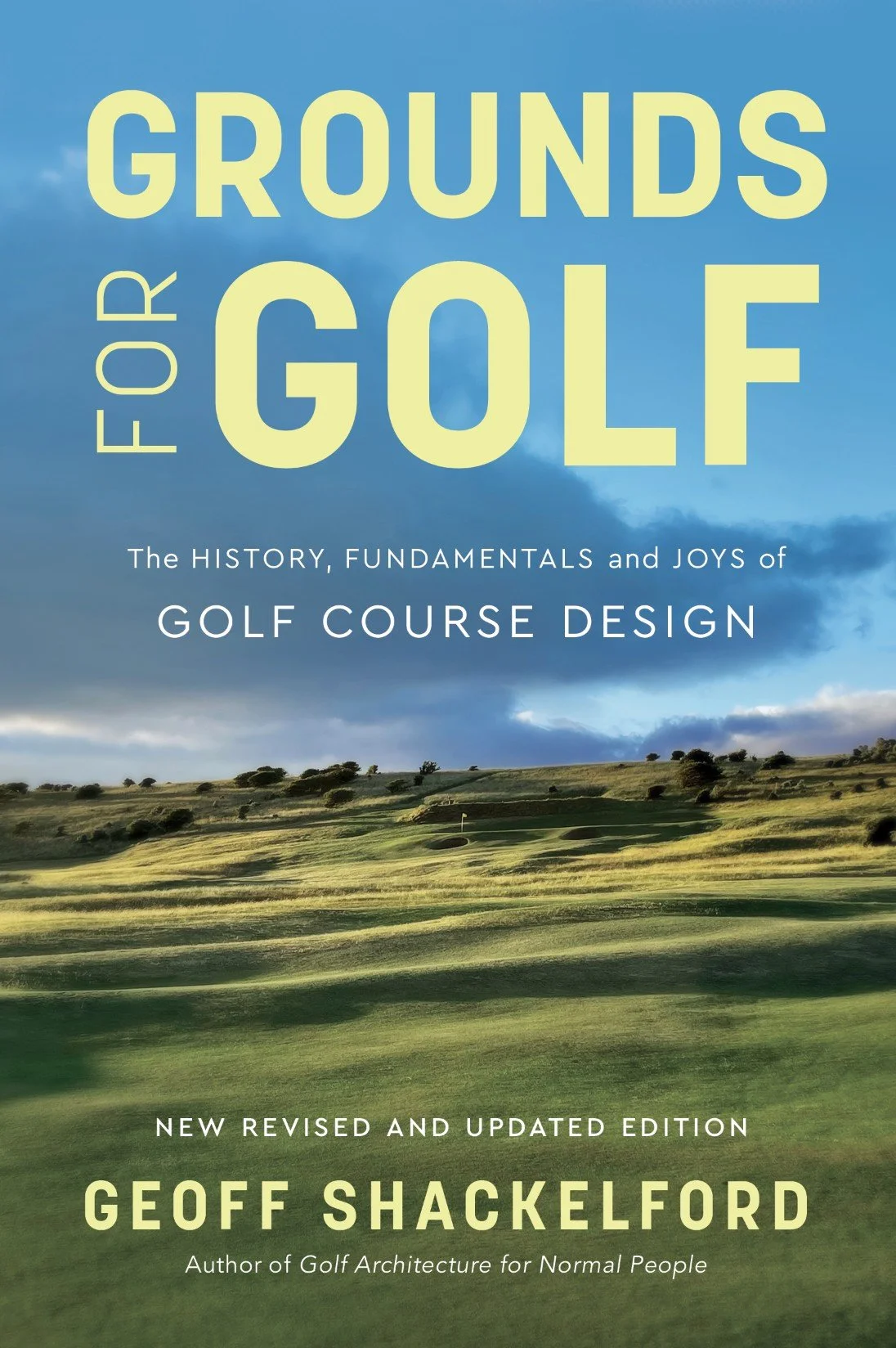
It’s back!
Twenty years later Tatra Press has kindly allowed me to bring back Grounds For Golf now that golf architecture is of more interest to the masses. A new Introduction looks at what’s driven the interest growth and two new chapters I had a blast adding (plus a few edits to keep things up-to-date).
The Amazon purchase page for the book arriving June 15, 2026.
...my latest Golfdom column is now posted.
From guest contributor Steve Elling comes this note:
Eyeing the updated world rankings today. It says that Tiger has padded his lead over #2 Mickelson to a record margin since the ranking methodology was tweaked a couple of years ago.
Small wonder.
Tiger has seven wins worldwide in 2006 -- matching the total of the rest of the top 10 in the rankings COMBINED.
Scott, Goosen, Els and Garcia (all ranked in the top eight) have contributed zero.
Ogilvy and Phil have two wins apiece.
This unbylined wire story covers the U.S. Ryder Cup team playing K Club today and notes that the players all took carts.
What about the caddies?
Golfonline's Joe Passov reviews his five favorite Robert Trent Jones designs, and notes this about Firestone:
By the late 1980s, Firestone South had run into a wall of criticism. "It's too long. It's too hard. It's too boring." Indeed, most of Firestone's holes run parallel to one another and the majority of greens are elevated and fronted by bunkers, lending a certain sameness to the proceedings. Yet, in 2006, the course isn't outrageously long by modern standards and a new generation of pros has come to appreciate the layout's straightforward virtues.
Hard to imagine that a course deemed "too long" just two decades ago is now the home of mostly driver-wedge par-4s.
Yours truly appears on segments 3 and 4 Sirius Radio's Golfchix radio show with Susan Hunt and Linda Giaciolli (Amy Alcott was off this week).
You can listen to the show by heading here and hitting the "This Week's Show" link on the left. The Golf Channel's Rich Lerner appears in the first two segments.
 The PGA Tour driving distance average jumped from 289.1 yards to 289.4 yards after the WGC Bridgestone at Firestone.
Tiger Woods jumped from 305.5 to 308 after Firestone.
The number of 400-yard plus drives for the season rose from 17 to 23, with all 6 coming at Firestone (Cabrera 426, Holmes 413, Holmes 405, Holmes 405, Stenson 402, Stenson 402, Love 400).
David Toms was the only Top 10 finisher at Firestone who did not average over 300 yards for the week.
After struggling over the weekend and winning, Tiger Woods was asked:
Q. Do you feel like you just won a pretty prestigious tournament with your B game?And we didn't get a "right in front of you," just an "in front of you."
TIGER WOODS: Well, I was not hitting it all that well the last two days. I was kind of struggling. I was just trying to piece it together somehow, somehow just piece it together. I was putting well today, but I just couldn't give myself any looks at it. Then when I did, I was missing putts.
But I was just trying to get it around somehow and keep myself in the ballgame. If I got to double digits, I thought I could win it at either 11 or 12, and 10 or 11 would have been a playoff. If I could just get to those numbers somehow, forget what everyone else was doing, just get to those numbers, I'd be all right. I got to 11 and just didn't stay there. 10 ended up being the playoff number.
Q. What is it with Akron and this course that's really been so special?
TIGER WOODS: Well, I love this golf course. As I said earlier, we don't get a chance to play this type of course very often. The new, modern golf courses never look like this. You never have a piece of property where there are no homes on it. It's just a golf course.
So from that standpoint, it's a treat to be able to play a tree lined golf course that's straight forward in front of you, and we saw what happened yesterday when it got hard and fast, that any round that was in the high to mid 60s, you would vault up the board. Most Tour events that's not the case. You shoot low scores just to try and keep pace.
This golf course, if it got hard, dry and fast, nobody would ever be in double digits.
Check out Tiger's stats from Firestone:
Driving Distance Avg 343.4 357.5 334.3 296.9 - 333.0
Fairways Hit 71.4% 57.1% 50.0% 50.0% - 57.1%
Fairway Opportunities 14 14 14 14 - 56
Longest Drive 385 394 393 316 - 394
GIR 77.8% 83.3% 38.9% 72.2% - 68.1%
Thanks to LPGA Fan for the latest warm-fuzzies from Carolyn Bivens, who surely must be finding herself courted by several Fortune 500 companies by now.
Rob Oller writes in The Columbus Dispatch:
Bivens, in just more than one year, has encouraged players and frustrated the Tournament Owners Association with her fresh ideas on what the LPGA business model should be. Her view is that the tour needs to start acting like it belongs with the "big boys" of sports — football, baseball basketball, PGA Tour — and part of the plan includes providing health benefits to the players and increasing their retirement fund.
It also means asking tournaments, such as the Wendy’s Championship for Children, to dig deeper into their pockets to invest in the tour’s growth and also help defray costs that the tour has paid for years. For example, the tour is planning to require tournaments to pay for the electronic scoreboards that dot courses. Currently, the Tour splits those costs (about $30,000 each) with the sites.
"The status quo gets the LPGA less than an acceptable marketing budget," Bivens said yesterday at Tartan Fields Golf Club.
Just think of a world without "These Girls Rock" posters. See why charity must suffer?
Tournament directors who wonder how they will raise the additional money need to look around, Bivens said.
"It’s no different than any other corporation or private citizen," she said. "You figure out your salary is X, your expenses are Y. If you’ve got a mortgage that the interest rate is going up next year, you’ve got to figure out … do you take an extra job? It’s life."
Or maybe death, if you happen to be a tournament organizer.
"I think (Bivens) wants to raise the standard of operating practices, which is great. We should all challenge ourselves to be better," Wendy’s tournament director Kip Eriksen said. "I look at that (issue) a little different from the ($100,000) funding request."
Eriksen, who is a member of the Tournament Owners Association, said the owners want a clearer picture of what Bivens’ proposals will look like and how they will affect their tournaments.
"What is the return for us on the incremental investment," he said. "The tour will get better. What does that mean? How does that translate to the Wendy’s Championship? "
Eriksen also thinks he knows how sponsors will react when tournaments approach them for more money.
"They’re going to say, ‘What do we get in return?’ " he said.
And if Bivens is wrong and is aiming too high?
"If I’m overshooting, then the marketplace won’t replace tournaments. There won’t be more sponsors and there will be a new commissioner," she said.
You? Overshoot? That's hard to fathom.
Meanwhile, Gordon White in The Pilot lumps Bivens in with Maurice Clarett, Duke lacrosse and everything else he sees that is wrong with sports. Now that's positive branding.
With all of the drugs in golf talk, Golf World's John Hawkins makes a courageous admission about taking the prescription drug Adderall and its positive impact on his golf game:
The matter of legality regarding “performance enhancement” depends totally on the sport itself. Do I think pro golf needs some form of drug testing? Absolutely, but not just because it has become a hot-button media topic once again. The game’s governing bodies should feel obligated to examine the concept in a prudent, somewhat urgent manner. In failing to establish suitable policies on equipment in recent years, those two adjectives have been conspicuously lacking.
Stuart Hall writes about Scotland's Richie Ramsay holding off Sunnehanna winner Webb Simpson to reach the U.S. Amateur finals, not only insuring John Huggan a pre-Masters column, but making him arguably the most rules-obtuse player to ever reach such a prestigious position.
Ramsay grounding his club in the creek left of Hazeltine's No. 16 fairway has to rank as one of the most egregious violations ever caught on tape (not to mention the questionable practice swings beforehand).
John Huggan tackles a variety of topics in his Sunday column, including Medinah vs. Royal Liverpool.
Speaking as someone who, even after repeated circuits of the premises, is having a hard time remembering every hole at Medinah, the question remains: was this month's USPGA Championship venue a success or not? In other words, was the year's last major the Greater Hartford Open in disguise? Or did the 'hit-and-stick' stuff on display really double as a highly-entertaining example of modern golf at its tip-top best?And his conclusion...
What really matters is how the scores are compiled. So, while the winning totals at Hoylake and Medinah were similar, it must be said that our Open was much the more interesting to watch and, no doubt, to play. Where most of the holes at Royal Liverpool could be negotiated in as many as three or four different ways, at Medinah there was only one. Give it five out of ten for effort.
Of course, Medinah looks like St. Andrews compared to Firestone, which set up a quality 30 minute nap for me today. Wow is that architecture at its most banal.
John Hawkins calls Tiger's free loading dock relief drop an embarrassment and asks...
Since when did the clubhouse and parking lot become part of the golf course? I’m no rules aficionado, but I’ve always thought that any shot that leaves the field of play is considered out of bounds.
BTW, did anyone actually see the ball turned over to Steve Williams or Tiger, as Bill Kratzert said on TV?
In Thomas Bonk's piece on the drug talk in golf, he writes:
The driving distance of the top players on the PGA Tour has been steadily increasing for decades.
Well, actually only "steadily increasing" in the last decade (which Bonk points out, leading me to believe there was an editing mistake). Anyway...
Advances in equipment, such as shallow-faced drivers with thin faces of space-age metals, plus improved physical conditioning by the players, inspired largely by Woods, are most often credited with the longer drives.
After the last five or so years of hearing executives, players, and media say that the distance explosion has been driven by the incredible player conditioning, might we going to see most of the blame shifted back to equipment in order to protect the image of players and quiet the calls for drug testing?
Wishful thinking, I know.
Thomas Bonk files a front (sports) page story on Tiger's call for drug testing, with several interesting quotes. Starting with Tiger's agent, Mark Steinberg:
"There's a lot out there right now, with BALCO, the cycling and the sprinters, so what he's saying is, 'Start with golf, start with me. I'm clean and I think the sport's clean,' " Steinberg said Friday.And some experts weigh in:
" 'If people are speculating about golf, let's get it over now.' "
Added Charles Yesalis, professor emeritus at Penn State and an expert in performance-enhancing drugs and sports, "Anyone who doesn't say it's a can of worms or that it's a time bomb that is going to explode in your face is nuts. "Given what [baseball Commissioner] Bud Selig went through with his stupidity, with the way he handled it, golf, before it gets hauled into court, should start with something. That's what the smart money would do.And, in response to Finchem's position:
"I've heard every excuse, every rationale you could ever think of, and to listen to the spin of the holier-than-thous — the spin people always point their finger in every direction other than the right one — is misguided.
"With a ton of money involved in golf, there's talk of beta blockers, low doses of human growth hormone, and if you already have the 10th of a 10th of a 10th of a percentage of the public that is good enough to play the PGA Tour, then you take that guy and add 10 pounds of muscle, are you telling me the ball won't go farther?"
"Although the 'Chariots of Fire' model is interesting, that's not the world we live in," John Hoberman, an expert on drugs in sports at the University of Texas, said Friday.
Because there is no PGA Tour list of illegal performance-enhancing substances, drugs such as beta blockers, which have a tranquilizing effect on users, could find their way into golf, according to Hoberman.
"The real threat to golf, with all hell breaking out in baseball because of steroids, are the drugs that would probably be more useful, say the beta blockers, for calmness, self-control, lack of anxiety, steady hands, attention and focus, all qualities that would seem useful in putting," he said Friday.

Tiger Woods makes more history, the OGA holds their reduced flight ball event, Tom Lehman makes Ryder Cup picks, and what story has quietly taken hold? The need for drug testing in golf. Naturally, you have to enjoy the irony of the situation, which has arisen in large part because of an unwillingness to regulate equipment, since there is no evidence that a problem exists.
Still, as Tiger noted, the wise course is to be proactive, instead of reactive, while Greg Norman used an obscenity to describe the Tour's drug stance. You all had plenty of interesting views on the subject.
P.B. writes: Finchem wasn't expecting the drug questions so soon, especially since he doesn't even have a list of banned substances, talk about naive. This guy's been caught with his pants down a few times this year, he's making things up as he goes along, drugs, Fed Ex Cup, fall finish. He's a master without a master-plan!
Pete the Luddite writes, As a former college athlete who was tested several times, I will tell you that even at that age I welcomed the testing. Show you're clean. The potential for a drug problem on tour is simmering toward a boil. As long as the TOUR and the players live in denial, Tom The Ostrich's views will keep anyone from knowing. Look back at baseball - McGwire and Sosa were clean in 199, right? I mean, there were no tests to show they were on anything, so they must have been pure athletes. Today, any feat in baseball has the shadow of drugs around it. Is this what we want for golf?
Jeremy Rudock: Interestingly, Shawn Micheel uses something similar to "the cream" to combat an extremely low natural testosterone level. I wonder what a drug testing policy on tour would think of that? There is zero tolerance for it in other sports such as cycling or track & field.
NRH: The risk to the reputation of the game rests in Far Hills, not at BALCO. This gentleman's game does not need testing when the groundwork for it is its place in other sports, a couple of guys who took Beta Blockers and a misdirected side effects of the avaricious ways of the pillars of the Carlsbad community. Now, about those long putters...
Chuck: Unlike the stuff being cooked up in a warehouse by BALCO, there are players who might actually need beta blockers and antidepressants. So we can't exactly make them 'banned substances.' And you'd be very hard-pressed to determine 'actual need' for the drug in cases where the psychiatric or cardiological complaints are so non-specific as to be duplicated by any patient or any doctor...
DPatterson writes: Camilo Villegas weighs 160 lbs and drives it 300+. It seems to me that distance comes from improved equipment and technique, not muscularity. Who needs steroids? Well, maybe for the rough when the US Open comes around.
Wally on Frank Hannigan's Golfobserver.com column: Couldn't drug testing today be equated to the USGA R&A actually doing a bit of testing themselves 5 yrs ago? Had that testing on equipment actually been done Frank [Hannigan] wouldn't be able to cite it as fact. Joey Sindelar is the only person so far that is speaking from common sense. Drugs are everywhere in every sport, being done by all kinds of athletes, even ametuers in the Olympics, and through all of this somehow the PGA Tour is immune. Nonsense, and of all people Frank Hannigan should know better than to espouse evidense to the contrary.
Scott Stearns writes: Golf is the only sport where the golfers call penalties on themselves, and have for hundreds of years. Just because Sammy sosa corks his bat, or people hack Shaq on his way to the hoop, does that mean the tour should put a guy with a striped shirt with every group? Lets solve the problems of golf--like equipment--rather than solve problems that dont exist.
Smolmania writes: In view of all of the other problems which exist out there (ball goes too far, FedUp Cup, no tour event in Chicago), drugs aren't that high on my list.
Regarding the selections of Stewart Cink and Scott Verplank, Van said: Capt. Tom didn't have a good second pick. This team's in trouble, and I think he senses that. The K Club, a perfect substitute for The Belfry. The horror, the horror, the horror. To be five of the last six.
MacDuff: Trouble is every captain wants to win "his" Cup year, so experienced players get the Captain's pick slots. It's a shame they can't pick a number of youngbloods that look like they'll still be around ten years hence -- like O'Hair, Quigley and Glover. The Australian cricket team did just that in the early 1980s. Under an experienced playing captain, a whole raft of promising but internationally inexperienced players got whipped for a couple of years, but developed into world-beaters for the next decade.
CBell: it's all a crapshoot - you can't predict how any of these guys are going to play in the Cup any better than I can predict how I'm going to play tomorrow. Tiger Woods is arguably the most dependably superior golfer in the history of the game (Okay, fans of Hogan/Nelson/Jones, chime in...) and look at his record in the Cup...And then there's Monty.
On the OGA event, Jeff Pollner writes: I don't see how having a standardized ball helps unless it goes about 15-20% shorter. If the USGA just changed the required specs, every manufacturer could still sell balls and pretend they had the longest under those specs just like they do now.
Hawkeye: First off: Roll back the ball, yes. OK, done. Secondly: Please give at least SOME credit to the improvements in knowledge of biomechanics and the role use of cameras has had on instruction. I recently watched some official films of British Opens and US Opens from the 70's, and it's astonishing to see how inefficient most of the swings were. Pure hand-and arm-actions, reverse-pivots, tilt-and-blocks, everything.
Peter Barcelo: As far as I'm concerned there is already a gap (bifurication) between pros and amauters with regard to the equipment that we are currently using. Bifurication is only going to take a bit of air out of the pros playing the game, while saving me money at my club. I'm already sick and tired of the assesments that have been put on our membership everytime the committee decides we need to keep up with technology. Today we have tees that 95% of the membership never plays from, and water hazards just off the fairways that the membership can't even reach with their Sunday best drive. I say bring on the bifurication before I go broke playing this game and quit.
Speaking of changing courses, we learned that Valhalla is undergoing an complete overhaul by original architect Jack Nicklaus.
Garland says: Couldn't help but think that where it said "challenge modern players" it meant challenge modern equipment.
Hux notes: Since Jack probably learnt something from Tom Doak at Sebonack, he can go back and redo as many of his earlier courses as he wants as far as I'm concerned.However it's not modern equipment that's making them dated so quickly. Let's make that point clear.
Adam C: How many examples of lengenthening will it take before people figure out it is the wrong direction?
Geoff Shackelford is a Senior Writer for Golfweek magazine, a weekly contributor to Golf Channel's Morning





Copyright © 2022, Geoff Shackelford. All rights reserved.