U.S. Open Photo Caption Fun, Vol. 1
/I've been searching for anything fun but apparently the photographers are saving their energy for the expected weekend heat. Therefore, courtesy of GolfChannel.com, because he's easy...

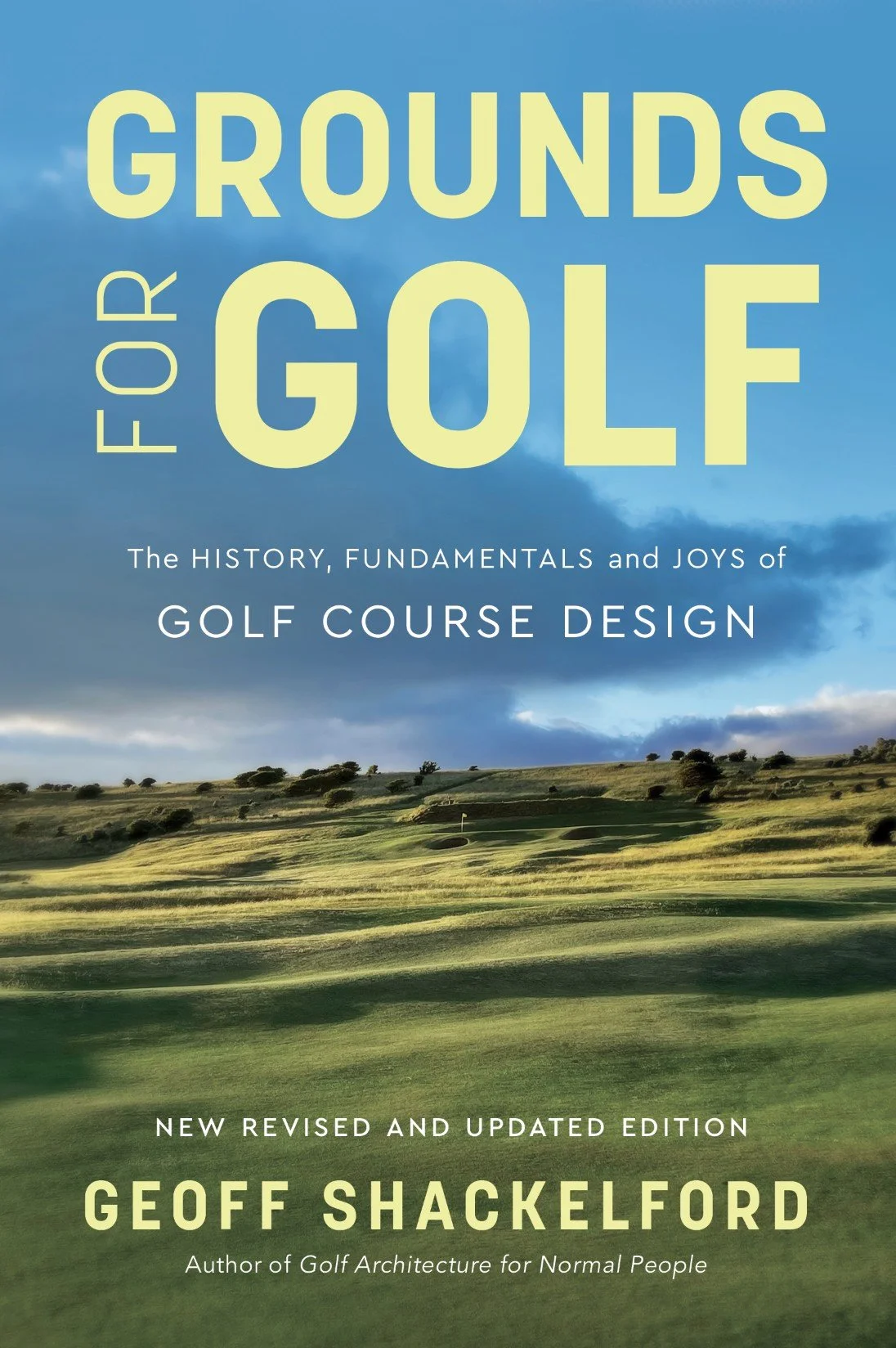
It’s back!
Twenty years later Tatra Press has kindly allowed me to bring back Grounds For Golf now that golf architecture is of more interest to the masses. A new Introduction looks at what’s driven the interest growth and two new chapters I had a blast adding (plus a few edits to keep things up-to-date).
The Amazon purchase page for the book arriving June 15, 2026.
I've been searching for anything fun but apparently the photographers are saving their energy for the expected weekend heat. Therefore, courtesy of GolfChannel.com, because he's easy...
 Another excellent edition of Golf Channel's Pre-Game U.S. Open coverage featured the usual gang (Kann, Pepper, Nobilo, Oosterhuis, Lerner) stepping up to the plate with fresh insights into the field and course, with colorful (literally) reports from Marty Hackel and a fun look inside the Pirates' ballpark.
But it was all highlighted by the Steve Sands interview with an obviously perturbed Phil Mickelson.
One comment from Phil was notable for its honesty and accuracy, the other just a sign of these wacky times.
Sands: You nervous at all...about the wrist?
Mickelson: I'm uncertain whether or not it's going to hold up on some of the shots out of the rough. It's been hurt in this rough before. Yesterday, 5, 6 people got hurt that Jim Weathers had to go work on. I think this golf course is a physical hazard to the players. I don't think that that has been very well thought out. So I think every player should be concerned--not just me--when they hit a shot in the rough.
I know I've shared my bias on this as someone who had a wrist injury and as someone who finds it pitiful that rough is harvested like a crop so grown men can compensate for some mysteriously vacant portion of their golfing soul that believes this torture rewards skill, but isn't there something seriously wrong with the game when antics like rough-on-steroids could impact our national championship and potential damage the well-being of a player and his career?
Anyway, here's the part where the modern player mentality of having consistent greens throughout the course is a bit hard for me to relate to. Continuing on after his comments about the rough...
Mickelson: This has forced me to prepare on the greens. Pelz and I have been out here on the greens this weekend, I feel like I have a good concept of how the putts break but also the speeds. You know the speeds have fluctuated tremendously from green to green. And I know they're doing the best, but they do the same thing to each green. They cut it the same height, roll it the same for every green. Well that's just ridiculous because you have greens that are high that are more exposed and get more wind and greens that are low that get a lot more moisture, so the fluctuation in the greens have been up to four and half feet from the fastest to the slowest. And so I think guys are going to struggle and I think that on the greens I may have an advantage knowing what the actual green speed is.
I guess this is where I would say to Phil that you knowing the varying speeds of each green is a cool thing and that attempts to make speeds uniform would be more contrived than what's out there now.
In Jon Show's Sports Business Journal story on the USGA's deals with Lexus and AmEx, he writes:
In addition to Miller¹s activities, Lexus is offering a swing simulator at its vehicle display tent that lets fans take shots on a computer-generated Oakmont course. Any fan hitting a hole-in-one will win a new Lexus LS 600h L. Visitors to the tent can also have their photo taken with a full-sized replica of the U.S. Open trophy that will be posted to www.MyOwnPursuit.com, a site being created by Lexus for the feature.So naturally, the USGA President's press conference had to include a pseudo plug for the new sponsor's pavillion.
If you haven't been there, I would urge each of you to go across the Turnpike and go up to the main entrance and see all of that and the things that are available for the spectators as they come in. They can have their picture taken with a replica of the U.S. Open trophy. I understand there were 6,000 people in line to do that yesterday. So you might want to time your visit at some low point in the crowd, but I'm not sure when that is going to be.Synergy baby. Brand those platforms. Or is that platforming the brand? Or synergized cross-pollination? Eh, anyway...
Q. This is for Walter and/or David. Johnny Miller came in yesterday and said he thought that this was the -- I think he said, "Greatest golf course in the world right now." I'm interested in your reaction to that, and do you agree with that? I know you have other courses in your rotation.
WALTER DRIVER: I was told when I took this job that saying anything negative about any golf course was like insulting someone's spouse, and you better not do that.
So I think this is a great golf course. As to comparing it to other golf courses. I'm not going to go there, but this is one of the great golf courses in the United States without any question.
DAVID FAY: By the way, the first person to make that comment about insulting one's spouse, Charles Blair McDonald. I've got to get that plug in.Yeah, right. Sigh.
Well, we'll let this one slide. He didn't say anything about spouses, but it was the thought that counted.
 That's right, the inaccessible Bud Selig stopped in the US Open press center after the USGA press conference and here's what the assembled scribes peppered him with:
You must be so happy with the resurgence of the Milwaukee Brewers. Even though you are no longer their owner, how much of their great play do you believe is attributable to your wonderful leadership over the years?
Have you had much of a negative reaction from fans about taking the 2008 All-Star Game to Yankee Stadium?
As a follow up, have you seen the plans for the new Yankee Stadium? We had Joe Torre in here earlier and he says it's going to be the best in America. Would you agree?
Joe also said the World Series is the one that most players really want to play in and win. What do you think of that assessment?
You must be excited about Barry Bonds and his chase of Hank Aaron's record? Will it be televised?
Okay, enough. You get the point. There's a USGA cover story in Golf World, injuries to two top players induced by course conditions, major questions about square grooves and USGA operations, even more major questions about next year's venue and the scribblers are asking David Fay, Walter Driver and Jim Hyler if they agree with new Lexus pitchman Johnny Miller about the brilliance of Oakmont?
Mighty, might impressive!
Just consider the brainpower necessary to pose such thoughtful, creative and compelling questions!
Q. I know you don't have a target score, but do you ever intentionally try to make a venue more difficult because scoring was very good, for instance, 2003 at Olympia, the last run of Opens have been more difficult; and any reaction to that?
Q. Jim, when you set up a course for the U.S. Open, how much are you endeavoring to test the intangibles, poise, patience, maturity in addition to skill?
Q. You mentioned the renovations, all of the trees that were taken away; one addition from '94 is the new bridge. Just your thoughts on the USGA's impact on that bridge and making it a better golf course for the gallery.
Q. Wonder if anybody up there could respond to the idea of what reaction you're getting from players thus far, and how does the USGA define the difference between rigorous and sadistic? (Laughter)
Hardeeharhar...
Q. This is for Walter and/or David. Johnny Miller came in yesterday and said he thought that this was the -- I think he said, "Greatest golf course in the world right now." I'm interested in your reaction to that, and do you agree with that? I know you have other courses in your rotation.
Q. Maybe my question will follow-up on that. Yesterday we heard players and Johnny Miller talk about, this is the greatest golf course, this is the hardest golf course we've ever seen. My question is, what's the correlation between something has to be the hardest golf course to be the best golf course for your purposes or can it be something less than that?
You're asking the chairman emeritus of the Rees Jones Fan Club this question?
Q. Another thing that Johnny Miller said yesterday was he's hearing more and more players talk about how this is a tournament they love to win but sometimes hate to play and there have been some examples in the past eight years or so of events that did get across the line a little bit in certain places. Do you think this is an important week for you guys with the weather, the course conditions to prove that you can walk that fine line between fair and unfair?
Q. Wonder, did the USGA get involved at all in any decision making on the trees and the tree removal; were you consulted, were you happy with the course in '94 the way it was?
And that helps us how?
This is long overdue...
Charles Blair Macdonald to Enter World Golf Hall of Fame
Oakmont, Penn. (June 13, 2007) – Charles Blair Macdonald, instrumental in the founding of the United States Golf Association and credited with building the first 18-hole golf course in the United States, will be inducted into the World Golf Hall of Fame on Nov. 12 as part of the 2007 Class of Inductees.
“Charles Blair Macdonald is recognized today as the Father of Organized Golf in the United States,” said David Fay, Executive Director of the United States Golf Association and Member of the World Golf Foundation Board of Directors. “Without Macdonald, the USGA would not have been created. And without his leadership and strong character, the game in this country could easily have gone astray. As a player, administrator, architect, rule maker, and chronicler of the game’s history, he was one of golf’s true giants.”
 Steve Elling on Phil's wrist injury, with an interesting take on the support device he's wearing:
Mickelson received a cortisone shot last week, has been trying muscle massage, rehab therapy and various forms of stimulation to increase blood flow to the affected area, and is traveling with a shaman of sorts, former Green Beret Jim Weathers, whose business card lists him as "motivational speaker, shiatsu master and reflexologist."
The wrist is so iffy that doctors ordered Mickelson not to practice, sign autographs or participate in any "strenuous workouts." (Note to Tiger Woods fans: Insert punchline here).
Facts are, the Open isn't a place you come when you are nursing a hand injury -- it's a place you leave with one. Witness Woods at Shinnecock in 1995, when he hit a ball into the high rough, tweaked a wrist while hacking out of the hay, and had to withdraw.
Mickelson might face another uncomfortable hurdle, as in whether the wrist wrap is copacetic in the eyes of the golf rulebook. USGA rules official John Morrissett said Tuesday that he had not inspected the wrap Lefty is wearing, but said it appeared to be made of an "Ace bandage material with no rigid parts." Players are prohibited from using swing-aids and devices designed to restrict wrist movement.
The bandage covers part of Mickelson's left thumb, the back of his hand and encircles his entire wrist. Clearly, taping the wrist is intended to keep Mickelson from further straining the injury and any swing benefit would not be his directed intent. Mickelson joked there could be a crossover effect.
"I would say this will help me keep it one shot at a time, and this brace will help me alleviate any extra wrist break at the top of the swing that I may have," he said.
Then Mickelson turned to a nearby USGA media official and cracked, "Is it OK if I use this (bandage) now that I said that?"
Let's not dismiss it with a flip of the wrist. Morrissett said the bandage "doesn't appear to inhibit movement in the wrist," though it will likely restrict and support it to some degree. Otherwise, why wear it at all? Mickelson even indicated he would tighten the bandage before hitting shots.
"There's a chance somebody with the USGA will take a look at it," Morrissett said.
Okay rules aficionados, what do you think?
Thanks to reader Kevin for this Robert Dvorchak story in the Pittsburgh Post-Gazette looking at the history of the Stimpmeter.
This beautifully sums up Oakmont's greens:
On six of the 18 greens, the surfaces aren't flat enough to get a Stimpmeter reading. The ball just keeps rolling and rolling. So the numbers from the 12 flatter greens are used for the course average.
When US Golf Association officials meet today with reporters, expect confirmation of what has been reported by some publications -- that the 2014 US Open will head to Pinehurst No. 2. Nothing will be announced about the 2013 US Amateur (dates for that are out only through 2010), but all indications are it will go to The Country Club in Brookline, Mass., as a way of commemorating the centennial of Francis Ouimet's historic US Open victory. As most Bostonians know, Ouimet walked across the street from his home to win the 1913 Open, a stunning triumph that is credited for popularizing the game in this country. The 50th and 75th anniversaries were saluted with US Opens at TCC (in 1963 and 1988), but the National Amateur would be a fitting tribute, for Ouimet was a lifelong amateur and twice the US Amateur champ. Architect Gil Hanse, his star on the rise for his design of The Boston Golf Club in Hingham, Mass., is working with TCC officials on whatever changes will be necessary for the 2013 US Amateur and possibly the US Open several years after that. Since a second club is always necessary to help accommodate a large US Amateur field, look for Charles River CC in Newton to fill the bill in 2013.
Jon Show in the Sports Business Journal writes about Johnny Miller joining Lexus for several synergistic cross platforming upward product valuation and branding opportunities.
NBC golf analyst Johnny Miller will spend this week as a spokesman for Lexus, part of the company's activation of its new sponsorship with the U.S. Golf Association that includes rights to the U.S. Open.There's that activation word again!
Miller is scheduled to make appearances on behalf of Lexus through Sunday, including appearing via satellite on morning shows to promote a Lexus-sponsored survey asking golfers how they improve their game.
Good to know he's got his priorities straight.
He also will appear in ads running in major golf publications and will be featured in TV spots running on NBC, which is televising the majority of the event.
Oh, but will he plug the product on the air as he did with Ford? Will he go easier on the USGA now that he's working with one of their sponsors?
This year also marks the first U.S. Open to have large-scale corporate backing. Lexus and American Express signed separate deals this winter with the USGA, which conducts the U.S. Open. Each is activating heavily in its first event.
Activating heavily! As opposed to merely activating.
And the story drops this little surprise.
The USGA is looking to expand its number of corporate partners to four, hoping to announce one in January 2008 and one for 2009. USGA CMO Barry Hyde said he expects efforts in that arena to ramp up this fall, after the organization¹s 13 national championships conclude.
Actually, this Jon Show-Sports Business Journal interview with AmEx's Rick Lehrfield contains all sorts of new verbs, adverbs and nouns to add to the list.
Rich Lehrfeld is overseeing American Express first year under a new corporate partnership structure marketed by the USGA. He spoke recently with correspondent Jon Show about the allure of this week¹s U.S. Open. How much of your activation efforts are you pulling from your sponsorship of the U.S. Open of tennis?
Oh nice, activation efforts. And that was just setup!
LEHRFELD: We¹ve taken a good amount, between the fan and cardholder card-member experiences and the welcome pavilion. It¹s not a true takeoff but a lot of the engagement for the U.S. Open tennis we tried to use [for] the golf event.
Hmmm, anyone care to tell me what a true takeoff is vs. an engagement?
What attracted you to the USGA?
LEHRFELD: Who they are and what they represent in the game of golf. It¹s an organization that runs 365 days a year with multiple events. There are a lot of different platforms that we can build on with them. The USGA really wants to keep the event as special and pure as possible. We¹ve worked with them on where we should and shouldn¹t be branding, how we can deliver benefits and access.
Platforms and branding. Yawn. And I don't know about the pure part if they are taking on sponsors.
How do you measure success in year one?
LEHRFELD: First is trying to develop impactful programs and working to develop a comfort level with the USGA. That¹s hard to measure. Engaging consumers and building programs and experiences through content or on-site. Delivering real value through a brand perspective, which we determine through research and response. And then, the business perspective.
Impactful value through a brand perspective. Amen brother.
Any plans to expand your interests in golf?
LEHRFELD: We¹re definitely looking to grow our efforts in golf. Maybe in event sponsorship, maybe not.
Wow, stop teasing us like this!
Should anything be done to improve the World Golf Championships events, one of which is title-sponsored by AmEx?
LEHRFELD: They¹ve done a good job with the players. I think they probably have to do a little more rotation and make it more global, which is tough with the players¹ schedules. They¹re faced with a big challenge in trying to make it a global property.
Wow, that's a fancy way of saying the WGC's aren't working!
 Thankfully no one hurt themselves Tuesday, but the boys sure had plenty to say about the course and setup.
John Huggan shares thoughts on the setup and several player reactions.
Has Oakmont, almost universally feared and revered as the toughest, most brutal and most unforgiving track on the US Open rota, been prepared in a way that will allow the best to prosper? Or has the USGA blindly done what it normally does and eliminated any semblance of strategy and flair in a misguided effort to make America's national championship 'fair,' while at the same time producing a winning score some way north of par?
Sadly, the initial signs are that the latter policy has yet again reared its tedious head.
Monty tabs a local Oakmont looper to suffer for four days with him (well...assuming he doesn't fire him too).
Josh Massoud talks to Adam Scott, who has some interesting thoughts on the setup.
But Scott said the experts had confused greatness for toughness.
"That's not what the game is about. It's got to be fair in every area. I think everyone is so hung up with par; there's an obsession with par. If you put the world's best players on a golf course, they should be able to break par."
Rick Starr looks at the 12 amateurs in the field.
This AP story summarizes Johnny Miller's Tuesday press conference remarks.
Furman Bisher says things have never been better at the USGA under Walter Driver, and cites the Shinnecock Hills U.S. Open under Driver's Championship Committee watch as evidence of how Driver gets an unfair rap.
Driver was chairman of the USGA’s competition committee, which means the responsibility of setting up the course was his. “His arid setup,” as Golf World phrases it, “was an embarrassment,” a term to be questioned.
“Arid” refers to the rain which was forecast, but didn’t fall, and the winds which dried out the greens. Curses to the competition chairman.
Wow, I guess Google hasn't made it to the Atlanta Journal-Constitution. Rain in the forecast? Oy...
And finally, back on the planet earth, Craig Dolch blogs about the day's interviews and the demise of the scrum.
And finally, the USA Today's Joe Saraceno writes one of those so-over-the-top-it's-funny columns about Tiger's impending fatherhood.
I was out all day so I only looked at the Ogilvy, Woods and Mickelson press conferences. I found no really good rally killers because that would mean there were rallies to be killed.
So, the few highlights I could find. Geoff Ogilvy said:
It's a great property. It looks fantastic without any trees on it. I can't picture it without any trees on it. That's how good it looks without trees. Collection of the best greens I've seen anywhere.Tiger Woods had this to say:
The bunkers are tough and the rough is really tough. It's a great golf course. It's completely different from Winged Foot, a different type of property, a different type of golf course, but Winged Foot is fantastic, too.
Q. Have you played out of the church pews at all during your practice rounds --And before the questions about becoming the first father in the history of the world...
TIGER WOODS: No.
Q. Have you dropped a ball there?
TIGER WOODS: No.
Q. Is it like 17 at Sawgrass --
TIGER WOODS: I don't really think that you should be practicing negativity. You're not going to place the golf ball there, and if you are, if you do make a mistake there, you just basically are going to wedge out anyways. Accept your mistake, and move on. I'm practicing where I'm trying to place the golf ball and tendency is I think where the greens, even with good shots, balls with run-off to certain areas, and that's basically what I've been doing so far.
Q. You had mentioned, I think earlier on, that this course had supplanted Shinnecock has the hardest you had played; I wonder if you still subscribe to that? And part two would be the greens here seem to be the thing that everybody talks about, arguably the hardest, anywhere, if you could just touch on those two issues.
TIGER WOODS: Yeah, they are by far the most difficult greens I've ever played. I thought Winged Foot's pretty tough, Augusta's pretty tough. But both golf courses have flat spots. You know, Augusta may have these big, big slopes, but they have these flat shelves that they usually put the pins on. Here, I'm trying to figure out where a flat shelf is.
And most of the greens here are all tilted. Some even run away from you, which is not the norm in modern course design. Overall, these greens -- like I said, depends on how the pins are set; if they give us a chance to play, or if they are going to make it really impossible. We'll see.
And from Phil Mickelson:
PHIL MICKELSON: I had a chance to play nine holes today. It was the first time in a while and it was nice to get out on the course and get to hit some shots.
As you know, I've had a bit of a wrist injury the last two weeks. And since Memorial, I took four or five days off and had two doctors look at it. Fortunately I had the same diagnosis from both doctors; that it was inflammation. I took four or five days off and tried to play last Tuesday and hit balls and just wasn't able to do it
Q. I didn't get to see all of the holes this morning; did you play any shots out of the rough and if you did, how did it feel?
PHIL MICKELSON: I didn't hit any shots out of the rough. I don't want to aggravate it. Tried not to hit too many drivers yet. I don't want to go at it full speed just yet. I think I hit one or two drivers at the most. Just kind of easing into it.
I've got a really good game plan mapped out for the tournament. I'm just not sure if I'm going to be ready to implement it because I haven't had the normal practice and preparation that I would have going into it a major.
But I'm still looking forward to being able to play and hopefully implement or put together the game plan that I had hoped.
And...
Q. As a follow, do you have any concern as you go in Thursday that you'll be able to perform this week?
PHIL MICKELSON: Sure I do, I have concerns. But I'm going to do the best I can do it. I'm going to do all that I can to do that.
At least he's honest. And this...
Q. We all remember Shinnecock a few years ago, and last year No. 1 at Winged Foot had to be looked at and watched very closely. Are there any greens that if they are not careful --
PHIL MICKELSON: Oh, yeah, there's six or seven of them, sure.
 The John and Sherrie Daly matter is getting downright ugly.
In lighter news, Steve Elling looks at Oakmont's 8th and wonders if the USGA's 288-yard setup is within reason.
At 7,230 yards, the course isn't punitively long by modern standards, but the crazy eighth should generate a cacophony of complaints. From the back tee, the 288-yard par 3 is the longest in U.S. Open history -- funny how that general theme is repeated each June in some respect -- and stands an attention-getting round-wrecker.
Moreover, if the USGA set-up sadists put the flagstick on the back of the green, the hole can measure an intimidating 300 yards. Mind you, technology gains or not, the average driving distance on the PGA Tour is 285.1 yards.
In other words, this hole, as they used to say in the mills hereabouts, will separate the steel from the slag. Pittsburgh has morphed into Titanium Town.
And this from Phil Mickelson...
"I love the hole because, in architecture -- and I've been slowly getting into architecture -- the longest par 3 you ever see is about 240 or 250 yards, and the shortest par 4 is about 330," Phil Mickelson said. "There's 80 or 90 yards there, where you don't know what to call them."
Scott Michaux weighs in on the tree removal with this.
Ford says that the greatest irony of it all is the fact that the same course architect who oversaw the conclusion of Oakmont's deforestation project is the same one resembling Johnny Appleseed with mature trees cropping up all over Augusta National Golf Club.
"It's very coincidental that Tom Fazio is our architect who help cut them all down and he's the architect at Augusta National and they're planting trees," Ford said. "It's pretty wild, isn't it?"
It's quite a lark considering that Augusta National played the defining role in Oakmont's shaded canopy era to begin with.
"If it weren't for Augusta, we never would have planted the trees in the first place," said Ford.
Mike Dudurich explores some of the wild and weird occurrences on the wonderful short 17th. He also has this interesting playing strategy from Phil Mickelson, who you may recall, bungled Riviera's 10th earlier this year with a similarly peculiar approach.
It looks like the majority will play aggressively on the 17th. At least that's what the No. 2 player in the world, Phil Mickelson, is thinking.
"You drive it up the left of the 17th fairway and then we'll see how thick that rough is," Mickelson said. "I had a tough time hitting the green with a wedge out of there. But it's still the play, hitting it over there because it takes bogey out of play. If you don't hit a driver, you're risking a five. I'll be trying to hit it in the left rough if the pin's in the back right or in the "Big Mouth" bunker if it's front left."
Rory Sabbatini's philosophy is even more confusing:
"Take out the driver and go for the green," the South African said without hesitation. "The rough front left of the green is the thickest on the golf course. I think you only make things more difficult on yourself if you lay up in the fairway."
Ok! Whatever floats your boat.
Scribblers: food for thought for Wednesday's sitdown with USGA President Walter Driver and Executive Director David Fay. Naturally, it quick read of Chris Millard's Golf World cover story would be wise preparation for the news conference (though my press room sources noted that it was conspicously absent from the toilet reading giveaway table).
Geoff Shackelford is a Senior Writer for Golfweek magazine, a weekly contributor to Golf Channel's Morning

Copyright © 2022, Geoff Shackelford. All rights reserved.