Azinger Appears Overwhelmed By Leroy Neiman's Captain's Portrait

Portraits.jpgI know what you're thinking. Leroy Neiman still paints?

Unfortunately.

He was commissioned by the PGA of America to capture the current Ryder Cup captains for reasons unknown. Azinger could not look more pleased, don't you think?  The look says, "this will look great in my garage right next to the Leroy Neiman African safari prints that the previous owners left behind."

But Azinger won't have to make room for it, charity will be the uh, beneficiary.

The works of art will be auctioned to benefit the Ali Center and The First Tee of Louisville.

The unveiling was held in the LeRoy Neiman Gallery of the Ali Center, which also features Neiman's famed portrait and other images of Ali.

The Ryder Cup Captains' portraits will move to the Cobalt Artworks Gallery nearby on Louisville's Main Street. Both pieces of original art will be auctioned off by public bidding, which will continue until Sept. 17, 2008, when the portraits will be awarded to the highest bidders during the Ryder Cup Gala Dinner.

Technofitting

Ryan Ballengee, prompted by posts here and on Golf Digest about their Panelist Summit, makes several interesting points on the restoration debate, particularly related to Tom Fazio's remarks. Though Ryan loses all credibility when he labels me a Great American but could win some points for the creation of fine new term to describe the Fazio/Jones approach to classic courses: technofitting.

The PGA Tour Really, Really Loves America...

img8303701.jpg...so much so that they are willing to fight a Scottsdale city variance, all so their new "Superstore" can proudly display the stars and stripes. Peter Corbett reports in the Arizona Republic:

The PGA Tour Superstore plans to seek a variance from the city to allow the stars and stripes - 30 feet by 50 feet - to fly from a 100-foot flagpole, said Paul Rodriguez, district manager for the Atlanta-based company.

The 47,000-square-foot golf and tennis store northwest of Shea Boulevard and Loop 101, opened Oct. 11.

A new Chandler PGA Tour Superstore has a 30-foot-by-50-foot flag on a 100-foot pole, and other stores in the chain have even larger flags on poles of 135 feet.

"With the wind blowing, they are just plain awesome," Rodriguez said. "You can see them from a mile away."

Scottsdale's zoning code limits spires, which includes flagpoles, to no more than 65 feet, said Tim Curtis, a Scottsdale principal planner.

"It's like a glorified club championship."

Bob Harig reports that you can kind of feel the Fall Series dying right before our eyes and offers up some tough comments from Steve Flesch:

Dubbed the Fall Series, the final seven events on the PGA Tour schedule will mercifully come to an end next week in Orlando, where the biggest stories will revolve around players losing their full-time status (despite making $700,000 this year) or secure veterans who try to fit in golf around visits to the Disney theme parks.

"There were 100 people following the final group last Sunday in Scottsdale," said PGA Tour veteran Steve Flesch. "It's like a glorified club championship. I don't think that's what the tour intended. And I think they need to address it."

And this from another reliable mind: 
"It's a slap in the face to some of those events to almost label them B-class events," said Daniel Chopra, who was in contention for his first PGA Tour victory at the weather-plagued Ginn. "Disney's been around for years. Vegas has great history at that event. ... We need to do something because these sponsors are putting up a lot of money, and the tournaments are not getting the respect they deserve."

Harig also explores possible solutions, including one that I remember hearing in the early FedEx Cup chatter: points in the fall counting for the following season.

I've always wondered why that notion died. Seemed like a win-win for the Tour, FedEx and the fall event sponsors. Oh, and those guys the Tour revolves around, the players.  

Daly Delivers Consistency: Registers Season-Leading 6th WD

Okay, it's not Tiger chasing Jack's 18 or Snead's 82, but according to Craig Dolch, he's leading the tour in WD's with his Ginn Classic bail out.

Meanwhile Steve Elling says the Tour's obviously not fining him enough, then dares to go where few have thought to venture, boldly questioning how fans can keep loving the guy when he pulls this stuff. I also like this point, which does punch a hole in the regular guy persona that Daly has been abusing:

He's become an affront to the credibility of the PGA Tour and has offered repeated slaps to the face of those buying tickets to watch him. Moreover, his behavior is offensive to players who could have better maximized the notable number of wasted, and mostly undeserved, opportunities that Daly received this year from various sponsors.

Nobody received more largesse than his largeness.

Daly, playing mostly on sponsor exemptions because he didn't finished in the top 125 in earnings last year, won't reach the financial threshold again this year, either. He was at No. 182 entering the week, despite playing a full schedule of 24 events. He has been reduced to seeking handouts from title sponsors to get into their fields.

That latter figure means a couple of things. Firstly, many tournament directors are lining up to give him exemptions into their events, because they know that fans buy tickets to watch Daly's seemingly inevitable train wreck. And, second, it underscores that he remains the biggest quitter active in the game today, if that's not an oxymoron.

To wit, Sunday marked his sixth withdrawal of the year.

 He didn't give a reason for quitting but didn't report any injury or illness, a tour media official said. According to tour rules, he has 30 days to send a letter to tour brass outlining his reasoning, which will be reviewed. He faces a possible fine if his excuse doesn't pass muster. Whatever the dollar amount figures to be, and the tour has never disclosed its fines, it clearly hasn't been enough to modify his behavior. He should be booted on general principle for conduct unbecoming a professional.

"Why would anyone bother trying to design a course for us?"

For those of you new readers who haven't followed the technology debate and its impact on the game, John Huggan offers a juicy primer that is also filled with some fresh quotes and thoughts for those of you who have tracked this key issue.

The other day, former US Open champion Geoff Ogilvy played a round with friends at the splendid Kingston Heath course in his home city of Melbourne. When they came to the 567-yard 14th hole, which was playing downwind, admittedly, Ogilvy hit a good drive... before striking a 7-iron approach through the green.

That's not a misprint. How long does a hole have to be before one of the game's leading exponents is unable to reach the putting surface with two full-blooded shots? Given that Ogilvy hit a drive and 7-iron around 575 yards, he was capable of reaching a green about 200 yards further on with his 3-wood.

Let's make the hole 800 yards in length, just to make him think a little. As the world No.11 asked companions rhetorically: "Why would anyone bother trying to design a course for us?"
Fast forward... 
"I don't pay too much attention to distance statistics, because most of my courses are not being built for the professionals," says leading designer Tom Doak. "But I try to stay abreast of what's going on, because the governing bodies don't!"

Wow, the Doakster finally speaking out forcefully! Better late than never.

And from Huggan: 

The typical response to this new breed of tour player has been predictably, and disappointingly, one-dimensional. Most courses have resorted to golf's most boring hazard - longer and thicker rough - and ever-increasing length, and in the process have destroyed any semblance of strategic choice for players who are supposed to be the best.

In other words, thinking and planning have largely been eliminated from the game at the highest level. On almost every hole there is but one choice of shot, with the creation of interesting angles for the approach something those old guys did before technology ran amok. It is tedious and heartbreaking to watch and, no doubt, to play.

The danger is that the average golf club committee will imagine that growing more and deeper rough and creating longer holes by way of more back tees offer the way forward for their course. Big mistake. That approach ignores the fact that the average golfer gains little or no advantage from modern technology. Largely starved of the club-head speed that is yardage's fuel, his drives have "stretched" by only a few measly yards. Besides, there is a better way.

"On most of the courses we work on, we put in back tees for the good player only on those holes where the green size is appropriate," says former European Tour player Mike Clayton, now a much-respected course designer. "We would not, for example, make a 310-yard hole 40 yards longer just because we could.

"In fact, par-70 is the answer to many tour course design questions. By reducing the par by two shots, you create two less vulnerable holes. Throw in a couple of great short par-4s and a short par-3, and it is possible to keep a course around 7,000 yards in length while still making it both difficult and thought-provoking for the professionals, and playable for the members without having tees they never go anywhere near."

Of course, all of that could be achieved by hauling the ball back 50 yards. Come on guys, get it done!


50? Shoot, I'll take 20 at this point. 

"Well, it's a simple issue. You just fix it. You do it."

Bob Carney does a super job summing up the various debates and vigorous give-and-take that took place during the Golf Digest Panelist Summit, and offers this from Tom Fazio on his work at Augusta National. I missed his presentation today while flying the unfriendly skies. But it was a typically masterful blend of Fazio rationalization:

Fazio, who did that remodeling, was having none of it. "Put yourself in Hootie Johnson's postion. You are in charge. And you have the best players in the world and you have a venue that used to contain long, strong par 4s--No. 1, No. 5--that required a long drive and a mid-iron. What do you do. Well, it's a simple issue. You just fix it. You do it."

Yes, and it's been so well received.

Length, yes Tom. Rough, silly tree planting, no optional tee flexibility and an overriding emphasis on protecting egos through other contrived features?  Not working.

Fazio suggested another exercise in imagination. He said imagine Donald Ross, today, watching Tiger Woods tee off on Pinehurst No. 2. The ball explodes off the tee. "Donald Ross has never seen anything like this, says Fazio. "What do you think he thinks? He's going to say, 'If that's the way golf is now, we need to look at that.'"

Yes, on the regulatory side. But since Fazio has openly encouraged the distance expansion, it's clear he has his own best interests at heart over the health of the game. What a shame. 

A Few More Panelist Summit Comments

I sat through two enjoyable Powerpoint presentations by John Fought and Rees Jones here at the Carolina. Two points by Jones were of most interest.

Encouraging was his message to Golf Digest and the panel: categories like Aesthetics, Ambiance and Conditioning threaten to make the rankings "into a rich man's list." Losing those categories while emphasizing how much "continuing interest" (repeat playing fun) of a course would make, in Jones's view, for a better ranking that serves the game better. Naturally I wholeheartedly agree.

Another comment of interest was his disdain for the Golf Magazine panels' love of "collapsing" bunkers and how courses featuring this "fad" were overtaking their list and threatening to ruin it. Collapsing would be your Coore/Crenshaw/Bradley/Doak/Urbina/Hanse/Wagner/Devries etc. style that Rees has always hated, but unfortunately which many golfers are finding more appealing looking compared to cleaner, rounder hazards.

I got a giggle out of his remarks, yet on a similar theme, the panelists who had just played Pinehurst No. 2 were saying privately at the evening dinner (after Jaime Diaz gave a great talk on Tiger entering the design business) were consistently underwhelmed by the course. And in large part, their lack of enthusiasm stems from the course's lack of visual interest, and in particular, the bunkering as well as the mundane wall-to-wall Bermuda look eliminating much of the sandy scrub that once gave the course such a distinctive flavor. I have to say I strongly agree that Pinehurst has lost much of it's unique character and other than its distinctive greens, looks like way too ordinary.

So the morale of this story is simple: visual stuff does matter in making you want to play a course. I think those rugged, wild, inspiring and seemingly natural "collapsing" bunkers are here to stay.

More importantly, Rees posed for a photo with his favorite golf blogger (I've cropped the others in the shot to protect the innocent from any potential photo caption fun!).

GeoffandRees.jpg

Survival!

Yes, I have survived and can live to tell you about the Golf Digest Panelist Summit presentation I gave this evening in Pinehurst's St. Andrews Room. Rees Jones sat in the front row, which made things interesting when I showed a few photos of his work. But I have to say, the panelists were by far the best audience I've ever spoken to. They were fully engaged and asked some great questions after, while some offered very thoughtful counterpoints to my horribly biased take on classic architecture. Sorry, I know, you wanted horror stories!

I'd share more but there's a great history of Pinehurst on the hotel room widescreen that I just have to watch. And you hopefully have better things to do anyway.
 

"This is utter rubbish and it has to stop."

Dottie Pepper in the current SI Golf Plus:

What will it take for Team Wie to realize that things simply aren't working? There were whispers in tour circles earlier this season that her driver was actually heavier and stiffer than Tigers Woods's driver. Even if that's not true, it shows how poisonous the atmosphere around Wie has become. Some believe Michelle hasn't had a personal lesson with her teacher, David Leadbetter, in a very long time. Still, a simple video comparison from three years ago should make her deterioration apparent and be a wake-up call for Michelle's dad, B.J., who seems to have become her day-to-day coach. At the same time, B.J. and Michele's mom, Bo, have moved to Palo Alto, Calif., where Michelle is a freshman at Stanford.

This is utter rubbish and it has to stop. Michelle has already sacrificed her childhood, and now her college experience is in jeopardy as well. Let Michelle grow up and make her own decisions. Her play might or might not rebound. But what's happening right now goes way beyond birdies, bogeys and bank accounts. It's stifling the person as well as her game.

Great to see someone (as usual, Pepper) willing to state such an important point about Wie's future well being.

Greetings From Pinehurst

greetingsfromnc.jpgGreetings from the home of American golf. I'm informing you of my presence not because you should care, but should this be my final post, you will know where I met my demise. You see, I'm speaking to Golf Digest's annual gathering of panelist's and while Google has mercifully lost some of my more disparaging columns questioning the sanity of the panel or the rationale for such a panel gathering, I know some out there in panelist land never forget.

I'll be sure to let you know if I survive. I'm confident that the requested chicken wire from the Golf Digest audio-visual department should at least shield me from Newcastle's and Becks.

If the sun comes out I might even post some photos, but apparently the forecast is for (much needed) showery weather tomorrow and early Saturday. 

"They need to start over anyway.”

From Rex Hoggard posting on the Golfweek blog:

Big talk on the practice range here at the Tesoro Club, site of this week’s PGA Tour stop, is on the wild fires that were raging in southern California.

One update late in the afternoon suggested Torrey Pines, site of the annual Buick Invitational and next year’s U.S. Open, is in danger of being scorched. “Good,” snorted one player, among the many who don’t like the changes to the venerable South Course, “they need to start over anyway.”


"In June 2007, Lincoln's only fairway mower broke."

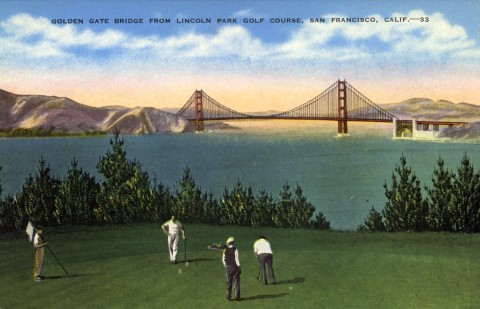
LincolnParkpostcardDan De Vries, Eden Anderson and Richard Harris authored a San Francisco Chronicle op-ed column on the latest at Lincoln Park, where the city and residents are battling over the course's future. I can't imagine why it's in poor shape:

Lincoln Park, the city's oldest and most scenic golf course, is Exhibit "A" for the need to change the public golf course maintenance status quo. Lincoln's fairways are a patchwork of gopher mounds, leaky-sprinkler-fed bogs, and brown patches where the water has been shut off to stop leaks. In June 2007, Lincoln's only fairway mower broke. Instead of repairing or replacing it, the Recreation & Park Department mowed the fairways infrequently all summer with a narrow, slow, trim mower, leaving grass so tall that the fairways became indistinguishable from the roughs. After rain, Lincoln's fairways become waterlogged and inhospitable both to golfers and mowers, due to poor drainage system. The quaint, 1920s clubhouse is dilapidated, its public rooms empty, food service minimal and the bathrooms dank. The pro shop and restaurant have been on a month-to-month lease for more than five years, discouraging the concessionaire from making needed repairs. It is more than coincidence that the number of annual rounds declined from 55,000 in 2002-03 to 35,000 in 2005-06, the last year for which complete figures are available. So far as we are aware, the city has no current cost estimates for the needed infrastructure repairs.
And this was disturbing...
Why is this happening? Between the Recreation and Park Department, the Board of Supervisors, and the Mayor's Office, no clear statement has been made of the city's intentions at Lincoln. But one thing is perfectly clear. Lincoln is extremely valuable property, as it adjoins the exclusive Seacliff neighborhood. When neglected or abused, such property becomes target for developers. And thus civic birthrights are lost. At Lincoln, there is an ironic twist to this old story: a so-called friend of public parks, San Francisco Neighborhood Parks Council, is calling for construction of an "event center" on Lincoln's famous 17th hole. No details have been released, but an "event center" inevitably means building complexes, roads, parking facilities, congestion, noise and traffic. And all of this in the middle of the famous view of the Golden Gate now enjoyed not only by golfers, but also neighbors, strollers, schoolchildren, bikers, motorists, dog-walkers, birders, museum-goers, not to mention visitors from around the world.

A shame the PGA Tour, which is using nearby Harding Park, can't step in and offer the city some assistance. Then again, maybe some of the city don't want any help. The worse it gets, the less it makes and as the columnists note, the more willing people are to accept redevelopment.  

Mickelson Home OK; Entire Family Heads To China On Human Rights Fact Finding Mission

Tim Rosaforte reports the good news and a heartwarming tidbit:

Phil Mickelson's home in Rancho Santa Fe (Calif.) has escaped fire damage, a source told Golf World on Wednesday, but five homes in the same neighborhood, including one across the street, have burned to the ground. Mickelson, whose family evacuated the home Monday, was able to gain access to his property Wednesday, and he's planning to leave Sunday for a two-week trip to Asia, where he's scheduled to play the Singapore Open and HSBC Champions.

Mickelson's family will accompany him; they're planning to turn it into an educational trip with a visit planned to the Great Wall of China, among other historical landmarks.

Oh I smell a children's book in the making. 


Meanwhile Rex Hoggard reports on the fire's impact on others in the golf industry.