Tiger's Match Play Win In Perspective

It's not easy to say anything fresh about Tiger's dominance, but a few columns managed to do it. Thanks to reader Clive for spotting this Iain Carter piece on Tiger's match play win, that includes two this tidbit that John Huggan noted a few weeks ago:

A couple of weeks ago we could say that the gap between Woods at the top of the rankings and Phil Mickelson in second place was greater than the margin between the number two and the guy ranked at 1000 in the world.

We can’t even do that now. Woods’ point average is 11.12 ahead of Mickelson, who has a rating of 10.12. This means ANY golfer registered on the rankings is closer to Mickelson than Lefty is to Tiger.

Finally, a decent use for the world ranking: quantifying Tiger's complete dominance.

And..

Bookmakers are offering a measly 12-1 for the calendar year Grand Slam of all four majors - 12-1 for something that’s never been done before!

Steve Elling offers some other stats:

In a span encompassing mid-1999 into late 2000, Woods won 17 of 30 (56.7 percent) of his official starts worldwide, a span where he also managed three seconds. That tallies to 20 of 30 (66.7 percent) events with either first or second as his final result. He was outside the top 10 four times and won four majors.

 In his current stretch, Woods has won 16 of his last 29 starts (55.2 percent) dating to his win at the 2006 British Open. He also has five runner-up finishes in that span. So, that's first or second in 21 of his last 29 starts (72.4 percent). He finished outside the top 10 four times and won three majors in that span.

Faldo Avenges Tilghman's Attention Draining Remarks With His Own Off Base Comments

Nick and Kelly have a Bill and Hillary thing going. He just can't take all the attention she's getting, so he sticks his foot in his mouth. Touching, except perhaps to the Golf Channel Apologies Department which has already spent years defending Mike Ritz

Lawrence Donegan sums up the comments that came during Sunday's early morning telecast of the WGC Match Play:

During coverage of the WGC World Match Play in Tucson the six-times major winner, who is paid a reported $3m (£1.5m) a year to host coverage of the PGA tour, made unfavourable comparisons between balls made by TaylorMade and the Nike balls used by Tiger Woods, below, and Stewart Cink. Faldo signed a sponsorship deal with TaylorMade last Wednesday.

Steve Elling added this:

Golf Channel play-by-play analyst Kelly Tilghman noted on the air that it was an all-Nike final. That, in itself, sounded like a free plug, since Tilghman last December emceed a Nike outing for Woods in South Florida.

But Faldo, who also works for CBS Sports, went a step farther on the conflict-of-interest front. A few weeks after signing a new endorsement deal with TaylorMade, he launched into a lengthy discourse about the superiority of the TaylorMade golf ball, and noted how only certain players with high skill levels should bother using the Nike ball, lest it fall out of the sky. Faldo once endorsed the Nike line.

Hot off the Apology Dept. presses:

"Nick Faldo is one of the best in the business because of his experience and insight, and viewers enjoy that," the network statement read. "But his opinions do not always reflect those of the Golf Channel. In this particular instance -- although he referenced published research -- using the Golf Channel in this context was not appropriate. Nick realized this and set the record straight with our viewers in a timely manner."

A Nike spokesperson said the company was surprised that Faldo would take such a stance, but otherwise took the high road.

"We were disappointed in Nick Faldo’s comments, especially given the fact that he referenced golf product that was totally unrelated to what was happening during the competition itself," Nike spokesperson Beth Gast said Sunday night.
"These comments were all the more inappropriate having come just days after he signed with TaylorMade-adidas. He has apologized on air and we consider this isolated incident as closed."

Sure, after another week's worth of debate. And that's before Golfweek runs a cover featuring a pair of Taylor Made balls replacing Faldo's testicles.

Couples To Be Next Presidents Cup Captain; As Of Now Plans To Attend Night Functions

couples_310.jpgAccording to Golf Digest's Local Knowledge blog, Fred Couples will be named the next Presidents Cup Captain even though Jaime Diaz suggests in this month's Golf Digest that Freddie really doesn't want to go to some black tie dinner with a bunch of suits.

Can you imagine that? Think of the interesting stories he'd miss out on.

Earlier this year Thomas Bonk outlined some of Freddie's other captaincy concepts. Should be fun to see how many he follows through on.

"The problem is with the Ping lawsuit, everybody is scared."

Craig Dolch looks at the demise of shotmaking and talks to players who offer several different takes, including this from Tom Pernice:

Purists believe that the USGA has dropped the ball, so to speak, and the only way for shotmaking to become the premium it should be is for the PGA Tour to implement its own set of rules in terms of grooves.

"I personally think the tour should step in, but Tim (Finchem, the PGA Tour commissioner) is never going to go that way," tour pro Tom Pernice Jr. said. "Tim is going to do everything to be as non-confrontational as possible as commissioner.

"That's just his personality. Is that good or bad? Who knows? But almost every other sports organization has their own set of rules instead of us. The problem is with the Ping lawsuit, everybody is scared."

Pernice is correct: Finchem, when asked at last month's Buick Invitational at Torrey Pines, made it clear he and the tour are not ready to implement its own set of rules. He says they will continue to monitor the situation, but believes the USGA and the R&A are the ones to make the rules - something he's been stressing for more than five years.

"There seems to be a slippage in recent years in that area," Finchem said of shotmaking. "You could interpret the data different ways. But we have taken the position that the USGA and the R&A should take the lead in that area and we should be in a supportive role."

I can't imagine why Finchem would want to stay out of the rule making business. It only lead to his predecessor's demise.

"Tim's trying to protect our image, but he's putting our image at risk."

The tour media gurus exposed Tim Finchem to some brand building exercises at just the right time: he's got some popularity issues.

Check out the pattern developing over just the last week.

First there was John Hawkins's reference to Finchem's growing unpopularity, then Doug Ferguson's piece on the state of the WGC's and now, depending on how credible you find him, Paul Azinger's criticism in a Michael Bamberger authored item for SI Golf Plus.

After talking about how degrading it is for players to drop their trousers and pee in a cup (because after all, it's such a fun job for the test observer), Azinger says that he's not bothered by Finchem's salary and control of the policy board, but it sure sounds like he is.

Azinger's not feeling the love, or the solidarity. "Tim answers to his board," he says. "We answer to our money list."

Azinger's bold. But not a revolutionary. Not for now. He wants to use his boldness first to secure an American victory in the Ryder Cup, crown jewel of the PGA of America. Along the way, Captain Paul is looking for every possible edge and advantage he can find. Legal ones only, of course.

"A couple of readers said courses should charge extra for playing from the back tees."

Thanks to reader John for John Paul Newport's WSJ follow up column on the joys of not playing too far back.

One of modern golf's fundamental problems, according to Bill Amick, a Florida-based golf-course architect who has thought much about this issue, is that many of its traditions were established in a far less egalitarian era, and the glamour of the sport continues to revolve around elite players. Developers believe, probably with justification, that only "championship" courses in excess of 7,000 yards long will receive enough notoriety, such as rankings on the prestigious top-course lists published by golf magazines, to successfully anchor a new high-end housing community or to be a draw at a big-time resort.

'I can confirm that I have never had a client ask for a shorter course, even when it was abundantly clear it would be more appropriate," emailed David Leininger, who worked for many years in golf-course development.

Owners and operators also got a lot of heat for being so ineffective in directing players to the appropriate tees. But readers had plenty of suggestions, ranging from the eminently practical (posting signs at the first tee suggesting which tees were appropriate for which handicap levels) to the European (putting out only one set of playable men's tees each day, as many courses in Scotland do) to de-genderizing tees by eliminating red markers, the customary color for women's tees.

A couple of readers said courses should charge extra for playing from the back tees. Frank Thomas, the former U.S. Golf Association technical director, says -- in all seriousness -- that courses should give free postround beer to foursomes willing to play from up front. "They might end up selling more beer in the end, and probably [would] be able to squeeze in a few more foursomes per day, because of faster play," he said.


"Best hole in the world"

230136-1357880-thumbnail.jpg
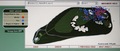
The Cumulative ShotLink Scatter Chart For No. 10 (click to enlarge)
I made a point to spend as much time as possible watching Northern Trust Open play on Riviera's 10th, and while I'm sure most of you have moved on to the match play, I thought I'd share a few observations from the week while I'm away this weekend and posting infrequently. Here goes...

Why Not Lay Up? That's the question I kept asking all week as guys fumbled their way to pars, bogies and the occasional double, even though laying up left will rarely result in worse than par.  Check out the ShotLink scatter chart (above) for the week and the clusters speak for themselves. A new high of 72% went for the green, up 10% from last year and up about 40% from three years ago. Yes, that's fun to watch but it does mean some risk/reward temptation has been eliminated by the lack of distance regulation by the governing bodies. And yet...

The green continues to baffle.  In 2007, just 62% of the plays here resulted in a green hit in regulation, about 20% lower than on most PGA Tour par-4s of comparable distance. The number was 60% in 2008 and the scoring average has remained steady at about 3.8 and change. 

It's the grooves. Even with the green firm and fast, I saw way too many guys lay up down the right and hold the front portion of the green with ease, Jeff Quinney's amazing second shot Saturday being the most prominent example. But I believe the grooves have a greater impact by compelling guys to drive the green (or past it), knowing they can mop up with a flop wedge shot. 230136-1357882-thumbnail.jpg
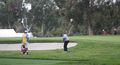
Many players opt to lay up where Steve Flesch did even though it's a harrowing shot...change those grooves! (click to enlarge)

72%. Is it a bad thing that more guys than ever go for No. 10 without contemplating a lay up? Yes and no. I would love to see more guys face an internal debate over the lay-up option instead of the decision being between 3-wood and driver. The hole was drivable in Bobby Jones's day (pre-kikuyu), so it's an important part of the design. Either way, it's such a joy watching the world's best get into so much trouble driving it all over the place and doing absolutely mindless things!

Addicting. Mid-morning Friday I was heading back to the press room when I stopped in to watch a group come through. It turned into five groups and a chance to watch the action with the AP's Doug Ferguson. He made the interesting point that other than 12 at Augusta and maybe 16 at TPC Sawgrass, Riviera's 10th is the only hole where players all seem to watch what the group behind them is doing as they walk off the 11th tee. And as a spectator, it's astonishing what you see with each group. They really need a grandstand here and round-the-clock video coverage on PGATour.com. It's that interesting.

230136-1350780-thumbnail.jpg
Rise to prominence. Ferguson asked me while we were standing there why the 10th had risen to prominence in the last few years. Obviously I would have referred him to my recent Golf World article if we had web access on the spot, but more than that I pointed out that it wasn't very driveable until recent years, except by the bombers. I would also say that the final piece to the puzzle in No. 10's resurrection has been the removal of the coral tree grove that surrounded the green until the late 90s. They have left the green more exposed, only adding to the drama and fear factor.

When I was standing with Ferguson, the pairing that included Joe Ogilvie and Davis Love came through. Ogilvie drove it in the front left bunker, hit it into the back bunker and made par en route to a missed cut. As he was walking off the green, within earshot of us, Ogilvie shook his head and muttered, "best hole in the world."
 

Close Encounter of the Congressional Kind?

Thanks tor reader Ari for the Leonard Shapiro Washington Post story on Congressional agreeing to host the 2009 AT&T National.

Congressional also is the site for the 2011 U.S. Open, and club and USGA officials plan a major restoration of the club's greens to make them suitable for Open play. The project will begin after Woods's tournament in 2009 and is expected to be completed by the spring of 2010.

The club plans to use the proceeds from the 2009 AT&T event to help pay for the restoration, estimated to cost about $2.5 million. The Tiger Woods Foundation also has pledged $500,000 toward the green restoration project.

Isn't that cutting it a bit close to the U.S. Open? Considering the problems they had with the greens last time, I'm amazed the USGA would sign off on such a short window between seeding greens and the tournament.

The Boo Files: "I'm like, 'Pick it up?' Honestly, I didn't know"

Steve Elling on Boo Weekley apparently not understanding that you can give putts in match play. Here's the transcript if you don't believe him, or just take Elling's word for it:

Still country to the core, the pride of the rural Florida Panhandle showed up this week having not played in a match-play event as an amateur 12 years ago, which was somewhat embarrassingly reinforced on the first hole of his opening match on Tuesday.

Germany's Martin Kaymer lagged the ball to within a few inches of the hole, and Weekly didn't concede the putt. Several awkward moments passed.

"It wasn't probably eight or nine inches from the hole, and I'm sitting there and I'm putting my ball down, and he's looking at me and I'm looking at him, like, 'Are you going to tap it in?'" Weekley recalled with a laugh.

Weekley's caddie finally told Kaymer to pick it up.

"I'm like, 'Pick it up?' Honestly, I didn't know," Weekley said. "So that's how that started out."
Mark Lamport-Stokes also included this bit from Boo in his story:
"The man that was walking with us was like: 'I'm going to be walking with you today'. And I was like: 'Good, I can ask you if I have a problem?'

"This match play is different, very different," he said. "I kind of like that stroke play better myself."

John Garrity reports that Monty didn't understand the first tee Boos for Boo. Really!

Helen Ross previews Friday's matches, including Boo's head-to-head with Woody Austin. Now that should be fun! 

“We developed a bias towards action rather than a preference for smoothness"

driver.jpgBradley Klein scores an exclusive "exit interview of sorts" with outgoing USGA President Walter Driver.

His agenda and its implementation, not surprisingly, created a feeling of mistrust, even veiled hostility, among many USGA employees. Driver, too, acknowledges the perceived heavy-handedness on his part and by the Executive Committee but offers no apologies.

“We developed a bias towards action rather than a preference for smoothness,” he says.

I'm sure there are people who understand what that means. I'm not one of them.
Golfweek: During your tenure as USGA president, you oversaw considerable change, including corporate sponsorships with American Express and Lexus. Why the need for so much change?

WD: In the area of structuring what I’ll loosely call the business side of the USGA, what we found was a lack of coordination. In some cases, for example, where we’d like to find a relationship with someone on the Internet side, we found that our broadcast contracts had been negotiated without properly considering the impact of the Internet and were at cross purposes with what we were trying to do. Those things just had not been properly coordinated, there were too many silos functioning and we needed to have coordination among the areas of activity that had been lacking.

I've always believed wholeheartedly that silo coordination was vital.
Golfweek: Your attempt at cost cutting through proposed benefits reductions led to considerable discontent among longtime USGA staffers. What went wrong?

WD: No one at the USGA could remember the last time there was a thorough review of compensation and benefits. It had been at least 18 years, and so we hired two consultants who gave us recommendations about how the overall compensation benefits rewards program was, in their words, “not functioning.” And so we reacted to their expert recommendations and adopted some of their recommendations and not others. But all the Executive Committee did was hire an expert to tell us how to do it.

That's right, it was all their doing!

I didn’t come here with that in mind at all.

We looked at three legs of the compensation stool – benefits, salaries and bonuses.

Uh, I'm sorry to interrupt. But doesn't a stool need four legs? Continue...

Benefits were relatively high, salaries were medium and there was a lack of correlation between performance and rewards. We finished the benefits part first and presented it. It surprised me how it blew up. In retrospect, we should have waited to present the entire package.

Oh I'm sure that would have changed everything!

Golfweek: What stands out among your more than 10 years of volunteer service to the USGA?
 
WD: Hearing about springlike effect in the fall of 1997, and then learning that 6 million of the approved drivers had already been sold. . . .

Standing with Phil Mickelson on the first tee at Bethpage during the 2002 U.S. Open as the crowd sang ‘Happy birthday’ to Phil. . . .

That's a fond memory?

Meeting with Arnold Palmer in Latrobe (Pa.) to discuss his lending his name to the USGA Center for Golf History, and then being invited to stay for lunch, play a round of golf with him, have drinks afterwards, then dinner and staying overnight at his house and then flying him down at lavish expense to give my introductory speech at the annual meeting.

Wait, that last part was me, sorry!

On Sunday morning of the 2004 Open at Shinnecock Hills, getting a call from Mike Davis: ‘I’m at the seventh hole. I think we have a problem. You better get out here.’ Then (Driver) having to call starter Ron Read at the first tee and telling him, ‘We need to stop the U.S. Open.’"

 That's more like it. That is the Walter we want to remember! 

"More Americans Are Giving Up Golf"

Paul Vitello in the New York Times tries to figure out why people are playing less. This from the National Golf Foundation fella intrigued me:

“The man in the street will tell you that golf is booming because he sees Tiger Woods on TV,” Mr. Kass said. “But we track the reality. The reality is, while we haven’t exactly tanked, the numbers have been disappointing for some time.”

Surveys sponsored by the foundation have asked players what keeps them away. “The answer is usually economic,” Mr. Kass said. “No time. Two jobs. Real wages not going up. Pensions going away. Corporate cutbacks in country club memberships — all that doom and gloom stuff.”

And... 
At the meeting here, there was a consensus that changing family dynamics have had a profound effect on the sport.

“Years ago, men thought nothing of spending the whole day playing golf — maybe Saturday and Sunday both,” said Mr. Rocchio, the public relations consultant, who is also the New York regional director of the National Golf Course Owners Association. “Today, he is driving his kids to their soccer games. Maybe he’s playing a round early in the morning. But he has to get back home in time for lunch.”

Mr. Hurney, the real estate developer, chimed in, “Which is why if we don’t repackage our facilities to a more family orientation, we’re dead.”

Oddly, no one mentioned pending groove regulation or a ball rollback as likely dangers lurking around the corner. 

“They could lose $5 million forever and it wouldn’t matter"

usga.jpgAdam Schupak authors the lead piece in Golfweek's USGA package. Several items stand out in his look at the USGA's new business model.

It signed its first two partners – American Express and Lexus – and expects to finalize two more deals shortly. But the USGA is proceeding cautiously to ensure its commercial ventures don’t undermine the integrity of its tournaments and mission.

Industry observers describe the changes under way as part of an inevitable evolution. Sports and sponsorship, they say, go together like red meat and red wine.

“If the pope hires IMG to be his marketing guy, the USGA can certainly get in the modern era,” says Mark Mulvoy, former managing editor of Sports Illustrated and a member of the USGA’s Communications Committee from 2000 to 2006. “It’s late coming to the table. Now it’s a question of what do you have first, the shrimp or the salad?”

Shrimp or salad? Ask the Pope! Because you know, he's always right.

For many years, the USGA’s goal was to grow reserves equivalent to one year’s operating expenses in the event of some unforeseen occurrence, what Fay termed the proverbial “rainy day.’’ The USGA has far exceeded that numerical target.  

“They could lose $5 million forever and it wouldn’t matter,” says Frank Hannigan, a USGA staff member from 1961 to 1989 and executive director the final eight years of his tenure.

While that may be true, the USGA develops its multiyear budget under the premise it will not count on its reserves to cover operating losses. Says Fay: “Use of the ‘endowment’ will only be used for material special projects.”

Hmmm..define special projects...

Fay contends it would be “borderline reckless” for the USGA not to consider other revenue sources that fit within “what we think the USGA is.” So in 2006, the Executive Committee hired McKinsey & Co., a management consulting firm, to look at the USGA’s business model. How much of its blueprint the USGA is following is unclear.

“Sometimes the best thing they do is confirm what you were thinking of doing all along,” Fay says.

So, we have Walter Driver saying that the consultants are the ones to blame for the staff benefit cuts that have ripped the hearts out of the staff, and we have David Fay saying it's good to have someone confirm what you were thinking of doing all along. Hmmm...who to believe?

Thirty years later, the theme of the USGA’s commercialization has surfaced again. It is considered the principal reason why Campbell has withdrawn from what was such a big part of his life.

“Imagine driving Bill Campbell away,” Hannigan says. “That says it all.”

Campbell politely declines to speak of his case of déjà vu, except to say that the beauty of the USGA’s structure is that every two years the leadership of the Executive Committee changes. “You just have to wait long enough,” he says.

There's a ringing endorsement for Walter.

But by then it may be too late.

“We’re beyond the crossroad,” Bevacqua, the chief business officer, says. “Crossroads necessarily means there is some wavering and decisions to be made in which direction you want to head in, and we’ve made it. And we’re all going down the same road.

“My goal is that people will look back five to 10 years at this time and say, ‘That was really a time of transformation. They became modern without losing their identity. They did it in a tasteful way. They never lost their core mission, yet they became a 21st-century organization that is healthy and set up to survive well into the future.’"

You won't survive if you don't stick up for the game, fellas. 

"I still get a kick out of somebody wanting this old man to come and develop a golf course"

225996-1.jpgGreg Hansen reports on Jack Nicklaus's site visit to, gulp, The Ritz Carlton Golf Club's Tortolita Course, host of next year's WGC Match Play.

For the last act in his wonderful life, Nicklaus has become the Tiger Woods of golf course design. He retains such clout that when an entourage of six SUVs drove down a dirt road Tuesday afternoon, kicking up dust near the 17th green of the Ritz-Carlton's Tortolita Course, PGA Tour commissioner Tim Finchem was in the group awaiting Nicklaus' arrival.
Why does the image of that scene make me laugh? And Jack probably enjoyed it too.
"I still get a kick out of somebody wanting this old man to come and develop a golf course,'' Nicklaus said in his typical self-effacing style. "It's a legacy from my standpoint, something that will be here long after my life and my golf game.''

It's ironic that the man who played in just one Tucson Open (1963) in his superb career is involved in preserving Southern Arizona's place on the PGA Tour.

Ironic, absurd, take your pick.