"I'm on drugs"

In the latest Men's Vogue, John Cassidy writes about playing a round of golf at Bethpage on the drug propranolol, a soon-to-be-banned beta blocker.

Were the beta blockers responsible for my improved shot selection and my dramatic mid-round recovery? Was it a placebo effect? Dumb luck? I have no idea. But the next time my regular four-ball partners start kicking my tail in our weekly three-dollar Nassau, I'm going to try and get hold of some more propranolol. Sure, it might be medically irresponsible and morally questionable, but the ban on beta blockers applies only to the PGA Tour, and I need all the help I can get.


"At Augusta, you do not fully appreciate many of the nuances until you have made a double or triple bogey by hitting it in the wrong spot."

asset_upload_file388_4745.jpgThe latest Links Magazine features Masters-related columns penned by Ernie Els and Geoff Ogilvy.

Ogilvy compares the Masters and U.S. Open and sums them up this way:

Overall, if I could only play either the Masters or the U.S. Open this year, I’d be lying if I did not say the Masters. With the exception of the changes to the 11th and 17th holes, where the club has planted too many trees, it’s easily the most enjoyable, exciting and fulfilling tournament we play all year.
Meanwhile Els seems to have had an epiphany and now likes the changes to Augusta National:
I really like the changes to the course over the past several years. But then again, being one of the longer hitters, I guess in theory it’s supposed to play into my hands. I remember talking to Tiger a couple of years back and we agreed that there’s a real chance the long hitters could separate themselves from the field if they get their games together.

One thing that has intrigued me is how some purists have a kind of “don’t touch” attitude to Augusta and many of the other great courses. These updates are not an unsightly stain on a masterpiece, but rather a successful restoration that brings back some of the original shot values that the designers intended for players. I support that philosophy.

Ernie used to be one of those purists who liked Augusta without the second cut:
Ernie Els wishes they would do away with the rough completely.

``It's hard to criticize Augusta National,'' Els said. ``It's one of my favorite places, and it still is. But I really enjoyed it the way it used to be.'


Second Guessing

gwar01_0800404augusta9and1.jpgMy Golf World story on the second cut's 10th anniversary is now posted.

I couldn't use this Geoff Ogilvy quote with the story because it didn't fit in with the theme of whether the second cut has made Augusta more difficult or easier:

Augusta's setup is the model setup for every course on the tour except for Augusta. Flyer rough and slightly wider fairways would be perfect.

"Finchem believes it adds to the telecast and thus the boom won't be banned."

gwar01_080402insider.jpgTim Rosaforte interviews his boss at NBC to follow up on the Bubba-Elk incident and find out if the Tour is going to ask the networks to back off. Mercifully, they are not. (Oh, and don't you love the photo of Bubba and Elk chatting it up after the round. No eye contact, stiff body language...)

Anyway, Rosaforte writes: 

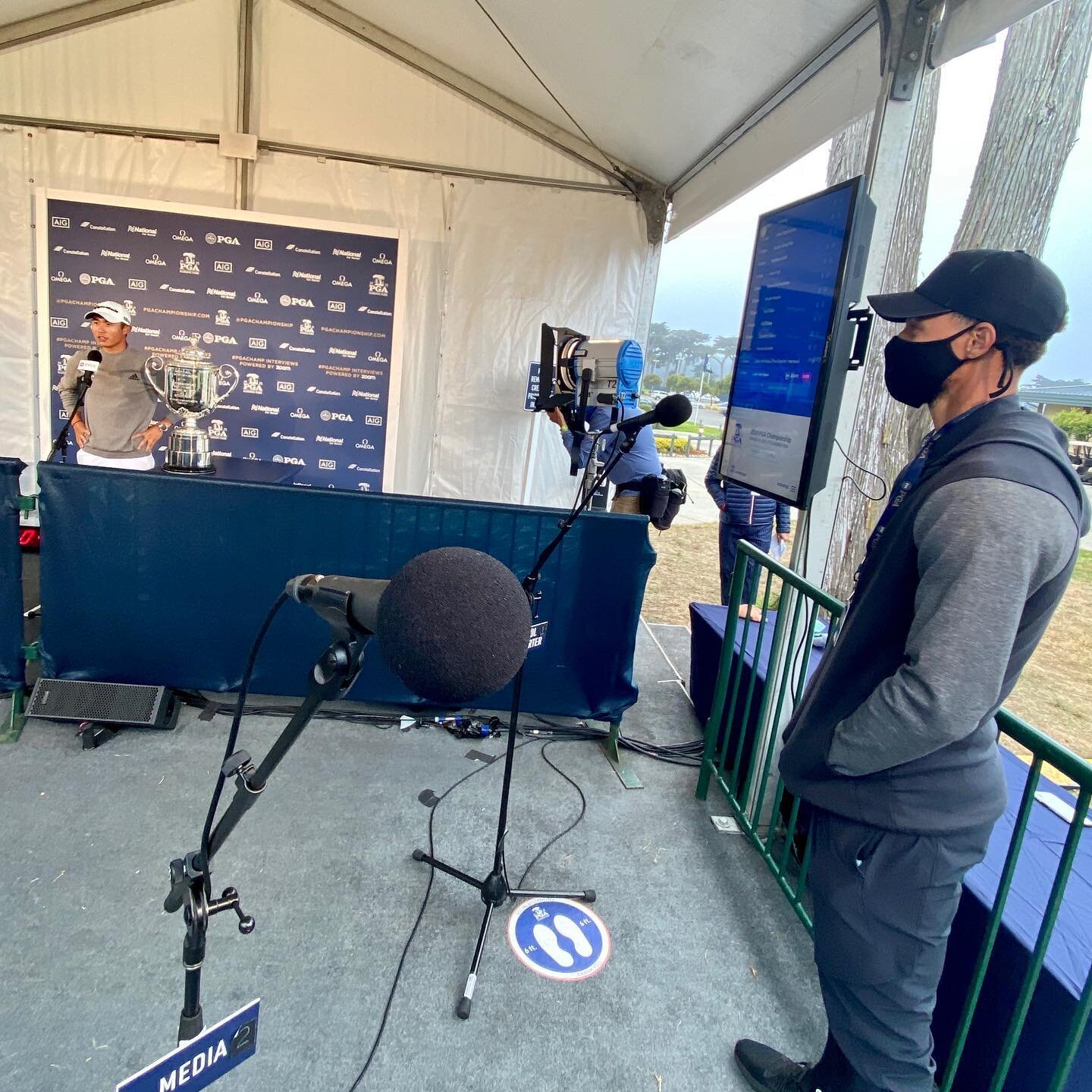
I've heard that one high level player and caddie don't like the boom mike listening in on their decisions. I also remember controversies that erupted years ago when a seven-second delay wasn't enough time to censor Fred Couples at La Costa and Curtis Strange at the TPC Sawgrass. Thankfully, the use of sound is an element that comes down from the top; Finchem believes it adds to the telecast and thus the boom won't be banned.


Go Home: Finchem Likely To Lose KB Board Seat

Thanks to reader Michael for noticing this wire item on a shareholder recommendation not to renew Tim Finchem's tenure on the KB Home board.

Proxy Governance Inc. recommended KB Home (NYSE:KBH) shareholders withhold votes for board candidates Timothy W. Finchem and J. Terrence Lanni because they approved an excessive pay package for Jeffrey T. Mezger when he became chief executive.

The shareholder adviser said Finchem and Lanni serve on a compensation committee that approved a compensation package for Mezger that was too high.

When the homebuilder's former CEO was deposed because of the options backdating scandal, Mezger was granted $7.8 million worth of options and $2 million in restricted stock.

Hey they only lost $1.41 billion last year, what's another $9 million?


All Eyes On Ochoa

LorenaOchoabig.jpgNice to see what looks like a solid media turnout for the LPGA's first major of the year. Naturally, they focus on Lorena Ochoa's bid to win her 8th tournament in her last 12 starts. Lawrence Donegan provides the UK take while Thomas Bonk (here) and Leonard Shapiro (here) offer the American perspective.

Only Doug Ferguson dared to focus on someone else, considering the pressure Paula Creamer is under to win even though she's still only 21. 

Brand Lady Sacks Drug Testing Firm; Execs "Role Play" For Scribblers

I never like to encourage Carolyn Bivens' passion for firing people, but it sounds like this move was more than justified after the fiasco earlier this year.

Sean Martin reports on the change.

Now, would someone who was in the press tent please explain this fiasco.

Here I am checking out transcripts on ASAP thinking it's going to be a boring night of blogging when I see that the LPGA general counsel Jill Pilgrim and new testing outfit VP Chris Guinty role-played how the LPGA drug testing program will work with players (let's hope they didn't pee in cups in front of the scribes).  

I wish I could write stuff like this:

(Role playing. Jill playing LPGA Volunteer Escort, Donna playing LPGA Player, Chris Guinty playing self/Drug-Free Sport Lab Representative).

PLAYER ESCORT: Excuse me, Donna? Hi, I'm Jill Pilgrim. I'm a volunteer that's working here with the tournament and the LPGA, and I have been asked to notify you that you have been selected for drug testing.

And I have this form here that explains the process, and there's a notification form, and what I'd like you to do is look at this form and read this paragraph here that explains the different things that you need to do in the next hour to comply with the drug testing program, and then what's going to happen is that I'm going to stay with you and escort you to the drug testing station when you're ready to go tested.

LPGA PLAYER: Okay, do I have to do this right now or can I do it a little bit later?

PLAYER ESCORT: It says right now you have to 60 minutes from now, and we're going to record the time on the sheet in a moment.

So if you want to go off and do something else, you're welcome to but you have to stay within the tournament site, and just understand I'll be with you wherever you go and I'll be your chaperone until we go to the drug testing station. So if you want to go putt, or is there something you want to go do, do you have to go do media or something?

LPGA PLAYER: Actually do I need to go run over to media for a minute, and after that I would like to hit a couple of putts if I have time.

Okay that's enough bandwidth wasted on that.

Ty, will Ed Moorhouse or Charlie Zink be role playing the PGA Tour's testing approach at The Players?

"What Hootie Got Right"

maar01_hootie.jpgThere are many points worth looking at in Ron Whitten's biennial reversal of his previous take on Augusta National's changes (we still love ya Ron!), so let's start with something that illustrates the club's approach to recent course changes.

Whitten writes:

To us, Hootie seemed haughty. Asked if players or architects were consulted before any course changes were implemented, he answered, "No, no players were consulted. Only Tom Fazio. We didn't consult him; we worked with him."

Then, later on in the story:

Fazio, consulting architect to Augusta National in recent decades, usually declines to speak on the record about any changes to the course. But last year, when told of Jones' article -- and about the specific language regarding approach angles -- Fazio couldn't resist."Why would we redesign a course for a game that nobody plays anymore?" he said. "Nobody hits fades or draws to certain spots in a fairway. They bomb it. They hit it very long, they hit it very straight."

Now, we could focus on the fact that Fazio and Hootie resist consulting the players, yet seem to know that they no longer play a certain game. Some might call it arrogance, from my perspective it's simple incompetence. If you see my story in Golf World this week, it includes many player comments that shed some different light on this.

But this is what I found most interesting:

Hootie Johnson, no doubt in deference to Payne, declined to comment, and in response to questions for Payne, the club replied, "The changes made to the golf course, including the addition and subtraction of trees and the defined second cut have not eliminated preferable angles for the players. The state of golf today must be taken into consideration. Historically, bump-and-run shots, balls hit with low trajectory and Bermuda greens made playing the angles more prevalent. Today, the game is different. Ball flight, how it spins, its trajectory and grooves on clubs have changed how people play this golf course. Players don't play the angles anymore to the same degree that was done in Jones' day. It's also important to remember that this course has always had some rough and that trees have been planted for a very long time." 

So let's say they are right. The players no longer attack the course strategically. They no longer play the angles.

So you take them away?

Now I could understand reducing fairway corridors if the club was trying to cut costs and reduce maintenance. But we know that's not the case.

I'm struggling to understand why you would take away options that believe players don't use. What's wrong with leaving them just in case say, temperatures drop and the course firms up and the options do become relevant again? I know, a stretch.

Furthermore, how do you know that they don't use those options if you do not play like them, or if you are not actually speaking to them about how they play the course? 

"Ochoa should have won this major by now."

On the eve of the first women's major of the year, Doug Ferguson compares the remarkably similar starts to 2008 shared by Lorena Ochoa and Tiger Woods, but he also considers Ochoa's struggles at Mission Hills.

Two years ago, she tied an LPGA major record with a 10-under 62 in the opening round and still had a three-shot lead going into Sunday until a meltdown on the back nine. Ochoa recovered with an eagle on the final hole to get into a playoff against Karrie Webb, who won on the first extra hole.

Ochoa was tied for the lead going into the weekend last year and looked poised as ever until she missed the par-3 17th green, whiffed on a wedge, took three putts once she got on the green and took quadruple bogey that effectively knocked her out of the tournament.

Moments like that are what makes winning even harder.

The Kraft Nabisco is the only LPGA major that has been played on the same course every year, which makes it similar to the Masters in that respect - and only that respect. Augusta National does not have a Wienermobile next to the practice green.

Geoff Ogilvy spoke recently about why the Masters has such a long list of players who never won a green jacket, and he mentioned the familiarity of the course breeding so much contempt.

"There are demons that don't go away," Ogilvy said. "If you have a few close calls at the U.S. Open, you're always doing it somewhere else. If you have demons at Augusta, which everybody does, guys always remember."

Great as she is, Ochoa's biggest challenge will be to bury those memories.

"I already erased them," she insisted. "I only feel good things about this course, and good vibes and good memories. Of course, you're going to make mistakes and have a few bad holes, like what happened on 17 last year. I struggled on holes 13, 14 and 15. They were holes that I played over par, and I'm going to work on those this year and make sure I play that stretch in a positive way.

"And I think that will really help get a good result on Sunday."

"He has zero interest in building the world's largest waterfall."

Alan Shipnuck profiles Adam Scott's efforts to improve his short game and ready himself for a Masters run, and includes this anecdote about his forays into golf course design.

"When he takes on a project, he dives in," says Adam's father, Phil, a prominent course designer in Australia. "He has been candid that last year he felt a bit distracted by all the decisions he had to make off the course." Last year the Scotts collaborated on Crooked River Golf Club, which will be the first Adam Scott signature design when it opens in 2010. Located in Kimana, 90 miles south of Sydney, the enticing site features rolling heathland, winding creeks and old-growth forests. After walking the land on a half-dozen occasions, Adam has come up with an old-school design featuring narrow fairways and small greens framed by challenging runoff areas. "His tastes are from a different era," says Phil. "He has zero interest in building the world's largest waterfall."

Well the waterfall part is good, but we definitely need to have someone explain to Adam that old-school is not narrow fairways and small greens! 

"He does, though, feel he makes an important contribution around the world in promoting golf."

Norman Dabell quotes Monty's agent, who tries to soften the blow of Monday's remarks about Augusta National's exemption policy.

"Colin completely understands Augusta's right to promote themselves," his manager Guy Kinnings told Reuters. "The last thing he would want to do is show disrespect or tell them who they should or should not invite."

Well I don't know if that's the last thing he would want, but...

"He's done everything he can to be there, including changing his schedule, and he's just very disappointed because he values the tournament so highly. He does, though, feel he makes an important contribution around the world in promoting golf."

Ah yes, we know how highly he thinks of himself, but thanks for the reminder. 

"It is a strange way to make up a field for a Major championship – television rights."

TH1_13montb.jpgMount Monty blows! The old bird couldn't even wait until the end of the week.

James Corrigan has the tantrum:

The Scot will miss Augusta for only the second time in 17 years after slipping down to No 75 in the world rankings when he needed to be in the top 50 before yesterday's qualification cut-off point. But while lower ranked players from China, Thailand and India have received special invitations to play the first major of the season, the 44-year-old said he will be at home "washing his car". And he revealed that that is because the Asian countries have huge television markets.
See, it's not an April Fool's Day joke. The giveaway: Monty can't wait to wash his car. Brilliant he says.


Oh here's the part that will ensure he's never invited to the Masters: 

"There has been no call from Augusta and I am not expecting one," he said in Munich at a promotional event for June's BMW International Open. "Now, if I were the only person in the country, à la China, I might get in. It is a strange way to make up a field for a Major championship – television rights. They are quite open about why. They were when I missed out last time in 2005 when they picked Shingo Katayama who was 67th in the world and I was 51st. They picked him over me for the Japanese rights. And they have done the same with Thailand and China this time.

"I am not the only one who feels that way and not just because I am not in. In or not I'd be saying the same thing. It is a strange criterion to pick a major field.

"The Masters is the only one you can get invited to. At the Open, the US Open and the USPGA you have to qualify. But the Masters have their own rules so we will leave them to it. It would be easier to swallow if no one was invited and it was done on sporting and not commercial criteria."

And in lieu of a April Fool's Day prank, I give you Mike Aitken's exclusive one-on-one with Monty about the state of his personal life, published in January. It just feels like an April Fool's prank when he writes that Monty was one of Great Britain's most eligible bachelors and that he said his fingers were cut up from moving boxes. But wait, there's the line about the car washing.

Ah just hit the link, sit back and giggle.

"We should have caught that for prime time and didn't."

Steve Elling, the Hogan, Snead, Nicklaus and Woods of press room cussing, a true master of the medium, says these fancy new microphones picking up saucy language may turn out to be a very, very...bad thing?

But still, there's no reason the masses in the audience must be involuntarily subjected to Watson's screed, right? Some citizens, not to mention the FCC, take a dim view of this sort of speech.

Someone has lived in Orlando way too long. This is interesting:

Oddly, the Golf Channel rightly saw fit to bleep out the objectionable language in its post-game news show, where the disagreement between Watson and Elkington was examined in detail, but let the objectionable language fly live and nationwide in the raw replay. That's irresponsible or lazy, if not a bit of both. According to Golf Channel spokesman Dan Higgins, there is no fabled seven-second delay on the broadcasts and the re-airing of the comments without editing was a mistake the network acknowledges.

"That's something we have to improve upon," Higgins said Monday. "We should have caught that for prime time and didn't."

I seem to recall the "crawl" during the rebroadcast was offering up a teaser about the incident. Hmmm...

If you didn't catch Bubba apologizing to God, country and every volunteer who has ever been subjected to an entertaining on course spat between millionaires, here it is on PGATour.com.