"The lack of any traffic, really?"

Over on the Golfweek Masters blog, Scott Hamilton wonders...

What’s the deal with the lack of foot traffic along Washington Road today? The lack of any traffic, really?

Sure the street that passes directly in front of Augusta National Golf Club still has more cars on it than a three-brand auto mall along a South Carolina interstate. And, yes, those cars are creeping along at a glacial pace.

But it’s Friday at the Masters and the vibe feels anything but Masterslike. There’s little buzz along the sidewalks – which are far from packed – and the various vendors set up along Washington Road don’t appear to be getting much business. That includes the stand selling various golf photos and – for whatever reason – a picture of Mickey Mantle (and it was set up in the center of a display, no less).

The guy getting the most business was the man preaching to anybody within earshot. But that’s because he was smart enough to set up near a pair of crosswalks in order to secure a captive audience.

It may be quiet now, but Tiger Woods isn’t on the course yet. Gotta think business is about to pick up.

Those of us viewing at home are even more startled by how the property begins to empty out around 5 p.m. 

Makes you wonder if they could offer a new badge that allows patrons willing to stay late on Thursday and Friday to enter the gates after 2 p.m.? If nothing else, to fill some of those empty seats.

"To be coming into these greens with woods, it is not designed that way is it? "

Ben Crenshaw had a 3 wood into 18 and after hitting his approach into the left bunker, Nick Faldo snickered sympathetically and said, "it's a bit cheeky to be calling Ben an old timer, but to be coming into these greens with woods, it is not designed that way is it?"

Jim Nantz wanted no part of that and started reminding us about Carl Jackson and Ben's embrace in 1995! 

"Before, there was always a little cherry dangling."

Sandy Lyle talked to Mike Aitken after his openign round and Lyle offered this on the course after his opening 72:

"They've taken away a lot of choices," he volunteers. "Before, there was always a little cherry dangling. For instance, on the first hole it was 265 yards over the bunker, so you looked at the wind, at the pin position, and decided whether to go for it. If it came off you got your reward. Now it's 320 yards to carry that bunker, and it's scary. So I think they've spoilt the course a little bit and, although it doesn't necessarily play into the hands of the long hitters – no one would describe Zach Johnson, last year's winner, as long – it means fewer guys can be competitive out here."

And the search continues for someone praising the direction the golf course has gone in. 

Butler Cabin Fireplace Watch

Last year I live blogged round 1 and noted that the Butler Cabin fireplace looked like it had been doubling as the town crematorium.

Each day it's blackened stone supports progressively improved and we noted it here and here. I considered the club's urgent response a landmark moment, but probably a rough week for someone in Augusta National housekeeping.

This year it looks just as blackened, so this time I took a photo. Let's see if they break out the cleaning crews by Sunday.

 2008Masters1Fireplace.jpg


"It would suck to have to come out at 8 and we've got a 10:45."

At the 6 p.m reset with music and Jim Nantz waxing on about day one, the crane shot captures Phil Mickelson crossing the bridge, setting up Nantz to ask us to consider all of the greats who have crossed the Hogan Bridge. The music was turned down and as Phil's crossing, he's deep in conversation with Bones and says: "It would suck to have to come out at 8 and we've got a 10:45."

So I think it's safe to say Phil wants to finish the round today. 

"You don't really shoot low rounds here anymore."

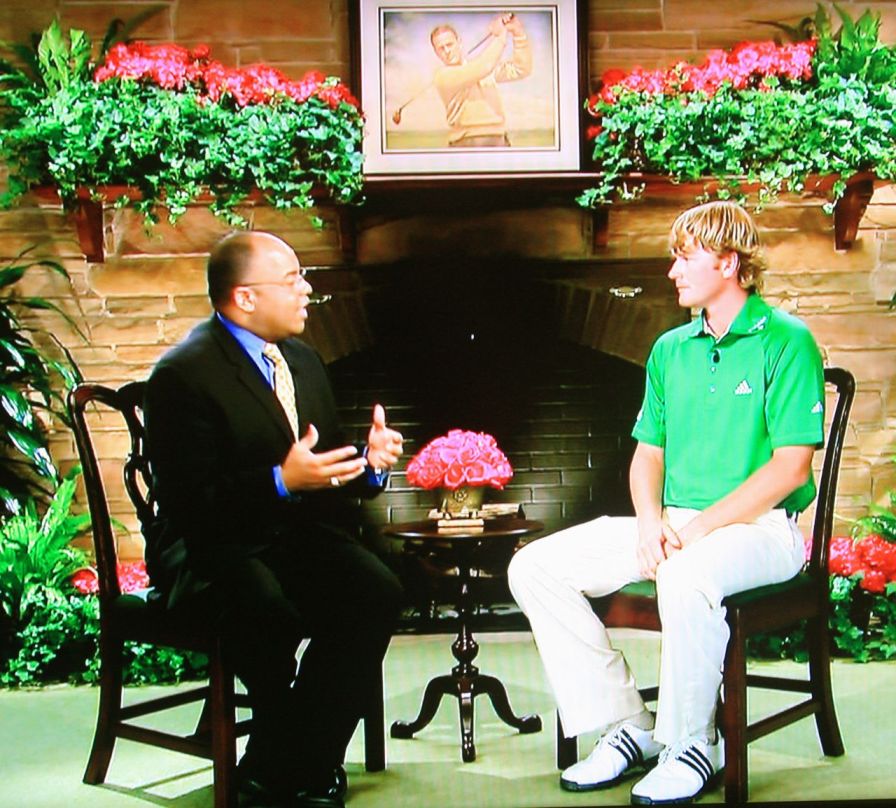
Mike Tirico left his post at Butler Cabin to talk to Tiger Woods after his even par 72. (Zach Johnson and Justin Rose came into Butler.)

A few of Tiger's notable comments:

"You don't really shoot low rounds here anymore. You've just got to plod along."

And...

"It's playing more like a U.S. Open than a Masters."

He also noted he only heard one roar. Other than that he loves the changes!

No. 11 and Bobby

11.jpgAmen Corner live is much improved and amazing production feat. The images, the quality of the media player and the...well, there is the announcing.

Bobby Clampett manned the booth for the first four hours. Now, I can deal with the Hogan's Bridge references. I can deal mentions of Brett Wetterich's great impact dynamics. And I certainly get a big chuckle out of Bobby's bottom obsession ("swing bottom" "forward swing bottom" and shots "almost bottomed out").

I can even deal with Bobby thinking that Zach Johnson has taken the lead right before his eyes, followed by a two shot lead when a quick glance at the leaderboard says otherwise.

Oh, and I can even handle the blatant sucking up to the "committee" when discussing the changes to No. 11.

What I can't deal with is his ignorance and direspect for the strategic design school that made Augusta National special.

Clampett complimented the ridiculous planting of trees down the right side of No. 11 because the ideal angle of approach (in his view) is from the left side. This corporate mentality of closing out the account because no one is buying the product seems fitting these days, but completely ignorant of what subtle, democratic and strategic design is about.

In the old configuration you were free to choose your angle of attack, Neither angle was easy.

Now let's say Bobby is correct and the left side is the preferred angle. Why would you want to close off the less idea angle if someone wants to take it?

Shouldn't their stupidity be encouraged and the intelligent play rewarded?

Isn't that more interesting than taking away liberties and telling players where to play?

Not in Bobby Clampett's mind. 


"Why bother trying?"

I normally don't pay attention when non-golf folks dare to write about golf, but in the case of Tiger and his peers seemingly being afraid of the man, I think Bill Plaschke's outsider take is worth noting. I'm not quite sold on this data though:

At least one study has shown that other golfers' fear of Woods is not only palpable, but measurable.

According to eight years of data collected by Jennifer Brown, a doctorate candidate in agricultural and resource economics at California, tour regulars average nearly a stroke higher in tournaments that include Woods.

Brown formulated her theory in a paper titled "Quitters Never Win: The (Adverse) Incentive Effect of Competing With Superstars."

She discovered a .80 stroke differential when golfers are confronted by Woods, a number that rises during periods when Woods is hot, and decreases during those rare times when he is perceived to be in a slump.

"This shows that if you are competing against an opponent you believe will win, you think, 'Why bother trying?' " said Brown, whose study has been embraced by several national media outlets.
 

"Other than tweaks maybe for Patron flow, drainage, otherwise, you could expect to see it for a long time in the future."

Billy Payne's second ever sitdown with the slingers...

How's this for a revelation?

Immediately after this press conference, we are encouraging all golf fans to go to Masters.org, CBSSports.com, ESPN.com, BBC.co.uk, and in Japan TBS.co.jp, and between now and June 1 register and tell us how they believe golf could be improved and promoted around the world.

Registration forms will be available immediately after this press conference on our Web site with promotional instructions in English, Spanish, French, Chinese, Japanese and Korean. We want to know, how can we capture the interest of children in this great game; can golf be made easier; why did it take so long to play; what is the best way to get kids involved at an early age.

We look forward to what we believe will be tens of thousands of responses that we receive and honestly expect to report to you at a later date that we have uncovered some really great concepts and ideas which can be incorporated into our own initiatives and efforts.

Send your pleas for Tom Fazio's ouster as consulting architect here. Imagine the USGA doing such a thing? Soliciting suggestions! Perish the thought. I do feel bad for the poor lad who has to read all of the stuff.

Q. Chris Berman is not going to be here; was that something that you guys --

CHAIRMAN BILLY PAYNE: I have never had a discussion about that. We don't tell our broadcast partners who their on-air talent can be.

Notice how the scribe couldn't even finish the question before Billy answered. Hmmm...

Okay here comes your annual question about letting a Woman-American join. Have to say the scribes are getting more clever.

Q. You talked about allowing boys and girls 8 to 16 to come in.

CHAIRMAN BILLY PAYNE: Yes, sir.

Q. Half of that equation, the boy half when they ask the person who brought them in, "But Daddy, sometimes I would like to join the club," and the girl part of the equation can't join the club. Do you see that changing?

CHAIRMAN BILLY PAYNE: I would tell you what I've told you in the past, that I don't talk about membership issues; that that's reserved for the private deliberations of the Members, and other than that, I'm not going to talk about it.

And now a word about the rough.

CHAIRMAN BILLY PAYNE: You know, we have always had different length grass here all the way from the very beginning.

Yada yada...we know...

I listened very carefully to the player interviews the last several days and looked back at last year's, and they are split almost right down the middle about their opinion about the second cut.

Now Billy, don't make me go tabulating comments. It's 50% hate it and 50% saying it doesn't impact play. No one's in love with it. Oh, except you...kinda.

But I think, first of all, we like it. We think that it does put a premium on driving accuracy. However, we do believe that when you're in the second cut, it's more difficult to reach some of the pins because it does impact the ability to spin the ball.

The opinion I've just expressed, if you ask a hundred people, 50 would take the other side, but we like our side, and that's what we're going to do. We like it. Other than tweaks maybe for Patron flow, drainage, otherwise, you could expect to see it for a long time in the future.

Because there are some mistakes we just won't admit. Though acknowledging that it's debated and that half of the people you ask don't like it is a big admission. Especially since the 50% includes just about every living former champion.

A pace of play question picked up by Fred Ridley. Check out the target time...

FRED RIDLEY: That's right. Obviously for the enjoyment of the game for the players and the Patrons is to move the field along. We look at that every year. As a matter of fact we have actually tightened up the pace of play this year. Our target time is four hours and 45 minutes, which is a seven-minute reduction from last year.

Now, whether or not we can achieve that is another story, but we think by encouraging the players and letting them know that this is the expected time, because that is one of the elements of whether or not a group is out of position, we think that we might speed up the play marginally, which I think would be good.
 And...
Q. Going back to slow play, because of the size of the field and the independence of the organization, you're probably in a better position than anybody to do something about it. Is there a possibility in the future you might start penalizing players shots in a meaningful manner that will change their behavior?

FRED RIDLEY: Well, we have a pace of play policy that we think is appropriate. And it provides some very detailed parameters for how quickly a pace we expect the players to play, and we think our officials, who are the best officials from around the world, understand that policy, and they will enforce it when it's appropriate.
So we are comfortable that we have a good pace of play policy. This is a golf course that just takes some time to play, but we are monitoring it very closely.

All in all, a very nice job by the assembled scribbs to get some answers. Of course, I'm always a sucker for slow play talk.

"Seven is just terrible."

It's not unusual to read strong critcism of the course changes at this point, which in itself is fascinating since no one would have dared rip the place 10 years ago. And while Billy Payne brushes it off and says it's 50-50 on the subject of the second cut, he has to be taking notice of the almost relentless wave of criticism. Because we know players aren't saying this stuff at this point just to be controversial.

Anyway, Rex Hoggard talks to several players about the overall impact of the changes and manages to get some pretty blunt stuff about several things, particularly No. 7.

“Seven is terrible. I played with Raymond Floyd in the Par 3 (Contest) last year and he just ripped it,” Arron Oberholser said. “Every guy that’s ever won there I ask them and to a man they say it’s terrible. Seven is just terrible.

“It’s supposed to be a short par -4 where if you get up there and want to hit 2-iron you can hit 2-iron and lay back,” Oberholser said. “But if you got the courage you can stand up there and hit a driver and a little flip wedge into that green which is very severe.”

Even Crenshaw, as gentle as ever, struggles to understand the change to No. 7.

“It’s too long,” he said. “Seven is one of the greatest greens I’ve ever seen, but it just doesn’t have to be that long.”