
Annika "Stepping Away" Stories

gwar01_080516sorenstam.jpgGolfweek's Evan Rothman paints a picture for us of the press conference scene while his colleague Beth Ann Baldry talks to Suzann Pettersen about her disappointment in hearing the news. Meanwhile Brian Hewitt offers a few predictions about how this may play out.

Steve Elling catches up with Kathy Whitworth about Annika's decision to go out while she's at the top. Golf For Women's Dave Allen gets Lorena's "surprise" reaction to the news and also explains how the timing of the announcement came about.

Golf.com (here) and GolfDigest.com (here) offer career retrospectives while Ron Sirak learned of the news Sunday and therefore had a little more time to file this career obit.

Sorenstam's mastery of emotional balance was so complete she gave no hint of inner turmoil. In 2004 she won eight LPGA events and twice more overseas as her marriage to David Esch was crumbling. Divorce papers were filed the following February. She similarly kept her father Tom's prostate cancer battle the last few years private, never using that distraction as an excuse.

And, of course, there was the transformation she made in dealing with the attention that came with being so dominant. As a rookie Sorenstam was so shy she took a month off after winning her first U.S. Open because she wanted to avoid the media. In 2003, the year she played in the PGA Tour's Bank of America Colonial, she handled the nearly four-month buildup to her appearance with aplomb.

Dan Jenkins, the Golf Digest writer who has witnessed virtually every significant event in golf for nearly 60 years, has said Annika's opening tee shot at Colonial -- a 257-yard 4-wood off the 10th tee -- might have had more pressure on it than any single shot in the game's history. It was perhaps the most important shot in the history of women's golf and her superb execution in an opening-round 71, combined with the classy way she handled the attention, earned women's golf new fans and enhanced respect.

"Colonial was my mission," Sorenstam said Sunday as she looked back over her career. "It was my path, my journey and I felt like people accepted that, 'Hey she's an athlete, and she wants to get better.' I've always let my clubs do the talking. And I felt like people accepted me for that."

"Makes you wonder how he got a job working there, huh?"

Steve Elling talks to the USGA's Mike Davis about finishing the U.S. Open on a reachable par-5 and the answer might surprise you.

"From a personal standpoint, nothing would please me more than to see giant swings in scoring on this hole," Davis told CBSSports.com. "A player eagling the 72nd hole to win would be a dream come true."

Somebody pinch me.

A day after Ogilvy had admitted he'd won the Open in ugly, cat-burglar fashion he'd not care to see repeated, Davis' surprising sentiments were relayed. A wry smile creased the Aussie's face as he though of Davis, an affable guy in his third year setting up the Open venue. Davis' tenure has been marked by innovation and an approach that players have broadly characterized as more conservative than his Draconian predecessors.

"Makes you wonder how he got a job working there, huh?" Ogilvy cracked.

Following U.S. Open media day, John Strege posts this item about the 7,643 yard golf course.
But Mike Davis, the senior director of rules and competition for the USGA, said that number is deceiving. "I feel very confident saying we will not play that length one day of the championship," he said.

Davis said the USGA will utilize the variety of tee boxes available to them, resulting in a course that will play "somewhere in the neighborhood of 74 [7,400 yards] and change up to 75 [7,500 yards] and change." That's a big neighborhood, notwithstanding the USGA's benevolence in backing it down somewhat.

"I think playing golf during a war just sends the wrong signal."

Reader Tim clearly wants to get me in trouble. From an unbylined AP story:

President Bush said Tuesday he was disappointed in "flawed intelligence" before the Iraq war and was concerned that if a Democrat wins the presidency in November and withdrew troops prematurely it could "eventually lead to another attack on the United States."
Don't worry, we'll get to the golf part. I just wanted to share that precious snowflake. 
In an interview with Politico magazine and Yahoo News, Bush also said he gave up golf in 2003 out of respect for U.S. soldiers killed in the war, which has now lasted more than five years.

"I didn't want some mom whose son may have recently died to see the commander in chief playing golf," he said. "I feel I owe it to the families to be in solidarity as best as I can with them. And I think playing golf during a war just sends the wrong signal."

When you can go fishing off Kennebunkport, dance around like a fool and hold hands with the King of Saudi Arabia, golf would send the wrong message?

The sport is doomed!

Annika Retiring To Spend Less Time Playing Mediocre Courses

Doug Ferguson reports. Thanks to reader Greg for the link.

Greetings From San Diego: USGA Media Day Edition

sandiegogreetingsfrom.jpgThe USGA hosted its annual U.S. Open media day to give the region's newspaper assistant copy editors, middle-of-the-night radio sports talk show hosts and club newsletter columnists the chance to spend six hours slashing around Torrey Pines for free.230136-1561594-thumbnail.jpg

Jay Rains addresses the press (click to enlarge).

As part of the trade out for being comp'd and receiving a cap and bag tag, the moochers had to sit through a press conference hosted by media relations man Craig Smith, with speeches from president Jim Vernon (who made a great impression, as expected), executive committee member Jay Rains (it's okay to smile Jay!), Torrey Pines superintendent Mark Woodward (talks faster than Marty Scorsese on speed), championship committee chair Jim Hyler (the next Prez) and USGA competitions director Mike Davis (the main draw).

Each offered remarks you can read here, including some fresh golf course setup insights from Hyler and Davis.  Following was a short Q&A and on beamed in DVD, defending champion Angel Cabrera interviewed by Alex Miceli.

A transcript of the Cabrera interview was passed out before the play button was hit, which allowed everyone who remained to track every painstaking minute, which turned out to be 20 for those of us who stayed around. Nothing against Cabrera, but it became obvious within a minute or so that no one really wanted to hear each question translated in Spanish, followed by the answer in Spanish before we heard the interpretation.

Note to USGA: editing was invented for a reason.

As the interview progressed, it became hard to hear Cabrera above the chatter among those still in attendance. The droves filed out to prepare for losing ten balls and posting their three-digit scores.

While someone surely appreciated the journalistic integrity of showing us questions and answers in Spanish, next time let's chop that baby up and whittle it down to the English portion of the proceedings, eh?

I have to admit it was fun watching the blue coats nervously looking at the crowd filing out and amongst themselves wondering if they should pull the plug.

That said, I'm very excited about the Open's return to Southern California and anticipate that the combination of San Diego's fun coastal vibe, the magnificent arena the course should be (thanks to tree removal) and the exciting setup touches being cooked up by Mssrs. Davis and Hyler, that it's going to be a special week.

Some general thoughts and photos after spending the last two days walking around Torrey Pines:
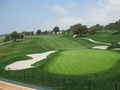
230136-1561657-thumbnail.jpg
View from grandstand behind No. 5. The classic Open look is taking shape (click to enlarge)
Golf Course - The South Course is in excellent condition. The heat wave we had a couple of weeks ago apparently made the kikuyu happy, so the fairways are excellent but not so thatchy that it'll prevent Woodward from speeding them up.  Even as wet as the course is right now with dense fog and some irrigating, I saw a lot of balls running.

The rough is dense, apparently a tad thicker than the USGA had hoped. Therefore they have slightly lowered some of the cut heights (see Davis's comments in the transcript). That said, it's predominantly rye and poa rough, with the occasional kikuyu lie. The first cut of rough will be reduced to 15 feet from 20 because Davis has decided that the course is already playing wide enough. 230136-1561660-thumbnail.jpg
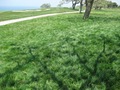
Healthy crop of rough just waiting to be trampled by spectators (click to enlarge)


The greens are in fine shape, still rolling a couple of feet slower than they hope to have them for the Open where they are aiming for 13 on the Stimpmeter Monday-Sunday. They still don't have the firmness, but there's plenty of time to deal with that.
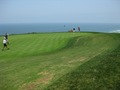
230136-1561667-thumbnail.jpg
A newly cut approach improves No. 4 (click to enlarge)
The bunkering looks a lot better with longer rough, but not nearly as attractive or strategically placed as I'd like to have seen. Rees Jones decries the "collapsing" bunkers of Doak, Coore/Crenshaw and Hanse, yet he is okay with them at "seaside" courses like Atlantic. When I asked him why Torrey Pines didn't count as a seaside course, he reasoned that the public couldn't have handled such bunkers.

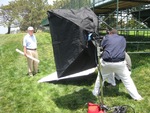
Oh yes, Rees and I chatted for a while in the midst of one of his on-course photo shoots...
230136-1561597-thumbnail.jpg
Rees Jones (click to enlarge)
Rees: He made sure to let me know that he was not in fact the vandal of Chamber Bay's lone tree, so it's nice to know that Rees is surfing the web in between press conferences, photos shoots and exclusive interviews.

In general the Open Doctor is very excited about Davis's plans to vary the setup of more than half the holes and will probably taking credit for having built so much variety into the course by June. Though I don't sense he's too wild about encouraging players to go for the par-5s at No. 9 or No. 18 in two.
230136-1561609-thumbnail.jpg
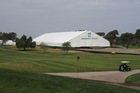
The merchandise hangar (click to enlarge)
Infrastructure: I paced off the merchandise pavilion as slightly over 100 yards long. And there's also a "satellite" location near the bus drop off by the 12th hole. The various corporate tent villages are coming along nicely and most feature great ocean views, though I did find the ones along No. 1 and near No. 2 tee to be a tad close to play. The Trophy Club (I don't know what it is, but I'm guessing it ain't cheap) sits in a stunning location on Torrey North's No. 2 hole, and just east of it is the media center which will feature an awesome patio and dining area overlooking the ocean. But it is surprisingly far from the drop off point, so scribblers bring comfortable shoes.230136-1561616-thumbnail.jpg
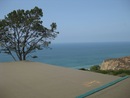
View from The Trophy Club (click to enlarge)


Speaking of the most important people in the world...

Media Hotel: I was bummed not to get in the Doubletree Del Mar since I've stayed there twice now at ridiculously low prices (thank you Priceline and Biddingfortravel.com). Besides housing 300 scribes, it's where the media parking and shuttle is located.  After driving around the business parks surrounding the Doubletree, I realized how little there is around the it in the way of local dining in an area with so much great local faire.   Then again, how can you not love a hotel that asks you at check-in to initial a pledge to respect it's no-tolerance-for-smoking-anywhere-on-the-property policy?  

Let the "I hate California" columns begin!

Links Golf Ruining Chances Of Scots Making It In Professional Golf

Douglas Lowe talks to Richie Ramsay about the negative influence of growing up a links tournament player, and what he's doing to hit the ball higher.

I caught up with the 25-year-old Aberdonian last week on the range at the Tolcinasco Castle course near Milan where he was preparing for the Italian Open with a row of some 20 different drivers behind him.

His shots were being assessed by a radar device that was designed originally to track missiles but which has been subsequently modified for golf balls.

"I am trying to hit the ball higher and this kind of technology helps," confirmed Richie, who learned his game on the Royal Aberdeen links and made his way right through the international ranks to the Walker Cup. "I can change my swing a little bit to achieve that, but altering the shaft and the weights in the clubhead can do the same."

Ramsay was a Walker Cup contemporary of the Americans Anthony Kim and JB Holmes, both big-hitting, high ball-flight winners on the PGA Tour this year. While such victories are inspiring, he was quick to point out that any suggestion that he and Lloyd Saltman are slower developers is not entirely fair.

"These guys are coming from college golf where they play top-class courses week-in, week-out," said Ramsay. "Then they go on tour and they play the same courses. People sometimes don't realise that when we played amateur golf, it was on courses like Royal Lytham and Royal Aberdeen. Then you come out here and it's completely different.

"For players like me who were brought up on links, it is a total change. I have to learn to hit the ball higher, especially with the driver. I also need a better flight for approaches to tight pin positions. That's the stuff I've been working on. I had a good result at the US amateur, but since then it's been a case of re-learning what I'm doing."

Sigh. What have we done to the game when growing up playing firm, windy links isn't the recipe to making you a better player?

Phil Considering Euro Tour Membership To Take Family On Educational Trips Where They Pay Appearance Fees

Andrew Both reports on what could become a trend for Phil Mickelson that started last fall.

His manager, Steve Loy of Gaylord Sports, has left open the door to the possibility.

"Phil is not considering joining the European Tour at this time, but it is an option in the future, given the global nature of professional golf," Loy said today.

Mickelson's membership would be a massive boost to the European Tour, which is using its international schedule and some deep-pocketed multi-national sponsors to challenge the once all-dominant American PGA Tour.

Mickelson is believed to be considering the move due to several factors, including his sponsorship deal with Barclays Bank, the naming-rights sponsor of the Scottish and Singapore Opens.


The Final Round Of The Players Took...

...how long? I've been told by a few people it was 4 hours, 40 minutes. The last pairing teed off at 2:30 according to PGATour.com and Paul Goydos missed his par putt on 18 at 7:10. 

But to confirm, I thought this pretty relevant statistic would be mentioned in a game story. I've searched them here, here, here, here, here, here, here, here and here. No luck. Plenty of mentions of 40 m.p.h. winds, but no mention of an equally important stat noting that the grueling round took an hour longer than a normal PGA Tour twosomes round.

Isn't that kind of important to know, particularly with all of the recent slow play talk?

Greetings From San Diego, Players Championship Edition

sandiegogreetingsfrom.jpgI took in most of The Players finale glued to the tiny TV's in the Lodge at Torrey Pines bar surrounded by hard core fans, including a few here for U.S. Open media day Monday. I forgot how fun it is to watch an exciting finish with serious fans, even though I sorely missed my HD.

Then again, TPC Sawgrass is a bit underwhelming in HD compared to others, perhaps because high-def reminds you how oversodded in green turf it has become compared to its more rustic days. And then there are those clean, white bunkers. Or the bloody catch basin drain caps that catch way too many balls. Pete! Surface drainage is not against the law.

Anyway, a few things stood out in Sergio's compelling playoff win over Paul Goydos.

The finale was your classic car wreck conclusion where the last person not to hit the turn-17 wall won. Or was it really car crash golf? Bob Harig wrote about Sergio's dominating ball striking performance, and something about watching this was different in feel than recent Masters or U.S. Open wrecks.

He led the field in fairways hit (43-of-56) despite winds that produced white caps on the numerous water hazards that dot the course. He tied for first in greens in regulation (56-of-72) despite rock-hard surfaces that repelled golf balls and left players and caddies in a futile search for pitch marks.

"He deserves it," said Goydos, who held a 3-stroke lead with six holes to play but could not hold on. "He played better than everyone else. Just look at the stats."

And...

Goydos, 43, got an up-close look at the greatness that is Garcia's long game during Saturday's third round, when the Spaniard hit 10 for 14 fairways and 14 of 18 greens. Those are unheard-of numbers in such windy conditions. Garcia began the tournament by hitting 16 of 18 greens. In Friday's second round, he hit all 14 fairways.

As goofy as TPC Sawgrass appeared at times (and I'm sure the field staff did their best to keep it from becoming outright unplayable), it seemed like ball striking mattered more than putting (except on 18 where the wind rendered an already brutal hole pretty much impossible).

The other noticeable aspect of watching The Players in a golf-friendly bar was how much people love the underdog. Granted, Goydos is a SoCal boy, but he was definitely the fan favorite. John Ashworth, among others, stopped in just to see how he was doing. The serious fans clearly cherish great stories like Goydos'. The tour should remember that next time they are slicing fields down and granting medical/family/some other excuse exemptions to David Duval.

Finally, there's the idea of playing 17 as your first sudden death playoff hole. Again, the bar crowd loved this but it put a serious dent in the major championship cache the event is going for. As must as I love the 17th hole, it's hard to fathom how the tour can love this as a proper way to end such an elite championship.

A three-hole aggregate playoff of 16-18 would add so much major-like cache, but I understand the television related issues. And as I said, the golf savvy bar patrons loved it, and they are the ones that matter.

Langer (75) Dragged Down By Record Number Of Shirt Logos

250494.jpgI can't find any good tight shots of Bernhard Langer during round 3 of The Players, but he has at least 7 that I can see (three on the chest, two on the left sleeve and one on the back). Photos from TheGolfChannel.com:

Not surprisingly Ceri Mobley talked to Mr. Style (a.k.a. Marty Hackel) about the tour's best and worst dressed for PGATour.com (yes, negative feedback on the tour's site!), and Marty includes Langer on his worst list. And not because of the logo orgy. 

Meanwhile, Bob Verdi posts a GolfDigest.com "postcard" on one of the coolest sounding spectating gadgets I've ever heard of (hint: a gizmo to let you watch the telecast or just the 17th hole coverage while you're walking around). 

"Great stuff that made one wonder why the stymie was ever outlawed in match play."

John Huggan visits the World Golf Village in St. Augustine and comes away very impressed with the quality of the exhibitions.

And just round the corner is a replica of the old stone bridge that crosses the Swilcan Burn on the Old Course's 18th fairway. Apparently, the bridge was originally built so that packhorses could haul mussels across the burn. Did not know that.

My favourite item, however, is the short film of a July 30, 1904 match between Harry Vardon and James Braid – a dour so-and-so on the admittedly scant evidence of this cinematic epic – at the Murrayfield Golf Club in Edinburgh. Watched by a 3,000-strong crowd, the contest ended all square, but not before Braid had flummoxed Vardon with a crafty stymie on one green. Great stuff that made one wonder why the stymie was ever outlawed in match play. Blocking the opponent's path to the cup had a sound tactical role to play in the psychological warfare that is head-to-head golf. The look on Vardon's face was a picture.

Lord knows we couldn't have that in today's major match play events. People might actually watch. 

"You know what? It's women."

Thanks to reader LPGA Fan for noting my oversight in not highlighting Juli Inkster's summation of the bizarro new LPGA rule about overcrowding on the putting green. From Doug Ferguson's weekly AP notes:

A half-dozen players not eligible for the pro-am last week on the LPGA Tour were on the putting green, with their caddies standing on the fringe. That's courtesy of a daft new policy that bans caddies from being on the practice green between the hours of 8 a.m. to 4 p.m.

Turns out a couple of players were having a putting contest when a caddie was standing in their line. They asked him to move, he did, but that wasn't enough. They went to the commissioner to complain about crowded conditions on the green, and a new policy was enacted.

The fine for a caddie being on the green - to work with his player's mechanics or retrieve balls from the cup - is $500.

The policy even applies to the chipping area, and it's peculiar to see players hit three or four chips, then shag their own golf balls.

Count Juli Inkster among those who think the policy is bordering on ridiculous.

"You know what? It's women,'' she said when asked for a comment. "If you just put that down, everyone will know what you mean. Just capitalize 'women' and you don't need to explain anything else.''


"The changes to the course have been horrendous on a number of levels."

Dean Barnett on The Weekly Standard blog compares The Players with the Masters, and says the TPC is better thanks to far less dreadful course changes.
Where The Players actually belongs to the players, the Masters and Augusta National belong to a bunch of weird guys who are prone to despotism. Additionally, the Masters has looked a bit long in the tooth in recent years. In a misguided effort to modernize the course, Augusta National unleashed a supremely mediocre architect to modify one of the best and most original golf designs ever.

The changes to the course have been horrendous on a number of levels. The most damaging has been the fact that the changes sucked the drama out of the tournament in the name of “defending par.” Augusta is now so long and difficult, there are few birdie opportunities and the players take over five hours to make their way around the course in twosomes. If the lords of Augusta National were capable of embarrassment (which they almost surely are not), this last fact would shame them no end. The course is now harder (and more boring), but is it a better and fairer test of golf? Does it effectively identify the world’s best golfers? Leader boards the last couple of years populated almost exclusively by no-names and an angry Tiger Woods suggest otherwise.