Is Leadbetter Trying To Get Fired?

From Thomas Bonk's L.A. Times golf column:

David Leadbetter, Michelle Wie's coach, on Wie's playing strategy that has included playing PGA Tour events: "It's a shock to me and to her agents that this is happening. I don't think the family is making the right choice. There's definitely more to lose than to gain.
"I've put too much time and effort into Michelle to be able to sit by and watch this happening without saying something. If she doesn't stick to doing what's sensible, we could see one of the greatest potential talents the game has ever known going to waste."

"The document has been very well lawyered."

Adam Schupak considers groove rule change ramifications on equipment manufacturers and offers this:

One issue that equipment companies likely won’t worry about: filing a suit against the USGA.

Nauman said Acushnet won’t oppose implementation of the rule. And Ping officials – who previously battled the USGA and PGA Tour over grooves nearly two decades ago – said the USGA, while drafting the changes, took every precaution to avoid litigation.

“Let’s put it this way: The document has been very well lawyered,” Solheim said.

"The 41-year relationship between the PGA Tour and Westchester Country Club was like a good marriage gone bad."

While Bill Pennington celebrates the elegance of Tillinghast's Ridgewood, Sam Weinman files a compelling dissection of the messy decision to leave former Barclay's host Westchester. He writes for golf.com:

The 41-year relationship between the PGA Tour and Westchester Country Club was like a good marriage gone bad. There was the innocent beginning, the complacent middle years and then, finally, when the Tour's wandering eye led it to Ridgewood Country Club in Paramus, N.J., the bitter, dish-throwing end.
And this does make any rational soul understand why the Tour had had enough:
Among the membership's longstanding agreements with the Tour was that during tournament week members could still play the adjacent South course, still play tennis on the courts that bordered the par-3 1st hole and still have access to the sports house that included the pros' locker room and a fitness center.

The uneasy coexistence was best encapsulated by an incident at last summer's Barclays, during which Tour player Aaron Baddeley was kicked out of the fitness center by a Westchester member who said Baddeley didn't belong there. (Westchester president Phil Halpern confirmed that an "older member" mistakenly thought the room was for members only.)

"I think what happened is that the Tour and its tournaments evolved, and what was acceptable and overlooked in the 1970s and '80s was no longer the case," says a PGA Tour official who requested anonymity. "Every host venue has evolved or been replaced, but they simply weren't of the mindset to evolve. You won't find another venue on Tour where they play tennis off the 1st hole or play the other course when the tournament's going on. I guarantee you there's not another locker room on Tour shared with members."

Van Sickle Words Hard For The Sonny

More importantly, while the SI golf writer loops for son Mike in the U.S. Amateur, he's able to deliver a solid metaphor for Dave Shedloski, but I'm not sure about the matching outfits.

Van Sickle, ranked 14th in the Golfweek Scratch Players World Amateur Rankings – and sixth among Americans – won both the Pennsylvania Open and the Pennsylvania Amateur, making him just the second man to turn the double in one year, joining Jay Sigel, who won back-to-back U.S. Amateur crowns in 1982-83. A resident of Wexford, Pa., Van Sickle also became the first amateur to win consecutive state open titles and just the third to successfully defend.

He wasn’t shabby on the national stage, either. Van Sickle birdied the final hole at the Southern Amateur at Lake Nona Country Club in Orlando to force a playoff before losing on the first extra hole to 2007 Walker Cupper Kyle Stanley of Gig Harbor, Wash. He also finished third at the Porter Cup at Niagara Falls Country Club.

Iwas fighting my swing a little bit," said Mike, 21, who enters his senior year at Marquette University. "I guess I ran out of gas."

"He was like Kenny Perry at the tail end of his hot streak," said Gary, 54, who for nearly 12 years has been a senior writer covering the PGA Tour for Sports Illustrated. "He played real well for a month or two, but it ended sort of as the Amateur began. Just no way to explain that."

The Great Playoff Debate

Via email and not appearing for all the world to see, the PGA Tour's Steve Dennis and I debate the best possible format for the pPlayoffs.

Essentially, I'm arguing for a true playoff that lets someone get hot, get to East Lake and maybe pull off a big upset. Steve wants to protect the season points leaders and crunch numbers right up to the end.

Playoff Eliminations Begin!

I like this new FedEx Cup volatility. We're already down to 136 players and it's only Monday.

Tim Rosaforte reports that playoff fever got the best of Lee Westwood, who listed "holiday" as his reasing for pulling out. And to show just how much the playoffs meant to him, Bob Estes...

who finished 124th in the final FedEx Cup standings, scheduled his wedding for this week and is not on the tee sheet.

NY Times Flash: Golf Made Easier When You Can Hear and See

Bill Pennington offers another instruction piece in Monday's editions. Because the world needs more golf instruction stories and what better place to read about them than the paper of record?

Ah but Pennington isn't serving up only "it's-all-about-you" fluff. He shares this interesting bit from a USGA test center visit with

Dick Rugge.“It’s all about how much water is channeled away by the grooves,” Rugge said. “Deeper grooves get rid of more water more quickly.”
This month, the U.S.G.A. announced new restrictions on the size and edge sharpness of grooves for clubs manufactured after Jan 1, 2010. The U.S.G.A. said the new rules were aimed at professional golfers who have had an advantage hitting out of the rough with modern U-shaped grooves in their clubs. With more control in higher grass, the pros haven’t had to worry as much about keeping the ball in the fairway, an accuracy challenge the U.S.G.A. hopes to restore on some level.

No worries mate!

But the scientific research behind the groove debate is fascinating, especially as seen in super-slow motion video. At the U.S.G.A., Rugge showed me that when a club cuts through heavy rough, grass squeezed against the face of the club actually releases water. This microscopic bed of water is what reduces spin on the ball. Larger, deeper grooves whisk away the water, like treads on a car tire, and allow for crisper contact with the ball. And in expert hands, more imparted spin.
Back in March, Rugge didn’t tell me what the U.S.G.A. might do about the more efficient U-shaped grooves in golf clubs. But playing that video back and forth, and watching clubs in thick grass putting spin on golf balls, I had an inkling. It’s all about the water.

So, shouldn't the USGA and R&A just advocate putting less water on courses instead of changing the grooves?

Oakland Hills: 2008 PGA vs. 1996 U.S. Open

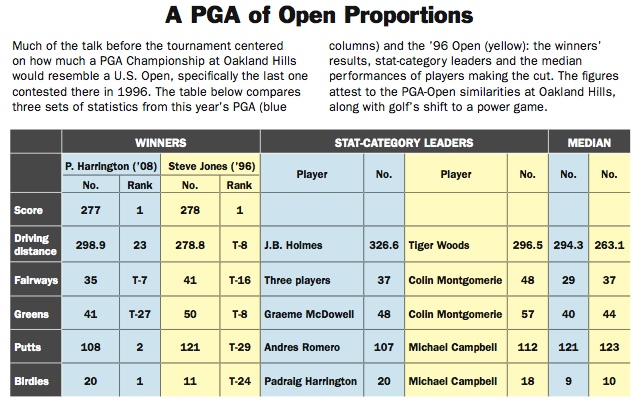
In the post PGA coverage, Brett Avery offers a rather astounding chart in the Golf World stat package (PDF).
Now I'm in favor of the groove rule change because it has the potential to restore the importance of firm greens, but will only be meaningful if an increase in fairway width comes with it.

However, the USGA and R&A continue to contend that armed with V-grooves, the world's best will be forced to respect rough and therefore they will have to throttle back in an attempt to hit more fairways. In other words, it's a backdoor way of rolling back distance increases. I still believe it's pure fantasy, but hey, if it makes them happy and leads to other positives, so be it.

Yet no study has determined how much fairway narrowing has played a role in the driving accuracy decreases so regularly cited as the cause for regulating grooves.

So here we have Oakland Hills, host to the 1996 U.S. Open and on the cusp of the distance explosion, and again host to the 2008 PGA where a remodel narrowed fairways and rough was farmed and coifed.

The 2008 field median was 30 yards longer off the tee than in 1996 while the fairway's hit median dropped 8 fairways.

The governing bodies would like us to believe that these dramatic increases in distance and decreases in accuracy are a result of players finding themselves armed with U-grooves that persuades them to flog drives with reckless disregard for the awful fairway contours crafted to take driver out of their bag.

Seems in the case of Oakland Hills that the radically improved driver/ball combination (oh and of course, the increased athleticism!) along with a further reduction in width since 1996 was likely much more significant than the grooves in fostering such radical differences in distance and accuracy.