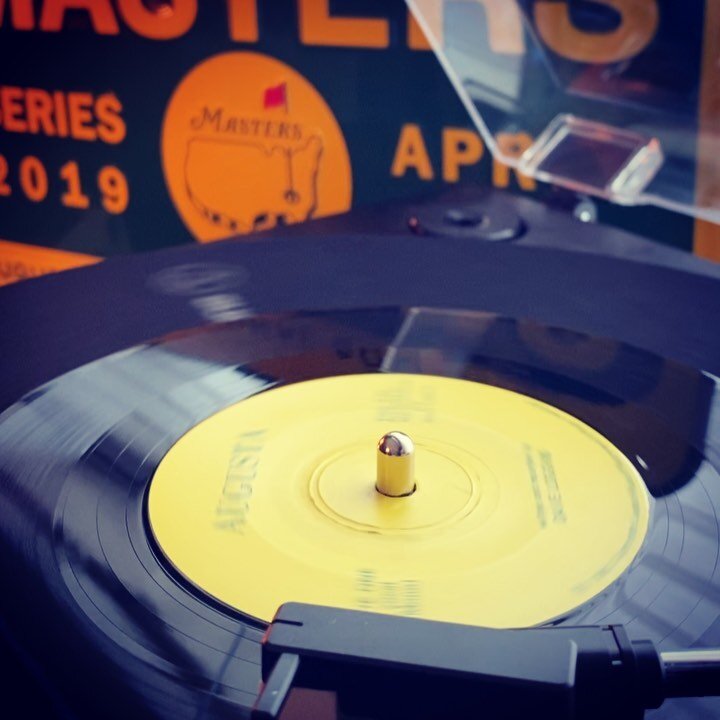
"As soon as I saw Rory kick the sand I knew it was a foul and rushed out to ring Chubby"
/Nice catch by reader Stan in this Rory McIlroy story by Bernie McGuire, with Darren Clarke commenting on the Masters Friday rules incident:
Read More
It’s back!
Twenty years later Tatra Press has kindly allowed me to bring back Grounds For Golf now that golf architecture is of more interest to the masses. A new Introduction looks at what’s driven the interest growth and two new chapters I had a blast adding (plus a few edits to keep things up-to-date).
The Amazon purchase page for the book arriving June 15, 2026.

 I was going to start this post asking why course setup was such a major topic (again) going into this Masters and yet, how few actual details we learned about what went into the committee's efforts to finally make Augusta National resemble its old self.
Sure, the committee will never be the chatty types, but how about some basic observations on tee and hole locations based on observation (you know, by leaving the press center). Or true player/caddy insights into what they actually saw? (And not just that the greens were clearly soft. We at home could see that.)
But then I saw this USA Today headline on a Jerry Potter story:
Players say scoring at majors often dictated by course setup
Rumor has it that tomorrow they've got a grabber titled, "Players say lowest score at majors often wins."
From what I've seen so far of the post Masters issues, the weeklies offer little in the way of details. However, a few reviews are in and, as warranted, they are quite positive.
Doug Ferguson rightly praises the overall change in tone. "The magic of the Masters, however, is not so much about the score as it is the opportunity."
Ron Sirak noted this detail, which seemed to have been overlooked but which was apparent on television (and almost noted on-air by Feherty at No. 15 before he realized the club has snipers trained on him in case he reverts to his true self):
Also, grass was allowed to grow ever-so-slightly longer, preventing balls that in the past may have rolled into water to hang up just short.
Steve Elling had a different take, not convinced just yet that the course is all the way back.
Even with abnormally idyllic weather, softer greens, easier pin locations and front tees that were used liberally throughout the week in a notable departure from the norm, the low score was 12 under par, marking the third time in eight years that the Masters winner finished at that exact number. Thus, it was hardly a sub-sonic total, yet it required perfect conditions and plenty of course tinkering to pull it off.
That represents a flashing yellow light.
Regular readers here know that after Shinnecock, Oakland Hills and way too many other recent rounds, I am fascinated with the idea of courses becoming silly when it's 75 and the wind is clocked at a whopping 15 mph.
So last week for me that "flashing yellow light" came in the form of intentionally soft greens. We should applaud whoever made the call to make the greens slower and softer, because it helped mask the deficiencies in the architecture and gave us a memorable week.
In recent days I've polled folks in the know, asking who deserves the most praise for making this call. They unanimously say Billy Payne deserves it for setting a new tone and essentially overruling the committee charged with setup. Still, let's nod our caps to Fred Ridley, course super Marsh Benson and the committees who found a few new hole locations and did the dirty work.
Of course they should not have to work so hard if the architecture was in better condition. Yes, it was clear the second cut has been negated in many key areas by a discreet widening out of holes. And the frontal additions to several tees clearly helped based on comments by Crenshaw and Weir. But still, is this quote from an AP notes column (nice spot reader David) really what the club wants to read:
"We played the ladies' tees two days in a row." – Steve Williams, caddie for Tiger Woods, on the course setup.
There were a few times I was worried about player safety on No. 11 when it looked like a Palmer follow-through might lead to a plunge off the front. Then again, wasn't it wonderful Sunday to see the 15th play so short that players were able to bomb it past the abhorred Fazio/Hootie tree farm?
Which is the issue at hand. The committee had to work their tails off to offset the glaring deficiencies: the decrease in width, the second cut, the still-missing ebb and flow of the back nine, and the lack of genuine tee "elasticity." (Oh and we'll give a shout out to Brandel Chamblee who rightly questions the deepening of key fairway bunkers to the point that they eliminate the temptation factor.)
Minus the rough, minus the Christmas trees that are turning into monsters (shrewd planting work there!) but with a few old tees and corridors widened out to their old selves, firmness could be restored. Remember, Bobby Jones HATED soft greens, even writing an essay about it that originally appeared in the USGA Green Section Bulletin and subsequently in Masters of the Links.
Wider and firmer does not necessarily mean players would be put back on the defensive. On the contrary, it should lull them into a false sense of security, a primary tenet of great risk-reward design. And best of all, the committee wouldn't have to work so hard covering up the mistakes made in changing the course.
But can we all agree, the overall change in tone the last few years was not merely a product of the weather?
SI's Alan Shipnuck files his typically rich-in-detail-no-one-else-has Masters game story. So rich, I'm running for the Pepto tablets just thinking about Angel Cabrera's diet:
Earlier in the evening a quaint Masters tradition had compelled him to eat a champion's dinner with the Augusta National members. Eschewing the lobster macaroni and cheese and other delicacies from the buffet, Cabrera settled on an irresistible item called the Tiger Woods Cheeseburger. The burgers were smaller than expected, so a famished Cabrera ate nine of them, washed down by gulps of red wine. Back at the house, as it neared 2 a.m., he took lusty sips of his favorite drink: Coke mixed with Fernet Branca, a bitter, aromatic spirit brewed from grapes and more than 40 herbs and spices.
Thanks to Dave who forwarded this insider's view of a board meeting at Missouri's Sikeston Country Club. The sensitive subject of tree removal is in play. I think it is safe to say that anyone who has spent time on a club committee will relate to this. The video is also a fine introduction to Overstream.com.
 In reading reviews of the CBS coverage, most focus seems to be on the announcing and how they followed the Tiger-Phil drama. Bradley Klein charted these numbers:
The first commercial break didn’t come until 66 minutes into the telecast, and all told, by my count, we saw only 20 minutes of ads. That left time for golf, 378 shots in all shown live or “a moment ago.” Those shots comprised 57 drives; 96 full approaches into greens; six pitch-outs; 35 chips, recoveries or sand shots; 52 long putts, 83 short putts and 49 tap-ins. As for the common argument that we see too much putting, the evidence shows that 49 percent of all shots shown took place on the green.
Michael Hiestand in the USA Today really doesn't say much at all, but I thought I'd link it anyway. Kind of following in that Rudy Martzke tradition, isn't he?
Chris Zelkovich picks on some of the sappier CBS comments in entertaining fashion. Don't worry, PK, he doesn't mention you!
Unmentioned in these reviews is the impact of Augusta Live, the amazing online bonus coverage that DirectTV subscribers also had access too.
On the live blogs here, we were consistently astonished just how few live shots CBS shows in comparison to what we were seeing in the online coverage of Amen Corner and the 15th/16h holes. Our friends watching BBC reported comments from post round interviews we never would have gotten and several other observations based on seeing actual golf shots instead of pre-packaged material.
For instance, we live blog participants knew all about Anthony Kim's historic round Friday as well as Rory McIlroy's disastrous finish and his ruling controversy, all thanks to Augusta Live or tips from viewers overseas. Yet for CBS, it was if they had a set script and no golf was going to get in the way.
Also disastrous was the 12th hole sequence Sunday. Every year the 12th tee caddy-player discussions provide us with the ultimate pressure moment. When Phil and Tiger arrived there, Ian Baker Finch and Nick Faldo talked over way too much of the club selection discussions. Now, I admire both as announcers and Faldo was particularly strong last week. So part of me wonders if they are told to talk viewers through things because there are so many non-golfers watching.
But I couldn't help noticing that Ian Eagle and Matt Gogel, announcing on Amen Corner Live coverage, went silent as Tiger-Stevie/Phil-Bones made the all-important 12th tee decision. (In hindsight, I should have muted my CBS feed.)
So my question: Is Augusta Live undermining CBS's credibility by exposing just how few live shots we see and golf shots period? Or is this merely the future of the broadcasting the Masters, where a network feed is an excessively-produced, almost documentary-style telecast for the masses while we viewers at home select feeds we want to watch, ala Augusta Live?
But 42 million people tuned in at some point over the weekend, which isn't bad.
Geoff Shackelford is a Senior Writer for Golfweek magazine, a weekly contributor to Golf Channel's Morning



Copyright © 2022, Geoff Shackelford. All rights reserved.