"Wouldn't it be nice if we could add Tiger to the list?"
/Greg Hansen shares this jinx quote from Wade Dunagan, executive director of the WGC Match Play, commenting on the possibility of a Tiger Woods return at the Accenture event.
Read More
It’s back!
Twenty years later Tatra Press has kindly allowed me to bring back Grounds For Golf now that golf architecture is of more interest to the masses. A new Introduction looks at what’s driven the interest growth and two new chapters I had a blast adding (plus a few edits to keep things up-to-date).
The Amazon purchase page for the book arriving June 15, 2026.

...says Radaronline.
 Larry Dorman writes about Riviera's lore.
A riveting celebrity photo outside the men’s locker room shows Dean Martin, Jerry Lewis, Bob Hope and Bing Crosby.
“These walls have seen the biggest stars from every era,” said Michael Yamaki, the club’s corporate officer. “They have seen it all. There was a report once about W. C. Fields getting arrested here for debauchery.”
It had something to do with Fields taking liberties with the daughter of a Los Angeles police officer and is a true story, said Yamaki, who was once a member of the Los Angeles Police Commission.
Fact and fiction have a way of blending together at places where the combustible mystique of show business and golf mix, but at Riviera the facts are good enough.
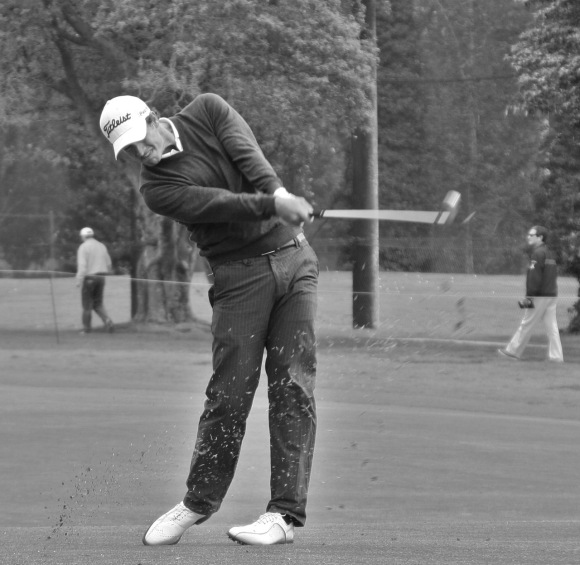
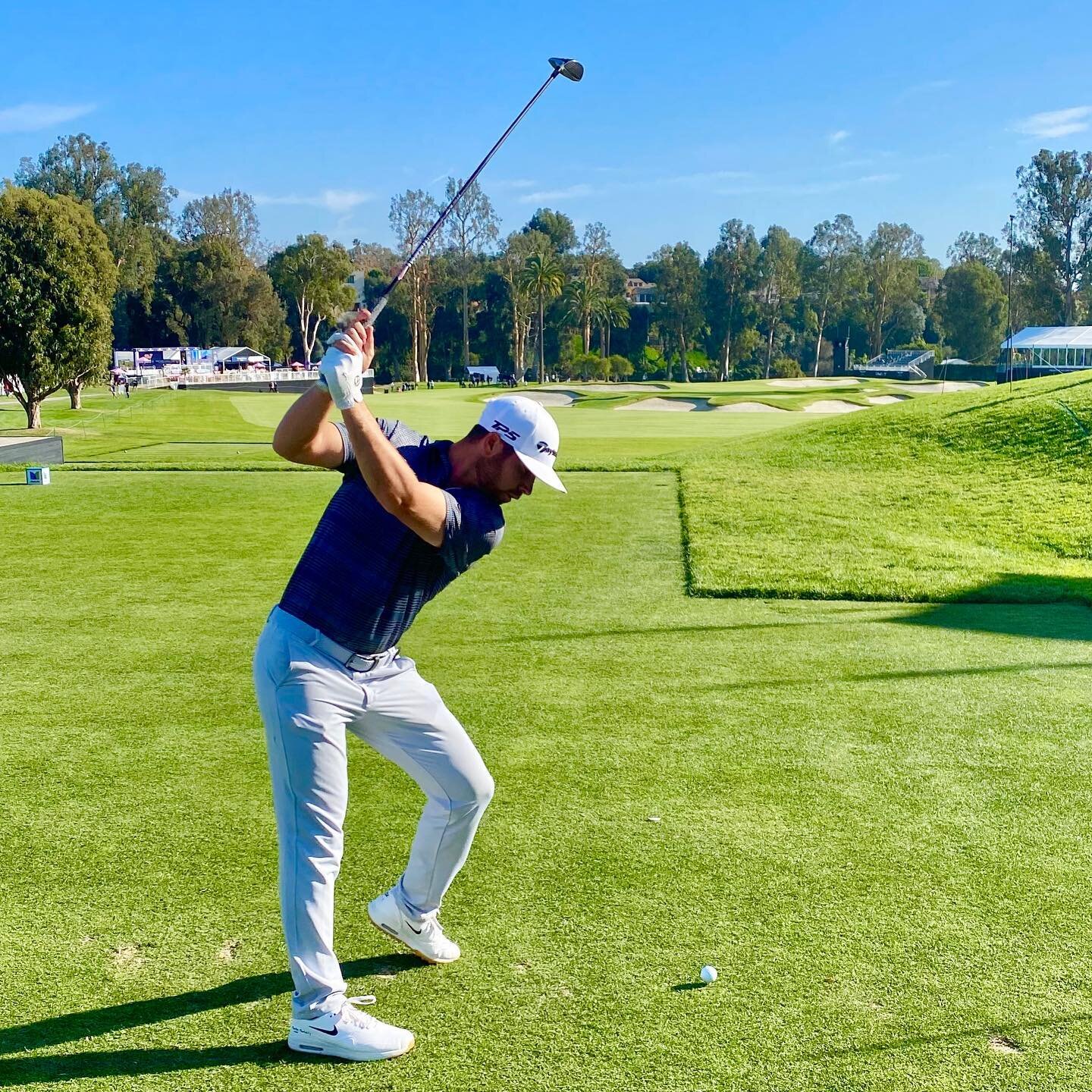
Adam Scott approaches the par-4 second hole.
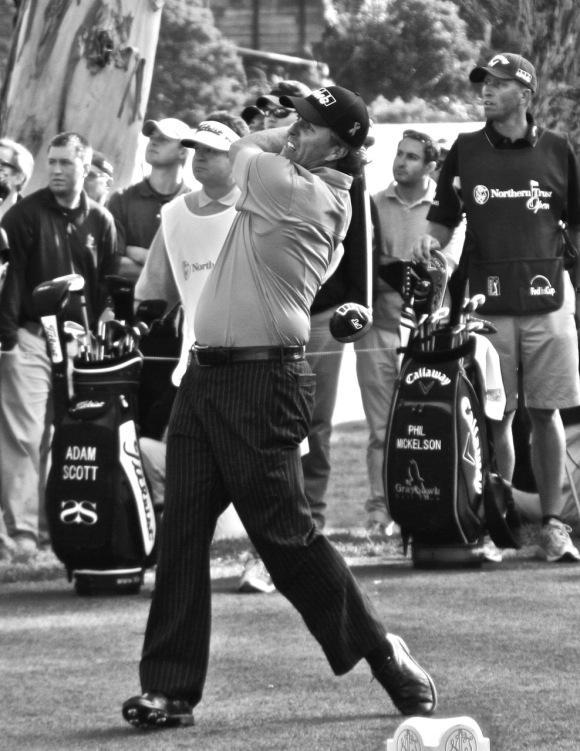
Phil tees off on No. 11.
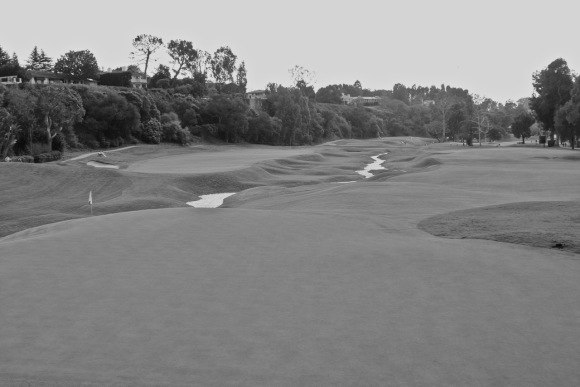
The revamped 8th.
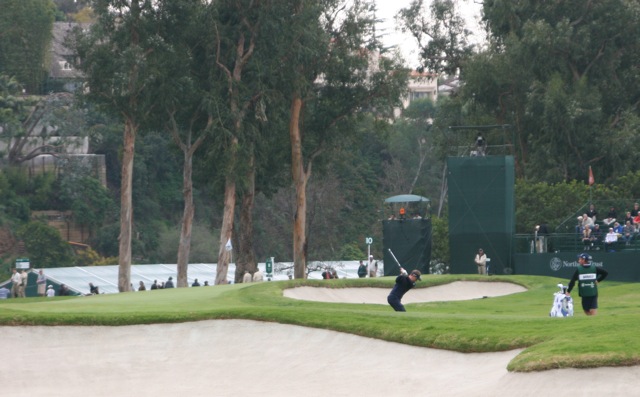
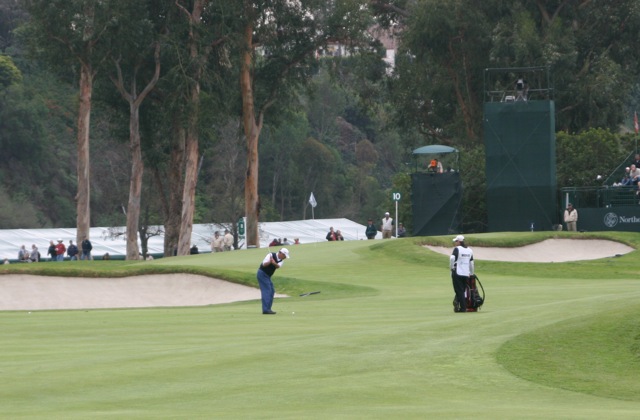
Round 1, 2010 Northern Trust Open, morning play. All three players laid up (a rarity in the era of improved workout programs).
Based on the lay-up position, see if you can guess which player made a 9 footer for birdie, which missed his 14 footer for birdie and which player had to get up and down from the left bunker for par? (And no ShotTracker cheating, please.)
Luke Donald's approach shot:
Rocco Mediate's approach angle:
Jason Dufner's approach angle:

For more on No. 10, enjoy some of Doug Ferguson's morning Tweets from the scene.
**Those who guessed Dufner made birdie were correct.
 More like "most" drivable par-4s, but either way a nice use of ShotLink by the PGATour.com staff and a fine warm up to the annual 10th at Riviera watch. I'll do my best to hang out there this week and share what I see. And for those of you watching at home, NBC has installed a "speed shot" tower about halfway down the hole (see photo for angle), so figure on seeing bonus coverage of the hole.
 Tim Finchem (click to enlarge)Fighting off of a profusely bleeding paper cut, Tim Finchem joined us in the Northern Trust Open press center at 10:30 with a Mickelson presser set for 11, so naturally he kept that in mind with his opening remarks.
COMMISSIONER FINCHEM: Thank you, Laura. Good morning, everyone. Laura tells me we're on a hard stop here at 11:00, so I'm going to make some brief remarks and see if I can answer your questions.
18 minutes and the entire history of groove squabbles in golf later...
During these first four weeks, we have had five players we've had 218 different players play those four tournaments. Of those 218 players, five different players have actually used a Ping Eye 2 manufactured before 1990; not a huge amount of usage, but a number that was sufficient to create a fair amount of interest, particularly when one of the best players in the world in the short game area chose to use it, which he was fully entitled to do.
And that focus on the rule has led to a couple of things. One is that there was some unfortunate commentary by other players in the media in the last week or so, and let me just pause there and restate, as I issued my statement last week, these are the rules of golf. Any player is entitled under these rules to play a Ping Eye 2 wedge designed before 1990 if he so chooses. There is nothing wrong with that. There is nothing that violates the rule. There is no hidden direction to players or side direction not to play that club, so there is absolutely no basis to criticize a player for doing so. None. And to do so in our view is inappropriate.
No grey area there. Makes me wonder if McCarron faced a possible suspension?
With respect to a particular player that used a particularly unfortunate choice of words, I would say that there is perhaps a mitigating factor to the amount of reaction. There is no justification for certain language being used, but the reaction was stronger than it could have been, had we more intensely last year got in front of players with the details of this rule.
Now, what do I mean by that?
We screwed up?
Well, two years ago when we instituted our drug policy, we made sure that we were in front of every single player in dialogue on the ramifications of drug testing, on the reality that you could be suspended if you violated the drug testing rules, and the dos and don'ts of staying in compliance. Players paid attention. They came out and performed, and we haven't had drug issues on this TOUR. That's not to say we haven't had a violation; that's been reported. But we haven't had issues.
We didn't act with that level of intensity. In my view, had we, the reaction to the use of these clubs might have been lesser. But that is what it is, and I think we're about to close the chapter on that part of the history of this.
Well there you have it, an admission of error, Finchem style.
In this particular case, the most striking thing about the difference between the groove discussion in 1989 and '90, which was based on some tests and led to a lack of confidence on the part of the PGA TOUR or the USGA that you could win a lawsuit, in this case there have been years and years of very careful measurement of data, of the lack of correlation of hitting the ball in the fairway and performing well on the PGA TOUR, so it's a very strong case, and I think that's one of the reasons you didn't see a lawsuit amongst manufacturers here, because there is a strong case.
But the byproduct I know I've read some people say this is a backdoor attempt to create softer balls. I'm not aware of anybody that believes that.
Uh Tim, that's Dick Rugge, USGA for starters.
But I do think that with this rule we really could relax a little bit about the need to fool around with the ball and the driver for an extended period of time. That's my only view.
Well good to know that after five weeks you were able to draw a conclusion from the data.
Geoff Shackelford is a Senior Writer for Golfweek magazine, a weekly contributor to Golf Channel's Morning





Copyright © 2022, Geoff Shackelford. All rights reserved.