"I can't believe the R&A and USGA can't get together with the manufacturers and come up with something that is for the betterment and protection of the game."

So much great stuff in John Huggan's profile of Tom Weiskopf, and I'm quite sure where to begin (though it's worth reading for all of the stuff beyond distance rants):

"The problem stems from the fact that the USGA lost a lawsuit with Ping over the grooves on clubs all those years ago. Now the authorities are scared to get involved in another. But they are smart people. I don't see why they can't come up with a 'tournament specification' for the ball. That wouldn't mean that the amateur couldn't play or buy that ball. It would be just like it was over here when you guys had to change from the small ball to the big ball. Or they could roll the ball back over a period of time until they reach a predetermined point.

"The saddest thing is that the ball has taken so many wonderful courses out of play for the professionals. Look at what is being done here at the Old Course, with all these tees that are not even on the premises. I don't know what the solution is, but I can't believe the R&A and USGA can't get together with the manufacturers and come up with something that is for the betterment and protection of the game and those who play it at the highest level. Maybe they should have stopped the ball as soon as it became clear that they were going to have to mess with the Old Course.

Recommended Final Round Listening

Opengolf.com features an excellent radio broadcast of the event and can be listened to all over the world (many Americans submitted questions for the team to answer during lulls in play.)

If you are looking for an alternative to television, you'll get some stellar coverage here. For eight pounds I purchased the FM radio's sold at the course and had a joy listening to the crew yesterday while out on the Old Course. One highlight: a great chat between Tiger and Stevie about what shot to hit into a green. They never once talked over it. Miracles to happen.

Moral Of This Story: Don't Be So Quick To Pick Up Your Provisional

Nancy Amour on Mark Calcaveccia's nine Saturday:

Calcavecchia's drive landed in a bunker, and he had to play out sideways. His third shot, from the fairway, sailed right and disappeared into the gorse. Thinking the ball was lost, Calcavecchia played a provisional and then went to search for the first ball.

Told his ball had been found, Calcavecchia picked up the provisional. But then he discovered the found ball wasn't his, and he wasn't able to locate it before the five-minute limit expired.

That meant Calcavecchia took the stroke-and-distance penalty (two shots) under the lost-ball rule, and lost another stroke on the penalty for lifting a provisional without authority.

Oosty, Casey And Round Three Of The Open Championship

The Home Hole after Saturday play (click to enlarge)I'm at a loss right now to describe how good the play of Oosthuizen and Casey was today, especially since some of their birdies came when the wind was up and the temperature the coolest it had been all week. The hole locations were fairly forgiving on the front but the back nine offered few opportunities and it showed.

As I told someone earlier this week, Oosty's two missed cuts, French Open WD and MC record in the Open Championship screamed -15 through three rounds. That said, I'm glad my money is on Casey, Kaymer (80-1 each way!) and Westwood. The Old Course only lets Hall of Famers in the door just like Pebble Be...oh right.

Your predictions please.

Betting On Golf: As It Should Be!

No greater joy at the Open than betting on the field. I must say I was a bit disappointed visiting Ladbrokes today and they weren't ready to share some of their exotics, nonetheless I got Tiger at 5-1, Westwood at 5-1 and Casey at 8-1. Most of my early week bets are not looking good, but I do have Kaymer and Van Pelt lurking and possible "each way" winners, so let's get in the top 5 boys!

Incidentally Van Pelt stopped in Ladbrokes the other night supporting his betting friends but could not have been too thrilled when the place was populated by an army of golf writers who were thrilled to be putting down a few pounds (and yes, it's a much different experience than logging into a phone app where you have an account...that's just not the same experience!).

Tim Rosaforte talked to Chubby Chandler about the culture of sports betting here.

Pins, Grounding And Suspending Play

Lawrence Donegan (here) and Steve Elling (here) sum up the player complaints from Friday's second round. They fall into two categories: hole locations and suspending play.

From what I saw of the course, the holes were fairly reasonable and not cut on high spots as several players have claimed. There were undoubtedly a few very difficult locations, like the 11th, which was almost inaccessible along with the 8th and 10th on high spots. But does every hole location have to be accessible? I think not.

As for the decision to suspend play and restart in conditions that soon were just as bad as they were when play was stopped? That's a trickier proposition.

I'm not buying the "they did it for Tiger" conspiratorial venting of players who were understandably cranky about getting in their playing zone and then having to pull up, only to face the same or worse winds when they went back to the course.

The issue of green speed is certainly on the table in this debate since the greens look faster than they were in practice rounds and it takes so little to put these greens over the edge. But ultimately, this may just be about the quirkiness of the rules of golf, as Bob Harig notes.

The reason for such consternation over a golf ball that rolls is the penalty that can be incurred if you ground your club. A player who rests his putter behind a ball is deemed to have moved the ball if the wind blows it.

"I understand the rule, but it's such an unfair rule because you haven't really done anything wrong and the ball starts to roll and you incur a penalty," said Trevor Immelman, who shot 74. "That was the kind of thing you had to be careful of today."

2010 Open Championship Friday

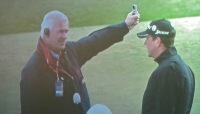
What a nutty day of rain, followed by high winds, followed by an hour and five minute play suspension and more wind. The wind gauges came out (see right image), though the real issue was on the greens where balls weren't remaining in place.

Miles Evans reporting for Reuters, quoting the R&A's David Rickman:

"We certainly had problems at 12, 13, 10, seven, the odd ball oscillating happens, but when we have a series of incidents I'm afraid that's the time (to halt play)," the Royal and Ancient's director of rules David Rickman told the BBC.

"All we can do is monitor the wind so we're trying to establish when there's a drop and when that happens we'll seek to resume play when we can. Sadly the forecast is for it to stay windy until early evening."

After the delay I headed to the epicenter of trouble, the wondrous 7th and 11th greens and saw some epic shots, from a few 150 foot putts down on the seventh up to the eleventh green (all three putts). And then there was Ross McGowan trying the same distance with a four iron. He ended up taking four shots from there (I guess it's technically a four putt.)

I can't emphasize enough just how brutal the wind was out on the point, far more stiff a breeze than what we experienced up by the clubhouse. (For a fun account of some of the shots we saw, check out Dan Mirocha's rundown of the action at 7/11.)

Still, it was a shock that play was suspended when it was but not later on when some gusts had to be over 35 mph and players on eleven were struggling to keep their ball in place. Of course in the U.S. we'd just throw some water on them and continue play. But I think you also have to admire the R&A for not resorting to that as tough as it is to suspend play. No one feels good about altering the playing field artificially with water.

That said, the question that will be asked: what was the difference before and after the suspension? I'm not sure there was one.

"My friends say I look like Shrek, some of my friends, and you can't choose your friends, so what can I say?"

Steve Elling on leader Open 36-hole leader Louis Oosthuizen and his Shrek knickname.

Largely unknown in the United States, Oosthuizen is writing yet another British Open fairy tale, hoping to become the latest in a series of unheralded winners at the oldest of golf's major championships after taking the early lead Friday at 12 under par.

The 27-year-old briefly used a headcover of the cartoon ogre, before his caddie somehow convinced him that it was bringing him bad luck. Of course, at least Shrek is a name that everybody can pronounce.

It has been cringe-inducing listening to the various news outlets absolutely butcher his surname this week, if not his first name, which is pronounced Louie, not Lewis.

Scott Michaux profiles second place man Mark Calcaveccia, who was in the group in front of Oosthuizen. Not surprisingly, they were the first groups off today.


Calcavecchia, who like many seniors is an early riser, was first off the tee at 6:30 a.m. Friday when the sun was actually out briefly before the rains hit. It was the perfect pole position for him to catch a spark and keep rolling.

"The R&A is nice enough to know that I like to play fast and they certainly know I'm not going to hold anybody up," he said. "But that was the first time I actually hit it first. So yeah, that's pretty cool."


"Mickelson let himself become one of those who would not be a factor at the 139th Open Championship simply due to a poor attitude."

Tough love from Bob Harig after Phil Mickelson finished right before play was suspended.

Lefty's disposition did not become much better when he was talking to reporters after his round Friday and heard the announcement that play had been suspended due to high winds -- meaning those on the course were getting a break from the bad weather, or so it seemed.

"I'm happy for those guys," Mickelson said in full sarcasm mode. "That's great."

Weather is almost never a factor in suspending play at the Open due to the excellent drainage capabilities of sand-based links courses and a lack of thunderstorms.

But if golf balls cannot stay still on a green, there is no choice but to halt play