In golf construction art and utility meet; both are absolutely vital; one is utterly ruined without the other. GEORGE THOMAS
It’s back!
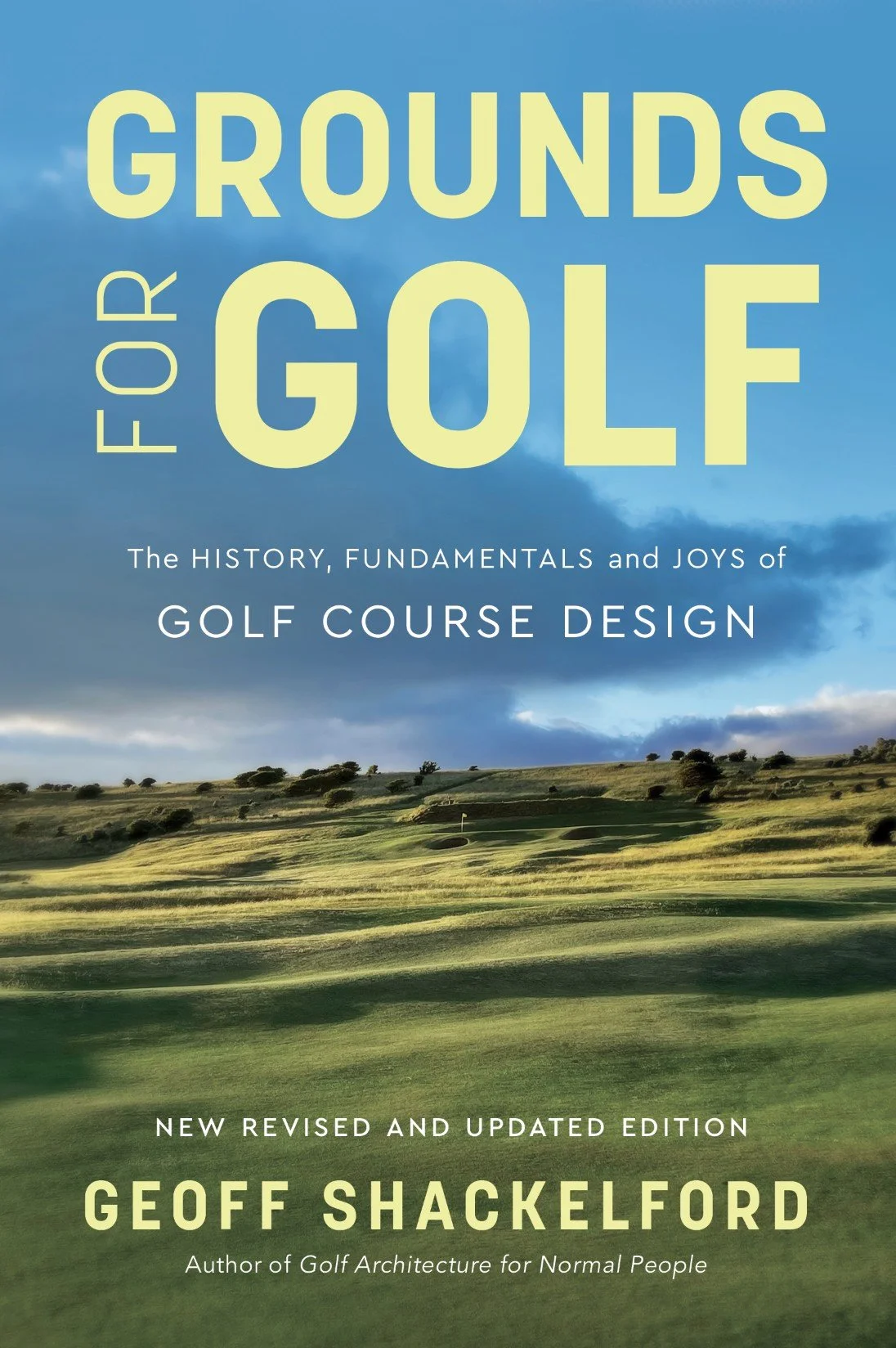
Twenty years later Tatra Press has kindly allowed me to bring back Grounds For Golf now that golf architecture is of more interest to the masses. A new Introduction looks at what’s driven the interest growth and two new chapters I had a blast adding (plus a few edits to keep things up-to-date).
I've been hearing from reader Rob Matre about amateur Russell Henley, winner of Sunday's Stadion Classic on the Nationwide Tour over his home course at the University of Georgia. Rob posted a gallery of images from Sunday's round.
“I can’t even feel my arms,” Henley said. “I was nervous all day. I don’t know how long it will take to sink in. Eight months? Nine months? A couple days? I don’t know. I’ve never done this before.”
The three-time All-America selection finished at 12-under 272 on the University of Georgia Golf Course.
If you want to experience what golf highlights were like in the silent era, here's a B-roll with graphics of the final round in Athens.
This is for all you heathens either (A) not spending Mothers Day with mom or worse, (B) making mom watch the Wells Fargo Championship against her will.
I was mostly to nervous for my man Shackleford to notice the pre-race commercials, but it was hard not to be glued to one that ran during the Kentucky Derby and turned out to be for...Nike golf balls!
Pretty impressive piece of work here, with some golf course damage thrown in. Anyone know what course this is? Looks like something Northern California.
Life isn't a game, of course, but the tragedy behind the glory of Seve Ballesteros was that sometimes he plainly found it hard to distinguish between the two. He wept unashamedly in defeat and was distraught when he finished second as a 19-year-old at the Open at Royal Birkdale in 1976. Ballesteros always lived in the moment, and if such anguish was hard to understand after he had been beaten only by the superstar American Johnny Miller, and tied with Jack Nicklaus, it was soon enough widely understood that the thin, intense youth played only to win. It wasn't considered an ambition; it was a birthright.
He won three Opens along with his Masters titles, and each time he won a major he seemed to journey a little deeper into the improbable, even the surreal.
He could also be awkward. He could shut down a party with a look. That is the kind of power and charisma he had. But he loved the game, he loved to play, he just loved hitting balls. He was more than a golfer, he was a global star. It was such a shame that a life like his should end like it did. They were a very sad last two years, living in a bloody big house overlooking the Bay of Santander with a housekeeper and his brothers popping in. His family lived in Madrid and he was largely on his own. He knew he was dying. It was very sad.
I last saw him a couple of months ago. We went down to film a documentary. He lived in some style. You went into his garage and you discovered a Lamborghini and a Ferrari. He'd had them for years but they had fewer than 4,000 miles on the clock. A dealer friend of mine asked me to ask Seve if he wanted to sell them.
He offered Seve a decent price but he wanted a million pounds each for them because 'they belong to me'.
I first met Seve when he was a teenager at the under 25 championship in Evian.
It was a practice round and this engaging Spaniard arrived on the first tee with some dodgy-looking shoes and minus the full compliment of clubs.
My first question was: who are you caddying for? "I am playing," was the reply.
After a few holes, I realized I was in special company and it was the beginning of a friendship that would last until his untimely death of such a brutal illness.
''He was bloody kind with his time. Any time I saw him going to the practice green I'd head over there as well. He was very free with his advice and he'd spend a lot of time with you, talking you through stuff. For a young guy that was purely inspirational.''
It is no exaggeration to say that we will never see his like again. Quite apart from the fact that the explosion in club and ball technology over the last 20 years or so has left professional golf all but bereft of the subtle shot-making, touch and artistry Seve took to previously unexplored levels, the Spaniard played, to paraphrase the great Bobby Jones' famous description of Jack Nicklaus, "a game with which no-one else was familiar". Added to which he was the ultimate competitor, as his 50 European Tour victories - a record - and 87 worldwide wins so graphically indicate.
The Spaniard won his first major championship at Royal Lytham in 1979, beating a white handkerchief-waving Hale Irwin, a clinically accurate American who only a month earlier had won his national Open. Seve clattered the ball all over the links from the tee but in one of the most staggering performances on a brutally difficult course he holed the most improbable of putts, hit the most perfect bunker shots and then finished off Irwin, Nicklaus, Ben Crenshaw and Australian Rodger Davis when he made a birdie at the 16th after driving into the carpark.
The orthodox and normally ruthless Irwin could not stomach a man burying him on the golf course whilst missing fairway after fairway with a swing that showed little regard for orthodoxy.
"What he did for European golf was what Tiger Woods did for worldwide golf. The European Tour would not be where it is now if it were not for Seve. His allegiance to the European Tour was admirable. I mean the guy was an icon; just an incredible golfer. I've always said most of us could shoot 65 in about 30 or 40 ways. He could do it about 10,000 different ways. He could miss every fairway, chip in five times, hole two bunker shots...what a sad day today. He was so creative around the greens. It didn't matter if there was a tree or bunker, he'd figure out a way to get up and down. He and I had a great duel at Royal Lytham in 1988. It was a great day for each of us. I remember the seventh hole he made an eagle right on top of me. I remember after we played that hole that one of us was going to win because we were both playing so well that day and neither of us was going to back down. He was always very kind to me. Whatever you may have heard about him, his love for the game and his competitiveness was something I learned so much from.
Defending champion Tim Clark of South Africa, who won last year in stunning fashion with a weekend sprint to the top, has asked the PGA Tour to take his nation's flag down a week before usual.
On Clark's direction, his agent called Players Championship media official Laura Hill Saturday evening and asked that the Spanish fly be flown atop the Circle of Champions this week instead of the South African flag, a gesture he is making to Seve Ballesteros, the Hall of Fame player from Spain who died early Saturday of a brain tumor.
Hill got the word to the right people and the Spanish flag will be hoisted over the landmark at the bottom of the hill between the clubhouse and the practice area beginning Sunday morning. At the base of the flag are plaques commemorating each Players winner. Ballesteros never won the tournament but for a week his career will be honored as if he had.
"Obviously, he has been present all the time,'' he said. "Our relationship was so close. I always felt privileged for all the moments that we shared together, and there have been many. Even though I knew what the situation was, when the moment arrives you are never sufficiently prepared.''
Playing partner Colin Montgomerie said Olazabal was "in floods of tears most of the day. He has lost an older brother almost.''
"It was very difficult to get too much out of Jose Maria - he was very tearful and filling up. You could see in his eyes the great loss he feels and they've been a great support for each other. He did well to play at all today,'' said Montgomerie, who partnered with Ballesteros in a number of Ryder Cups. "It was his brother, really. It was a very, very sad day for him.''
Nick Faldo: "I am deeply saddened by the news on the passing of Seve. He had a real impact on me and on my life in this sport. He was a leader; bringing the spotlight to the European Tour, paving the way to European success at the Masters and bringing his relentless passion to the Ryder Cup. Today I would call him, Cirque du Soleil. For golf, he was the greatest show on earth. I was a fan and so fortunate I had front row seat."
The Golf Channel writing team took a crack at the Kentucky Derby and sadly, overlooked the obvious favorite and horse for the ages, Shackleford. New Golf Channel man Jason Sobel writes:
"The Ballesteros family informs that Seve’s neurological condition has suffered a severe deterioration. The family will inform accordingly about any change in his health condition and takes this opportunity of thanking everyone for the support that both Seve and his own family have been receiving during all this time."
I'm sensing an encore season to the Hank Haney-Charles Barkley smash Golf Channel show after watching his opening tee shot at the Senior PGA pro-am. This will also not be a future ad for Nike clubs.
Paul Gittings profiles Martin Hawtree, The Donald's second architect for his Scotland project and next in line to be blamed for something. In the meantime, he talks about creating plans and about fairness, two things you generally don't want to hear when someone is building a links course.
Geoff Shackelford is a Senior Writer for Golfweek magazine, a weekly contributor to Golf Channel's Morning Drive, is co-host of The Ringer's ShackHouse is the author of eleven books.


 I've been hearing from reader Rob Matre about amateur Russell Henley, winner of Sunday's Stadion Classic on the Nationwide Tour over his home course at the University of Georgia. Rob posted a gallery of images from Sunday's round.










