Cordevalle To Get 2016 U.S. Women's Open
/Play at the current home of the Frys.com Open would mark the first time for the Women's Open is played in California since...1982.
Read MoreWhen you come to think of it that is the secret of most of the great holes all over the world. They all have some kind of a twist. C.B. MACDONALD
Ewan Murray comes to Vijay Singh's defense and gets a surprising statement from R&A chief executive Peter Dawson who also is golf's representative with the International Golf Federation, and therefore the Olympic movement.
Singh admitted using the antler spray during an interview with Sports Illustrated. The spray reportedly contains IGF-1, a substance named among those banned by the PGA Tour. Singh's subsequent statement that he did not know what the antler spray contained would represent little or no defence.
That much is straightforward but IGF-1 would be detected only by a blood test, which the Tour does not undertake and, in any case, Singh has not been tested at all.
Dawson said: "You begin to wonder if your testing regimes are right. This is going to cause a lot of soul searching and I wouldn't be surprised if there are changes to procedure."
This is an odd statement for the reason Murray noted: that Singh did not fail a test. It's also strange in that the policy specifically states that even an attempt to acquire a banned substance is a violation. So how is the testing at fault when the policy was violated by an admission of guilt under the policy guidelines?
Also, deviating from the current policy could lead to golf not being in compliance with World Anti-Doping Association guidelines, therefore jeopardizing its place in the Olympics. Some people wouldn't mind that.
Dan Wetzel is the first to take the outrage over wrestling's departure from the Olympic Games in 2016 and directly blame golf's inclusion.

 Thanks to reader Patrick for what may be the first of several questioning golf's inclusion in light of the surprising decision to end wrestling's run as an original Olympic sport.
In part because golf and rugby are coming to the Olympics, something had to go. This time it was wrestling, apparently edged out by the modern pentathlon for survival.
As such, both freestyle (somewhat similar to what you see in American high schools and colleges) and Greco Roman, each of which dated back to the 1896 Games in Greece, will soon be history. Wrestling can try to get back in, but the odds are long.
This is a poor decision and it would be only slightly less poor of a decision if it was modern pentathlon (a five-event competition of fencing, horse riding, swimming, running and shooting) that got the boot instead.
It's golf that should never have been granted access in the first place.
He goes on to make the case that the best Olympic sports are rare collections of the world gathering to compete. And we know that happens multiple times a year in golf.
**Add WSJ's Jason Gay to the anti-golf group following yesterday's announcement:
And while I enjoy watching golf and playing golf, I need Olympic golf as much as my cat needs a Jacuzzi. And golf does not need the Olympics. At all. Golf already has plenty of high-profile professional platforms, both in terms of individual and international team play.
**AP's Jim Litke on the politics behind wrestling's demise and the inclusion of other sports like golf.
Rather, it's the way the IOC tries to cash in by piggy-backing on formerly taboo pro sports and pandering to whatever demographic holds sway at the moment. That's why the Winter Olympics look more and more like the "X Games," and why basketball, soccer and tennis _ with golf and rugby on the way _ are now "core" sports, even though they're chockfull with paid mercenaries and boast championships way more prestigious than anything the Olympics could offer.
What administrative joy this will bring...click to enlarge the email that went out to past amateur participants today:

 Bill Nichols files an update on the Trinity River project ouside Dallas where Coore and Crenshaw have been hired to build a course for AT&T excecutives with the hope of one day hosting the Byron Nelson.
Trinity Forest will be cut in the mold of, say, Chicago Golf Club or Tulsa’s Southern Hills: No water, no trees; but lots of gnarly grasses swaying over a wind-blown landscape surrounded by forest and lowlands.
“The fairways will be expansive with meandering hills,” Coore said. “It will be a natural look with smooth contours that ripple and roll, ever cascading.”
From the highest point of the course, the No. 5 fairway, you can see downtown during winter months. That view will be blocked by trees the rest of the year.
Although there are no dramatic highs and lows, the elevation changes about 35 feet.
The layout promises to reward creativity. Three holes will cross a deep ravine. The most dramatic could be the par-3 No. 8, which goes downhill over the ravine with forest to the right.
ESPN.com's Bob Harig asks, "How is it that Singh is even playing?"
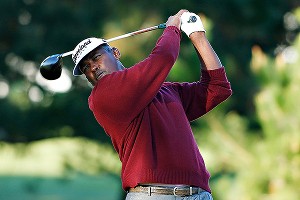 He's referring to admitted doping policy violator Vijay Singh, who is in the field this week at Riviera for the Northern Trust Open as some feel his situation becomes a distraction for the tour each week he plays.
Because his status is under review, Singh is permitted to play, although there is a possibility that any official earnings or world ranking points could be rescinded, depending on the outcome of Finchem's investigation.
This much is clear: If Singh took a banned substance, knowingly or not, he has to be penalized by the tour's own rules. Ignorance is not a defense, nor is the argument that deer spray or IGF-1 is ineffective; it has been on the tour's banned substance list since the drug testing program began in 2008. Players were warned in 2011 about deer-antler spray in literature and emails widely circulated.
Doug Ferguson also submits a commentary suggesting that Singh should take a leave of absense until his situation is resolved.
Under the anti-doping policy, the Tour is required to disclose the name, confirm the violation and declare the penalty.
So far, there has been silence.
This is not a call for the Tour to rush to judgment. Singh's case is muddled. Yes, a player who admits to using a banned substance is the same as a player testing positive. But is there evidence that IGF-1 was in the spray that Singh was using? More than one doctor has said it's impossible for IGF-1 to enter the blood system through a spray. And the Tour does not have a blood test, anyway.
Plus, players have the right to appeal, and the policy says a hearing must take place within 45 days.
Singh brought this mess on himself, and now is the time for him to give back to the game that has provided him with so much. Singh could eliminate this distraction by taking a leave of absence until the Tour sorts this out. The sooner the better.
**James Corrigan in the Telegraph sees it the other way, responding to much of the criticism in Europe, though this discounts the doping violation language which does not require a positive test. An admission of attempting to take a banned substance is enough.
The Tour will also know by now that minute quantities of IGF-1 may be found in milk and beef and many other products it would not think to outlaw. It will have heard the generally held view of the experts that it is impossible to absorb IGF-1 in the body if it is not injected.
Indeed, it may well prove the case that Singh was actually less ignorant than the authorities.
The lynch mob are loudly baying for Singh’s sporting life. They would presumably be satisfied with the potential scenario of a man being banished from his profession for unknowingly doing nothing wrong?
This absurdity is where hysteria has taken sport and the vigilantes’ demand for action is set to become more shrill with the revelations of widespread doping in Australia. The temptation is to declare that here is a simple case of good against evil. But it is not necessarily black and white. The Singh affair shows it can be a mess of grey.
Golf Channel's parent company is all in now!
From Yahoo news.
Now before you go wondering how someone can play like Brandt Snedeker has with "sore ribs" do remember that he has rib issues before, including playing with a cracked rib last year.
 Rex Hoggard reports on Snedeker's WD from next week's WGC Match Play:
Snedeker’s Sea Island (Ga.)-based trainer Randy Myers told GolfChannel.com that he strained the rib during a practice round at the Humana Challenge and re-aggravated the injury on Thursday at Pebble Beach. Snedeker had an X-ray on Monday in California and is awaiting the results of that test. He plans to return to Nashville, Tenn., later this week to meet with his doctor, Dr. James Elrod.
“He felt like he was playing well enough after the Humana he wanted to keep playing,” Myers said. “His biggest concern is he worked so hard to become a No. 1 seed (for the Match Play) and he’s played well there, (but) this is just preventative.”
The reigning FedEx Cup champion could return in time for the WGC-Cadillac Championship in March.
Snedeker sustained a cracked rib at last year’s RBC Heritage and missed the better part of the next three months recovering.
Note in the press release the part about recent winners of the PubLinks...
USGA ANNOUNCES SERIES OF CHANGES TO FUTURE CHAMPIONSHIP ROSTER
Introduces U.S. Amateur Four-Ball Championships in 2015, Marking First National Championships to Be Added to USGA Competition Roster in More Than 25 Years
Announces Plans to Retire U.S. Amateur Public Links Championships After 2014
Far Hills, N.J. (Feb. 11, 2013) – The United States Golf Association (USGA) today announced the introduction of two new championships, the first national championships to be added to the USGA’s competition roster in more than 25 years. The addition of the U.S. Amateur Four-Ball Championship and the U.S. Women’s Amateur Four-Ball Championship, which will be played annually between mid-March and late May with the inaugural events scheduled for 2015, reflects the Association’s continued commitment to supporting and growing amateur competition well into the future.
The last time the USGA added a national championship for individual golfers was in 1987 with the creation of the U.S. Women’s Mid-Amateur Championship.
“We couldn’t be more excited about the creation of national four-ball championships, given the popularity and enjoyment of this competitive format at the amateur level,” said USGA Vice President and Championship Committee Chairman Thomas J. O’Toole Jr. “Because the four-ball format lends itself to spirited team competition and aggressive risk-reward shotmaking, we are confident these championships will deliver exciting amateur golf to the national stage for both players and spectators alike.”
Eligibility for both national four-ball championships will be limited to amateurs, with no age restrictions. Team partners will not be required to be from the same club, state or country, and substitution of partners will be permitted until the close of entries. Entry is limited to individuals with a USGA Handicap Index® not to exceed 5.4 for men and 14.4 for women.
The USGA’s national amateur four-ball championships will begin with sectional qualifying at dozens of sites across the nation. The U.S. Amateur Four-Ball and U.S. Women’s Amateur Four-Ball will consist of 128 and 64 two-player teams respectively, each playing their own ball throughout the round. Each team’s score will be determined using their better-ball score for each hole. After 36 holes of stroke-play competition, the field will be reduced to the low 32 teams for the match-play portion of the championship.
Four-ball has become a widely popular format for State and Regional Golf Associations across the United States. In 2012, more than 150 championships, either strictly four-ball or as part of a competition format, were conducted in all 50 states and the District of Columbia.
“We appreciate the support and energy that the USGA is bringing to these new four-ball national championships,” said Jim Demick, executive director of the Florida State Golf Association, who served on the advisory group of State and Regional Golf Association executives and tournament directors consulted by the USGA. “Along with my fellow associations around the country, we look forward to showcasing this unique brand of team competition through what promise to be first-class events.”
Host sites for the inaugural U.S. Amateur Four-Ball Championship and U.S. Women’s Amateur Four-Ball Championship will be announced by the USGA at a later date.
In conjunction with the creation of two national four-ball championships, the USGA also announced the retirement of the U.S. Amateur Public Links (APL) and U.S. Women’s Amateur Public Links (WAPL) championships, following the completion of the 2014 competitions. The decision follows an internal review which determined that the APL and WAPL championships no longer serve their original mission because of the widespread accessibility public-course golfers today enjoy in USGA championships.
The U.S. Amateur Public Links was first played in 1922, and is the fourth-oldest championship conducted by the USGA. The APL was established to provide public golfers with access to a national championship because, at that time, the U.S. Amateur Championship was restricted to players from USGA Member Clubs. The U.S. Women’s Amateur Public Links was established in 1977, for the same reason as the APL. In 1979, however, the USGA modified the entry requirements for the U.S. Amateur and U.S. Women’s Amateur championships to allow entry to public-course players.
“While our fondness for these championships made this decision a difficult one, we will continue to proudly celebrate the legacy and important role that the APL and WAPL have had on the game by forever honoring them in the USGA Museum, as well as in other appropriate ways,” said John Bodenhamer, senior managing director of Rules, Competitions & Equipment Standards for the USGA. “We also wish to express our heartfelt gratitude to all the champions, participants, host clubs, volunteers and benefactors who, over the years, helped build a strong legacy of public links competition.”
Over the course of their existence, the U.S. Amateur Public Links and U.S. Women’s Amateur Public Links championships have assembled a rich history across the competitive golf landscape, and are part of the USGA’s long heritage of supporting public golf. The competitions boast an impressive lineup of champions including most recently: Billy Mayfair (1986); Tim Clark (1997); Trevor Immelman (1998); Ryan Moore (2002 and 2004); Brandt Snedeker (2003); Yani Tseng (2004); and T.J. Vogel and Kyung Kim (2012). These championships have also contributed to the USGA’s record books: Michelle Wie (2003) became the youngest champion in USGA history when she won the WAPL at age 13; Ryan Moore (2004) became the first golfer to win the APL and the U.S. Amateur in the same year, while Colt Knost matched the feat in 2007; and Pearl Sinn (1988) and Jennifer Song (2009) won both the WAPL and U.S. Women’s Amateur in the same year.
In addition to staging the U.S. Open Championship at public courses, the USGA continues to grow public golf, and support all golfers, through its various programs, including Rules of Golf education, Course Rating services and Turf Advisory Service visits. Through its partnership with national organizations such as The First Tee, LPGA-USGA Girls Golf, The PGA of America and the National Alliance for Accessible Golf, the USGA supports numerous programs that benefit junior golfers, beginning golfers and golfers with disabilities who play at America’s public golf courses. With the development of its new pace-of-play initiative, the USGA hopes to serve golfers by helping public courses identify ways to reduce the time it takes to play the game.
**The format of the new event, from the USGA interview on Morning Drive today:
Q. You'll have sectional sites and then you will have stroke play that will turn into match play for the final 32 teams, both the men's and the women's, correct?
JOHN BODENHAMER: The specific format will be on the men's side, there will be a full field after qualifying, 256 players or 128 teams or sides that will ‑‑ again, the men's competition will play a 36‑hole stroke play qualifying, the low 32 teams will advance into match play, and that will culminate with an 18‑hole final match to identify our champion. And on the women's side we'll start with 128 players, 64 teams or sides that will then qualify out of stroke play qualifying. Again, the low 32 teams will play match play into an 18‑hole championship final to identify our women's champion.
Regarding the Masters spot traditionally given to the Pubic Links winner:
Q. And finally on this, Augusta National Golf Club has always celebrated the amateur, and obviously by extending the invitation to the winner of the Pub Links. Has there been any discussion with them? Are they receptive to the idea that this is an invitation that they have honored so the idea that this is going away, that is a spot in the field which I know you hate to lose that because it's such a great link. Have you had lengthy discussions with Augusta National and their what are their thoughts about this?
JOHN BODENHAMER: Well, we've not had lengthy discussions with Augusta National, and frankly they've been most gracious over the years I think since 1988 in extending that wonderful exemption. I think it would be ‑‑ I think the fairest way to answer that would be to allow Augusta National to answer that. It's their exemption, and they would be apt to address it.
**Keegan Bradley tweeted his response, which was skeptical.
Arron Oberholser was downright satirical.
Adam Schupak brought back an old David Fay quote suggesting the former Executive Director was leery of doing away with such an event.
Julie Williams talks to saddened women who played in the US Womens Amateur PubLinks.
Geoff Shackelford is a Senior Writer for Golfweek magazine, a weekly contributor to Golf Channel's Morning



Copyright © 2022, Geoff Shackelford. All rights reserved.