Ridley's First Glance At Tiger's Drop: "Splitting Hairs"
/On the day the
Read MoreWhen you come to think of it that is the secret of most of the great holes all over the world. They all have some kind of a twist. C.B. MACDONALD

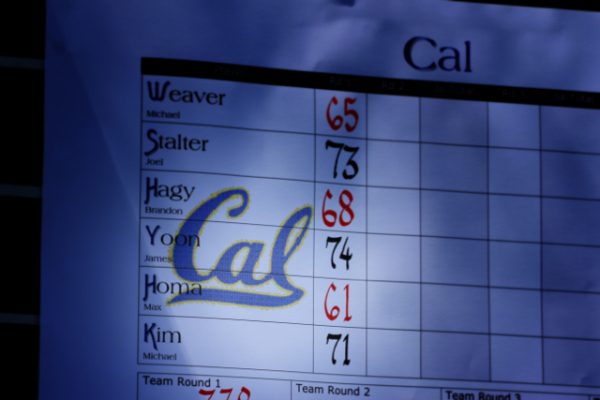
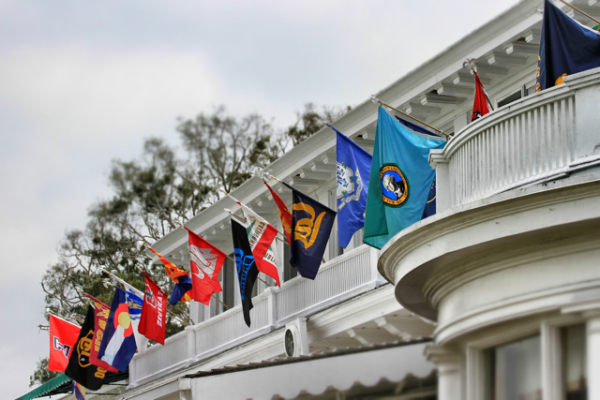
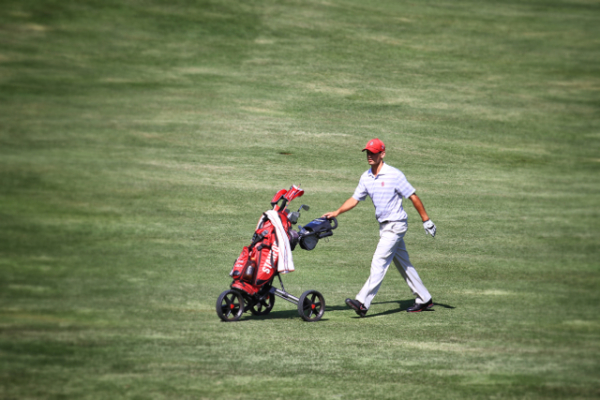
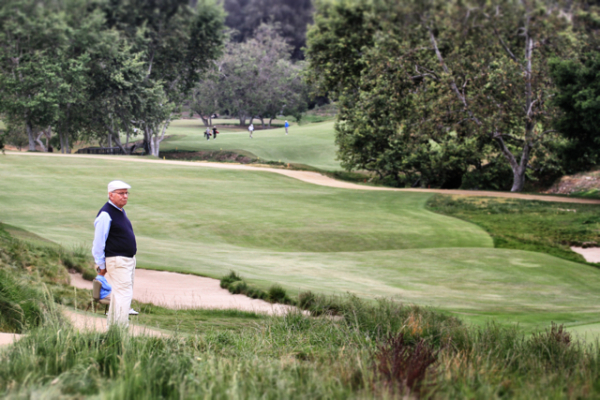
Thanks to some stellar play under difficult conditions, the lucky few taking in round three of the Pac 12 Mens Golf Championships were treated to some fantastic golf. While the scores didn't quite match the incredible opening day scoring, the precision play inspired by U.S. Open greens (almost 14 on the Stimp, extremely firm) and George Thomas and Billy Bell's architecture revealed the level of talent in the Pac 12.
I'll leave the summary to the Pac 12's website where you can also see scores and a photo gallery. Also, Golfstat has the individual and team leaderboards.
Instead, a few random observations from L.A. North prior to final round play.
-- I spent most of the morning watching Stanford's Patrick Rodgers and the afternoon following Cal's Max Homa, UCLA's Jonathan Garrick and Washington's Chris Williams. All impressed with their swings, attitudes, precision and short game while playing the course intelligently...other than the painful sight of their repeated rangefinder use.
--Ahhh yes, the rangefinder. What a waste of information on a course with firm greens where yardages to the flagstick mean so little. Which is probably why players still check sprinklers, yardage books or simply walk the numbers off if they are within 80 yards of the green. Speed up play? Rangefinders, they do not.
-- The aforementioned players and many others I saw from various Pac 12 schools are placing the ball in unfathomable locations off the tee. That would be my nice way of saying they hit the ball absurd distances. The next time I hear the governing bodies insist driving distances have peaked, I now have photographs of young lads in fairway landing areas so far beyond what hazards that even they might have a hard time justifying their decade long indifference to the obvious. Peter Dawson recently said on anchoring, better late than never!
--UCLA trails by two strokes. UCLA's Pontus Widegren was penalized two shots in a second round 75 for just barely missing his afternoon tee time after he was changing to the prescribed second round UCLA team shirt. Because the first round was running long, Widegren only had a few minutes to change.
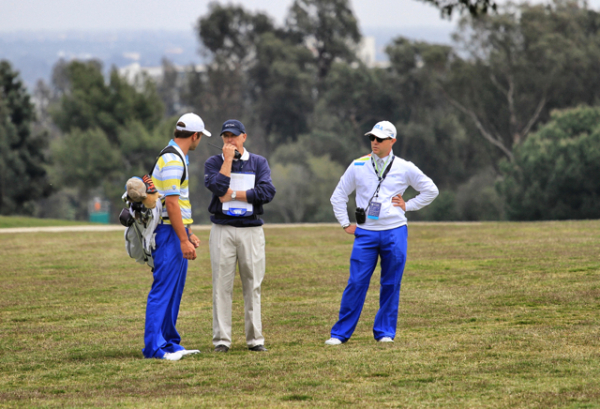
I'm not sure how quickly I'll get to post round 4 observations and photos, so here's a big gallery from the first two days:
















I'm out watching PAC 12 golf but I know you need an outlet to express your joy at the heartwarming news of Vijay's acquittal on admitting to having purchased a banned substance.
**John Strege explains the decision.
And the statement...
PGA TOUR Statement Regarding Vijay Singh
The PGA TOUR Anti-Doping Program, which has been in effect since July 2008, closely follows the International Anti-Doping Standard set forth by the World Anti-Doping Agency (“WADA”) particularly as it relates to the interpretation and application of the List of Prohibited Substances and Methods.
In a January 28, 2013 article that appeared on SI.com, Vijay Singh was quoted as admitting to his use of a deer antler spray supplement. Subsequently, Mr. Singh confirmed his use of deer antler spray in a statement he issued. Deer antler spray contains IGF-1, a growth factor listed on both the WADA and PGA TOUR Prohibited Lists, which the TOUR warned players about in August 2011. After the SI.com article came out, WADA also issued a warning about deer antler spray on February 5, 2013.
There is no test for IGF-1 currently available in routine blood testing. However, the PGA TOUR Anti-Doping Policy provides that an admission to the use of a prohibited substance is a violation of the policy even if there is no positive drug test. After confirming the presence of IGF-1 in the deer antler spray product provided to the TOUR by Mr. Singh through tests at the WADA-approved UCLA laboratory, the TOUR proceeded with the matter as a violation of the PGA TOUR Anti-Doping Policy, and a sanction was issued. Mr. Singh subsequently appealed the sanction under the PGA TOUR Anti-Doping Program guidelines. During the appeal process, PGA TOUR counsel contacted WADA to confirm a number of technical points. At that time, WADA clarified that it no longer considers the use of deer antler spray to be prohibited unless a positive test results. Indeed, on April 30, WADA subsequently provided written confirmation to the TOUR that:
“In relation to your pending IGF-1 matter, it is the position of WADA, in applying the Prohibited List, that the use of "deer antler spray" (which is known to contain small amounts of IGF-I) is not considered prohibited.
On the other hand it should be known that Deer Antler Spray contains small amounts of IGF-1 that may affect anti-doping tests.
Players should be warned that in the case of a positive test for IGF-1 or hGH, it would be considered an Adverse Analytical Finding.”
Based on this new information, and given WADA’s lead role in interpreting the Prohibited List, the TOUR deemed it only fair to no longer treat Mr. Singh’s use of deer antler spray as a violation of the TOUR’s anti-doping program.
Since his initial quote was made public, Mr. Singh has cooperated with the TOUR investigation and has been completely forthcoming and honest. While there was no reason to believe that Mr. Singh knowingly took a prohibited substance, the PGA TOUR Anti-Doping Program clearly states that players are responsible for use of a prohibited substance regardless of intent. In this regard, Mr. Singh should have contacted the PGA TOUR Anti-Doping Program Administrator or other resources readily available to players in order to verify that the product Mr. Singh was about to utilize did not contain any prohibited substances, especially in light of the warning issued in August 2011 in relation to deer antler spray.
Going forward, the PGA TOUR is committed to increasing its educational initiatives to remind players of the PGA TOUR Anti-Doping Program and the risk of utilizing any product without a full understanding of the ingredients contained in that product. Such educational initiatives will include reinforcing with its members the many resources available to them on a 24/7 basis to respond to any questions they may have concerning any product.
The PGA TOUR recognizes that the science of anti-doping is an ever evolving subject, and the TOUR will continue to work with its consultants and WADA to stay abreast of all current developments in this area. This will include staying abreast of developing policies and procedures, specifically with regard to testing for growth hormone and IGF-1. When fully implemented tests for those substances become available in routine blood testing, the TOUR will continue to monitor the situation and make changes to the policy as necessary or appropriate.
 Golf has lost one of the great superintendents and people in Stan George, Prairie Dunes' caretaker for the last 30 years.
This Saturday Ballantine's Championship drive by former Open Championship winner Louis Oosthuizen is destined to be a classic for a number of reasons. Best of all may be the camera work, announcing and the obliviousness of the fans to the ball.
Just watch, you'll see what I mean:
Brett Rumford won the Ballatine's.
Fun and funny new CBS golf ad starring Feherty and Nantz…now if Nantz would just get in the studio to record Hello Friends...
The Australian's Will Swanton caught up with the Shark and besides pretty much calling Vijay Singh a cheater, Greg Norman said it's time for golf's "disgraceful" testing to branch out to include blood tests.
PGA Tour Commissioner Tim Finchem, who long opposed drug testing and who has not been in a hurry to add blood testing for stuff like HGH, probably has downgraded the Shark's buddy status to 1995ish, when the two giant (egos) of the game were less chummy.
"You have to have blood testing, simple as that. It's a pin prick for a player, and you find out what's going on. If you're the head of golf or any sport, if you're the commissioner for a sport, it's your responsibility to make sure your sport is clean. That should be your No 1 priority."
"You only have to look at what happened to Vijay Singh just recently to know the drugs issue is there," Norman told The Australian yesterday.
"We know that because Vijay Singh got caught. How deep it is, I have no idea because we only do urine analysis instead of blood testing. If you really want to be serious about it and find about what's really going on, we need to do blood testing. I think it's disgraceful, to tell you the truth. The golf associations have to get together and step it up.
John Paul Newport profiles Arnold Thiesfelt, a retired ad exec, who has a book out about the wild and crazy Time Inc. days when the expense account was more liberal and yes, the golf ball didn't go so far!
To hear Arnold Thiesfeldt tell it, golf has changed a lot in the last 50 years, and not much for the better. Courses are too difficult. The ball goes too far. Costs are out of hand. "People take the game too seriously," he said. "The camaraderie isn't what it used to be."
 Even better are his stories about spending to help Time Inc. sell a few more ads...
As late as 1997, Sports Illustrated paid big money for 20 VIP seats for clients to travel on the Concorde to Spain with the U.S. Ryder Cup team for the matches at Valderrama.
Selling was more collaborative 40 years ago. The ad agencies had big staffs with which the magazine guys worked to develop plans and marketing gimmicks. Nowadays, companies use "more of a math equation," a former executive said. Changes in the tax code, tighter federal regulations on entertainment practices and the overall decline in print-ad sales have also had an effect.
Geoff Shackelford is a Senior Writer for Golfweek magazine, a weekly contributor to Golf Channel's Morning







Copyright © 2022, Geoff Shackelford. All rights reserved.