
Sunnylands In The International Diplomacy Spotlight
/Larry Bohannan says Friday and Saturday's
Read More
It’s back!
Twenty years later Tatra Press has kindly allowed me to bring back Grounds For Golf now that golf architecture is of more interest to the masses. A new Introduction looks at what’s driven the interest growth and two new chapters I had a blast adding (plus a few edits to keep things up-to-date).
The Amazon purchase page for the book arriving June 15, 2026.

I'm particularly interested in the course stats component promising an "interactive look at statistics and trends for each hole."
And For Immediate Release...
U.S. OPEN APPS NOW AVAILABLE
iPad application new for 2013; iPhone, Android device apps upgraded
Far Hills, N.J. (June 5, 2013) – The United States Golf Association (USGA) today launched U.S. Open applications for iPhone, iPad and Android devices. These user-friendly apps are designed to bring the excitement of the 113th U.S. Open Championship to fans around the world. The U.S. Open will be played at Merion Golf Club in Ardmore, Pa., June 13-16.
New for this year is a data-rich, scoring-centric iPad app, developed by IBM. Detailed player information along with scorecards, statistics, groupings, starting times and live Marquee Group coverage throughout the championship highlight the tablet experience for iPad users. The app also features hole insights, which provide fans with an interactive look at statistics and trends for each hole. A personalized live leaderboard option that allows users to track up to five of their favorite competitors is also available.
Powered by IBM cloud computing and analytics technologies, all applications provide users with access to live HD video streaming, real-time scoring, live updates, news and photos. Their user-friendly design will provide fans on the go with up-to-the-minute information and statistics from America’s premier golf championship.
Mike McCarley's most recent email to the Golf Channel community announced the addition of 52 more employees via the acquisition of two tee sheet software companies to compliment GolfNow, the OpenTable of golf. Included in the acquisition is a company based in Europe, which one can read a lot into. Or not.
 From the Golf Channel head's note to the staff after Golf's Longest Day coverage, note the ambitious last sentence...

More from the Nicklaus Museum. Parts 1 and 2 are here.
Part 3 is the famed one-iron from 1972 U.S. Open at Pebble Beach and 1967 U.S. Open at Baltusol with insights from curator Steve Auch.
My favorite segment is part 4, the "White Fang" putter painted by Barbara, gripped by Deane Beman (with a now illegal golf pencil insert), then it disappeared, and then it was recovered after someone brought it to a birthday party for one of the Nicklaus children.
Part 5 looks into the museum's Masters display, including his 1975 shirt and the story behind the 1986 putter.
Doug Ferguson's AP notes includes this from Johnny Miller, who misses the old U.S. Open of high rough, chipping out and uh, more rough. He should get his wish at Merion.
''I think it lost its identity, personally,'' Miller said. ''I don't agree with that one bit. To me, the U.S. Open is supposed to be the ultimate test. ... I just thought like at Torrey (Pines), they set it up like an old Andy Williams with distance. Not that it wasn't a good Open - it was a great Open. But I like the rough, personally.''
Those who've seen it have said the putting green tee option for the 464-yard 14th at Merion is "awkward" at best, downright goofy at worst. Do look for that as the aerial tour begins over the putting green.
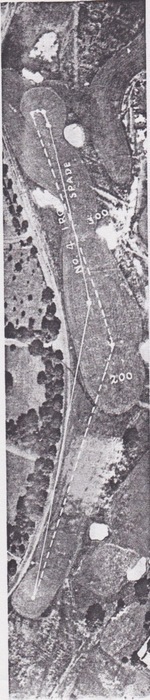 (Click to enlarge)More disappointing is the lack of space to hit the ball to drive the ball, especially when compared to the look in 1930 when the road to the left was a key hazard and one that, when flirted with, shortened the hole.
Now it's "high fescue rough" obviously designed to make the hole play longer in the face of intense core work by today's pros, but also means it plays less strategically.
Here's a scan of a photocopy of how Bobby Jones played the hole in the two stroke play of the 1930 U.S. Amateur.
The video:
Watching the Golf Channel highlight package from Golf's Longest Day you hate to dwell on the negative. But I will!
Adam Schupak wonders about all of the WD's--22 to be exact who couldn't be bothered to finish the 36-hole Sectional qualifier at the Colonial site--and offers a solution. Worse, many quit mid-round, which disrupts the pacing in a group and is particularly obnoxious if a player in the group has a chance to qualify.
Not surprisingly, most of the WD's were PGA Tour members saving their energy for the 29th major this week in Memphis.
I think it’s high time the USGA penalize players who withdraw from the qualifier. If the USGA wanted to eliminate the problem in an instant, it could decrease the number of spots available at sites based on WDs, but that wouldn’t be fair to the players who keep playing. So here’s what I propose: If a golfer WDs from the sectional, he forfeits the opportunity to skip local qualifying the following year (a privilege granted to Tour pros). I bet that would make guys think twice about walking off in the middle of a round. For one, it’s not fair to your playing partners. It can screw up pace of play. Threesomes became twosomes having to wait behind threesomes. In fact, so many players withdrew at Colonial that I witnessed three empty holes on the South Course.
This is for the right to play for our national championship. Show a little respect and go the distance.
It was one thing when they crashed the Broadmoor, but another in the middle of the San Fernando Valley.
A CBS 2 News report on the Black Bear that showed up at Knollwood CC in Granada Hills.
Thanks to reader Tuco for sending and Shane Bacon for finding this Adam Sarson GIF of Tiger's swings from wee lad to today. 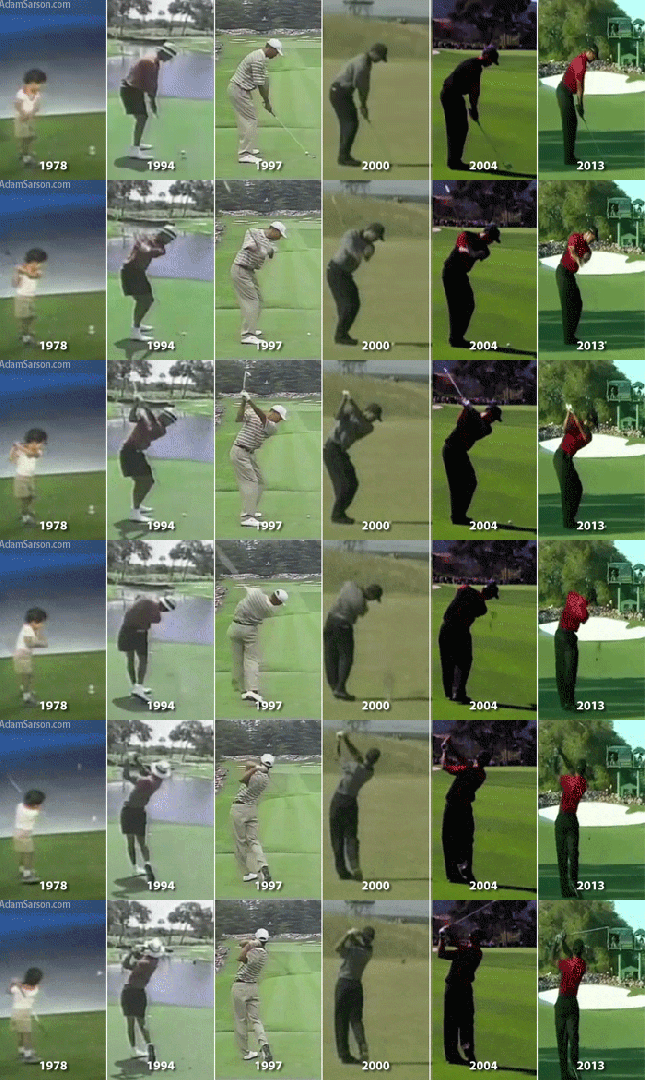 Cool stuff.
The tiny 13th is listed at 115 yards but can play about 15 yards longer than that, or, more tanatalizingly, shorter with the possibility of a yardage listed under 100 yards should the USGA decide to lighten the mood.
The putting surface is only 20 yards deep.
While year two of Golf Channel's extensive "Golf's Longest Day" coverage didn't yield the same number of unforgettable on-course moments as the inaugural effort, the marathon day of coverage paid off again with a few fine moments and overall sense that this day is why we love our sport. That was best proven by the player interviews with golfers genuinely grateful to be heading to Merion made for great television. But also credit Golf Channel for giving the actors in this drama time to talk and share what qualifying for the U.S. Open means.
 Technically, the daunting effort to cover 11 sites was superior to last year, with the use of attractive and easy-to-follow graphics standing out. The on-site coverage from Merion, where there was no qualifying, seemed more disruptive than informative. Perhaps in future years there can be a little more affection for the regional and state golf associations that are running the U.S. Open Sectional Qualifiers for the USGA, and a little less on the blue coats who get plenty of attention a week later.
Either way, the point of the ambitious coverage is to whet our appetite for the U.S. Open and share the many satisfying rags-to-riches stories that come out of the Sectionals, and once again Golf Channel succeeded wildy.
Rusty Miller sums up the Columbus qualifier that ended with an 11-player qualifier for 7 spots and was led by Charley Hoffman fresh off a final round 81 at the Memorial.
Jeff Rude was at Columbus and focused on final qualifier Luke Guthrie who eliminated Mike Weir, Steve Flesch and Jason Kokrak with a 5-footer. Flesch, who has been juggling playing and commentating, had son Griffin on his bag for the first time ever and the young lad Tweeted about the day.
Guthrie Tweeted his joy:
Wow! I'm so pumped for an opportunity to compete for the US Open! Pretty intense out there in the playoff! Thanks for all the messages!
— Luke Guthrie (@LukeGuth1) June 4, 2013
But the most fun qualifier was at Century CC and Old Oaks in Purchase, NY where Canadian Tour player Jesse Smith led the way over 18-year old Gavin Hall and 48-year-old Geoffrey Sisk who punched his fifth U.S. Open ticket.
Jerry Foltz wrapped up the coverage in this report.
David Dusek on the brief thrill Brandon Matthews had in easily the most exciting moment of Golf's Longest Day coverage. Though he didn't make it, Matthews is still an alternate. There is no clip online right now, but his unplayable lie and chip in was easily the best moment of the broadcast.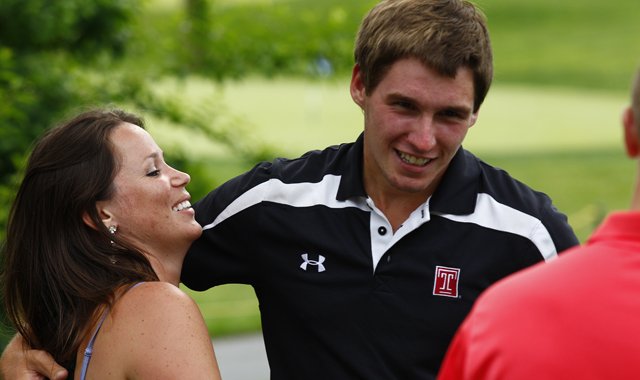 Dusek also writes about 18-year-old Gavin Hall, whose final of four straight birdies was caught by Golf Channel.
Barry Svrluga reports on Sam Saunders' near miss that included a four-inch putt, Fred Funk missing by two and Lee Janzen's DQ for wearing spikes at a course where spikes weren't allowed and where competitors were told they were not allowed.
Jay Coffin obtained a copy of a letter sent to contestants of the Woodmont qualifier with the second item that says: "Steel spikes are not permitted for the qualifying rounds or for practice rounds. It is a condition at all qualifying sites, unless otherwise indicated by an asterisk on the entry application …"
Kay Cockerill covered Lee Janzen’s disqualification for wearing steel spikes and interviewed Michael Cumberpatch Mid-Atlantic Golf Association.
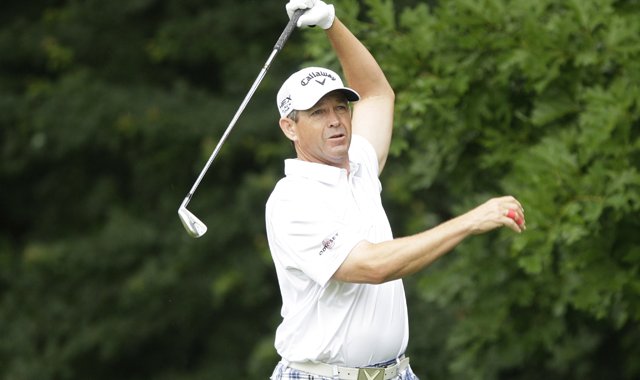 Golfweek notes from the Woodmont qualifier.
Adam Schupak reports from Memphis where Kevin Sutherland was medalist, former NCAA champion Scott Langley made an ace and Cinderella story Brandon McCrick is in, too.
Cassie Stein's notes from the Ball Ground, Georgia qualifier where Nicklaus Award winner Michael Kim arrived after a quick trip to Columbus to collect the award for top college player made it through to Merion.
Rex Hoggard reports from Newport Beach where a struggling Bio Kim easily qualified while NCAA Individual Champion Max Homa made it through in a playoff. Cal's Homa has already taken to Twitter to request a practice round with Stanford's Tiger Woods.
@tigerwoods just won PAC 12s, NCAA championship, and qualified for the us open. Any chance I can get a practice round with u?? #hero
— max homa (@maxhoma23) June 4, 2013
Nick Masuda's notes from the Bradenton qualifier where two players return Tuesday morning for a one-spot playoff.
Andy Zunz's five things from the St. Louis qualifier where 54-year-old Jay Don Blake stole the show.
Brentley Romine's notes from the Springfield qualifier.
The USGA's main Sectional page with links to photos and scoring, with stories to come in the night.
Golf Channel's results page and their Twitter feed page from the day.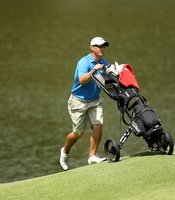 Golfweek has a photo gallery from Hawks Ridge, including a push cart shot. Cover your eyes golf snobs!
The USGA has photos from 10 of 11 sites and here they are:
Newport Beach
Bradenton
Ball Ground, Georgia
Rockville, Maryland
St. Louis
Purchase, New York
Columbus, Ohio
Springfield, Ohio
Dallas, Texas
Cle Elum, Washington
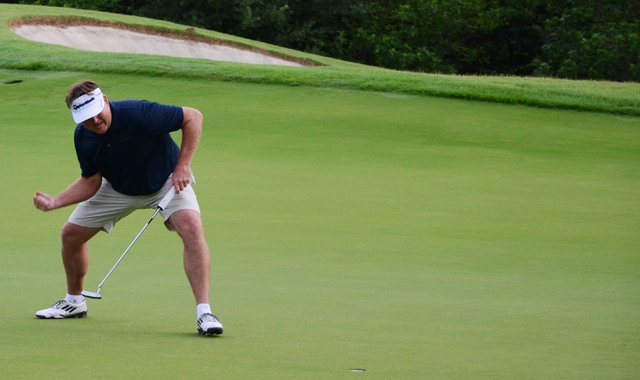 **Nick Masuda on "Trump protege" (the poor man works for The Donald) John Nieporte, who qualified in Bradenton. And yes, the name does look familiar because it is. He's the son of longtime Winged Foot head pro Tom.
Strong analysis of Tiger Woods' Memorial week--in case you were suddenly down on the lad's chances at Merion--starting with this from Robert Lusetich.
Yet at Memorial Woods hit 46 of 56 fairways — good for fifth in the field — and drove it not just straight but long.
It reflected the work Woods has put in to his driving game given the importance of tee shots at Merion, a tight course where the winner won’t have played from the long rough.
In Ohio, his short irons were inconsistent, his short game bad and his putting was abysmal.
That’s a cause for concern, but those facets of his game have been strong points all year.
And then there’s the fact that it wasn’t a slow bleed.
Woods made 15 birdies — and missed countless other chances — but uncharacteristically blew up, making three double bogeys and two triples, something he hasn’t done in a tournament in 16 years.
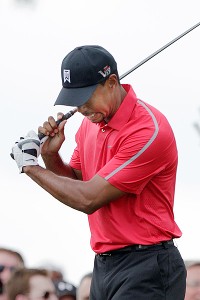 Gene Wojciechowski went to the top for advice on Tiger.
And just to make the point, Nicklaus told a story.
"I'll give you this one," he said, smiling. "Last U.S. Open I won I shot 72-79 the week before. I missed the cut. Atlanta. OK, how's that? And then I broke the Open record.
"So I wouldn't read too much into that."
Nicklaus got most of the facts right.
He did miss the cut at the 1980 Atlanta Classic at the Atlanta Athletic Club, but he shot 78-67. And sure enough, he went to Baltusrol and broke his own U.S. Open record for total score (272) -- a record that stood until McIlroy's performance at Congressional in 2011.
I'm with Nicklaus. I wouldn't read too much into what Woods did here. He has won big here and he's stunk it up big here too.
Three of his worst 22 finishes as a pro have come at Memorial. It happens.
Meanwhile those sleepless nights for many of you can end now that agent Mark Steinberg reveals to Bob Harig that Tiger is just about ready to sign a new deal and that he hopes it's viewed as a "bold statement." The deal will be done as soon as Steiny stops yapping to the press about it and gets the paperwork in front of Tiger, Tiger says.
This was interesting:
Earlier this year, Golf Digest, as part of an annual report on golfer's incomes, put Woods' earnings at $77-million off the course in 2012. It did not break down what he received from Nike, although the figure is believed to be more than $20 million per year. Sports Illustrated, however, as part of a recent compilation called "The Fortunate 50," pegged his total compensation at closer to $40 million annually.
Steinberg would not confirm specifics of those reports, saying only that "those numbers are traditionally low."
Traditionally low?
Geoff Shackelford is a Senior Writer for Golfweek magazine, a weekly contributor to Golf Channel's Morning








Copyright © 2022, Geoff Shackelford. All rights reserved.


