
The Ultimate Club Pro Signs Off
/Peter McCleery of Golf Digest files a nice read on longtime Oakmont head man Bob Ford
Read More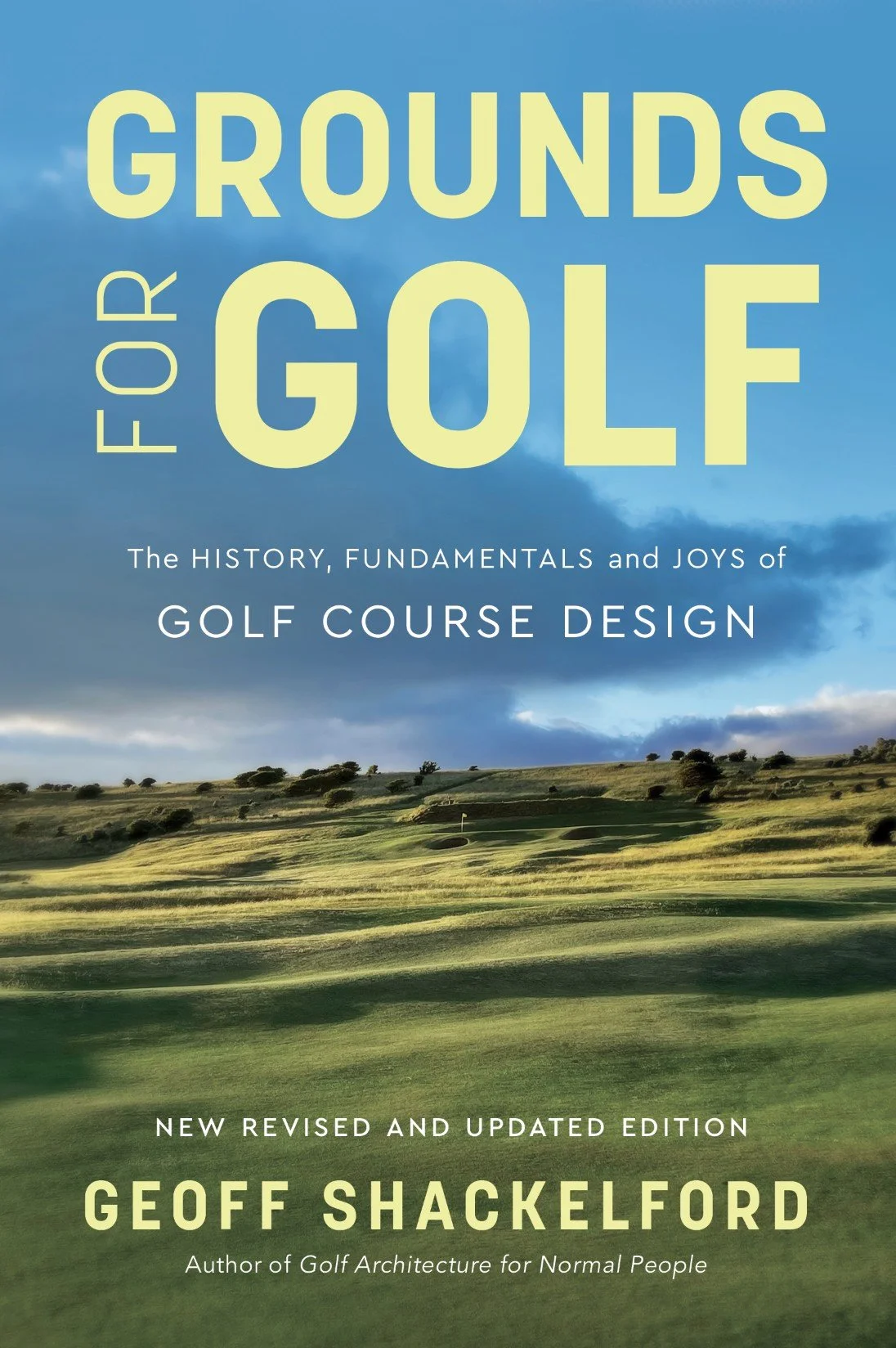
It’s back!
Twenty years later Tatra Press has kindly allowed me to bring back Grounds For Golf now that golf architecture is of more interest to the masses. A new Introduction looks at what’s driven the interest growth and two new chapters I had a blast adding (plus a few edits to keep things up-to-date).
The Amazon purchase page for the book arriving June 15, 2026.

A case could be made that the 11th is the least interesting hole at Oakmont, playing uphill to a landing area the golfer can't see and forcing a lay-up for most of today's players who have not managed to boost driving distance averages since 2003.
The green slopes from back left to front right but should give up plenty of birdies. A nice thing since there aren't many left after this.
The flyover:
The par-5 12th featured fairway contour issues last time around that let to the field's GIR finishing at only 44% according to the USGA. Those issues have hopefully been fixed. Tees will be moved around here to offer the look of a reachable five a legit three-shotter. The ingredients here are all pretty spectacular and hopefully the setup is better this time around.
Nice spot by golf.com of this Brazilian bird called a "Siriema" bouncing a golf ball off a path. Presumably, the bird thinks these are eggs.
After the second strike-out trying to crack the egg, it is properly freaked out.
Stunned because the timing for a book is a bit surprising.
 Thrilled because some of the topics mentioned in the release sound as if he'll expand on some of the more interesting thoughts shared with co-author Lorne Rubenstein for a Time interview earlier this year. And Tiger has a lot of fascinating takes on the game he's held back.
Resigned to the idea he's not feeling the itch when someone who doesn't like to look back is agreeing to doing a book reminiscing.
The release posted at TigerWoods.com:
Grand Central Publishing (GCP), a division of Hachette Book Group, is thrilled to announce the acquisition of UNTITLED TIGER WOODS 1997 MASTERS BOOK by sports icon Tiger Woods, co-written with Lorne Rubenstein. Jamie Raab, president and publisher at GCP, negotiated world rights to the book with Mark Steinberg of Excel Sports Management, with Gretchen Young, VP, Executive Editor at GCP editing. The book will be published in hardcover, e-book and audio editions in March 2017 in conjunction with the 20th anniversary of Tiger's win at the 1997 Masters.
Tiger, then only 21, won the 1997 Masters by a historic 12 shots, which remains the widest margin of victory in the tournament's history, making it arguably among the most seminal events in golf. In UNTITLED TIGER WOODS 1997 MASTERS BOOK, Woods will recount, in his own words, his experience of winning his first major, becoming the youngest Masters champion ever. The 1997 Masters was Tiger's first appearance in the tournament as a professional; he had turned pro only the previous August. Tiger was already among the most-watched and closely examined athletes in history. He was the first African-American/Asian player to win the Masters, and this at the Augusta National Golf Club, perhaps the most exclusive club in the world, and one that had in 1990 admitted its first black member. His utter domination of the field after shooting a 4-over-par 40 on the front nine of the first round, and then recovering with a 6-under-par 30 on the back nine, captivated and astonished the golf world and beyond. Tiger has called it the defining tournament of his career, having won 13 more major championships since.
The book, Woods' first since his 2001 book, "How I Play Golf," will explore Woods' history with the game, the tournament itself, how golf has changed over the last 20 years and what it was like winning.
Hopefully Tiger reads up on the USGA/R&A report saying distances haven't spiked much the last 13 years! We wouldn't want to get our facts wrong!
Woods will open up about his relationship with father Earl Woods, dispel previous misconceptions and will candidly reveal many more stories that have never been told before.
"The 1997 Masters was one of the most important tournaments in my life for many reasons," Tiger said. "I think about the hug with my dad and all the events that went on that week. A lot of people know generally about that tournament, but this gives me a chance to tell in detail what happened on and off the course."
"It is a great privilege to help bring to light this vivid account by the legendary Tiger Woods of his barrier-breaking win at the 1997 Masters Tournament," Young said of the acquisition. "For the first time he shares with readers the personal, professional and societal challenges he experienced in reaching and winning the tournament, providing keen insight from one of the game's all-time greats on the Masters then and now, as well as on the sport itself."
Maybe a chapter on the changes to Augusta National that resulted from the performance? We can only dream!
Let's interrupt the grow-the-game claims to give attention to a place to grow the game and now is in danger of redevelopment.
Ben Crenshaw speaks in this 18-minute tribute to a public course that was vital to his development as a player. But as he explains, Lions is more than just a historic place for shaping a two-time Masters champion. It's a place that kids could hang out and learn the game. It's a place adults could learn the game affordably. It's centrally located in an urban area. It grew the game. There are many just like it that have been neglected and golf doesn't seem interested enough in saving them. Maybe Lions will turn things around!
Listening to well-paid players justify their move from what was a stalwart, 54-year PGA Tour event stop Miami to the charming confines of Mexico City over money, several did not wanting to get fined suggested it was a grow the game moment. Even Jack Nicklaus, whose Memorial Wednesday was overshadowed by the news, wheeled out the grow the game maxim, adding yet another chapter in this catchphrase.  The inclusion of golf in the Olympics ushered in the justifying of any and all behavior as part of growing the game. In the case of the Olympics, there is truth to the partnership if the exposure or funding promises come true, or if there is subliminal legitimization of the game in places it was previously mocked.
Most times, grow the game is a protective shield to justify the mere act of making money. Or, for choosing unconventional paths to brand glory. "Grow the game” was wheeled out to celebrate the antics of the #SB2k16 gang, and no doubt thousands who knew nothing of golf and saw a semi-naked Smylie Kaufman dancing atop a golf cart and Jordan Spieth impersonating David Feherty have since invested money earmarked for paying off college loans to the purchase of a club membership. However, it was an even greater joy to read Natalie Gulbis employing the phrase when telling us about the Donald Trump she knows for Golf.com’s podcast and in a written piece.
The two grow the game references, for your reading pleasure...
He encouraged me to look at myself as a brand and as a professional golfer with a huge platform to grow the game of golf, regardless of my gender.
And...
I had seen "The Apprentice." Who hadn't? It was cutthroat and competitive, and it featured a lot of arguing, so I wasn't sure I was a fit. But Donald said that as a participant I would achieve three things: grow the game of golf, draw positive attention to the LPGA, and raise money to start my own Boys and Girls Club, which he knew was one of my life goals.
Yes, consider the legions who might have taken up the game had Natalie appeared on Celebrity Apprentice! We can only dream. #growthegame
If you were looking for a reason to back Rory at Oakmont, he certainly gave punters all they needed to see on some of the tour's toughest greens.
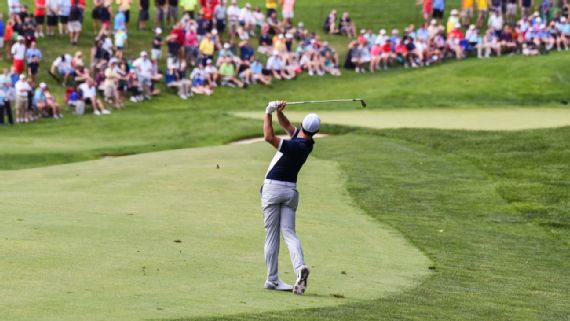 From Bob Harig's Memorial report on Rory McIlroy's play (-13, T4) just a little over a week before the U.S. Open at Oakmont:
But perhaps more important was McIlroy's putting. Typically a sore spot and the aspect of his game that holds him back, McIlroy was second for the week in strokes gained putting and never took more than 29 putts in a round. (He had more than 30 in each round two weeks ago in Ireland.)
"Off the tee I was really good this week, and I feel like my putting improved a lot,'' he said. "If you look at the stats from my putting, I feel like it's been really good. So all things considered, it's been a decent week. Time to get ready for Oakmont.''
And this from Golf Channel's Justin Ray:
.@McIlroyRory: final round 68 (-13 overall). 2nd in field this week in strokes gained putting - was 122nd this season entering week.
— Justin Ray (@JustinRayGC) June 5, 2016
I think most fascinating about the putter grip change from left hand low to conventional is just how much less he "pops" a putt instead of a stroke. Popping is not a good thing on greens running 14. IMHO.
Tim Warsinskey notes that McIlroy has been preparing by watching the USGA's flyovers.
Apparently he's jumping on the Oregon bandwagon en route to Oakmont...
When you're about to takeoff but tell the pilots to wait! Playoff looked likely but not now! ✈️ pic.twitter.com/cPusHv3YUE
— Rory McIlroy (@McIlroyRory) June 5, 2016
Not that there has been an easy moment so far, but Oakmont only gets tougher from the 7th tee on. Even more exposed than it was nine years ago, this is one of the more sloped greens and a nice contrast to the flat eighth.
I'm not sure releasing a paper outlining the lack of distance gains and then lengthening the longest par-3 in U.S. Open history twelve or so yards does much to make your argument stronger. Especially when the hole saw only 27% of the field hit the green in regulation last time the U.S. Open was played here.
Nonetheless, the least interesting looking and playing hole at Oakmont is still interesting, a credit to its design.
Geoff Shackelford is a Senior Writer for Golfweek magazine, a weekly contributor to Golf Channel's Morning








Copyright © 2022, Geoff Shackelford. All rights reserved.

