Mike Stachura breaks down the USGA-R&A report issued today on distance. It felt like an effort to buy time from having to act in a significant way. So they'll continue to lazily change courses, stare at their swelling hedge fund investments and quietly slide into irrelevancy due to public stance on distance that passes few basic smell tests to longtime observers of the sport. (Luke Kerr-Dineen did a nice job rounding up the reactions and explaining the debate for those new to the issue.)
 Digging in on the current distances as acceptable while lengthening championship courses severely contradicts the (noble) efforts by the USGA's staff to make the game more sustainable (a correlation more and more golfers are making).
Couple in elements like going after anchored putters instead of distance, compiling massive vanity war chests and glossing over huge distance changes prior to cherry-picked years, and it adds up to damaged street cred.
Stachura got a sneak preview and was able to talk at length to the USGA's John Spitzer, a bright, level-headed fellow who is merely presenting what the data is telling him. But in one area I felt like he went a tad far in trying to discredit the potential jump in distance that 2016 is so far seeing.
“If you are looking to tell a story, you can cherry pick data and tell whatever story you want, and some of that has happened,” he said. “We just want to make sure that everyone knows that we are looking at this and we’re looking at it in a statistically significant and a statistically robust way.”
But as Stachura notes:
The report does not include any data on elite amateur players or even average golfers. Nor does it detail any of the results of USGA and R&A testing of shorter-distance golf balls. The ruling bodies requested these balls from manufacturers in 2005 as part of their research on distance and conducted a series of player tests over the last decade.
Spitzer said both of those areas may be part of future reports, and he indicated the plan is to release an update on distance research on an annual basis.
Furthermore, I've noticed that one of the primary arguments for possible distance and groove regulation in the past has been abandoned: the correlation between driving accuracy and success on the professional level. Not a peep in this report.
Brandel Chamblee's piece from two years ago on "total driving" remains relevant today in considering the old governing body stance on balancing the skillful acts of distance and accuracy.
Which brings us back to 2000. That year, Tiger Woods led in total driving, David Duval was second, Sergio Garcia third and Ernie Els seventh. It would be one of the last years that great driving mattered. Since then, it seems, the whole of professional golf is in the rough. Wild as the weeds they find there.
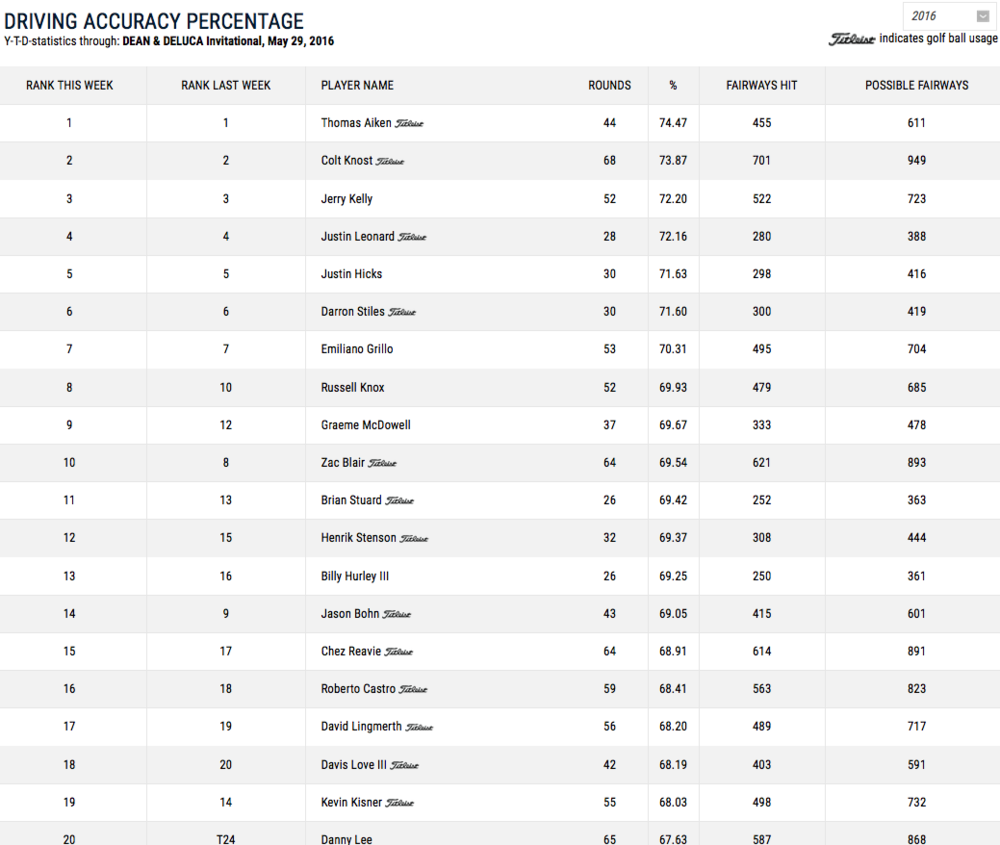
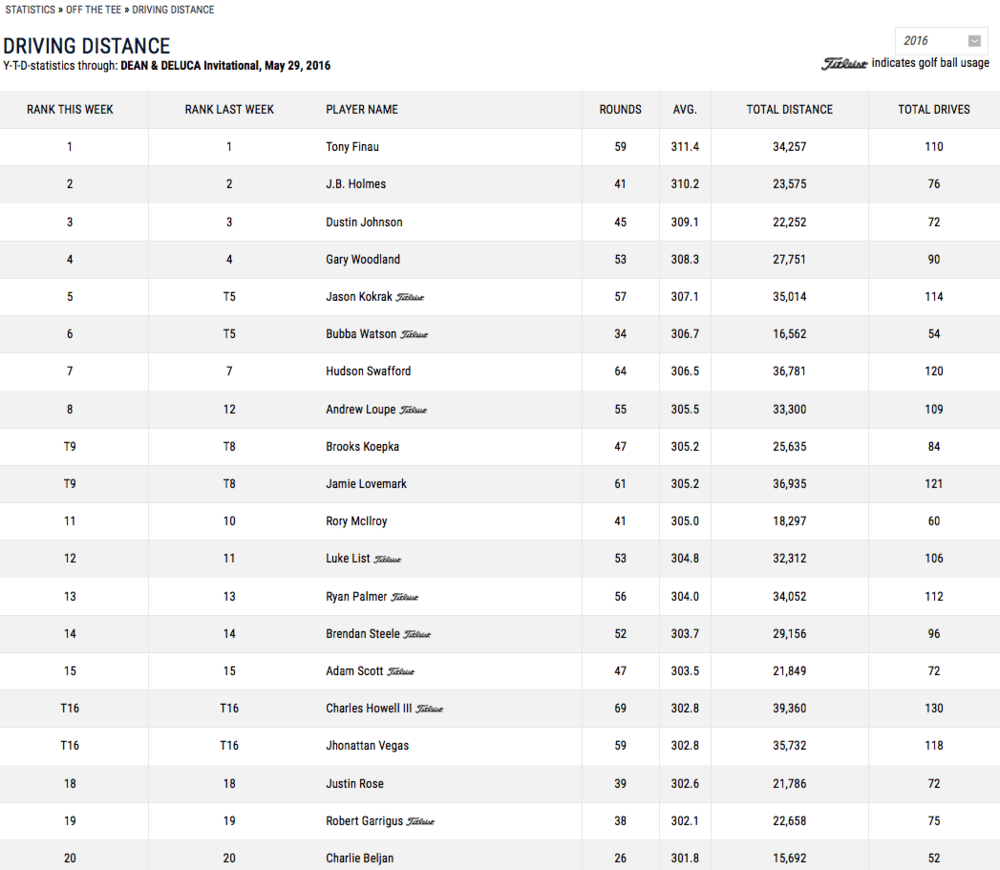
Here is the current Total Driving list from 2016, but an even more stark contrast in the have and have-nots is seen when looking at the Distance and Accuracy leaders.
I ask, based on your knowledge of the 2016 results and money, what list would you rather populate?
Let's humor the governing bodies and agree that there have been only minor distance gains since 2003, that all is well, that the leaps have been capped and, accordingly, no piece of golf equipment going forward will allow anyone to hit the ball significantly longer.
Just concede this: the gains made from 1998 to 2003 remain hugely destructive, expensive and counterproductive for the health of the game at the highest levels. After all, I'm pretty sure anchored putters never raised the cost of golf a cent, but the gains made in that five year stretch did untold damage to the planet by expanding the footprint of a modern golf course.
If you can concede that and the other side concedes that the current Overall Distance Standard is working, then why not tweak that standard to help bring hundreds of courses rendered irrelevant back to relevancy?
In 2003, that number increased to nine and it has kept climbing. Better athletes who have grown up not knowing what a persimmon miss looks like and who have optimized launch conditions are able to drive it significantly longer than their predecessors. So why not change that standard just a little bit to address this change in skill and restore relevancy to things like 6,900 yards, irons below the 8 and maybe only see a handful of players averaging over 300 yards off the tee instead of the 24 that currently do so?
Would that in any way damage the sport?
Update on 2016-06-03 05:44 by Geoff
**Kris McEwan at Golficity breaks down the numbers and says the year-by-year analysis is "the equivalent of measuring the growth of a child and only reporting the year to year change. In turn, you are ignoring how much taller the child is actually getting across the overall span of time. Suddenly, you look at your kid twenty years later and he’s six feet tall and you’re asking yourself, 'when did that happen?!'"
Looking at the USGA's charts, he writes:
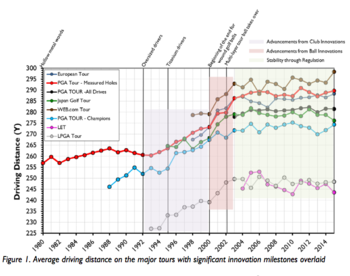
Take a look again at the red line representing the “measured holes” of the PGA TOUR. In 1992, with the advent of the over-sized driver, average driving distance is about 260 yards. Ten years later, players are hitting the ball an average of 20 yards farther with the driver.
Now let’s put that twenty additional yards to work in an actual scenario. A pro hits driver in 2002 on a par-4, 400 yard hole, that means his second shot is going to be 140 yards. In 2012, the same drive leaves him with 120 yards to the hole. Any hack on a municipal course on a Sunday morning will tell you how significant those twenty yards are.
Fast forward from 2002 to 2012 and pros are now hitting driver another ten yards farther. Meaning over a twenty year span, golfers on the PGA TOUR gained an extra 30 yards off the tee.
Oh, and before you tell me, “players today are in better shape and more athletic,” allow me to point out that the Champions Tour guys—you know, the old dudes—are hitting the ball 275 yards today versus 250 yards twenty years ago.