
Finally An Olympic WD We Can All Agree Is Regrettable, Understandable And Reason To Hate Wraparound Golf!
/Camilo Villegas
Read MoreWhen you come to think of it that is the secret of most of the great holes all over the world. They all have some kind of a twist. C.B. MACDONALD

I'm heading off to the home of golf and while I would love to say I've read all of the U.S. Women's Open preview stories, I have not. But as I note in this week's Forward Press, the course should provide an entertaining setting and due to unforeseen circumstances, will get some of its best visibility ever thanks to no competing PGA Tour or European Tour event and a west coast, prime time finish.
 But Ron Sirak's GolfDigest.com piece on Michelle Wie, winner at Pinehurst just two years ago is worth checking out.
But she is now winless in 50 LPGA starts since Pinehurst with 14 missed cuts and five WDs. One explanation for Wie’s inconsistency can be found in her health, where she’s had extremely bad luck. She’s had problems with her wrist, her back, her hips and her ankles. She also has multiple food allergies, which has complicated matters.
“It’s been a struggle this year,” Wie said. “But I still have half a year left and I’m just trying to get some confidence. I feel pretty good at the moment. I’m happy to come in here pain free.”
Wie remains a huge fan-favorite and is probably the woman who has moved the needle the most for women’s golf since Nancy Lopez almost 40 years ago. A winning Wie is good for golf.
Follow Ron for updates from the women's U.S. Open.
Here are a few highlights from the USGA media department's excellent table setter:
July 7-10, 2016
CordeValle, San Martin, Calif. (cordevalle.com)
usga.org/womensopen
www.twitter.com/USGA, #USWomensOpen; www.facebook.com/USGA; www.instagram.com/USGA
ABOUT THE CHAMPIONSHIP
This is the 71st U.S. Women’s Open Championship.
The first U.S. Women’s Open, played at Spokane (Wash.) Country Club in 1946, was the only one conducted at match play. The Women’s Professional Golfers Association (WPGA) conducted the inaugural championship, won by Patty Berg. The WPGA conducted the Women’s Open until 1949, when the newly formed Ladies Professional Golf Association (LPGA) took over operation of the championship. The LPGA ran the Women’s Open for four years but in 1953 asked the United States Golf Association to conduct the championship, which it has done ever since.
The youngest winner of the U.S. Women’s Open is Inbee Park, who won the 2008 championship at the age of 19 years, 11 months and 18 days. Babe Zaharias, who won the 1954 Women’s Open at age 43 years and 6 months, is the oldest winner.
In 1967, Catherine Lacoste, daughter of French tennis player Rene Lacoste and 1927 British Ladies Amateur champion Simone Thion de la Chaume, became the only amateur to win the U.S. Women’s Open. Six other amateurs, most recently Brittany Lang and Morgan Pressel in 2005, have had runner-up or co-runner-up finishes.
WHO’S HEREAmong the 156 golfers in the 2016 U.S. Women’s Open, there are:
U.S. Women’s Open champions (9)
Na Yeon Choi (2012), In Gee Chun (2015), Paula Creamer (2010), Eun-Hee Ji (2009), Cristie Kerr (2007), Se Ri Pak (1998), So Yeon Ryu (2011), Karrie Webb (2000, 2001), Michelle Wie (2014)
U.S. Women’s Open runners-up (10)
Na Yeon Choi (2010), Cristie Kerr (2000), I.K. Kim (2013), Candie Kung (2009), Brittany Lang (2005), Stacy Lewis (2014), Se Ri Pak (2001), Suzann Pettersen (2010), Morgan Pressel (2005), Angela Stanford (2003), Amy Yang (2012, 2015)
U.S. Women’s Amateur champions (7)
Danielle Kang (2010, 2011), Lydia Ko (2012), Hannah O’Sullivan (2015), Jane Park (2004), Morgan Pressel (2005), Jennifer Song (2009), Mariajo Uribe (2007)
U.S. Women’s Amateur runners-up (7)
Sierra Brooks (2015), Jaye Marie Green (2012), Brooke Henderson (2014), Moriya Jutanugarn (2011), Jessica Korda (2010), Azahara Munoz (2008), Jane Park (2003)
U.S. Girls’ Junior champions (7)
Amy Anderson (2009), Julieta Granada (2004), Ariya Jutanugarn (2011), I.K. Kim (2005), Minjee Lee (2012), Jenny Shin (2006), Lexi Thompson (2008)
And...
NCAA Division I champions (3)
Austin Ernst (2011, Louisiana State University), Stacy Lewis (2007, University of Arkansas), Azahara Munoz (2008, Arizona State University)
PLAYERS WITH MOST WOMEN’S OPEN APPEARANCES (2016 included)
Cristie Kerr (21), Karrie Webb (21), Catriona Matthew (20), Se Ri Pak (19), Angela Stanford (17), Candie Kung (15), Paula Creamer (14), Christina Kim (14), Maria McBride (14), Suzann Pettersen (14), Morgan Pressel (14), Brittany Lincicome (13), Michelle Wie (13), Karine Icher (12), Brittany Lang (12), Jane Park (12), I.K. Kim (11), Yani Tseng (11)
ACTIVE CONSECUTIVE U.S. WOMEN’S OPEN APPEARANCES (2016 included)
Karrie Webb (21, 1996-2016), Cristie Kerr (19, 1998-2016), Angela Stanford (17, 2000-16), Paula Creamer (14, 2003-16), Candie Kung (14, 2003-16), Suzann Pettersen (14, 2003-16), Brittany Lincicome (13, 2004-16), Morgan Pressel (12, 2005-16), Brittany Lang (12, 2005-16), I.K. Kim (11, 2006-16)
FIRST-TIME U.S. WOMEN’S OPEN COMPETITORS (44)
Sandra Angulo Minarro, Sierra Brooks, Hannah Burke, Liv Cheng, Chih-Min Chen, Ssu-Chia Cheng, Pei-Yun Chien, Yoon Ji Cho, Hye-Jin Choi, Allisen Corpuz, Olivia Cowan, Valentine Derrey, Julia Engstrom, Anna Hack, Erina Hara, Spencer Heller, Kotone Hori, Yu Sang Hou, Caroline Inglis, Taylor Kim, Naomi Ko, Jennifer Kupcho, Nicole Broch Larsen, Camilla Lennarth, Mika Liu, Yan Liu, Leona Maguire, Sung Hyun Park, Kasey Petty, Sophia Popov, Pamela Pretswell, Robynn Ree, Haeran Ryu, Madelene Sagstrom, Karah Sanford, Emi Sato, Chika Sawada, Jade Schaeffer, Erica Shepherd, Lauren Stephenson, Albane Valenzuela, Jing Yan, Julie Yang, Yunjie Zhang
COUNTRIES REPRESENTED IN THE FIELD (24)
Australia, Brazil, Canada, the People’s Republic of China, Chinese Taipei, Colombia, Denmark, England, France, Germany, Japan, the Republic of Korea, Malaysia, Mexico, New Zealand, Norway, Paraguay, Scotland, South Africa, Spain, Sweden, Switzerland, Thailand, United States of America
SPECIAL EXEMPTION FOR PAK
Se Ri Pak, of the Republic of Korea, received a special exemption into the 2016 U.S. Women’s Open. In March, Pak, 38, announced her intention to retire following the 2016 professional season. She plans to return to Korea and serve as an ambassador for the game of golf.
Pak’s 1998 U.S. Women’s Open victory at Blackwolf Run in Kohler, Wis., revolutionized women’s golf and sparked a cultural phenomenon. When Pak won the 1998 U.S. Women’s Open, she was the only Korean player on the LPGA Tour. Since then, countrywomen Birdie Kim (2005), Inbee Park (2008, 2013), Eun-Hee Ji (2009), So Yeon Ryu (2011), Na Yeon Choi (2012) and In Gee Chun (2015) have joined Pak as U.S. Women’s Open champions and more than two dozen players from Korea compete regularly on the LPGA Tour.
CHAMPIONSHIP FIELD
The USGA accepted 1,855 entries for the 71st U.S. Women’s Open. This marks the second consecutive year the U.S. Women’s Open has received more than 1,800 entries. The 2015 championship at Lancaster (Pa.) Country Club holds the entry record with 1,873.
The 156-player field includes 93 fully exempt golfers and nine past Women’s Open champions. Sectional qualifying, conducted over 36 holes, was held at 25 sites between May 9 and June 3, four international (China, England, Japan, Korea) and 21 in the United States.
Stick with it, because it's a good reminder that golf can be universal in many forms, with a diverse cast of followers. Especially in Compton!
Erik Anders Lang takes us on a tour of Compton's par 3 course.
As Joel Beall explains at GolfDigest.com, a small bump in The Open Championship purse is offset and then some by the plummeting pound, which hit a new low Tuesday.
 Beal writes of what the drop means to first place money:
Meaning that, while Johnson took home a $1.8 million payday for winning the British Open, this year's champ will receive close to $1.54 million, a significant cut in earnings.
The full purse announced Tuesday by the R&A:
Prize money
Place £ Place £
1 £1,175,000 36 £34,000
2 £675,000 37 £32,500
3 £433,000 38 £31,000
4 £337,000 39 £30,000
5 £271,000 40 £28,750
6 £235,000 41 £27,500
7 £201,000 42 £26,250
8 £170,000 43 £25,000
9 £149,000 44 £23,750
10 £135,000 45 £22,500
11 £122,000 46 £21,500
12 £108,750 47 £20,500
13 £102,000 48 £19,500
14 £95,500 49 £18,700
15 £89,500 50 £18,300
16 £82,000 51 £17,900
17 £78,000 52 £17,500
18 £74,000 53 £17,250
19 £71,000 54 £17,000
20 £68,000 55 £16,750
21 £64,500 56 £16,500
22 £61,500 57 £16,300
23 £58,250 58 £16,200
24 £55,000 59 £16,100
25 £53,000 60 £16,000
26 £50,750 61 £15,900
27 £48,750 62 £15,800
28 £47,000 63 £15,700
29 £45,000 64 £15,600
30 £43,250 65 £15,500
31 £41,500 66 £15,400
32 £39,250 67 £15,300
33 £38,000 68 £15,200
34 £36,750 69 £15,100
35 £35,500 70 £15,000
As the dust finally settles on Oakmont and the 2016 U.S. Open, Dustin Johnson's follow-up win at the WGC Bridgestone helps shift a little more focus on the winner and away from the rules issue that arose.
 While golfers still discuss the rule and decision that prompted the officials to intervene, it is important to better understand the culture that led to a moment which, had Johnson lost the U.S. Open over the ball moving on marble-like greens, might have done permanent damage to the reputation of the U.S. Open and golf.
Why did the USGA feel so compelled to intervene in a situation that few outside the rules community saw as requiring definitive action? Especially given that so many golfers recognized the issue was caused by excessive green speed. For those of us who've been frustrated with the use of green speed to offset regulatory malfeasance on the distance issue, the number of golfers making the connection between the issues is heartening.
Still, we would like to better understand the culture that focuses so much effort on the high-risk business of running up Stimpmeter speeds or adding tees to U.S. Open courses or policing innocent pro golfers, better known as: ABTB (Anything But The Ball).
So I was advised to go back and read Chris Millard's 2007 Golf World cover story on USGA President Walter Driver,. Ironically, the story preceded the U.S. Open at Oakmont. The story resonates on many levels, from understanding the USGA's focus to how much behind the scenes debate occurs.
Sadly, we know Driver has continued to influence the organization via the nominating committee, with his crowning achievement the naming of pal Diana Murphy as president to continue the corporate prioritization of the USGA's approach.
It's well worth a re-read, but this was one of the more enlightening moments:
Proponents of Driver say he has single-handedly shaken the USGA out of a slumber induced by the influx of cash the USGA fell into when it reconfigured its television rights contracts in 1994. They say he has tried to inject into a bloated USGA some badly needed business principles (the title of Driver's speech at the USGA's annual meeting in San Francisco last February was "The USGA As An Organization And A Business"). Detractors, many of whom see the USGA as a charitable organization first, say Driver has imposed his will on its culture and that his administration has disenfranchised everyone from Golf House staffers (those who work at USGA headquarters in Far Hills, N.J.) to equipment manufacturers to the organization's once-revered past presidents."I would say his effort to instill a new level of business-like procedure at the USGA has been important," says Reg Murphy, USGA president in 1994-95 and the man who authored the association's lucrative TV move from long-time partner ABC to NBC in 1994. "He's tried to create a more business-like organization. There are people who resist that idea, by the way, that the USGA ought to operate like a business."
Not that I'm questioning the tally, just fascinated that Royal Troon settled it's women-only issue with a vote by show of hands and no actual printed vote total. Given how the Brexit vote went, a good thing! Christopher Clarey with that and other details from Troon's vote as it prepares to host the 145th Open, cincluding this from club captain Martin Cheyne.
But Cheyne said the club had reviewed more than the issue of women’s membership in recent months. “The focus was on all categories of membership and how we could become more involved in promoting golf, a sport which is currently declining: declining in male, female and junior membership,” he said. “What we did tonight was focus on the single issue of women’s members, but we need to focus on how we can encourage young people to play this game.”
“Our custom and practice in the golf club is a straight show of hands,” he said. “We don’t do a count. It was overwhelming.”
Royal Troon’s constitution mandates that only members who are present may take part in such votes, and Cheyne said 360 of the club’s 861 members had been in attendance on Friday night.
Anyone know what Troon's junior member program looks like? If it's an affordable one that appeals to aspiring players, get the word out. A lot of clubs around the world need to get or serious about such programs and need prominent examples.
That's the question Jason Sobel's story poses after Jordan Spieth explain why he's trying to speed up. While he's earned a reputation as a slow poke, I would counter that television makes him look slow because he's been spending a lot of time over the ball. Whereas someone who is much slower like Zach Johnson, spends ages making a decision and when television comes to him, we rarely see that. 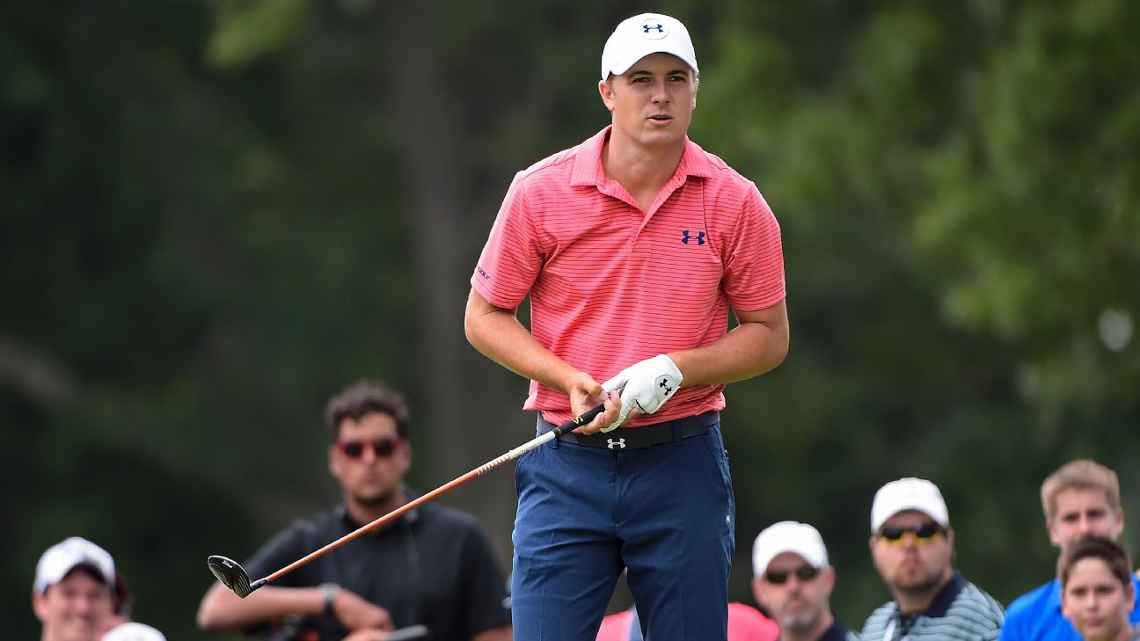 Anyway, Spieth has heard the criticism from fans and his instructor, Sobel says.
After the second round, Spieth didn't use playing quicker as an excuse. In fact, he credits the process for helping his game.
"The quicker part actually helps me, because then I just get up there and fire away," he explained Friday. "The more I can do that, actually I think the better off [I am with a] kind of gun-slinging mentality, just to go up and hit the way I always have played."
**Less successful so far is Spieth's plan to resist Twitter responses, setting the Golf Channel account straight for his "positive response" to a question about the 16th hole.
'I think it’s a poor hole from where we play it.' Spieth's not a fan of No. 16 after triple: https://t.co/fIgLaqthqr pic.twitter.com/gxnlNj2cA8
— Golf Channel (@GolfChannel) July 3, 2016

There isn't much to get excited about with this year's WGC Bridgestone, especially given that without it on the schedule in an Olympic year, the players would have a lot less to gripe about with excessive playing options.
 But we march along so the boys can collect their easy $50k, world ranking points and--silver lining alert--huge driving distance numbers!
As Mike Stachura explains after seeing Justin Thomas hit a 413-yard drive, Firestone remains one of the few courses were players can hit driver on nearly every non-par-3. But with an earlier date on the schedule and less humidity, Stachura says the field's 317.3 yard average from last year should be down this year.
If it's not...
What’s the number to beat? Aside from last year’s 317.1-yard mark, the tournament with the highest driving-distance average in the last year was the Shriners Hospital Open in Las Vegas last fall at 305.4.
Now, is it fair to say that if the average this week surpasses last year’s number, there should be more concern about driving distance increasing? Statistically speaking, it’s merely one set of data that carries as much weight in determining trends as does the driving-distance average at Harbour Town for the RBC Heritage, which this year was 278.8 yards. That’s, in a nutshell, the point the USGA was making in its recent report about the relatively modest growth in driving distance over the last dozen years or so.
Rory McIlroy, who was once excited about Olympic golf until Zika and New Balance uniforms came along, admitted that his WD call to captain Paul McGinley was one of the toughest calls he's had to make, reports Phil Casey (who also reports that Martin Kaymer can't wait to get to Rio).
 Casey writes:
“That was probably one of the toughest phone calls I’ve had to make, because we’ve talked about it so much,” said McIlroy. “We’ve done so much work, got accommodation, got security down there, got a chef in, got everything planned out. I got my jabs; I had two dead shoulders for about four days.
“But then at the end of the day, if I’m not 100% comfortable going down there, I just don’t want to put it at risk. There’s another Olympic Games in Tokyo in 2020 and I’m more than happy to wait until then to get that Olympic experience.”
It appears not many are buying the concerns about Zika, including the readers here. McIlroy has now been questioned by Bloomberg reporter Tariq Panja (here and here), who has asked the McIlroy camp for clarification as to why he vacationed in Barbados two months ago. Barbados is also a Level 2 Zika threat region, like Rio.
An unbylined AP story on Lee-Anne Pace of South Africa dropping out citing Zika keeps her consistent with everyone else from South Africa but Gary Player.
The 35-year-old said in a statement that she made the decision after discussing her options with her family and her team.
"I hope that everyone can understand that this was a very difficult decision to come to, however my health and my future family's health must come first," she said.
Matt Ginella talks to architect Gil Hanse about the Olympic dropouts and he's disappointed.
"The overall feeling is disappointment," said Hanse. "To have done what we’ve done, to have worked through so many challenges to complete the project, you’d obviously love to see the best players in the world compete on your golf course."
Hanse says he is contact with the team still on the ground in Rio, which includes the superintendent and the PGA Tour’s on-site agronomist, who are prepping the course for the Olympics.
"Morale is getting lower," said Hanse. “I’m disappointed for everyone involved."
 Hey, but there is a morale boosting news! Camillo isn't out...yet, though keeping his card may end up the priority, reports Golfweek's Adam Schupak.
“Yeah, I actually heard Jordan Spieth said I wasn’t going to go play. I’ve been talking to Jordan and a lot of the guys. And I’ve got to be honest, Maria and I are trying to have kids right now. So the Zika is a concern,” Villegas said after the opening round of the Barracuda Championship.
Meanwhile the eligible American golfers were briefed and they're feeling better about things, but are waiting to hear on something else. Also a Schupak report.
“I’ve always wanted to go but I want to make sure me and my team feel safe on the health and security issues,” Rickie Fowler said. “There’s still some stuff ongoing, some logistics to work out.”
As all of this plays out, Christopher Clarey of the New York Times talks to Brad Gilbert and others about tennis returning to the 1988 games and the soft start that sport had due to various concerns similar to the 2016 issues golf faces.
“What’s happening with the golf is a lot like ’88,” Gilbert said. “A lot of the tennis players just weren’t quite sure, and there were some security worries in Seoul.”
No. 1 Mats Wilander, winner of three of the four Grand Slam singles titles, did not make the trip even though he had long relished playing for Sweden in the Davis Cup. Neither did No. 4 Andre Agassi, who would later win the singles gold medal at the 1996 Olympics in Atlanta and discover that it was one of the most gratifying moments of his career.
Gilbert was coaching him at the time.
“When Andre asked me what was the biggest regret of my career, I said if I could change one thing, I would have changed that big penny I had into gold,” Gilbert said, referring to his bronze medal. “And Andre pretty much planned his whole year around the 1996 Olympics.”
On Golf Central, yours truly joined Lisa Cornwell, Matt Adams and Tim Rosaforte for an Olympic golf roundtable.
Geoff Shackelford is a Senior Writer for Golfweek magazine, a weekly contributor to Golf Channel's Morning








Copyright © 2022, Geoff Shackelford. All rights reserved.

