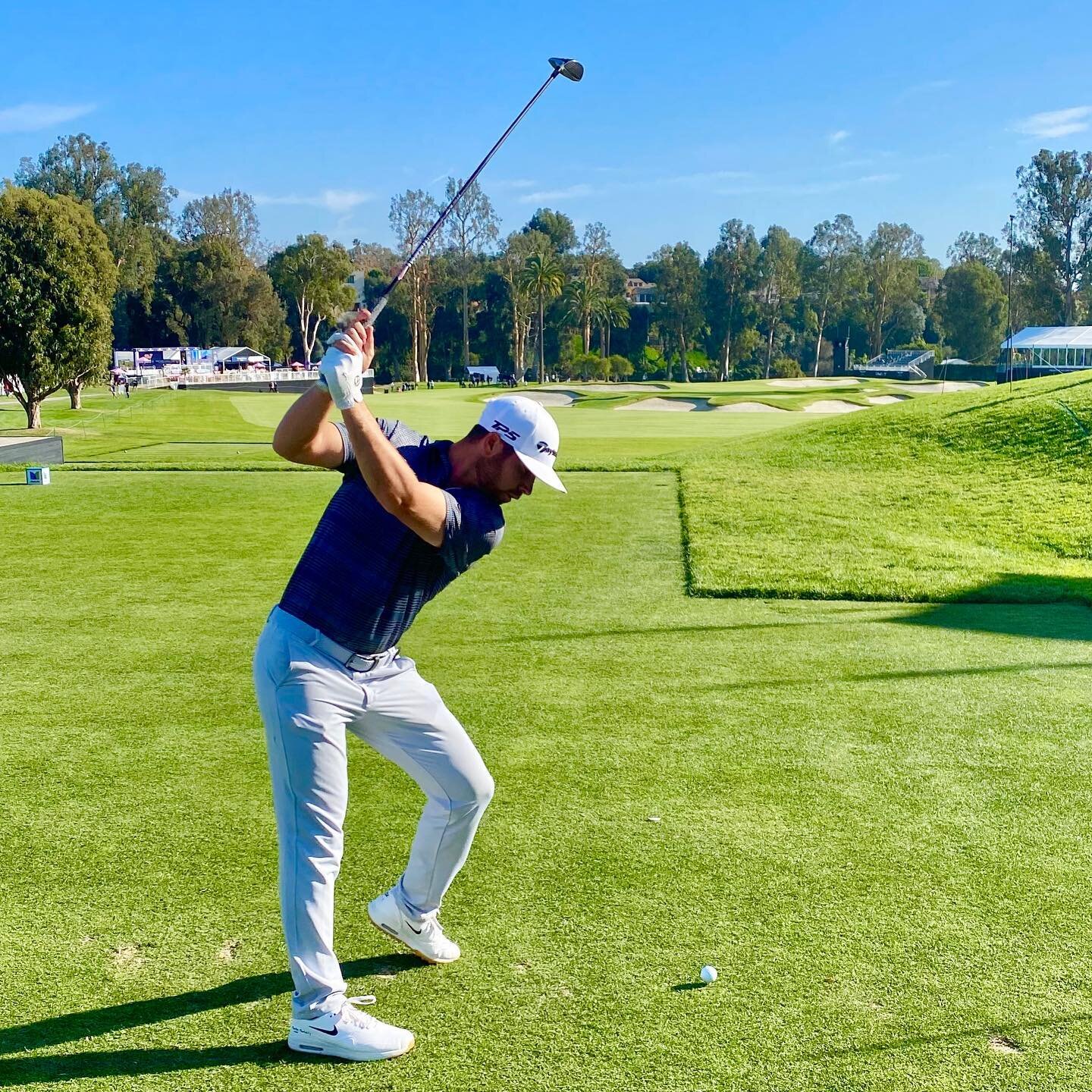
It's that time to start soaking up just enough history to be excited about a return to Troon and the times we live, which include multiple replays, Yanni theme music (with bagpipes!), Protracers and Johnny.
Speaking of Johnny, check out his hat early on in this 33 minute highlights package from the 1973 Open Championship at Royal Troon. While deep diving YouTube for some pre-tournament appetizers, this was the keeper of all films. We're all in on the 70s, from the attire to the music to the graphics. I kept expecting Ron Burgundy to pop in at some point.
Hope you didn't have much to do at the office Monday! Here goes:
Turning to Huffington Post to share her thoughts onDonald Trump's Bedminster course hosting the 2017 U.S. Women's Open, former Augusta National crusader Martha Burk is targeting the USGA with a petition to move next year's championship.
No LPGA players whom Golfweek asked for comment after their rounds at CordeValle, however, agreed with Burk’s call to move the event.
“Just because it has Trump’s name on it, doesn’t mean we shouldn’t play there,” said Jessica Korda, who competed at Trump National Bedminster in the 2009 U.S. Girls’ Junior.
England’s Mel Reid said she doesn’t necessarily agree with Trump’s values or policies and can understand why people would want to sign the petition. But, just as with the 2015 Ricoh Women’s British Open at Trump-owned Turnberry in Scotland, Reid doesn’t see the need to move the event.
Adam Schupak reports on prominent members of the black community joining in support of Burk. No matter where you come down, I think we can all agree Dr. Calvin Sinnette writes a good letter. This is what he sent to USGA Executive Director Mike Davis:
“The organization’s decision seems to be governed by a warped notion of fiduciary rectitude rather than a sense of moral probity. Pious pronouncements about ‘inclusion,’ ‘broader access,’ and ‘disparities,’ ring hollow when the USGA is forced to confront vexing challenges,” Sinnette wrote to Davis. “Unless the USGA changes the venue for the 2017 event and severs its relationship with a blatant racist and misogynist, I have no alternative but to relinquish my association with the organization.”
Trump Bedminster also hosts the 2022 PGA Championship.
Seems it was an interesting two days here at Castle Stuart, where the wind pushed the boundaries of sanity, prompting the European Tour to issue an apology for not setting the course up appropriately, reports Golfweek's Alex Miceli.
He also notesPhil Mickelson's Friday charge to make the cut and set himself up for a run this weekend. Mickelson is paired with Henrik Stenson for Saturday's third round. Alex Noren leads, with Danny Lee one back.
Adam Schupak with the unfortunate news of the 2017 Greenbrier Classic being in jeopardy due to necessary green rebuilding and regrassing caused by recent flooding.
The issues facing the resort pale in comparison to the troubles of those who lost lives and homes, but still a blow to the region should things not be able to be grassed in time.
The Old White TPC, host course for the tournament, suffered extensive damage from the flooding and was deemed “beyond reasonable repair to conduct the tournament,” Tour officials said. The tournament, scheduled for July 7-10, was cancelled on June 25.
“I’ve witnessed a lot of natural disasters to golf courses, but nothing to this extent, nothing even close,” said Roth, of the damage to the tournament course located in the Allegheny Mountains in White Sulphur Springs, West Va.
It's been nice to not read Zika-excuse related stories but they seem unavoidable as Dustin Johnson has pulled out of the Rio Olympic games citing the Zika virus. From an unbylined APstory:
"This was not an easy decision for me," Johnson said in a statement released by his management company. "But my concerns about the Zika virus cannot be ignored."
Stacy Lewis, while wisely wheeling out the understanding of Zika's grave threat to the male golfers of the world (rumors are it targets only those who play in The Open and PGA), notes this:
“It’s hard,” Lewis said. “Those guys play for so much money, and I think you kind of get lost in that at times. If I knew that I had the potential of a $10 million paycheck at the end of the year, I'd probably do my schedule a little bit different, too.
“You become a product of that environment. You have that opportunity to win that that money, you become a product of it. And you can't blame them for being that way. They are bred to be that way, with the amount of money that they play for.
“On our tour, while we have some pretty good paychecks, it's nowhere close to what those guys are playing for. So, to me, the opportunity to play in the Olympics, and to represent your country, is probably worth as much as winning a U.S. Women’s Open or winning an [ANA Inspiration] or winning any of those big majors. Winning a gold medal would be up there with winning a major championship, to me, and that's the difference of the men versus the women.”
I'm still investigating many things in the hopes of providing you tips on Highlands golf and elsewhere, but I'm already floored by a few things from my visit: value, options and golfers branching out to lesser known courses.
While there is still a ways to go in making this an East Lothian/St. Andrews pilgramage destination, for the record I want it known there was a tour bus at Lossiemouth today (aka Moray Golf Club). I couldn't have been more pleased! Americans testing the craft architecture!
And while I've pondered what Herbert Warren Wind would make of the masses pulling up to Dornoch and tackling the place with passion, ultimately I concluded from the epic Links House Dornoch that he would be utterly thrilled to see so many making the journey here for northernmost links golf.
Anyhow, as I said, more to investigate while you hopefully enjoy the Scottish Open at nearby Castle Stuart. But my findings will be here and at GolfDigest.com.
Many of you have forwarded the form replies you've received to your letters to the USGA following this year's U.S. Open.
Included is this FAQ page from the USGA that I found fascinating in its tone. And revealing.
Why are the Rules of Golf so complicated?
We recognize that due to the fact that golf is played outdoors, on a wide variety of courses, and by players using an assortment of different clubs, the Rules of Golf are naturally complex and can be challenging to apply. We, together with The R&A, have been conducting a fundamental review of the Rules of Golf in an effort to simplify and clarify them. We are well along in that process and intend to consult many within the game before implementing any revisions.
Why does the USGA use video review?
At the U.S. Open and its other televised championships, the USGA actively monitors the broadcast in an effort to respond to viewer inquiries and prevent questions and disputes from arising during the competition and after it closes. While we recognize that there are differing opinions about the use of video, it provides us with another method to help ensure the integrity of the championship and protect its outcome.
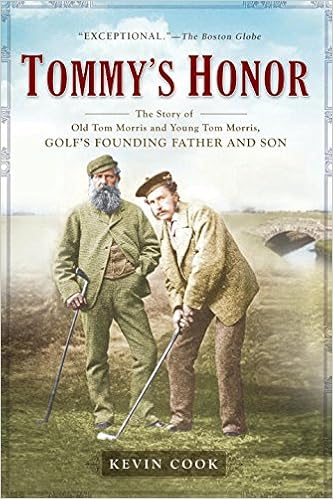
I resisted picking up Tommy's Honor in my usual fear of fictionalized versions of real stories and a cover that suggested it was going to be a downer. But for me it has become the best pre-Scottish golf pilgrimmage reading and one which I now crack open before heading to Scotland. (Note to self: don't judge a book by its cover.)
Any concerns about the Tommy's Honor storytelling related to golf's founding father and his decorated son are promptly eliminated when Kevin Cook takes us back to Old Tom's days in Prestwick. He captures a genuine sense of what these brave, slightly-nutty characters did to transform the idea of whapping a ball around on fescue turf and into the sport we have today. The former Golf Magazine editor does it with a perfect mix of historical accuracy, soulful storytelling and cinematic flair.
Given the book's early focus on the first Open Championship at Prestwick and an Edinburgh Film Festival screening of the film version receiving encouraging reviews (here, here, here), the author kindly answered questions about his work.
No distributor has been finalized for the film with a screenplay by Cook and wife Pamela Marin. But since the film has just hit the festival circuit (clip's below Q&A), and we should be able to see it later this year or in early 2017.
GS: What compelled you to tackle the seemingly impossible task of re-creating the life and times of Old Tom, Young Tom and the founding of golf?
KC: My wife, Pamela Marin, took me to Scotland for my first pilgrimage in 1986. I showed up at the Old Course at dawn and was lucky enough to play with three locals, Peter, Peter and John. They blessed me gravely when I descended into the Hell Bunker and laughed when I hit a grounder and called it a worm-burner. To them that’s a “scalded cat.”
They also talked about Tommy Morris. I knew about Old Tom, but the more I learned about his son the more I was drawn to this untold family drama with a tragic love story at its heart—all revolving around the dawn of professional golf.
GS: How many years was the book in the works research-wise and what kind of interesting things happened along the way in digging through archives for this?
KC: First came 20 years of filing away bits and pieces of the story. Then I got fired as editor of Golf Magazine. Seemed like a good time to write that book! In 2005 I rented a room in St Andrews and spent a couple weeks haunting the university library. That was the first of several trips, with side trips to the Mitchell Library in Glasgow, other archives in Scotland and the library at Royal Liverpool, where Tommy won the first big pro tournament outside Scotland in 1872. I hit a few worm-burners there before the 2006 Open Championship.
Along the way I made friends. One I’ll never forget was the late David Malcolm, a St Andrean who was one of the smartest and warmest people I ever met. (His Tom Morris of St Andrews: Colossus of Golf, co-written with Peter Crabtree, is a more scholarly approach to Tom’s life.) We compared notes and shared research. Our families became close, and we even house-swapped. David and his wife, Ruth, a gifted artist, got our pad in New York while Pamela and our kids and I stayed in their home in St Andrews.
GS: Old Tom’s Prestwick years have always seemed to be a bit of a mystery, yet you get right into them early on in Tommy’s Honor. What went into the Prestwick research and does Old Tom Morris get enough credit for his role in helping create The Open?
KC: Ian Bunch, then the club secretary at Prestwick, welcomed me to the upstairs archive where I pored through records of Tom’s 14 years there, including the invitations (on robin’s-egg blue paper) summoning crack golfers to the first Open Championship in 1860. Tom organized the whole thing, working with his patron James Ogilvie Fairlie and the wealthy, sporty Earl of Eglinton. Tom hit the first tee ball—just as the wind blew his necktie up over his face, blocking his view—and came in second to his rival Willie Park.
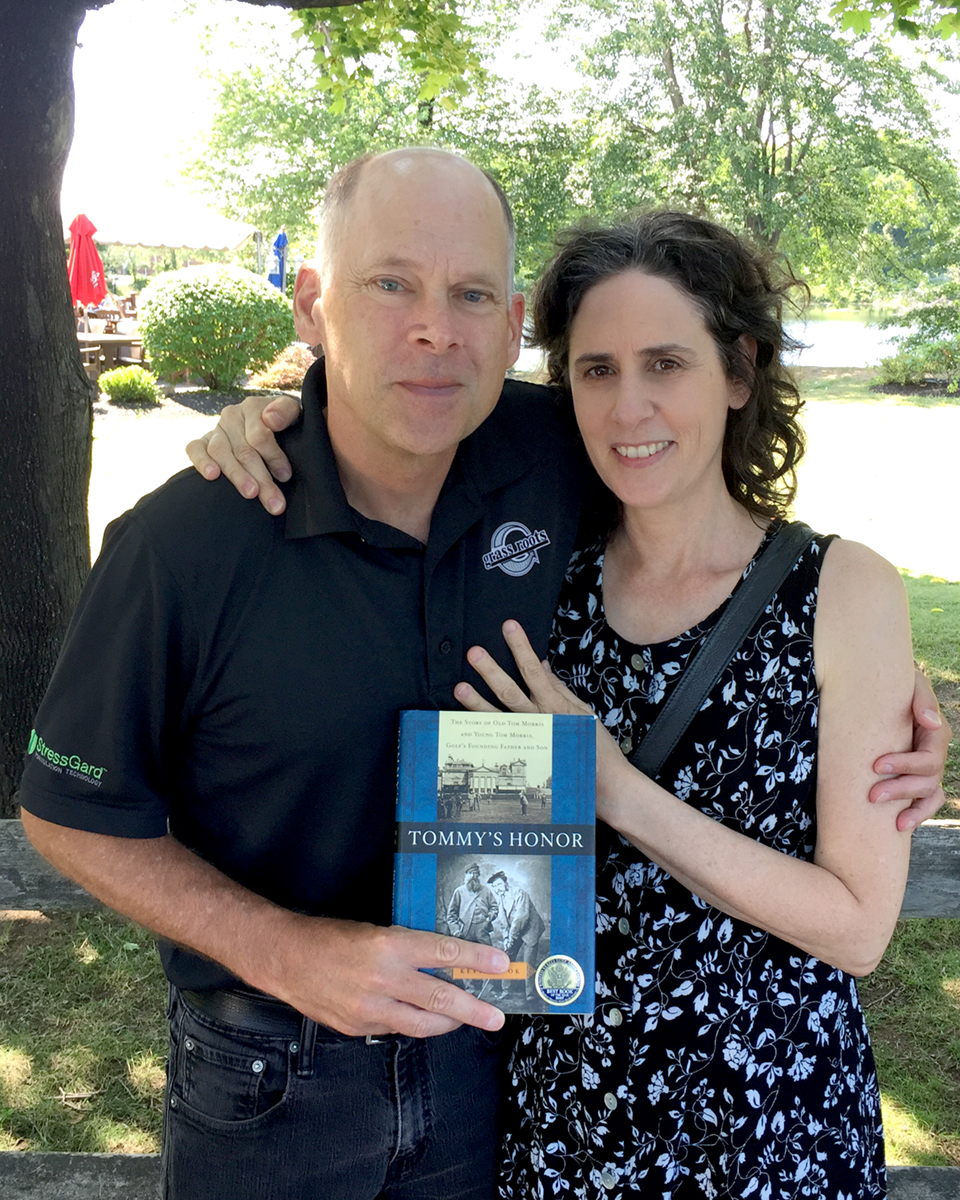
Kevin Cook and Pamela Marin, photo by Ken KubikGS: As a writer and historian, did you struggle at all with taking what you researched and how you made it into a narrative, even if you were perhaps fictionalizing at times? (As a reader you never come across as either uncertain in your take, nor overly presumptuous about the circumstances they faced).
KC: One surprise was how much specific information there was to tap into. During a time of what was called “Golfomania,” newspapers in Scotland and England tried to outdo each other in covering the game. I wore out a microfiche machine or two reading shot-by-shot accounts of famous matches. It was like discovering box scores from the very first baseball games.
Tom lived until 1908. As an eager publicist for his sport and his town (and his clubmaking business) he gave loads of interviews and loved to reminisce about Tommy. Many of their contemporaries wrote memoirs and gave interview of their own. David Malcolm’s research turned up fascinating details about Margaret, Tommy’s wife, which he generously shared with me. One of the great pleasures of writing the book was connecting the dots between countless details and putting them in context.
Yes, it had to hold together as a narrative. I was lucky to have a story that’s inherently dramatic, literally life and death. But there are times when you make storytelling choices, which boil down to educated guesses. For instance, I’ve got Tommy needling Tom about his lousy putting: “You’d be a fine putter, Da, if the hole were always a yard closer.” Now, I certainly don’t claim to know that Tommy said that on the hole where I’ve got him saying it, but he did tease his father, and Tom remembered that line decades later.
GS: How did getting the book to the big screen come about?
KC: A movie producer named Jim Kreutzer picked up my book on a golf trip to St Andrews and called to ask me about it. This was in 2012. Good timing. My wife, Pamela, a journalist and author of a well-received memoir, was remaking herself as a screenwriter. It’s an utterly different kind of writing—and thinking—and she’d written a script that got attention in Hollywood. That one didn’t get made, but it proved her ability. When the time came to make a deal for Tommy’s Honor, I optioned the book with one proviso: We write the script.
GS: The film looks visually stunning, but naturally, all golfers want to know is: did they make the golf scenes realistic?
KC: Jim Farmer, the R&A’s honorary professional and a former British Club Pro champ, did a terrific job as the actors’ golf coach. He got a surprise at first. During the casting process Jack Lowden, who plays Tommy, said, “Oh yes, I’ve been a golfer for years.” Because that’s what you do as an actor—if they ask if you can ride a horse or breakdance, you say yes. Later he told Jim he’d never swung a club in his life. But Jack’s an athlete as well as a brilliant young actor, and with Jim’s help he built a swing that’s authentic to the period. One thing I loved about Jim Farmer’s work was that the swings are authentic but different. Willie Park’s swing isn’t like Tommy’s.
There’s a crowd reaction that’s totally real. The great Peter Mullan, who plays Tom, had to make a ten-foot putt on a bumpy 19th-century green. He must have missed fifteen times. Each time, director Jason Connery reset the shot and the gallery got pumped up again. At last Peter knocks it in and the crowd goes genuinely wild.
The CGI people did a remarkable job recreating the blizzard of 1875 for one key sequence. And the biggest laugh in the movie comes during a favorite scene of mine, a caddies’ tournament that’s straight from the archives.
GS: How did the trimming process go for making the book into a film?
KC: As the screenwriters Pamela and I did our own whittling, sitting side by side at the computer in early 2013. If I showed you our first draft you’d see that its structure, tone and dialogue account for about 80 percent of what wound up onscreen. Jason Connery was a joy to work with and had a bunch of good ideas that we incorporated. Jason grew up playing golf with his famous father; he’s got this story in his bones.
GS: Is there anything since the book was published that you have learned that might have changed your approach to the “characters”?
KC: I think we got it right. Tom Morris was modern pro golf’s founding father. Tommy invented a new role—he was the first touring professional. Tour pros should tip their hats to Tommy every time they tee off on Sunday.
And I think or at least hope that my work, and the script of which Pamela was the lead writer, will remind readers and moviegoers that the game’s pioneers weren’t stained-glass icons out of ancient history. They were brave, tough, star-crossed strivers living in a fascinating time.
GS: What does it mean to you that your book is now often cited as required reading before golfers make the pilgrimage to Scotland for the first time?
KC: That’s the best compliment I ever got. Tommy’s Honor began with my first pilgrimage to St Andrews. If the book and movie contribute to others’ experiences, I’ll have done my bit to honor Scotland and its people.
If you saw Dustin Johnson on Golf Channel warming up for his WGC Bridgestone final round, you know he was hitting balls with a Trackman on Firestone's range tee.
Doug Fergusonexplains how the device has helped Johnson break out of an early season slump and improve the biggest (statistic) weakness in his game.
Johnson wanted it only for his wedges.
"All I look at it is carry numbers, just so I have more of a feel when I'm on the course and playing," Johnson said. "I felt like that was one area I needed to improve on. I felt like I was good with it, but I was too streaky. One day I'd be perfect, the next day ... not that I hit them bad, I just didn't hit them good enough."
Now it's perhaps the most underrated part of his game.
Three years ago, Johnson was tied for 113th on the PGA Tour in approach shots from 50 to 125 yards.
Now he is No. 1 on tour.
Regarding DJ's latest win, the SI/golf.comroundtable kicked the WGC Bridgestone around and noted this:
Alan Shipnuck, senior writer, Sports Illustrated (@AlanShipnuck): It’s the grittiness. We’ve all known for a long time DJ had the talent to overwhelm the golf world. Suddenly he is playing with a different hunger, and focus. If he keeps imposing his will like this, look out!
Cameron Morfit, senior writer, GOLF Magazine (@CameronMorfit): I remember once interviewing DJ and he made mention of his long limbs, but not in the context of that being an advantage. He was saying that because of his physique, when things got out of synch, they really got out of synch. Well, now he’s really, really in synch, and to do it on two vastly different tracks, one choked with trees and one with none, is impressive.
Heading to The Open, the Daily Mail's Derek Lawrensonlooks at Dustin's "late bloomer" evolution given his age and the way players are evolving at a young age, and reminds us of this:
You have to go all the way back to 1950 and seven Opens at Troon to find the last non-American champion and Johnson will now be favoured by plenty to continue that winning streak.
How has the game’s best athlete gone from something of an underachiever to serial winner at the age of 32?
I'm heading off to the home of golf and while I would love to say I've read all of the U.S. Women's Open preview stories, I have not. But as I note in this week's Forward Press, the course should provide an entertaining setting and due to unforeseen circumstances, will get some of its best visibility ever thanks to no competing PGA Tour or European Tour event and a west coast, prime time finish.
But Ron Sirak'sGolfDigest.com piece onMichelle Wie, winner at Pinehurst just two years ago is worth checking out.
But she is now winless in 50 LPGA starts since Pinehurst with 14 missed cuts and five WDs. One explanation for Wie’s inconsistency can be found in her health, where she’s had extremely bad luck. She’s had problems with her wrist, her back, her hips and her ankles. She also has multiple food allergies, which has complicated matters.
“It’s been a struggle this year,” Wie said. “But I still have half a year left and I’m just trying to get some confidence. I feel pretty good at the moment. I’m happy to come in here pain free.”
Wie remains a huge fan-favorite and is probably the woman who has moved the needle the most for women’s golf since Nancy Lopez almost 40 years ago. A winning Wie is good for golf.
Follow Ron for updates from the women's U.S. Open.
Here are a few highlights from the USGA media department's excellent table setter:
July 7-10, 2016 CordeValle, San Martin, Calif. (cordevalle.com)
The first U.S. Women’s Open, played at Spokane (Wash.) Country Club in 1946, was the only one conducted at match play. The Women’s Professional Golfers Association (WPGA) conducted the inaugural championship, won by Patty Berg. The WPGA conducted the Women’s Open until 1949, when the newly formed Ladies Professional Golf Association (LPGA) took over operation of the championship. The LPGA ran the Women’s Open for four years but in 1953 asked the United States Golf Association to conduct the championship, which it has done ever since.
The youngest winner of the U.S. Women’s Open is Inbee Park, who won the 2008 championship at the age of 19 years, 11 months and 18 days. Babe Zaharias, who won the 1954 Women’s Open at age 43 years and 6 months, is the oldest winner.
In 1967, Catherine Lacoste, daughter of French tennis player Rene Lacoste and 1927 British Ladies Amateur champion Simone Thion de la Chaume, became the only amateur to win the U.S. Women’s Open. Six other amateurs, most recently Brittany Lang and Morgan Pressel in 2005, have had runner-up or co-runner-up finishes.
WHO’S HERE
Among the 156 golfers in the 2016 U.S. Women’s Open, there are:
U.S. Women’s Open champions (9) Na Yeon Choi (2012), In Gee Chun (2015), Paula Creamer (2010), Eun-Hee Ji (2009), Cristie Kerr (2007), Se Ri Pak (1998), So Yeon Ryu (2011), Karrie Webb (2000, 2001), Michelle Wie (2014)
U.S. Women’s Open runners-up (10) Na Yeon Choi (2010), Cristie Kerr (2000), I.K. Kim (2013), Candie Kung (2009), Brittany Lang (2005), Stacy Lewis (2014), Se Ri Pak (2001), Suzann Pettersen (2010), Morgan Pressel (2005), Angela Stanford (2003), Amy Yang (2012, 2015)
U.S. Women’s Amateur champions (7) Danielle Kang (2010, 2011), Lydia Ko (2012), Hannah O’Sullivan (2015), Jane Park (2004), Morgan Pressel (2005), Jennifer Song (2009), Mariajo Uribe (2007)
U.S. Women’s Amateur runners-up (7) Sierra Brooks (2015), Jaye Marie Green (2012), Brooke Henderson (2014), Moriya Jutanugarn (2011), Jessica Korda (2010), Azahara Munoz (2008), Jane Park (2003)
U.S. Girls’ Junior champions (7) Amy Anderson (2009), Julieta Granada (2004), Ariya Jutanugarn (2011), I.K. Kim (2005), Minjee Lee (2012), Jenny Shin (2006), Lexi Thompson (2008)
And...
NCAA Division I champions (3) Austin Ernst (2011, Louisiana State University), Stacy Lewis (2007, University of Arkansas), Azahara Munoz (2008, Arizona State University)
PLAYERS WITH MOST WOMEN’S OPEN APPEARANCES (2016 included) Cristie Kerr (21), Karrie Webb (21), Catriona Matthew (20), Se Ri Pak (19), Angela Stanford (17), Candie Kung (15), Paula Creamer (14), Christina Kim (14), Maria McBride (14), Suzann Pettersen (14), Morgan Pressel (14), Brittany Lincicome (13), Michelle Wie (13), Karine Icher (12), Brittany Lang (12), Jane Park (12), I.K. Kim (11), Yani Tseng (11)
ACTIVE CONSECUTIVE U.S. WOMEN’S OPEN APPEARANCES (2016 included) Karrie Webb (21, 1996-2016), Cristie Kerr (19, 1998-2016), Angela Stanford (17, 2000-16), Paula Creamer (14, 2003-16), Candie Kung (14, 2003-16), Suzann Pettersen (14, 2003-16), Brittany Lincicome (13, 2004-16), Morgan Pressel (12, 2005-16), Brittany Lang (12, 2005-16), I.K. Kim (11, 2006-16)
FIRST-TIME U.S. WOMEN’S OPEN COMPETITORS (44) Sandra Angulo Minarro, Sierra Brooks, Hannah Burke, Liv Cheng, Chih-Min Chen, Ssu-Chia Cheng, Pei-Yun Chien, Yoon Ji Cho, Hye-Jin Choi, Allisen Corpuz, Olivia Cowan, Valentine Derrey, Julia Engstrom, Anna Hack, Erina Hara, Spencer Heller, Kotone Hori, Yu Sang Hou, Caroline Inglis, Taylor Kim, Naomi Ko, Jennifer Kupcho, Nicole Broch Larsen, Camilla Lennarth, Mika Liu, Yan Liu, Leona Maguire, Sung Hyun Park, Kasey Petty, Sophia Popov, Pamela Pretswell, Robynn Ree, Haeran Ryu, Madelene Sagstrom, Karah Sanford, Emi Sato, Chika Sawada, Jade Schaeffer, Erica Shepherd, Lauren Stephenson, Albane Valenzuela, Jing Yan, Julie Yang, Yunjie Zhang
COUNTRIES REPRESENTED IN THE FIELD (24) Australia, Brazil, Canada, the People’s Republic of China, Chinese Taipei, Colombia, Denmark, England, France, Germany, Japan, the Republic of Korea, Malaysia, Mexico, New Zealand, Norway, Paraguay, Scotland, South Africa, Spain, Sweden, Switzerland, Thailand, United States of America
SPECIAL EXEMPTION FOR PAK Se Ri Pak, of the Republic of Korea, received a special exemption into the 2016 U.S. Women’s Open. In March, Pak, 38, announced her intention to retire following the 2016 professional season. She plans to return to Korea and serve as an ambassador for the game of golf.
Pak’s 1998 U.S. Women’s Open victory at Blackwolf Run in Kohler, Wis., revolutionized women’s golf and sparked a cultural phenomenon. When Pak won the 1998 U.S. Women’s Open, she was the only Korean player on the LPGA Tour. Since then, countrywomen Birdie Kim (2005), Inbee Park (2008, 2013), Eun-Hee Ji (2009), So Yeon Ryu (2011), Na Yeon Choi (2012) and In Gee Chun (2015) have joined Pak as U.S. Women’s Open champions and more than two dozen players from Korea compete regularly on the LPGA Tour.
CHAMPIONSHIP FIELD The USGA accepted 1,855 entries for the 71st U.S. Women’s Open. This marks the second consecutive year the U.S. Women’s Open has received more than 1,800 entries. The 2015 championship at Lancaster (Pa.) Country Club holds the entry record with 1,873.
The 156-player field includes 93 fully exempt golfers and nine past Women’s Open champions. Sectional qualifying, conducted over 36 holes, was held at 25 sites between May 9 and June 3, four international (China, England, Japan, Korea) and 21 in the United States.
Geoff Shackelford is a Senior Writer for Golfweek magazine, a weekly contributor to Golf Channel's Morning Drive, is co-host of The Ringer's ShackHouse is the author of eleven books.