Brexit! Open Championship Purse Up, Value Way Down

As Joel Beall explains at GolfDigest.com, a small bump in The Open Championship purse is offset and then some by the plummeting pound, which hit a new low Tuesday.

Beal writes of what the drop means to first place money:

Meaning that, while Johnson took home a $1.8 million payday for winning the British Open, this year's champ will receive close to $1.54 million, a significant cut in earnings.

The full purse announced Tuesday by the R&A:

Prize money

Place    £                                             Place    £

1          £1,175,000                             36        £34,000

2          £675,000                                37        £32,500

3          £433,000                                38        £31,000

4          £337,000                                39        £30,000

5          £271,000                                40        £28,750

6          £235,000                                41        £27,500

7          £201,000                                42        £26,250

8          £170,000                                43        £25,000

9          £149,000                                44        £23,750

10        £135,000                                45        £22,500

11        £122,000                                46        £21,500

12        £108,750                                47        £20,500

13        £102,000                                48        £19,500

14        £95,500                                  49        £18,700

15        £89,500                                  50        £18,300

16        £82,000                                  51        £17,900

17        £78,000                                  52        £17,500

18        £74,000                                  53        £17,250

19        £71,000                                  54        £17,000

20        £68,000                                  55        £16,750

21        £64,500                                  56        £16,500

22        £61,500                                  57        £16,300

23        £58,250                                  58        £16,200

24        £55,000                                  59        £16,100

25        £53,000                                  60        £16,000

26        £50,750                                  61        £15,900

27        £48,750                                  62        £15,800

28        £47,000                                  63        £15,700

29        £45,000                                  64        £15,600

30        £43,250                                  65        £15,500

31        £41,500                                  66        £15,400

32        £39,250                                  67        £15,300

33        £38,000                                  68        £15,200

34        £36,750                                  69        £15,100

35        £35,500                                  70        £15,000

Flashback: "Can The USGA Survive Walter Driver?"

As the dust finally settles on Oakmont and the 2016 U.S. Open, Dustin Johnson's follow-up win at the WGC Bridgestone helps shift a little more focus on the winner and away from the rules issue that arose.

While golfers still discuss the rule and decision that prompted the officials to intervene, it is important to better understand the culture that led to a moment which, had Johnson lost the U.S. Open over the ball moving on marble-like greens, might have done permanent damage to the reputation of the U.S. Open and golf.

Why did the USGA feel so compelled to intervene in a situation that few outside the rules community saw as requiring definitive action? Especially given that so many golfers recognized the issue was caused by excessive green speed. For those of us who've been frustrated with the use of green speed to offset regulatory malfeasance on the distance issue, the number of golfers making the connection between the issues is heartening.

Still, we would like to better understand the culture that focuses so much effort on the high-risk business of running up Stimpmeter speeds or adding tees to U.S. Open courses or policing innocent pro golfers, better known as: ABTB (Anything But The Ball).

So I was advised to go back and read Chris Millard's 2007 Golf World cover story on USGA President Walter Driver,. Ironically, the story preceded the U.S. Open at Oakmont. The story resonates on many levels, from understanding the USGA's focus to how much behind the scenes debate occurs.

Sadly, we know Driver has continued to influence the organization via the nominating committee, with his crowning achievement the naming of pal Diana Murphy as president to continue the corporate prioritization of the USGA's approach.

It's well worth a re-read, but this was one of the more enlightening moments:


Proponents of Driver say he has single-handedly shaken the USGA out of a slumber induced by the influx of cash the USGA fell into when it reconfigured its television rights contracts in 1994. They say he has tried to inject into a bloated USGA some badly needed business principles (the title of Driver's speech at the USGA's annual meeting in San Francisco last February was "The USGA As An Organization And A Business"). Detractors, many of whom see the USGA as a charitable organization first, say Driver has imposed his will on its culture and that his administration has disenfranchised everyone from Golf House staffers (those who work at USGA headquarters in Far Hills, N.J.) to equipment manufacturers to the organization's once-revered past presidents.

"I would say his effort to instill a new level of business-like procedure at the USGA has been important," says Reg Murphy, USGA president in 1994-95 and the man who authored the association's lucrative TV move from long-time partner ABC to NBC in 1994. "He's tried to create a more business-like organization. There are people who resist that idea, by the way, that the USGA ought to operate like a business."


And nine years later, that business is operating in a way that has MILLIONS of golfers wondering what on earth it is up to.

Troon: Members Vote On Women By Show Of Hands

Not that I'm questioning the tally, just fascinated that Royal Troon settled it's women-only issue with a vote by show of hands and no actual printed vote total. Given how the Brexit vote went, a good thing!

Christopher Clarey with that and other details from Troon's vote as it prepares to host the 145th Open, cincluding this from club captain Martin Cheyne.

But Cheyne said the club had reviewed more than the issue of women’s membership in recent months. “The focus was on all categories of membership and how we could become more involved in promoting golf, a sport which is currently declining: declining in male, female and junior membership,” he said. “What we did tonight was focus on the single issue of women’s members, but we need to focus on how we can encourage young people to play this game.”

“Our custom and practice in the golf club is a straight show of hands,” he said. “We don’t do a count. It was overwhelming.”

Royal Troon’s constitution mandates that only members who are present may take part in such votes, and Cheyne said 360 of the club’s 861 members had been in attendance on Friday night.

Anyone know what Troon's junior member program looks like? If it's an affordable one that appeals to aspiring players, get the word out. A lot of clubs around the world need to get or serious about such programs and need prominent examples.

"Will speeding up bring scores down for Spieth?"

That's the question Jason Sobel's story poses after Jordan Spieth explain why he's trying to speed up. While he's earned a reputation as a slow poke, I would counter that television makes him look slow because he's been spending a lot of time over the ball. Whereas someone who is much slower like Zach Johnson, spends ages making a decision and when television comes to him, we rarely see that.

Anyway, Spieth has heard the criticism from fans and his instructor, Sobel says.

After the second round, Spieth didn't use playing quicker as an excuse. In fact, he credits the process for helping his game.

"The quicker part actually helps me, because then I just get up there and fire away," he explained Friday. "The more I can do that, actually I think the better off [I am with a] kind of gun-slinging mentality, just to go up and hit the way I always have played."

The Perks Of Firestone: Seeing What Happens When Top Players Actually Get To Hit Driver

There isn't much to get excited about with this year's WGC Bridgestone, especially given that without it on the schedule in an Olympic year, the players would have a lot less to gripe about with excessive playing options.

But we march along so the boys can collect their easy $50k, world ranking points and--silver lining alert--huge driving distance numbers!

As Mike Stachura explains after seeing Justin Thomas hit a 413-yard drive, Firestone remains one of the few courses were players can hit driver on nearly every non-par-3. But with an earlier date on the schedule and less humidity, Stachura says the field's 317.3 yard average from last year should be down this year.

If it's not...

What’s the number to beat? Aside from last year’s 317.1-yard mark, the tournament with the highest driving-distance average in the last year was the Shriners Hospital Open in Las Vegas last fall at 305.4.

Now, is it fair to say that if the average this week surpasses last year’s number, there should be more concern about driving distance increasing? Statistically speaking, it’s merely one set of data that carries as much weight in determining trends as does the driving-distance average at Harbour Town for the RBC Heritage, which this year was 278.8 yards. That’s, in a nutshell, the point the USGA was making in its recent report about the relatively modest growth in driving distance over the last dozen years or so.

Today In Zika: Rory, Barbados, A Female Defector And How Tennis Got Off To A Rough Olympic Start, Too

Rory McIlroy, who was once excited about Olympic golf until Zika and New Balance uniforms came along, admitted that his WD call to captain Paul McGinley was one of the toughest calls he's had to make, reports Phil Casey (who also reports that Martin Kaymer can't wait to get to Rio).

Casey writes:

“That was probably one of the toughest phone calls I’ve had to make, because we’ve talked about it so much,” said McIlroy. “We’ve done so much work, got accommodation, got security down there, got a chef in, got everything planned out. I got my jabs; I had two dead shoulders for about four days.

“But then at the end of the day, if I’m not 100% comfortable going down there, I just don’t want to put it at risk. There’s another Olympic Games in Tokyo in 2020 and I’m more than happy to wait until then to get that Olympic experience.”

It appears not many are buying the concerns about Zika, including the readers here. McIlroy has now been questioned by Bloomberg reporter Tariq Panja (here and here), who has asked the McIlroy camp for clarification as to why he vacationed in Barbados two months ago. Barbados is also a Level 2 Zika threat region, like Rio.

An unbylined AP story on Lee-Anne Pace of South Africa dropping out citing Zika keeps her consistent with everyone else from South Africa but Gary Player.

The 35-year-old said in a statement that she made the decision after discussing her options with her family and her team.

"I hope that everyone can understand that this was a very difficult decision to come to, however my health and my future family's health must come first," she said.

Matt Ginella talks to architect Gil Hanse about the Olympic dropouts and he's disappointed.

"The overall feeling is disappointment," said Hanse. "To have done what we’ve done, to have worked through so many challenges to complete the project, you’d obviously love to see the best players in the world compete on your golf course."

Hanse says he is contact with the team still on the ground in Rio, which includes the superintendent and the PGA Tour’s on-site agronomist, who are prepping the course for the Olympics.

"Morale is getting lower," said Hanse. “I’m disappointed for everyone involved."

Hey, but there is a morale boosting news! Camillo isn't out...yet, though keeping his card may end up the priority, reports Golfweek's Adam Schupak.

“Yeah, I actually heard Jordan Spieth said I wasn’t going to go play. I’ve been talking to Jordan and a lot of the guys. And I’ve got to be honest, Maria and I are trying to have kids right now. So the Zika is a concern,” Villegas said after the opening round of the Barracuda Championship.

Meanwhile the eligible American golfers were briefed and they're feeling better about things, but are waiting to hear on something else. Also a Schupak report.

“I’ve always wanted to go but I want to make sure me and my team feel safe on the health and security issues,” Rickie Fowler said. “There’s still some stuff ongoing, some logistics to work out.”

As all of this plays out, Christopher Clarey of the New York Times talks to Brad Gilbert and others about tennis returning to the 1988 games and the soft start that sport had due to various concerns similar to the 2016 issues golf faces.

“What’s happening with the golf is a lot like ’88,” Gilbert said. “A lot of the tennis players just weren’t quite sure, and there were some security worries in Seoul.”

No. 1 Mats Wilander, winner of three of the four Grand Slam singles titles, did not make the trip even though he had long relished playing for Sweden in the Davis Cup. Neither did No. 4 Andre Agassi, who would later win the singles gold medal at the 1996 Olympics in Atlanta and discover that it was one of the most gratifying moments of his career.

Gilbert was coaching him at the time.

“When Andre asked me what was the biggest regret of my career, I said if I could change one thing, I would have changed that big penny I had into gold,” Gilbert said, referring to his bronze medal. “And Andre pretty much planned his whole year around the 1996 Olympics.”

On Golf Central, yours truly joined Lisa Cornwell, Matt Adams and Tim Rosaforte for an Olympic golf roundtable.

Diaz: What Really Happened At Oakmont

Now that Dustin Johnson has spoken and has not had his mind changed a bit about his actions at Oakmont (Will Gray reports), Jaime Diaz has filed an in-depth, definitive account for the September Golf Digest of the 2016 U.S. Open's Dustin Johnson penalty. While most of the facts will still be very familiar, Diaz brings in views of some notable rules figures and tries to figure out the options for changing the rule.

This from two noted USGA veterans stood out, starting with comments from David Eger:


Eger believes the right call was made based on the rule as written, but admits his experience writing, interpreting and administering the rules gives him an uncommon perspective. “All the rules officials I know think Dustin broke the rule, but none of my friends who I play golf with think he did. None of my friends have all the information. They use the wrong criteria to judge. But the rules are so fastidious, precise and often complicated.”

But David Fay, the USGA’s executive director for two decades, who served as the Fox telecast’s rules expert, contends the Johnson ruling was a close one even for officials. “You could get 10 rules experts and show them video evidence of Wattel and Johnson’s actions around the ball. I guarantee some would say Wattel deserved a penalty and Johnson didn’t, or that neither deserved a penalty, or that both did.”


Wonderful!

There was also this from Diaz:


In retrospect, executive director Mike Davis, didn’t take charge at a time when an accountable leader was desperately needed to speak for the organization. Hall and Pagel were too careful and scripted in their interviews on Fox and Golf Channel, clearly looking over their shoulder. At Oakmont, the buck had no place to stop.

I think this next part is where the average golfer differs from the rules expert, but nearly two weeks later I'm still not entirely sure why the experts are so sure of their stance.

But in trying to solve a problem, the new rule created new ones that are arguably worse. The main one? When it comes to determining what made a ball move short of the club hitting the ball, there is almost never anything close to “proof” that a player’s actions were the cause. “More likely than not” or “51 percent of the evidence” is a recipe for too many close calls that will leave a feeling of player victimization, especially if and when it costs someone a championship.

"Golf Channel Posts Most Watched Second Quarter Ever"

Interesting bumps from NCAA golf and the KPMG, now the most watched women's major outside of the U.S. Women's Open.

For Immediate Release:

For 24-hour Total Day (6AM-6AM), 125,000 average viewers per minute were tuned in to Golf Channel during second quarter, a +1% increase vs. 2Q 2015. This growth was driven by the most-watched April and June ever, along with these year-over-year gains:

·       PGA TOUR: +5%
·       PGA TOUR Champions: +20%
·       European Tour: +8%
·       LPGA Tour: +6%
·       Millennials (P25-34): +29%
·       Prime viewership (8P-11P): +7%
·       Retained No. 1 ranking for quarter, delivering most-affluent audience in television in Total Day and Primetime

And...

NCAA Men’s and Women’s Golf Championships:
·       Live Coverage of the Men’s Championship (218,000 average viewers) is +70% vs. 2015.
·   Live coverage of the Men’s Wednesday night final match delivered 325,000 viewers per minute (+139% year over year).
·       Live Coverage of the Women’s Championship (152,000 average viewers) is +12% compared to 2015.
·     Live coverage of the Women’s Wednesday night final match delivered 249,000 viewers per minute (+25% from last year).

And...

KPMG Women’s PGA Championship: Second Most-Viewed Women’s Golf Event since June 2014:

·       The 2016 KMPG Women’s PGA Championship aired across Golf Channel and NBC for the 2nd year and was seen by 6.1 million unique viewers. That’s the second largest audience for a women’s golf event since NBC/ESPN’s coverage of the US Women’s Open in 2014 (9.8 mm) and the first time since 2010 that any LPGA Tour major other than US Women’s Open was seen by more than 6 million viewers.

The Case For Amateur Golfers In The Olympics...Isn't Strong

No offense to all who have written in the wake of star WD's from the Rio Games who have suggested that this would not be happening if we had amateur golfers instead of pros.

Zane Bojack is just one of many who have written this in recent days, suggesting many of the emerging new talents in golf would have remained amateurs for the Olympics.

I think he has a point with the amateur game farewelling stars like American Bryson DeChambeau, Englishman Matthew Fitzpatrick, Spain's John Rahm and Australia's Ryan Ruffels in the past 12 months.

If you don't know them yet, then you soon will as these athletes who've recently turned professional are the future of the game.

DeChambeau finished tied 15th in the recently completed US Open, Fitzpatrick took out the 2015 British Masters, John Rahm just finished third in a PGA TOUR event at Congressional and Ryan Ruffels turned pro at the ripe old age of 17.

These young guns should be the players competing for a gold in Rio, with the Olympics keeping them in the amateur game for longer.

Already there are fears Ruffels may have turned professional too early after missing the cut in seven events he has taken part in on the PGA Tour.

Unfortunately, the money to be made coming out of college is still there, as is the pressure to begin playing and earning status on various tours. I'm not seeing how an Olympic opportunity would change that or cause more to remain lifelong amateurs.

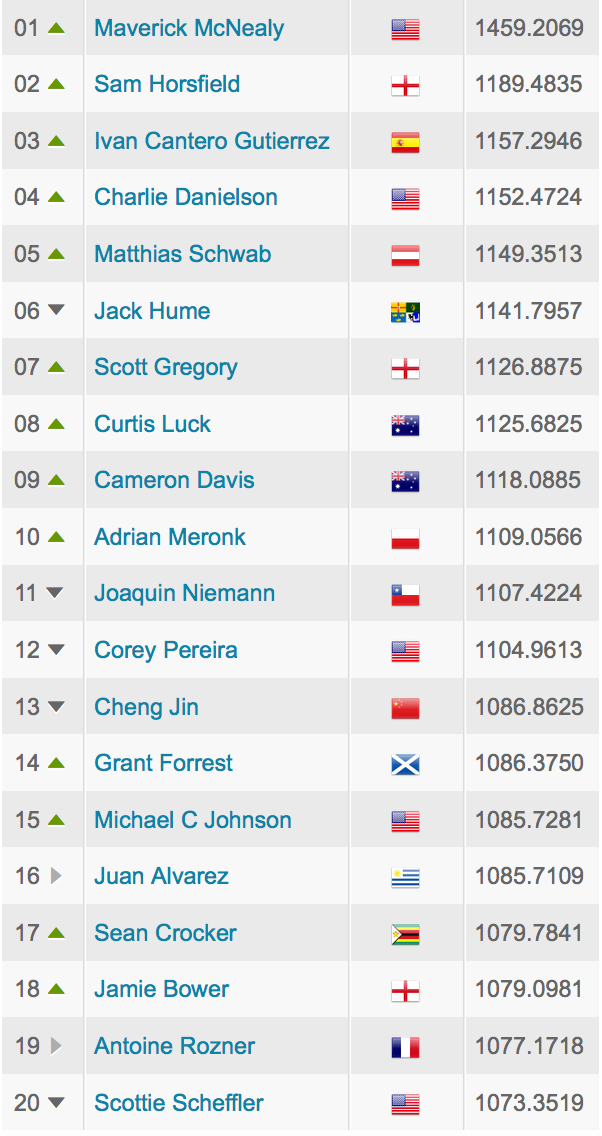
Here is the current World Amateur Golf Ranking top 20. All fine young golfers with immense talent but would anyone want to watch this field?